Super Stock: why I think the picture is improving at ITV

UK commercial television heavyweight ITV (LON:ITV) is often seen as a potential takeover candidate.
In recent years it has also often been described as a serial underperformer, battling structural headwinds from changing market conditions.
I think this view is too simplistic, overlooking the strategic progress the company has made and its impressive reach among UK viewers.
After a multi-year period of transition, I think the additional investment made in content production and digital operations should soon start to bear fruit.
I’m also optimistic that more favourable industry conditions should support a return to growth over the next 12 months. Against this backdrop, I think the stock’s modest valuation, high yield could provide an appealing entry point for investors.
Full disclosure: I own shares in ITV.
Summary
Pros:
Modest valuation with improving outlook
Strong quality metrics and large share of UK market
Opportunity for significant growth in US content production market
Takeover potential, with ITV Studios potentially valued in excess of current market cap
Cons:
Terrestrial broadcast television is in decline and ITV must keep hold of its viewers as they move online
Streamers present a competitive threat that didn’t exist 10 years ago – can ITV maintain its share of UK eyeballs?
No guarantee of a takeover; the necessary split could leave ITV’s UK operations with diminished earning power
ITV could end up becoming a value trap!
Profile
About the stock
ITV is a television broadcasting and content production company with operations in the UK, Europe and USA. It’s listed in the Media & Publishing industry group, within the Consumer Cyclicals sector.
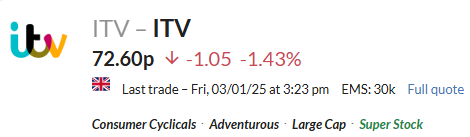
The stock dropped out of the FTSE 100 in 2022 but remains a FTSE 250 member, with a market cap of £2.8bn and a recent share price of 73p.
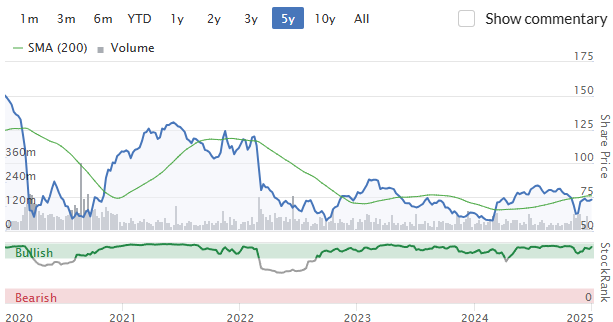
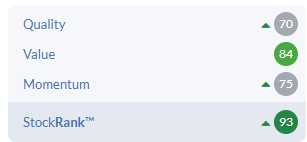
Despite its lacklustre share price performance over the last few years, the StockRanks have a positive and improving view of ITV – a view I share:
This broad mix of positive quality, value and momentum are also reflected in the company’s Super Stock styling:
About the opportunity
ITV has always been a cyclical business. A review of the long-term chart shows the stock falling by more than 80% between 2007 and 2009.
A strong recovery followed. But the tide turned again in 2016. Investors saw the ferocious growth rates of big streamers like Netflix and started to think about the possible consequences for traditional broadcasters.

CEO Carolyn McCall took charge in 2018. During her tenure, the company has expanded its content production business (ITV Studios) into external markets. With most of the big streamers on its client roster, this division of ITV has benefited from changing market conditions.
Adapting the UK television business to these changing conditions has been more challenging. ITV has had to invest heavily in its own digital operations, including developing a proprietary digital advertising platform. The aim of these investments has been to maintain ITV’s share of UK viewing and advertising spend, as audiences shift online.
I believe ITV has the right strategy and is making decent progress. However, the changes required have required significant investment and have been executed against a difficult industry backdrop.
Post pandemic, the big streamers have cut back their programme budgets and slowed new commissions. The Hollywood actors’ and writers’ strikes have also led to big delays in production starts, pushing back revenue.
These factors have been a headwind for ITV Studios, which produces programmes for most of the big streamers in addition to major broadcasters.
More or less at the same time, a major advertising slump affected ITV’s profits from its television business. In 2023, McCall referred to this as “the worst advertising recession we have seen since the financial crisis”.
As a result of these factors, ITV’s revenue has stagnated over the last few years:

… while higher costs mean earnings have fallen sharply:

The opportunity: ITV's spending commitments have now peaked and industry conditions are gradually returning to normal. The group's balance sheet is in decent shape and broker forecasts suggest a return to profit growth in 2025 and 2026.
I think the stock remains cheap for a highly profitable and cash-generative business. I believe the value of the Studios business is being understated, given its double-digit margins and international growth potential.
There’s also another possibility – ITV has long been touted as a bid target. Some analysts suggest the value of the ITV Studios business alone could exceed the current market cap.
In November 2024, Sky News reported that various private equity-backed groups were considering the idea, albeit only at a very early stage. Megan shared her thoughts on ITV’s takeover prospects here.
Regardless of the chances of a takeover, I think ITV shares could benefit from a re-rating if the company can continue to deliver on its strategy against an improving market backdrop.
Business & Model
What is the company’s history and what does it do?
The company’s history can be traced back to 1955, when a commercial broadcaster was established in the UK to compete with BBC.
Historically, ITV was a group of independent regional broadcasters, who also shared some programmes. These gradually consolidated. ITV in its current form was created from the merger of Granada and Carlton Communications in 2004 – when the newly-formed ITV plc floated on the London Stock Exchange.
Today, ITV owns the franchises to broadcast across England, Wales and Northern Ireland, while STV (LON:STV) operates in Scotland.
It’s the UK’s largest commercial terrestrial broadcaster and also operates a production company, ITV Studios. This business produces much of ITV’s in-house content, but also operates globally, producing content for many other major television companies.
How does the business model work?
ITV’s business is divided into two distinct reporting segments.

Media & Entertainment (M&E): this is the UK television business, including both broadcast and streaming (ITVX).
Viewing is free, with revenue primarily from advertising sales, together with some other ancillary revenue such as premium (ad-free) subscriptions, viewer voting and partnerships.
ITV Studios: ITV Studios produces programmes for the company’s own channels and for a wide range of third-party television companies, including the BBC and big commercial names like Netflix, Sky, Amazon and Fox.
Here are some highlights from ITV Studios H1 2024 output:

ITV Studios is the largest producer in the UK, one of the largest unscripted (reality) producers in the US, and a top three producer in most of its other international markets.
In revenue terms, around 40% of revenue comes from the UK (including ITV programmes), with c.30% from the USA and the remainder from other international markets.

ITV Studios also manages the group’s own content library. This contains over 90,000 hours of programming that it distributes globally for additional income.
Markets & Competition
What is the size and state of the company’s market?
As discussed above, ITV operates in two distinct markets – UK television viewing and the global content production market. It makes sense to consider these separately, as the size of these markets and ITV’s share of each are very different.
UK television (M&E): ITV has a 32% share of UK commercial broadcast television viewing. It showed 92% of the top 1,000 commercial broadcast programmes during the first half of last year. Both figures are fairly typical of recent years.
The company says its traditional linear TV channels still reach 38m viewers each week – around half the UK population.
Looked at more broadly, ITV claims that it has an overall share of UK commercial viewing of 23%, including the big streamers, but excluding the BBC:

Within this, the ITVX streaming operation captured 846m hours of viewing during the first half of 2024, with 14.6m monthly active viewers and 40m overall registrations.
ITV’s digital offering is strongly focused on preserving the company’s share of UK eyeballs, as viewers migrate online and spend more time watching streaming services.
ITVX’s large user base is also providing a treasure trove of data for the company’s in-house advertising platform, Planet V. This is used to serve advertising on the company’s digital services and is effectively like Google Ads for ITV – a sophisticated offering.
I think it’s fair to say that the overall growth prospects for the M&E business are fairly low. Minimal, perhaps. But even as the medium of delivery switches from broadcast to digital, I don’t expect UK television to disappear.
Just as music streaming services have not killed off radio, I think domestic television – with its much broader range of programme types – will remain relevant and complementary to video streaming services.
As a market leader, I believe ITV is well positioned to remain a key player in this market.
ITV Studios: the story is quite different for the Studios business. While the company already has a large share of the UK market, I estimate the company’s share of the US streaming market is still low, providing plenty of scope for further gains.
Here are some key statistics comparing the two markets. While ITV Studios revenue is not directly equivalent to revenue generated by streaming companies, I think comparing these two sets of figures is still useful:
ITV Studios 2023 revenue | Streaming market | |
UK | £911m | £4.7bn |
USA | £630m (c.$815m) | $48bn (2025 estimate) |
Streaming market data: Statista
ITV Studios clearly already has a large share of the UK content market, reflecting ITV’s share of viewing. I would guess that further incremental growth may be possible, but transformative growth seems unlikely.
In contrast, ITV Studios’ share of the US streaming market is still quite small. While the US is a large, diverse and competitive market, I think it’s reasonable to believe that ITV Studios should be able to gain further market share if it performs well.
How does ITV derive its competitive advantage – and are these advantages durable?
ITV’s share of viewing is certainly not impregnable. The success enjoyed by the ITV Studios business is due in part to the popularity of unscripted/reality content, epitomised by Love Island. This is not necessarily a genre that will remain popular indefinitely.
Even so, I think ITV’s scale, heritage and brand do provide some competitive advantages, at least some of which should be durable.
Intangible assets: the company’s brand is near-universally recognised by UK television viewers.
The company’s recent reporting suggests to me that most viewers are switching from linear TV to ITVX, rather than abandoning ITV altogether. This includes the key 25-54 age group, where streaming hours rose by 29% during the first half of 2024.
Because it’s free to view and universally available, ITV also remains a trusted and broadly accepted option for news and major sporting events. During Euro 2024, live match audiences averaged 6.5m across the tournament and peaked at over 20m during the England semi-final.
I find it hard to imagine a subscription service having this kind of reach.
Network effects & greater scale: ITV’s scale and ability to command a mass UK audience allows it to produce higher-budget programmes. These might be unaffordable for smaller, niche broadcasters and unappealing to US-centric streamers.
The more people who watch ITV services, the stronger these network effects should become.
Cost advantages: ITV has had to increase its spending on content and technology to support the growth of its ITVX service.
However, I think ITV’s vertical integration could provide some cost advantages. Owning ITV Studios provides a base of talent and resources that can be tailored to the company’s requirements and provide flexible capacity when needed.
Financials & Ownership
What is the record of growth & profitability?
ITV’s revenue growth has been limited in recent years. Rising costs mean that profits have failed to keep pace with revenue growth, falling sharply.
However, the company says that spending on its transition strategy has now peaked, while external market conditions are starting to normalise.
Broker forecasts suggest profits could start to recover – we’ll know more when the 2024 results are published in early March.

This profit slump has had a sharp impact on profitability. But ITV’s quality metrics have remained comfortably above average over the last decade, with the exception of the annus horribilis of 2023.

Indeed, I think it’s worth highlighting the StockReport’s quality metrics for ITV, all of which are well above average:

Is the balance sheet in good health?
ITV’s balance sheet is still in decent health, perhaps surprisingly so. Net debt has actually fallen since 2018. The most recently reported net debt represents a modest leverage multiple of 0.9x EBITDA.

Strong profitability and a relatively capital-light business model have enabled the group to continue generating positive cash flow in recent years.
While the dividend has been cut, Stockopedia’s data suggest the current payout would have been covered by free cash flow in all but one year since 2018:

A reduction in capex and a gradual recovery in profits should aid a recovery in free cash flow.
Cash conversion should also improve now that ITV’s (large) final salary pension scheme is fully funded, with no further deficit reduction payments required. The company says this “removes a significant historic drag on free cash”.
Is there evidence of historic share dilution?
The number of shares in issue has been largely unchanged for at least the last decade. There’s no evidence of shareholders being diluted:

Indeed, the company is currently engaged on a £235m share buyback that looks likely to reduce the share count by nearly 10%. This is being funded by proceeds from the disposal of ITV’s 50% share in BritBox International in March 2024.
I discussed the maths of share buybacks in a recent article – if ITV can maintain its trailing 12-month level of profitability, my sums suggest these buybacks could provide a 17% pre-tax effective rate of return. That could create significant value for shareholders over time.
What is the ownership of the company? Does management have stakes?
Management shareholdings are thin on the ground, as is common with big cap stocks. CEO Carolyn McCall held just 1.7m unrestricted shares at the end of 2023, worth around £1.3m today. Her total remuneration in 2023 was £2.9m.
However, the shareholder register does contain some entries of interest.
ITV’s largest shareholder is US cable giant Liberty Global, with 10.5%. Specialist value fund Silchester International Investors is also a notable presence, with a 5% shareholding.

Presumably these well-informed investors believe that ITV shares offer value and the prospect of attractive long-term returns.
Valuation
How does the relative valuation compare versus industry peers?
ITV’s only direct UK-listed peer is its much smaller Scottish peer, STV. Both companies trade on similar historic earnings multiples, but STV looks cheaper going forward, despite stronger earnings growth forecasts:

Looking to the US for a comparison with larger peers gives similar results – this sector is not commanding strong valuations at the moment:

Even so, ITV’s 6.8% dividend yield is significantly higher than rivals, including STV. This represents a clear attraction in my view, given that the dividend is expected to benefit from improving earnings and free cash flow cover.

What is the stock’s intrinsic valuation?
Analysts covering ITV shares have a consensus price target of 88p, 21% above the current share price.

I tried reverse engineering this price target with a dividend discount model, applying a required rate of return of 8% (see here for my recent discussion of valuation techniques).
This process suggested to me that City analysts are estimating a couple more years of flat dividend payouts, followed by sustainable dividend growth of 3%-4%.
I think that’s probably a fair estimate for the UK M&E business, but I believe the ITV Studios business could have greater growth potential than this.
Using the Earnings Power Value (EPV) approach gives me a somewhat higher target price of 110p. This model is based on the assumption profits will remain at current levels, suggesting a possible baseline fair value for the business today.
At the time of writing, ITV shares are trading at 72p, representing a discount of more than 30% to my EPV estimate.
Trends & Catalysts
What underlying trends are affecting the business?
Having carried out an initial land grab, streamers look set to maintain a lower rate of growth than we saw prior to 2022. However, the impact of the Hollywood strikes is receding, with production activity increasingly returning to some kind of normality.
At the same time, the advertising market will presumably gradually recover from its 2023 crash. This has always been a cyclical sector, after all.
Are there any catalysts that could drive a re-rating in the medium term?
I think there are two main possibilities here:
UK television (M&E): one possibility, perhaps less likely, is that ITV will demonstrate it can deliver stronger growth or profitability from its M&E business than currently expected.
Digital advertising has historically been less profitable than traditional linear TV ads, so one possibility might be that ITV demonstrates it can overcome this disadvantage.
A significant growth in viewing share might be a catalyst, but seems unlikely to me.
ITV Studios: this business is expected to generate average organic revenue growth of 5% from 2021 to 2026, below the 7% CAGR achieved from 2015 to 2023.
These figures seem to be broadly in line with expectations for streaming market growth, especially in the US. If ITV Studios can provide clear evidence its growing ahead of the market and gaining share, then I think this could be a catalyst for a re-rating.
Risks
Again, I think the risks facing ITV (and its shareholders) can be divided into two categories.
UK television (M&E): two things could go wrong here. The first is that ITV terrestrial television could continue to shrink more quickly than expected. This might leave ITV with a large slice of a much smaller pie, watching helplessly as advertisers abandon television and move online.
Google and Meta already control a sizeable chunk of global advertising spend. This shift could continue.
The second risk is in execution. For ITV’s digital transition to succeed it needs to master the technology and continue providing UK-centric content that appeals to a mass audience. I think the company is doing well so far, but there’s still much to do.
When I think about the viewing habits of under-25s I know, I am less confident about the longer term…
ITV Studios: the company’s notable strength in reality television is also a potential weakness, if fashions change. ITV recognises this, I think, and is gradually expanding its scripted output. But competition is intense, especially in the US, the key market for growth.
Recent trading & news
7 Nov 2024 - Q3 24 trading update: group revenue fell by 8% to £2,741m for the nine months to 30 September, as a 20% fall in ITV Studios revenue offset a 4% increase for the M&E division.
The slowdown at ITV Studios was said to be due to the timing of deliveries and the ongoing impact of the 2023 US writers’ and actors’ strike. However, management reiterated guidance for Studios to deliver record full-year adjusted profit, thanks to cost cutting and a heavy Q4 weighting to deliveries.
In television, ITVX saw a 14% growth in streaming hours in Q3 and 15% growth in digital advertising revenue, offsetting a weaker performance in broadcast. This result was helped by popular content such as Euro 2024, Love Island and Douglas Is Cancelled.
However, Q4 advertising revenue was expected to fall against a strong comparative from the Rugby World Cup in 2023. UK Budget uncertainty was also blamed for weaker Q4 advert bookings.
Outlook: ITV’s 2026 targets were reiterated for both Studios and M&E. But analysts did cut their 2024 earnings forecasts by 5% to 8.7p, despite the company promising an extra £20m of cost savings.
Full-year results are due on 6 March 2025.
Sentiment & Outlook
What do brokers currently think and are they upgrading estimates?
Analysts covering ITV have both cut and upgraded their estimates on several occasions over the last year.
The upshot is that 2024 earnings forecasts remain higher than they were in January 2023.
Forecasts for 2025 also continue to suggest modest profit growth this year:

The latest forecasts value ITV shares at around eight times forecast earnings, with a flat 5p dividend giving a yield of c.6.8%.
What would the person selling to us be thinking and who are they?
For a number of years, ITV has failed to convince the market it can generate the earnings growth needed to justify a re-rating. Given the structural headwinds facing the core television business, it’s entirely possible that the company will continue to struggle in this area.
I would imagine that a seller is likely to have lost faith in the company’s transition strategy and decided that more compelling opportunities exist elsewhere.
Conclusions
In my view, ITV is fundamentally a good quality business with strong profitability, attractive market share and a modest valuation.
However, for a number of years the company has been facing various headwinds in both of its key markets.
The challenges facing ITV Studios may recede as industry conditions return to normal. I don’t see any reason why ITV Studios cannot continue to compete on equal terms in its chosen markets. This business also remains a plausible acquisition target that could well be undervalued at current levels.
However, the challenges facing the Media & Entertainment (television) business are more profound and structural.
While the advertising recession is already receding, advertisers may continue to reallocate spending to platforms such as Meta and Google, reducing spend previously allocated to television.
There’s also a risk ITV’s slice of the UK viewing pie will be gradually eroded by the popularity of the big streamers, and by content viewed through social media platforms.
Investors considering buying ITV shares must weigh these risks against the opportunity presented by the company’s modest valuation and improving outlook.
As a shareholder I am likely to be biased, but I continue to think that the company has the correct strategy and necessary scale to achieve a return to growth.
I believe ITV shares are likely to be attractively valued at current levels.
Disclosure: Roland owns shares in ITV.
Disclaimer
This is not financial advice. Our content is intended to be used and must be used for information and education purposes only. Please read our disclaimer and terms and conditions to understand our obligations.

8 comments
As a VERY long-term holder of ITV (LON:ITV) I had to have an ironic chuckle to myself when I read your list of 'pros' and 'cons', Roland. You said that "ITV could end up becoming a value trap". Well if this stock is not already the very definition of a "value trap" I don't know what is? Just look again at your share price chart and the relentless slow decline from over 250p to today's 70p over nearly ten years. In fact the share price was also at 250p about 25 years ago!
Don't get me wrong, I like your article above and as a stale bull I still believe in the buy case that you outline. The trouble is that many of the arguments being put forward were exactly the same ones ten years back e.g. the value of the studios business, strong advertising market share, low valuation etc. Unfortunately there have been so many headwinds in this market with the ever increasing proliferation of streaming channels and competition for advertising sales from new areas like podcasts and social media that the bull case has been completely eroded no matter where ITV focuses its investment.
However, I am going to ignore what logic is telling me and continue holding the stock because of the compelling price of what is still a valuable strategic media asset -I hope! I also have to say that I disagree with timarr that the Liberty Media stake is a disincentive to a takeover. They have held this stake (bought at much higher levels incidentally) for many years now without doing anything with it. I am sure they could be persuaded to pledge their holding to any would be buyer and act as a springboard to an offer.
Anyway, to any Stocko investors who get drawn to this idea, I shall welcome you to the Club and look forward to discussing in another ten years why these shares are even better value at 50p!!!
Good article Roland.
I don't expect any takeover movement on ITV (LON:ITV) until Ofcom reports on Public Service Broadcasting in the summer. The PSB requirement acts as a disincentive to a takeover, as does the Liberty Media stake.
ITV have threatened to walk away from their PSB role (several times, in fact), but that carries risks in terms of market prominence, which is guaranteed by the status. But it would definitely open them up to M&A.
I hold.
timarr
Thank you Roland for your very detailed analysis, nice to have confirmation of a holding. I bought back in November for the content production side of the business & the dividend. When channels started to multiply into such ridiculous numbers it was obvious that demand for content would be high, i bought into a thriving firm which was eventually taken over, found nothing suitable to replace it until last year when the ITV price looked more attractive.
Your comprehensive company and market analysis is much appreciated and a regular must read for me, thanks again.
Thanks Roland for writing this comprehensive article. Do you think ITV (LON:ITV) would/could takeover STV (LON:STVG) or would the CMA block it. STV also have a growing production arm. Also, I see that ITV is producing Destination X, which many commentators are saying could be the new Traitors!
Hi bsharman,
Interesting question. I don't know how the regulators would view such a situation.
All the other independent regional broadcasters have ultimately consolidated into ITV (LON:ITV) historically - I don't know if there's any reason why STV (LON:STVG) couldn't do so too.
I have to admit I haven't seen Traitors or Destination X, so can't comment!
Roland
Hi bsharman, doing my own research as usual - Destination X is to be broadcast on BBC apparently, produced by Twofour production company who were founded by ex BBC staff, bought out by ITV. They produce content for many broadcasters . https://www.bbc.co.uk/showsand...
ITV (LON:ITV)
Thanks Roland. That is a really comprehensive report that I need to read a second time. Just one question. Given Trump’s first term track record as a guide, would ITVs product be a likely tariff target ?
Probably not. They own US production companies and facilities.