Technical Analysis (Part 17) - Price Confirmation Tools (PCT): Volume, Volatility and Sentiment

Previously, we looked at tools and indicators based around trend and momentum that confirmed price action. In this article, we will look at three further types of price confirmation tool: Volatility, Volume & Sentiment. These tools could help give you supportive, independent information in your analysis of any given asset. What is presented here, is not an exhaustive list of the technical tools used in this space, but some of the more generic and popular ones.
Volume
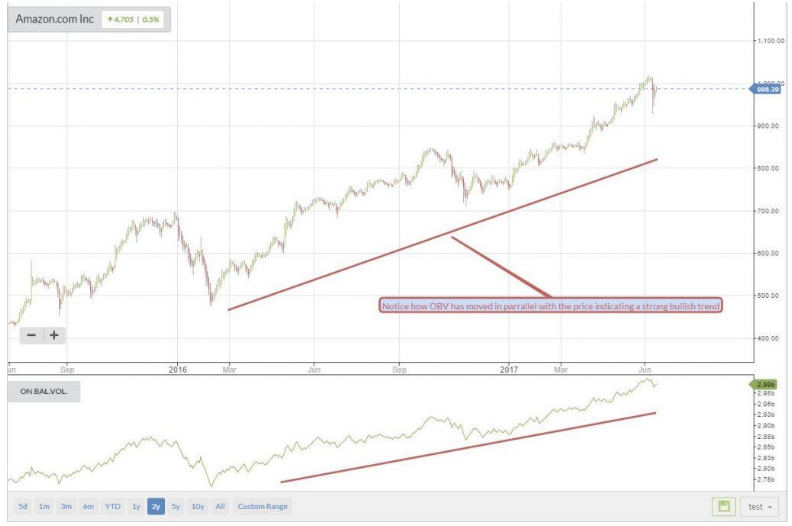
Volume is a measure of how much an asset has been traded in a given period of time. It can be a very useful tool to help confirm your price analysis. There are many volume tools, and we have already come across some in previous articles. For example, McLellan, Chailin and Accumulation / Distribution. Here we're going to take a look at On Balance Volume (OBV).
OBV is the total volume for each day, which is assigned a +/- value depending on whether prices close higher or lower for that day. A higher close causes the volume for that day to be given a +, while a lower close gets a -. A running cumulative total is then maintained by adding or subtracting each day's volume, based on the direction of the market close. The direction of the OBV trend is the key and not the values. If OBV is heading in same direction as price, this is a trend confirmation. When OBV diverges from price, this is a warning of a possible trend reversal.
Example using OBV for Amazon Inc (AMZN) (Charts: Stockopedia):
Volatility
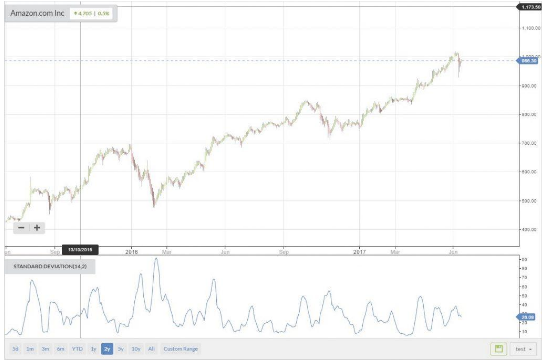
Like with volume, our paths have already crossed various volatility indicators such as Bollinger Bands and ATR. There are also very obvious measures that can be derived from price, such as historical volatility based on standard deviation. Another popular indicator used is the Chaikin Volatility measure. Appreciating the volatility of an instrument, can be crucial for your trade and risk management and an understanding of how the asset you are analysing behaves.
Example using the Standard Deviation tool for Amazon Inc (AMZN) to measure price action with a set up of 2 standard deviations on 14 daily periods (Charts: Stockopedia)
Sentiment
Sentiment is another area that you might want to look at adding to your technical analysis; often independently configured away from price, it can give you a 'feel' for the market. Sentiment is a way of measuring the overall market bulls and bears. Sentiment suggests the majority of market opinion is wrong at price turning points. Although the crowd is mostly correct in a trend, it is at the trends' extremes that the technical trader gets excited. Here, you are looking for extreme overbought and oversold situations for market reversals (e.g. bullish sentiment is often at its greatest at market tops).
A special note on Equities. When talking of market sentiment, most think of equities and many technical indicators have been developed to measure sentiment in that space, as we saw in Part 7: Market Breadth. However, the world of market sentiment is bigger than that.
We are going to take a closer look at 4 possible sentiment tools you may want to consider when analysing a particular market.
Open Interest (OI)
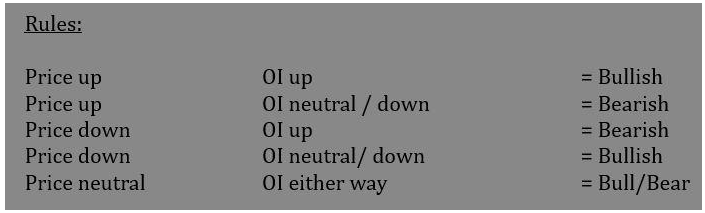
Especially useful in the world of futures trading. OI is the total number of outstanding contracts held by the market participants (ie. how much interest there is in a trend or asset). Because for each contract there is a buyer and a seller, the OI on a chart is not the two added together, but one side of the equation. OI is normally presented below the price chart and is represented by a solid continuous line.
Some OI rules:
Commitment of Traders report
Want to know which way (long/short) the professionals or groups of market participants are trading on the futures markets? – then this is the report you’ll need! It is a very under-utilised tool in the commodities and futures trading arena. Why would you trade against the herd if you knew what they were doing? It is a report published by the CFTC every Friday at 2:30pm EST. It measures the net long and short positions taken by speculative traders and commercial traders and is a great resource to gauge how heavily these market players are positioned in the market.
Application:
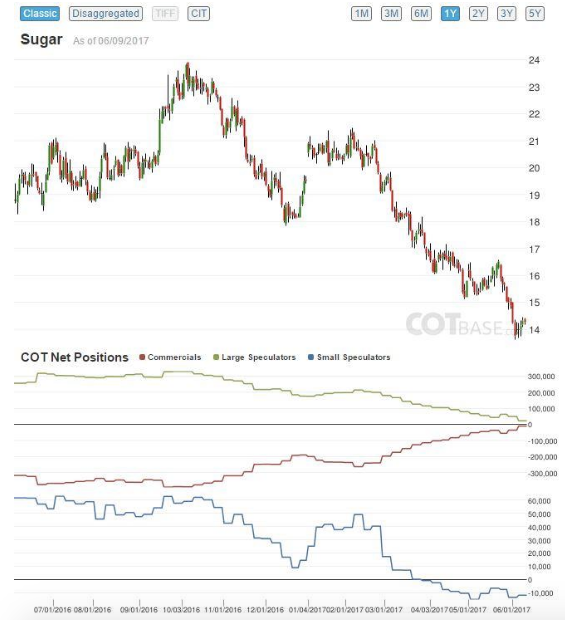
What we are interested in are 3 types of trader: Commercials (the end users of a commodity), Large Speculators (hedge funds, big trading houses etc) and Small Speculators (small players who are interestingly, more often than not, wrong!)
Various ways of using the COT report:
Changes in size of position
Crossovers e.g. Large Specs / Commercials
Extremes e.g. Overbought/ Oversold levels.
Example: Sugar No11 (Charts: CotBase) Note how the Commercials are inversely correlated to the price, whereas the Large Speculators follow the price.
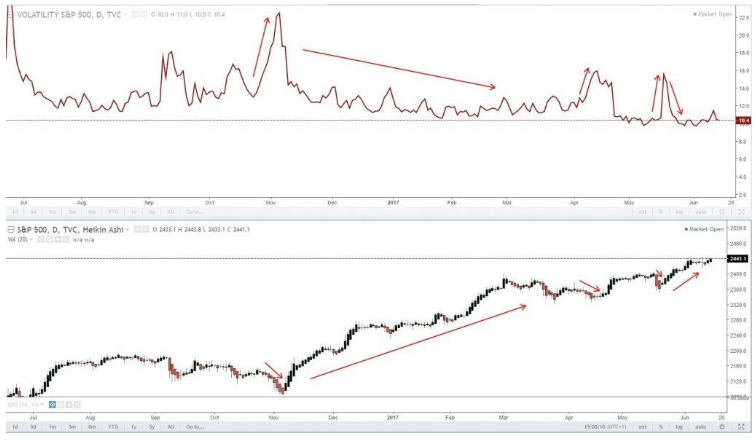
Stock market volatility sentiment: VIX
Here, we want to take a look at something more price independent. VIX derives from the world of options trading and implied volatility inputs on the S&P500.
VIX is a very useful sentiment tool for equities and can actually be traded itself as an asset. (WARNING – to trade this on its own you need some experience; it is a beast!) Most major stock market indices have their own version of the VIX.
In a bit more detail, the VIX is a volatility based index on the CBOE and is the market expectation of 30 day volatility, using implied volatility of the S&P500 index options. It is a measure of the perceived volatility in the market in either direction – up or down. It is simply a good investor fear indicator.
Application:
The higher the number, the more likely the markets are going to move around.
> 30 = high volatility = investor fear and uncertainty, anticipation of large moves.
< 20 volatility = low volatility = investor complacency / less stressful markets
Example: S&P500 plotted vs VIX - note the correlation between the two. (Charts: TradingView)
Currency strength
In the world of Forex and intraday trading, Currency Strength sentiment tools are very popular. These indicators are often based on cross mathematical relationships to each other, or from some pre-defined basket such as the US Dollar Index (DXY). In general terms, what any currency strength tool is trying to show, is the strength and weakness of any currency in relation to another; in the process filtering the currency pairs that you should trade. The general rule is to buy strength and sell weakness. Once added to your standard technical charts, these currency strength indicators can add a powerful overlay for your analysis and decision making.
Further reading and learning
If you are interested in learning more about moving averages then the following reading may help:
www.cftc.gov for more information on the Commitment of Traders report.
Technical Analysis of the Financial Markets, John J Murphy, New York Institute of Finance, 1985.
Technical Analysis, The Complete Resource for Financial Market Technicians, Charles D Kirkpatrick, FT Press, 2006.
Technical Analysis Explained - 5th Edition, Martin J Pring, McGraw-Hill Education, 2014
Conclusion
I find that volume, volatility and sentiment add a huge amount of 'independent' added value to your technical analysis. They come from a slightly different angle, and therefore, give you a more objective, rounded opinion on the price action of any particular asset you are studying.
Next time: Technical Analysis (Part 18): Alternative concepts in Technical Analysis
Disclaimer
This is not financial advice. Our content is intended to be used and must be used for information and education purposes only. Please read our disclaimer and terms and conditions to understand our obligations.
No comments yet
No one has commented here yet! Why not be the first one?