Technical Analysis (Part 5): Point and Figure Charts

Last week in Part 4, we looked at candlestick charts. This week, we look at one of the oldest charting methods popularised in the West: Point and Figure charts. To some, Point and Figure charts look like a glorified game of noughts and crosses! To others they simply make no sense or serve no purpose. Unfortunately, the interest in Point and Figure charts is on the wane, which is a shame because if you dug a little deeper, they can be a highly effective charting approach that you could use for your trading and investing. They can offer flexibility and a different perspective on price action.
Point and Figure history
This style of charting has been around since the 1880’s and pre-dates the bar chart. It started as a tick by tick charting system developed out of a practical need to record market prices on the go. Traders developed an efficient system to record prices, taking out previous very tedious methods of recording. Its beginnings were in a system that plotted price points between a set range and when the price points hit the range, the number was illustrated. This is where this method of charting gets its name from.

Point and Figure basics:
- It is the study of pure price movement i.e. it doesn’t take into consideration ‘time’ when constructing its charts (although most charting packages leave 'time' on the X axis).?
- Only price changes are recorded. If there is no change then the chart is left untouched.?
- Point and Figure ignores volume numbers – volume in effect is represented differently i.e. through the activity of the change in price on the chart. The heavier the activity, the more changes are recorded.?
- The sensitivity of the charts can be varied to provide short / medium / long term charts all off of the same data.?
- Point and Figure charts are very good for finding support and resistance.?
- Recording price moves on Point and Figure charts is a very different process to bar charts. It uses columns of X’s and O’s. Again: X’s = Up moves / rising prices, O’s = Down moves / falling prices.?
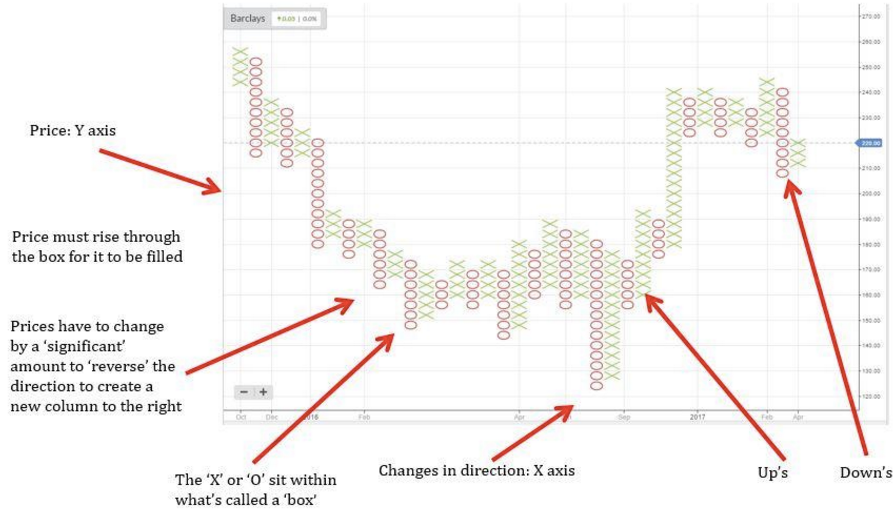
- The chart has two basic parameters: Box Value and Reversal Criteria. You would change these to increase / decrease the sensitivity of the chart and the amount of trading signals you’d get.?
- Increasing the box size offers less sensitivity and is better for longer term investors.?
- Decreasing the box size offers increased sensitivity and is better for short term traders.?
- The more boxes for a reversal, the less sensitive the chart becomes and vice versa.?
Setting up your Point and Figure charts
1. Select a convenient price scale / box value for the Y axis
2. I use ATR but there are many methods: we will look at a few.
3. Try to stick to round numbers – makes it easier.
4. Select the reversal amount:
- 3 Box reversal is the most common and widely used
- 5 Box also popular for longer term investors
- Best to fit the reversal to the underlying volatility
- 1 Box reversals are the original setting. Now not so popular. In this method you can have X’s and O’s on the same column. How? – if price reverses and then reverses back immediately again.?
Market practice
By far the most popular method currently is the 3 box method. The 1 box was too sensitive for some, so the 3 box was developed. The 3 box method means that you must only change a column when the price reverses through 3 boxes (filling them completely). There can't be X’s and O’s in the same column. The 3 box is very good for intermediate trend analysis. It is a simplified approach.
Parameter fixing
There are various approaches to finding a box size. It depends on the instrument you are looking at, its volatility and your trading objectives around sensitivity. You could take a subjective approach around your knowledge of the instrument to get a fixed block size. There is also a 'table approach' which is a factor of the underlying price range. There is also a percentage of the price approach. We look into the Average True Range method in a bit more detail below; I think it is one of the better approaches, as it factors in the volatility of the asset in question.
Average true range:
- A very simple and straightforward method to apply.?
- Use the industry ATR default of 14 days set up or manually set how you like.?
- Takes into account the volatility and movement of any asset's price.?
- Depends how sensitive you want to go but you could take the ATR/2, ATR/4 for example and use that as your box size.?
Getting the right box size is a crucial process. Things to consider
- Do you have a long / short term view?
- What sort of moves do you wish to capture?
- How sensitive do you want to get?
- What have past prices done??What drawdowns are you prepared to accept??
Reversal fixing
One thing you should ask yourself is – what do you think constitutes a significant trend change in your selected market?
- 1 box = intraday
- 3 box = used when trend is important and minor moves versus the trend are ignored
- 5 box = used when 3 box is too sensitive (longer term)?
Data
What price to use? It's down to personal preference and the asset you are trading. If you use the daily close, you ignore the range of the day. High/Lows can give a better picture but can be more volatile. In practice, the daily close and daily high/low are the most commonly used. Some options:
- Tick Data
- Daily Close
- Daily High/Low
- Daily Low/High
- Daily Open/High/Low/Close?
Interpretation
So, what is a Point and Figure chart showing? Quite simply, the interaction between supply and demand. It paints a great picture of the markets' fear and greed:
- When Demand > Supply = Buy
- When Demand < Supply = Sell?

- Rule: The stronger the support and resistance the stronger the signal will be when broken.
- Rule: Patterns – it’s not an exact science.
- Rule: For patterns, the wider the better.
- Rule: Uses similar patterns to bar charts / candle charts e.g. triangles etc.
- Rule: Congestion analysis can help predict the direction of the breakout. If the price action for example is at the bottom of an area then this equals strong support and is bullish.
- Rule: The fulcrum (dish) is the most important congestion pattern. A bit like a ‘W’ on a bar chart. On the right side of a fulcrum look for the ‘catapult’ (see below)!
- Rule: fulcrum can be different shapes e.g. a ‘V’, flat bottom etc. The reverse is true for bearish trades.
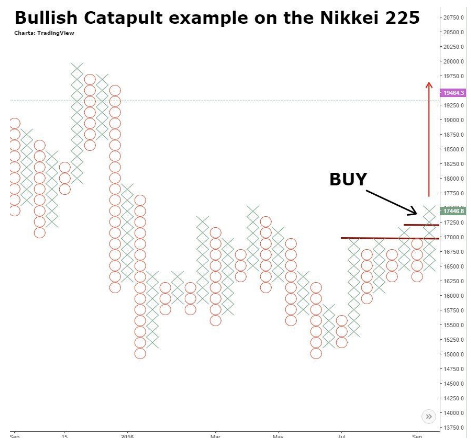
- Rule: A breakout and pullback is one of the strongest signals. Known as the catapult trade:?
The Catapult trade
A popular pattern normally on a triple top. (Bullish or Bearish)
- Breakout 1 to 2 boxes
- Pulls back well into the pattern
- Then breaks out above previous column?
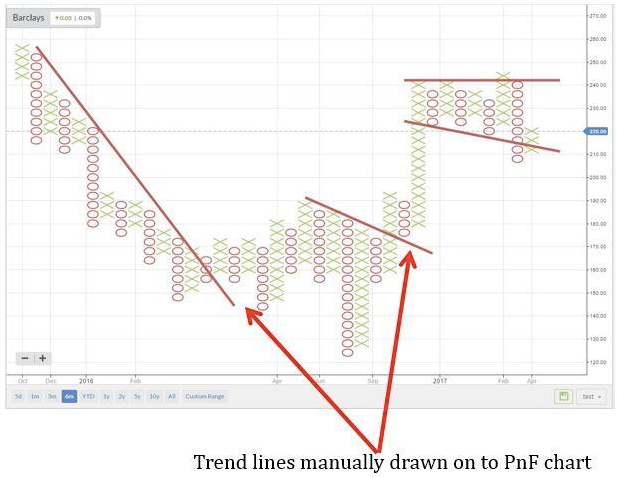
How do you draw trend lines on a Point and Figure chart? There are some rules. However, the approach uses the same methodology as line / bar charts.
- Can show bullish / bearish resistance lines
- Drawn at 45 degrees on 3 boxes connecting adjacent ascending boxes
- 45 degree breaks in Point and Figure very important.
- Can give trade entry signals
- You can add your own discretionary trend lines to the chart that aren't at 45 degrees.?
Barclays Bank Point and Figure chart with trend lines manually drawn on:
Use of indicators on a Point and Figure chart:
Due to the advancement of technology and charting software, you can now enhance your Point and Figure analysis even further and create some brilliant trading strategies. Almost all decent charting packages provide this functionality. You can now use indicators in conjunction with Point and Figure charts to improve results and timing of trades around entry and exit for example.
An example using Barclays Bank with trend lines and an Ichimoku system strategy:
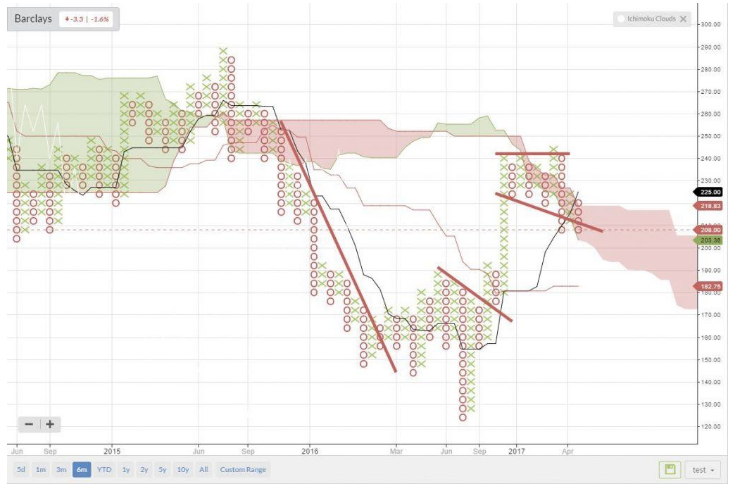
Point and Figure : A strategy in itself, very useful for trade management or complementing other methods.
Stops
You can also use Point and Figure charts for your trade management.
Some basic rules for Stops:
- Always risk below the last column of O’s in an up trade and over the last column of X’s in a down trade.
- Use trailing stops to below the latest O (up) or
- Use trailing stops above the latest X (down)
- If there is a significant move in X’s (e.g. 15 - discretionary) in an uptrend, move the covering stop to a point where a 3 box reversal would occur. (Vice versa O’s in down trade)?
Trading chart patterns
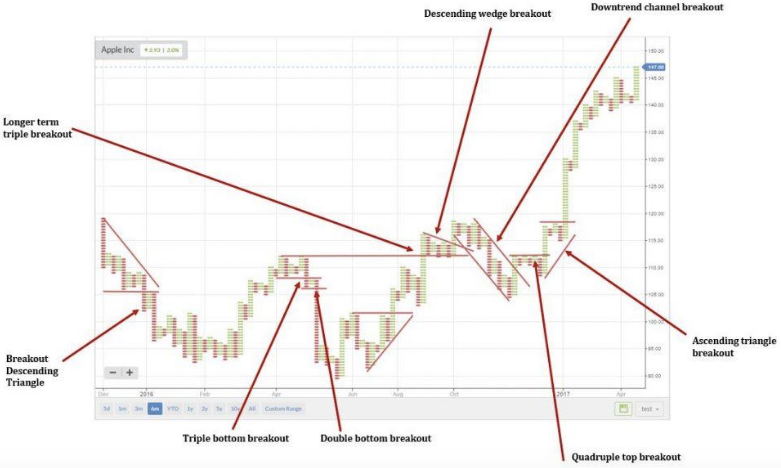
Some popular Point and Figure trading chart patterns in use today using Apple Inc:
Further Learning and Education
If you are interested in learning more about Point and Figure charts then the following reading may help:
- Technical Analysis of the Financial Markets, John J Murphy, New York Institute of Finance, 1985.
- Technical Analysis, The Complete Resource for Financial Market Technicians, Charles D Kirkpatrick, FT Press, 2006.?
One of the most current books on the subject that looks to evolve some of the older methods:
- 21st Century Point & Figure, New & Advanced Techniques for using Point and figure charts, Jeremy Du Plessis, Harriman House Ltd, 2015.?
His first major book on Point and Figure is also required reading for the MSTA exams and as a guide to the subject:
- The Definitive Guide to Point and Figure: A Comprehensive Guide to the Theory and Practical Use of the Point and Figure Charting Method, Jeremy Du Plessis, Harriman House Ltd, 2nd Edition, 2012.?
Conclusion
Point and Figure charting is one of the older pioneers of technical analysis, which unfortunately is slowly dying a death. Why? Possibly because it looks intimidating, takes some effort to understand and requires more manual intervention? This is a real pity, as I hope you can see from this brief article what possibilities it could have in your trading or investing world either as an outright system or as a complement to other methodologies.
Next time: Technical Analysis (Part 6): Equivolume charts
Disclaimer
This is not financial advice. Our content is intended to be used and must be used for information and education purposes only. Please read our disclaimer and terms and conditions to understand our obligations.
4 comments
PnF is available and when selected you can use the gear icon to choose the box size and reversal criteria. However, they behave a little oddly.
When initially selected the time period is not always accurate and I think it defaults to 'all data'. However, if 'saved' I think it gets it right.
Boxsize has to be altered for each share as it is entirely absolute price based. This is inconvenient and I think a little illogical. There are different approaches including setting boxsize as a % (relative price) and a logarithmic chart which I would find much more useful. I've sent these in as suggestions so they are likely somewhere 'on the list'!
However, they are well worth playing with, and reduce a lot of other technicals to 'buy higher highs with higher lows', sell on significant reversals from sustained columns, sell on lower lows (with lower highs). I find them very clear.
If you want to learn more about the potential of these charts I would also recommend Jeremy du Plessis -The definitive guide to point and figure. But personally I wouldn't pay full price.
You can select them in the 'chart type' drop-down. Same place as you choose line, candle, bar, Heiken Ashi etc
Hi - all of the info from my article on Point and Figure is already all available on the Stockopedia charts. Regards Stephen
I would like to use it if stockopedia were/does make it available