The Afentra trend is clear: drilling catalysts drive strong production growth

Inspired by Ed’s recent clear trends article, Gareth has been reviewing the African oil sector. All the companies have done well, given the oil price backdrop. However, one company stands out to me as particularly cheap on forecast earnings and, unlike some of the others, has modest net debt.
Afentra (LON:AET) has had an eventful few months. A strategic review process was triggered in March by press speculation but has now concluded, with the Board deciding to remain independent. The company has secured a new financing facility, FY25 results were released, and its first development well is currently drilling. I’m intrigued to take a closer look.

Disclosure: At the time of publication, the author does not hold a position in Afentra PLC.
The Pitch
Afentra (LON:AET) is an AIM-listed upstream oil and gas company, focused entirely on West Africa. It was formed in 2021 through the restructuring of Sterling Energy via a cash shell by former Tullow Oil executives. Paul McDade stepped into the CEO role, Ian Cloke took the key COO position, and Anastasia Deulina became CFO.
The company entered Angola in 2022, acquiring non-operated interests in Block 3/05 and Block 3/05A through a series of transactions with Sonangol, INA, Azule Energy, and, most recently, Etu Energias. On completion of the Etu deal (now restructured to include Sonangol as a co-participant), Afentra will hold a roughly 33% working interest in Block 3/05 and a 25% working interest in Block 3/05A. It has also been awarded a 40% operated interest in the adjacent Block 3/24 through direct negotiation with the Angolan government.
The Stockopedia algorithms give the company a respectable but not outstanding overall StockRank of 64.
- Value Rank 41: A forward P/E of just 3.1x makes the company look very cheap, but it is held back by a lack of dividend yield and a Price to Book of 2.42x.
- Quality Rank 53: This reflects the inherent variability of oil-company earnings and its impact on operating margins and returns on capital. The F-score is only 3/9, picking up the weak FY25 results.
- Momentum Rank 85: The shares are up around 50% over the past year, materially outperforming the broader market. All of this rise occurred in 2026 and is due to the market pricing oil much higher in response to the Iran War. Analyst earnings estimate upgrades over the past three months are also contributing, with the consensus FY26 net profit forecast rising by £18.2m. Again, these are due to commodity price impact rather than production growth.
The Big Picture
Afentra is a pure-play Angolan oil producer with a clear growth story. Its assets are concentrated in a mature but prolific oil-producing region with significant remaining resource potential. To date, the company has focused largely on assets undergoing remedial activities such as reinstating waterflood to offset natural decline and deliver steady output. The foundation for what management hopes will be a step-change in production growth has now been laid:
- A significant resource base: Following a re-evaluation of undeveloped discoveries on Blocks 3/05 and 3/05A, and the award of Block 3/24, Afentra’s working interest 2C contingent resources were upgraded by over 400% in January 2026 – from 20.9 mmboe to 87.3 mmboe (303 mmboe gross). This is in addition to the audited 2P reserves of 32 mmboe.
- A credible management team: Directors are seasoned oil executives with African experience. They own meaningful stakes in the business: McDade 2.4%, Cloke 1.7%, Wilson 1.5%, Deulina 1.2%.
- National oil company alignment: Sonangol, Angola’s national oil company, is both the licence operator and a fellow stakeholder in Blocks 3/05 and 3/05A. Its decision to participate in the restructured Etu acquisition alongside Afentra may have reduced Afentra’s stake. However, alignment of interests may pave the way for the unitisation of the two permits, offering a significant tax advantage by allowing cost pools to be utilised across both blocks.
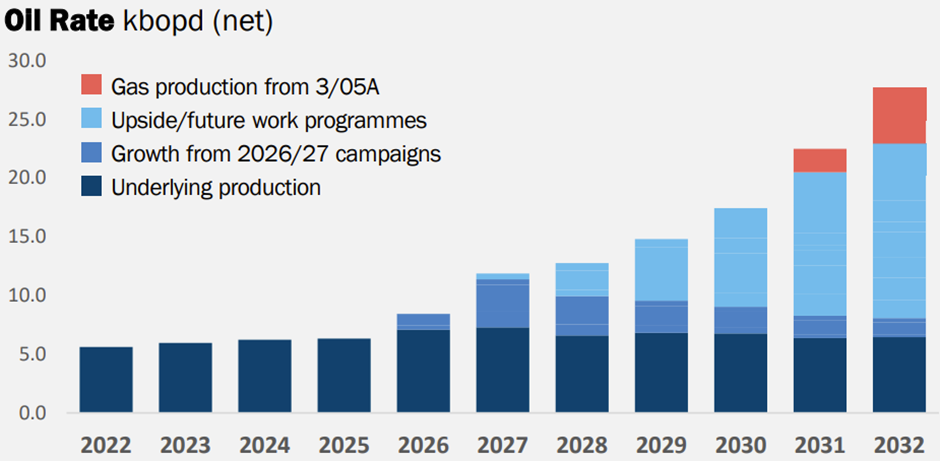
- A long runway for growth: The company is guiding the potential for a four-fold increase in working interest production, from around 6.5 kboepd today to approximately 25 kboepd by 2032, through a combination of infill wells, workovers, and low-risk development around existing infrastructure. Gas volumes from associated gas monetisation, encouraged by Angolan authorities, may also feature in later years:
Going Deeper
Several near-term catalysts could drive a meaningful re-rating:
- Current Drill Program: As part of Afentra’s 2026–27 work programme, the company has announced plans to drill two infill wells on the Impala and Pacassa fields in Block 3/05. The Pacassa SW-1 well is already drilling, with results expected next month. If successful, they expect an initial production rate of 5 kboepd from this well. Up to three further wells are planned if the current one is successful, targeting 70 mmbbls gross. The Impala-2 development well is planned for Q3, again with up to three follow-on wells targeting 50 mmbbls. Both wells have a significant cost carry from Sonangol. In aggregate, these two wells, plus three heavy workovers on the Palanca field, are expected to add around 3.75 kboepd net to Afentra, a 50% production uplift.
- Fast-tracked development on Block 3/24: Afentra has identified a high-priority infrastructure-led development opportunity on its newly awarded Block 3/24, centred on three legacy shut-in fields. These fields contain existing wells with flow rates of up to 6 kboepd each, located approximately 5km from existing infrastructure. FID is targeted for Q4 2026, with production potential of around 4 kboepd net to Afentra, providing the next leg of production growth into 2028–29.
- Favourable refinancing : In May 2026, Afentra secured a new US$125m pre-payment facility with commodities trader Gunvor, replacing its existing Reserve-Based Lending and working capital facilities. The new facility extends the maturity profile to 2030 and pays interest at SOFR+6% (improved from SOFR+8%). It also carries a 12-month repayment grace period, giving the company the financial flexibility to fund its drilling campaign.
- Oil price tailwind: Higher oil prices were cited as a key factor in the Board’s decision to remain independent. 44% of 2026 forecast sales are hedged via collars and puts. While this limits the near-term upside from the recent oil price spike, the cost of implementing these is only around $1/bbl, and protects the downside should there be a swift return to normal oil volumes through the Straits of Hormuz.

- Opex improvement: The current opex cost is around $23/bbl. When added to the $15/bbl fiscal take, this means cash operating breakeven is $38/bbl. However, higher future production should reduce opex/bbl to $15/bbl by 2030. With a consistent fiscal take, cash operating costs will be $30/bbl, increasing upside while protecting the downside from oil price weakness.
What The Brokers Say
Three brokers cover the company, and all three rate it a Buy. Stifel is their NOMAD, and we can’t access this research. However, both Cavendish and Tennyson Securities notes are available to individual investors.
- Cavendish has a target price of 114p based on a core NAV of 114p. On top of this, they calculate a risked upside of a further 98p per share, which would imply a material upside if current drilling campaigns are successful. Their latest note updated their model to reflect the new Gunvor financing terms and a higher near-term oil price assumption, which drove a 23% upgrade to FY26E adjusted EPS 50.6c.
- Tennyson Securities had already raised its target price to 104p from 90p on the back of the updated growth plan. They calculate a total risked NAV of 143p, noting that the shares trade on a forward EV/EBITDA of just 1.9x for FY26 at a US$70/bbl Brent assumption. At US$90/bbl flat, FY27 free cash flow increases to US$107m, a free cash flow yield of 56%.
The Bear Case
The investment case is not without risks, and it is important to understand why the shares remain well below broker price targets despite recent outperformance:
- Single-asset concentration: Tennyson’s SWOT analysis explicitly flags their dependence on a single asset as the primary weakness. Almost all of Afentra’s current revenue and operating cash flow derive from Block 3/05. Reservoir underperformance, operational setback, or sustained downtime would all have a material impact on the company’s financial performance.
- Political risk: While Angola has a long history of oil production, there is no escaping the single-country risk here. The country is grappling with high inflation, lingering sovereign debt risks, and severe foreign exchange shortages. Angola ranks 120th out of 180 countries on Transparency International’s Corruption Perceptions Index, scoring just 32 out of 100. This places Angola significantly below the global average of 43, though its score has improved over the past decade. In addition, while terrorism risk is generally low, separatist tensions in the northern Cabinda exclave have historically targeted foreign energy interests.
- Drilling risk: The planned production growth is heavily reliant on the success of current drilling campaigns. Without these additional wells, production will be largely flat with natural decline only managed through increased water injection.
- Non-operated status: Afentra holds non-operated interests in Blocks 3/05 and 3/05A, with Sonangol as the licence operator. This means that the pace and cost of the development programme are not entirely within Afentra’s control. They have taken on operatorship of Block 3/24, and one of their recently awarded onshore blocks. However, all current production is from non-operated fields.
- Weak historical financials: FY25 shows what can happen in a lower-oil-price environment, with production declining. A combination of a 15% decline in average oil prices from 2024 to 2025 and working interest production falling from 6.5 to 6.2 kboepd led to revenue falling by 37%. Normalised EPS was just 4.37c, down sharply from 21.1c in FY24.
The Bottom Line
Afentra is not a company that many investors would consider. It is an AIM-listed, single-country oil company with non-operated assets in Africa. There is real drilling risk, country risk, and oil price risk. With the combination of lower oil prices and a slight production decline in 2025, you can see why management may have been willing to entertain possible offers. The middling Quality and Value Ranks reflect that weak historical performance.
However, that strategic review process, in which a “limited number of counterparties” were engaged, produced no acceptable offer. It seems that the typical offer premium we see in the market didn’t reflect the valuation disconnect in a more positive oil-price environment. Brokers calculate a Core NAV well above £1 and a risked-NAV that is double the current share price.
The story here isn’t just about an unexpectedly high oil price, which may reverse with time. Several near-term catalysts may drive a re-rating. A two-well carried program on Block 3/05, combined with three planned heavy workovers, has the potential to add 50% to working interest production by the end of 2027. Then the Afentra-operated Block 3/24 GPQ cluster development is being fast-tracked for FID in Q4 2026, adding to production growth in 2028/29. In the current oil price environment, this production growth will add materially to free cash flow.
Afentra is not a low-risk investment, and it should be position-sized accordingly. But for investors willing to take on small-cap AIM oil exposure, Afentra has a credible team, a large resource base, a string of near-term catalysts, and momentum behind it.
Disclaimer
This is not financial advice. Our content is intended to be used and must be used for information and education purposes only. Please read our disclaimer and terms and conditions to understand our obligations.

9 comments
Thanks Mark for your analysis; I view this & all the Stocko 'Pitches' as purely how we, less able private investors, aught to tackle analysis of companies in which we are interested.
Having years ago just used Technical Analysis , before any sensible data was available , I have learnt the power of Fundamentals and now use both , with some success.
Wow! Its like the golden days of the noughties when we were all talking peak oil. I'm sure Stocko' was founded on a base of oil explo' specialist investors (maybe former industry professionals?).
When the Iran war started I asked CoPilot which UK listed oil cos had the highest beta v the price of oil. Afentra came out No. One, so I bought this along with a couple of others to hedge my portfolio. After listening to the "meet the management" seminar the other day, I' decided to remain invested as I like the story and think the company has an e exciting future.
Every Stocko rating for quality, value,momentum and the StockRank is low and falling with the price below the 50day average.Poor F score and RS.Any advice on timing?
I don't really do timing, I'm afraid. If it was possible to accurately time stocks based on the stock ranks alone, then Stockopedia would have been a quant hedge fund not a data site!
If they hit their forecast numbers the Value rank will be materially higher, and probably the Quality Rank too. In the short term, the global oil price and current drilling results will determine the direction, in the long-term the oil price and whether they meet their planned production increases (also dependent on dril results, but spread over more wells). If you believe they can deliver that production growth and the oil price will remain close to the current futures curve this is almost certianly undervalued, and compares well to the other peers from Gareth's article. However, those are some big unkowns!
Yes but people are relying on hope rather than structure and are simply directed to the buy button without reference to the price. It could during a bad week when people are putting their money down . No caution is expressed. Rob
I get the caution. After all, I don't own the stock. Although, my write up did confirm to me that it is probably the pick of the bunch from Gareth's original article.
However, it is worth re-iterating as there seems to be occassional misunderstanding
- These stock pitches are NOT tips. When we write them, we are not saying investors should invest in the company.
- They certainly don't contain any insight into how a particular company would fit an investors personal circumstances, risk tolerance, portfolio construction, or any timing aspects on when investors should consider trading.
- Investors tend to like the new StockPitch format as it gets to the key points quickly. However, it is certainly not exhaustive. For brevity, it will often miss some more nuanced bull and bear points.
- These are not pure quant articles where we always go for the highest ranked stocks (although that may help guide us)
That said we don't pick what we write up randomly. We tend to use screens or other themes to guide us. Recently, I have used my cheap growing compnaies screen as inspiration. This article was becaue Gareth wrote up the sector this week. What the Stock Pitches are intended to be is a first step in some idea generation; sitting somewhere between a list of companies in screen results, and a full investment analysis. They shuld be treated as such.
Thank you for the time on the exposition I have a lot to say on investor protection but here is the wrong time and place . Will be reading your book tomorrow and hopefully a later edition? Rob
Thanks. My book is a bit more about psycholgy, avoiding mistakes and portfolio construction. Hopefully still very relevant, even if its getting on a bit now. If you are into investor protection, you may find this article a humourous but eye-opening read, if you haven't caught it already: https://www.stockopedia.com/co...
There was a chart years back by a seasoned investor more re mining stocks that they make good investments during the drilling phase when newsflow is (hopefully or spinned) positive. Time to sell out pre production when accountancy rules take over !