The Property Franchise Group and Belvoir: two high quality small caps gearing up for growth?

Two property franchise specialists released full year updates this week: Property Franchise (LON:TPFG) and Belvoir (LON:BLV). I am interested in this business model because of its recurring revenues, strong cash generation, low capex and franchise networks.
I hold a small position in TPFG but it is Belvoir that has wowed the market with revenue growth of some 43% year-on-year. Belvoir is also significantly cheaper, trading at just c11 times forecast earnings and paying out a forecast yield of 4.73%. By comparison, TPFG is on 15 times forecast earnings and is set to pay out a 3.8% dividend.
Have I backed the wrong horse here?
The Property Franchise Group
Market cap: £59.39m
Revenue: £11.14m
Forecast PE ratio: 15x
Here are the headline figures from TPFG’s full year trading update, released on 28 January:
- In line with market expectations
- Much of the impact of the tenant fee has now been mitigated
- Record performance for lettings revenue
- Overall revenue +1.79% to £11.4m
- Management service fees +2.12% to £9.6m
- Number of tenanted managed properties serviced +5.45% to c.58,000
- Net cash now up to £4m
The outlook also sounds quite sunny:
“Early indications of improving market conditions underpin our expectation that the volume of house sales should increase in 2020. The lettings market is also anticipated to remain healthy, with rising rents and increased confidence leading to more opportunities for the Group's franchisees to acquire competitors' books than were available in 2019.”
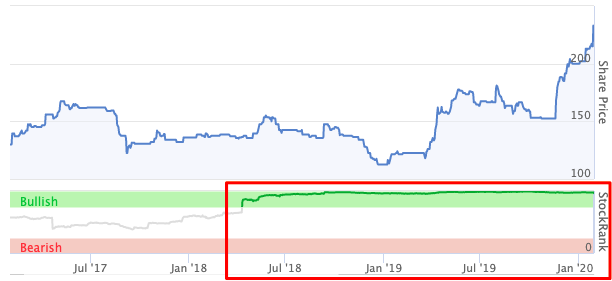
TPFG has been a 90+ StockRank stock for nearly two years now and in that time its share price has increased by 70% to 231p.
TPFG is the UK’s leading property franchise specialist. The Company was founded in 1986 and now operates through six brands:
- Martin & Co: a national lettings focused brand
- EweMove: a national, digitally enabled, hybrid sales and lettings brand
- CJ Hole: a full-service estate agency serving the West Country for 151 years
- Ellis & Co: a full-service estate agency serving London for 168 years
- Parkers: a full-service estate agency serving the M4 corridor for 70 years
- Whitegates: a full-service estate agency serving the Midlands and North of England for 40 years
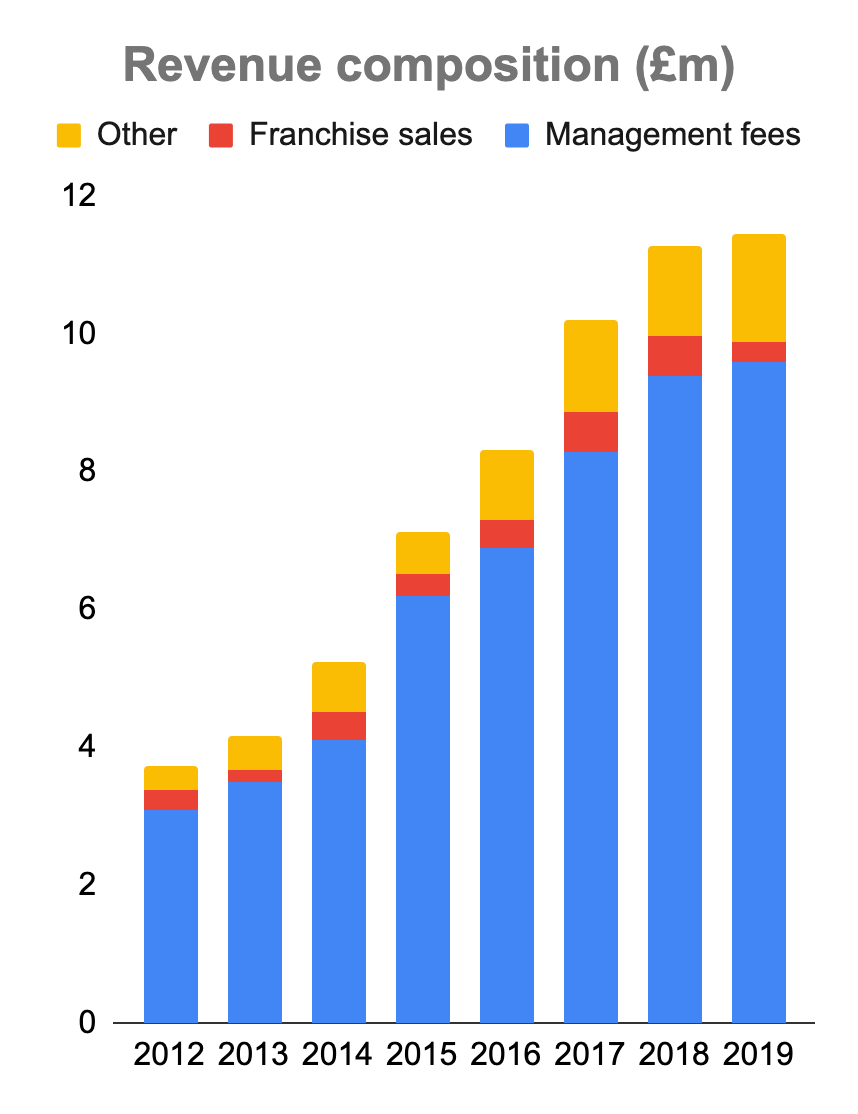
TPFG’s growth trajectory has been remarkably consistent over the years. Revenue, profit, and cash from operations have increased at pace since 2013 (when it listed on AIM as MartinCo). The growth feels so controlled because a large part of its revenue comes from recurring management service fees (royalties). This made up 84% of FY19 revenues.
The successful franchise model has resulted in an admirable track record of high returns and cash conversion. TPFG requires extremely little in the way of capital expenditure and it has no debt, so it is a promising vehicle in terms of generating cash for, and returning cash to, shareholders.
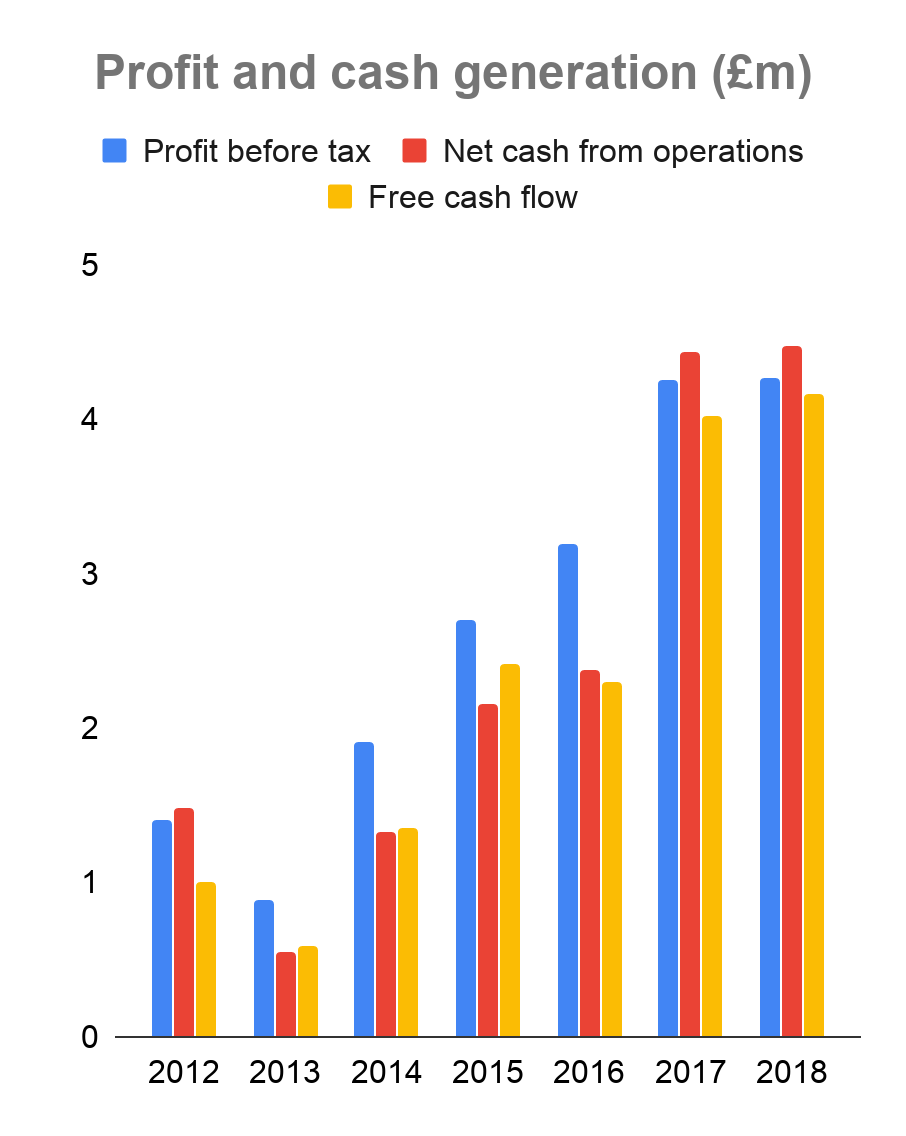
The rate of growth in profit and revenue has moderated over the past year. Are the days of 20%+ growth over? I think, even if the company does encounter a period of stalling growth, its cash generative nature and clean balance sheet means shareholders should be rewarded with dividend payments while the company invests to drive new growth.
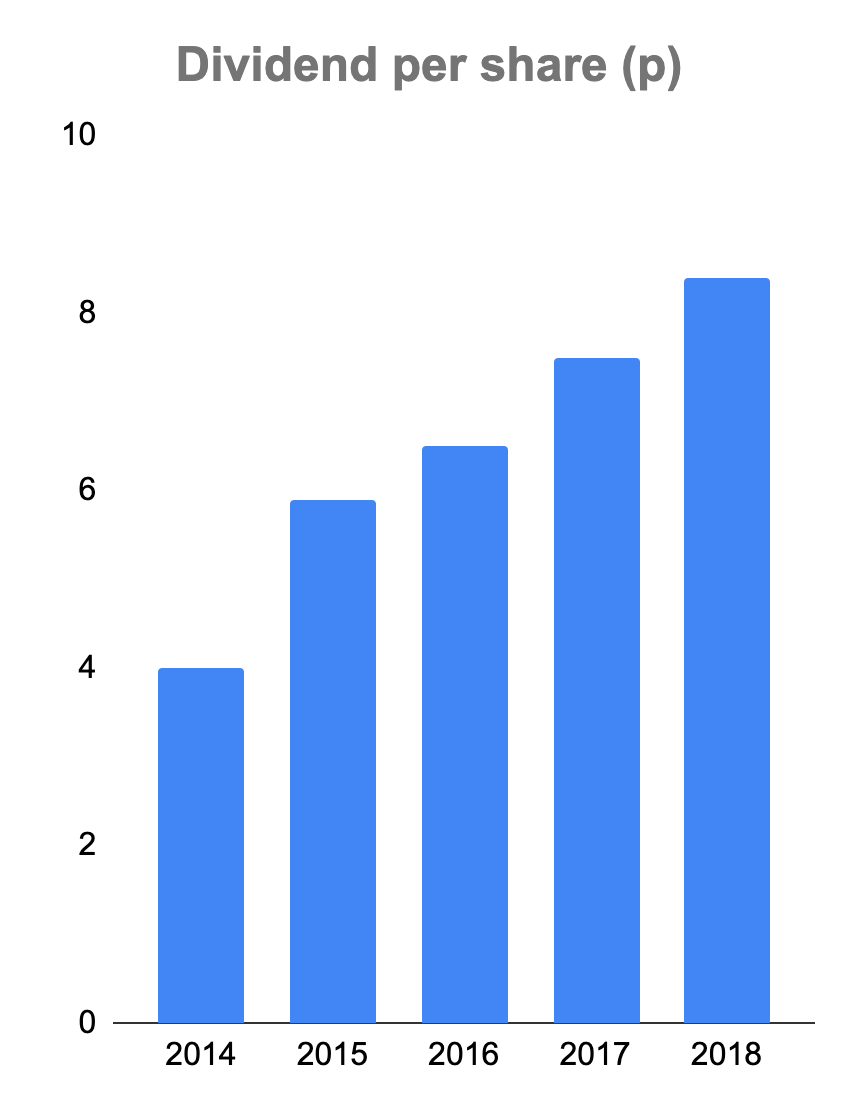
Since initiating a 4p dividend per share in 2014, TPFG has grown dividends at an annualised rate of more than 20%.
With no debt, a market cap of £60m, strong free cash flow and high returns on capital I’d back TPFG to find ways of growing further from here. In fact one promising development - its nascent financial services division - I go into a little more detail below.
Introducing Aux Group: TPFG’s new financial services business
Post period end, TPFG announced the launch of its Financial Services division. The group will use its strong cash generation to drive a “buy and build” strategy to establish a financial services division (operating as a subsidiary called Aux Group Limited) of meaningful scale.
Aux Group will focus on acquiring quality financial services businesses which are relevant to the Group's core business and directly authorised by the FCA. Through this new division, TPFG thinks it can significantly enhance longer term profitability.
TPFG has kicked off by acquiring a 72.25% stake in protection advisory business Auxilium Partnership for a “non material sum”. Auxilium was launched in March 2019 by Mark Graves who now moves into the newly created role of Financial Services Director at TPFG.
I imagine TPFG will be able to cross-market these new finance packages to its existing network of franchisees at low cost. From the perspective of a franchisee, it sounds like a useful additional service. In the group’s own words: “This strategy seeks to enable the financial services division to capitalise on the significant volume of leads generated by the core business, whilst the property franchisees are able to generate further revenue without adding to fixed overheads.”
This could be a margin-enhancing move for what is already a very high margin company. As Ian Wilson, Chief Executive Officer of The Property Franchise Group, comments: "Our Financial Services division will focus on generating a high quality of earnings and improved operating margins compared to the sector average."
It’s early days but I think this sounds quite promising.
Belvoir
Market cap: £56.51m
Revenue: £16.63m
Forecast PE ratio: 11.3x
Net debt: c£10m
I know much less about Belvoir (LON:BLV) and would like to hear from anyone that is more familiar with its operating history. The company has similar qualities in terms of revenue composition and free cash flow. It pays a higher dividend yield but it also has a net debt position on its balance sheet. This last point is the key difference for me as things stand. I haven’t had the time to perform any detailed analysis on the company, but getting comfortable with this debt position will be my first port of call.
In late 2017, Belvoir proposed a merger of the two companies. The TPFG directors, who together own a substantial stake in TPFG, rejected this move as not “in the best interests of TPFG’s shareholders” because it “significantly” undervalued TPFG and would lead to an increase in debt.
Scrolling down to the Net debt line of the Financial Summary also shows that, where TPFG has a net cash of £2.77m (now up to c£4m, according to its latest update), Belvoir carries approximately £10m of net debt. No surprise that Belvoir has an inferior F-Score (six compared to seven out of nine) and Z-Score (5.42 versus 16.61).
Going over the flurry of RNS releases in late 2017 TPFG says, while rebuffing Belvoir’s advances, that: “TPFG has a progressive dividend policy and has had a significantly stronger dividend cover than Belvoir over the last three years. The Board believes that the increased leverage that would be introduced as part of the Possible Merger Offer could put pressure on the dividend going forward.” Interestingly, this difference in dividend cover has narrowed in recent years. Belvoir cover has gone from 1.18 in FY17 to a projected 1.68 in FY19(E). Meanwhile, TPFG’s has slid modestly from 1.9 to an anticipated 1.72 times.
Belvoir’s level of net debt has nearly doubled over that same timeframe, however. It appears BLV has a more relaxed attitude towards capital structure. Taking on debt can lower a group’s cost of capital but it also brings in risk by introducing a class of bondholders that are prioritised above equity owners.
Glancing at the income statements, it seems as though for now Belvoir actually reports a net finance gain due to franchisee loan interest payments. So, on the face of it, its current level of debt is hardly onerous.
What’s more, BLV trades at a discount to TPFG (10x forecast PE versus 15x forecast PE). Perhaps there is an opportunity here?
Belvoir full year update
Belvoir’s actual trading brand appears to be “Belvoir!”, which sounds exciting but also feels as though the CEO himself has just snuck up behind you and shouted it in your ear.
Some key points from BLV’s full year update on 30 January:
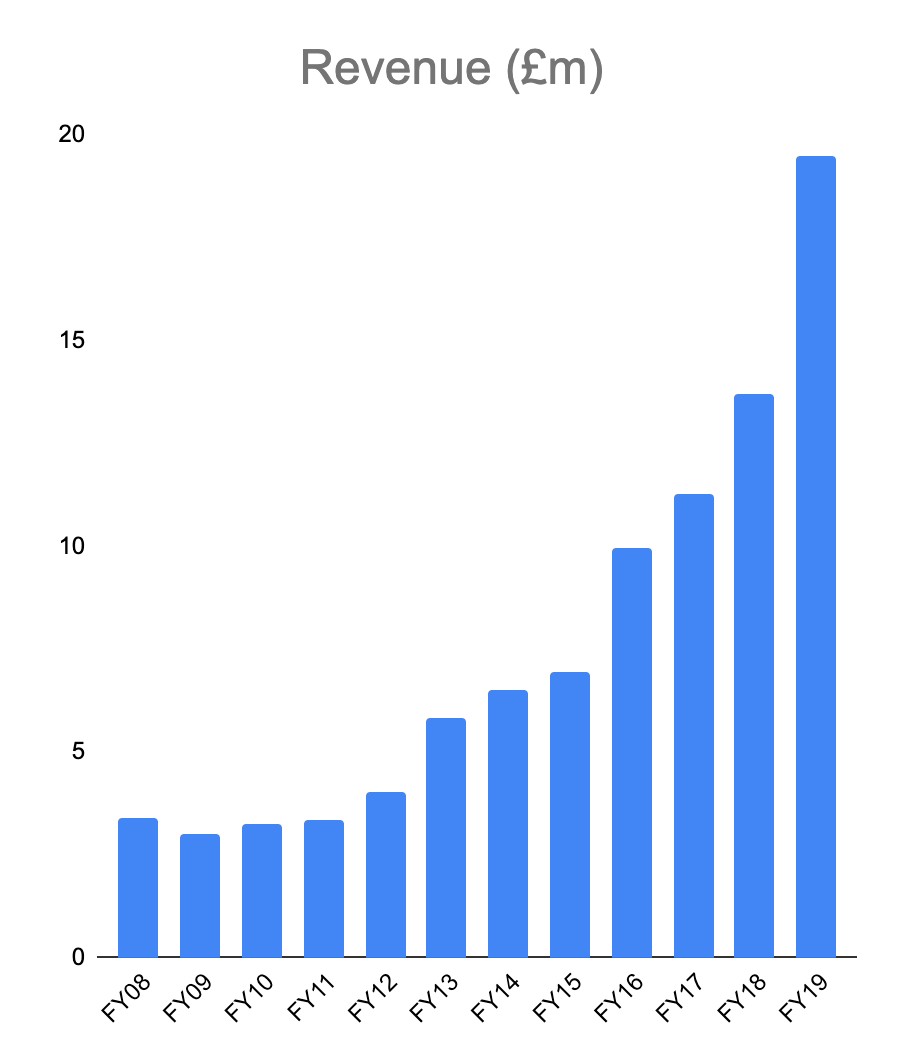
- “Outstanding” growth with revenue up 43% to £19.5m (2018: £13.7m)
- Profit before tax will be “comfortably ahead of management’s expectations”
- Management Service Fees increased by 4% to £8.8m
- Tenant fee ban has been fully mitigated
- diversification into financial services delivered significant revenue growth of 148%
- Portfolio of managed properties was up 7% to a record 67,000
- Net debt reduced from £9.6m to £6.9m (but has increased to c£8.9m post year-end following acquisition of Lovelle)
Impressively, this is the “23rd year of uninterrupted profit growth for the Belvoir Group”. People worry about the cyclicality of real estate, but it does appear as though the recurring management fee model provides some useful protection with these companies.
In fact the further you get with this update the more you start to wonder why this company is on a forecast PE of c10: “The Group has achieved a year of outstanding growth with revenue up 43% to £19.5m* (2018: £13.7m) and consequently the Board expects that the performance for the year, including profit before tax, will be comfortably ahead of management's expectations.”
It’s certainly an eye-catching step change in revenue, particularly by historic standards:
Belvoir’s franchisees also seem to have already mitigated the impact of the tenant fee ban, ahead of TPFG.
Interestingly, Belvoir is ahead of TPFG in terms of financial services.
“We could not be more delighted by our strategy to invest in financial services in 2017. At that time our number of advisers was just 13 servicing 20 of our Newton Fallowell offices, and now we have 166 financial advisers across the UK, all operating under the Mortgage Advice Bureau brand. Financial Services has been, and continues to be, a considerable success for Belvoir.”
“The Group's diversification into financial services delivered significant revenue growth of 148% in 2019 following the acquisition of MAB (Gloucester) in November 2018, and a 35% increase in the Group's financial services network.”
Dorian Gonsalves, CEO of Belvoir commented:
“The Board remains committed to its growth strategy of capitalising on further consolidation within the property sector and through diversification into other property-related services. With January 2020 signalling a marked improvement in both sales and mortgage transaction numbers, I am optimistic about the growth opportunities for Belvoir in the year ahead."
The more I look at Belvoir - with its strong growth, improving balance sheet, forecast PE ratio of 10.3 and forecast yield of 5.15% - the more I wonder if I’m in the right property franchise specialist… It is acquiring a business for £2m, which will push net debt back up. I’d like to see Belvoir emulate TPFG’s net cash position - perhaps then it would be rewarded with a more premium rating.
What I worry about is that further acquisitions will increase its net debt position.
Conclusion
TPFG has grown consistently since listing, it is high margin and highly cash generative, it requires minimal capex to fuel this growth, and it has a strong balance sheet. Dig beneath the prosaic name and you will uncover a lively, entrepreneurial company with ambition.
Belvoir shares many of the same characteristics: recurring revenue, cash generation, and minimal capex. While TPFG is just setting up its financial services division, Belvoir is already two years in and seeing strong growth. Its net debt position is an amber flag though and I would want to take a closer look at the group and its trading history before making any decisions.
There is also the fact that Belvoir proposed a merger and was rebuffed by TPFG. What did TPFG see in the deal that put it off? One of the sticking points was a refusal to consider a net debt position. You can find TPFG’s response here. Is TPFG being too conservative, or is Belvoir taking on too much risk?
I have an existing small holding in TPFG but I’m not making any calls in this article one way or the other. I’m just setting a marker down for future research into two interesting small caps with attractive financial characteristics and promising growth opportunities. On that note, if anybody has any thoughts on TPFG and/or Belvoir I’d like to hear them.
Disclaimer
This is not financial advice. Our content is intended to be used and must be used for information and education purposes only. Please read our disclaimer and terms and conditions to understand our obligations.

12 comments
I am a landlord and if I held Belvoir shares, I would be concerned about online competitors. I use the online letting agent OpenRent who charge around £50 for everything that I need to find a tenant. This includes marketing on the major portals, a digitally signed tenancy agreement, a credit check and rent collection. All I do is prepare the listing and do the viewings (which is essential anyway, as I need to meet the prospective tenant) I then manage the property myself, which is not too onerous.
You might only pay £50 with OpenRent, except you have to do your own viewings, answer all the queries from tenants, field all the phone calls, and also manage the tenants when they are in situ.
These are two different markets. Plenty of landlords that don't want to do all the "admin" of getting tenants in and managing them.
I took a £5k position about 5 months ago, so far I am up about 40%. Can't complain about that!
As a holder of Belvoir (LON:BLV) I am genuinely confused by the worry over the company's debt.
In 2018 the company generated £4.6m in operating cash flow, with little obvious maintenance capex.
With a net debt position of £10m and interest rates low it seems a good strategy to have reasonable levels of debt to fuel growth rather than paying it down.
If rates rise materially or business slows down materially - both highly improbably in the near term - then the downside looks minimal in light of their cash generation levels.
Please note the comment above is no reflection on whether this is a better holding than Property Franchise (LON:TPFG) (in which I hold no position), but merely trying to understand people's justification in being worried about Belvoir's debt position.
A
Would also be worth including M Winkworth (LON:WINK) in the comparison, another very similar operation, albeit somewhat smaller and even less liquid (~19m mcap).
I hold M Winkworth (LON:WINK), I would also quite happily hold either of the other two as well or instead.
I've held Belvoir (LON:BLV) for a bit over a year.
One thing I am keeping an eye on is organic growth. Buried in its September 2019 update it said that like-for-like growth in letting fees had fallen to +0.5% in H1 2019 which included one month of the lettings fee ban (in 2018 L4L growth was +2.6%).
The reported increase in management service fees for 2019 was probably down to acquisitions so potentially 2019 has seen a fall in organic revenue from lettings (maybe due to the fees ban?). This isn't necessarily a problem while it is growing through acquisition and the financial services division is storming ahead, but it is worth keeping an eye on.
The other factor to consider is whether Belvoir (LON:BLV) could lose business to online lettings agents like OpenRent.
Personally I am very happy to continuing holding as any softening in lettings income will be made up for by financial services and acqusitions. Plus there now seems to be more confidence in the housing market which may also benefit its property division which currently accounts for around 15% of profit.
I hold both with similar levels of gain. I like the fundamentals of both and see no reason why it has to be an either/or.
Hi Sharechap, I agree nothing wrong in holding both, just depends on investing style, I don't like to hold similar companies, just in case the market changes, legislation changes or any other event causes them to fall, they both go down (or up!)
Personally I prefer a little diversification, I guess similarly for HAT or RFX, for me it's RFX.
Good luck with both I hope they both fly...
TPFG all the way, huge growth to come as they build their financial services division, as they build the company, I build my position, just a shame the CEO is going, hopefully as there is no rush an excellent replacement will be found. Just my pennies worth
A very novice analysis!
Several years ago and on occasional checks since, Belvoir had a sea of green on the Stockopedia screen, whereas TPFG always seemed to have more yellow. The spread was also much larger for TPFG
This is my novice analysis.
Belvoir has more to offer as it has its financial services, however TPFG has that expansion to come and the lack of debt. Belvoir seems to be the company of the moment but TPFG has more to offer in the future so my choice would be TPFG.
Both appear to be equal except for debt, so I chose TPFG last November for this reason. I have seen too many firms with debt wen things go 'boss eyed' they disappear never to be seen again.