The SIF Folio: (Re)introducing my rules-based portfolio

I’ve now been running the Stock in Focus portfolio here at Stockopedia for nearly four years. Over that time there have been some changes. I’m also aware from subscriber feedback that many newer subscribers may not be familiar with the backstory on this rules-based portfolio.
As SIF approaches its fourth birthday in April, I’ve decided to mix my normal stock coverage with a series of articles taking a fresh look at the portfolio. This week I’m going to start by looking at the rules I use to guide my trading decisions and the results I hope to achieve.
Over the next few weeks, I’ll also be taking a more in-depth look at some of the changes I’m considering for the year ahead.
In the beginning
In 2015, I started the Stock in Focus column here at Stockopedia. The initial idea was to bridge the gap between a stock’s story and its financials. By sticking to the Stocko philosophy that rules-based investments are likely to outperform unstructured selections, I hoped to profile stocks that would go on to perform well.
At the end of 2015, it seemed logical to round up the performance of my picks after I’d written about them. The results were encouraging. So after discussions with boss Ed, I decided to convert my weekly column into a stock portfolio.
The rules were pretty simple. All stocks would be selected using a set of screening rules that I would develop. To ensure complete transparency and provide a reliable audit trail, the portfolio would be run as a Stockopedia Fantasy Fund.
On 19 April 2016, I launched the Stock in Focus (SIF) fantasy fund (this link only works on the old Stockopedia website).
Since then, I’ve bought 94 stocks for the SIF fund and sold 78 of them. After the first year, I was encouraged by progress, so since April 2017 I’ve also been running this portfolio as a real-money fund using my own cash.
Results so far have been encouraging. Here’s how SIF has performed against its FTSE All Share benchmark:
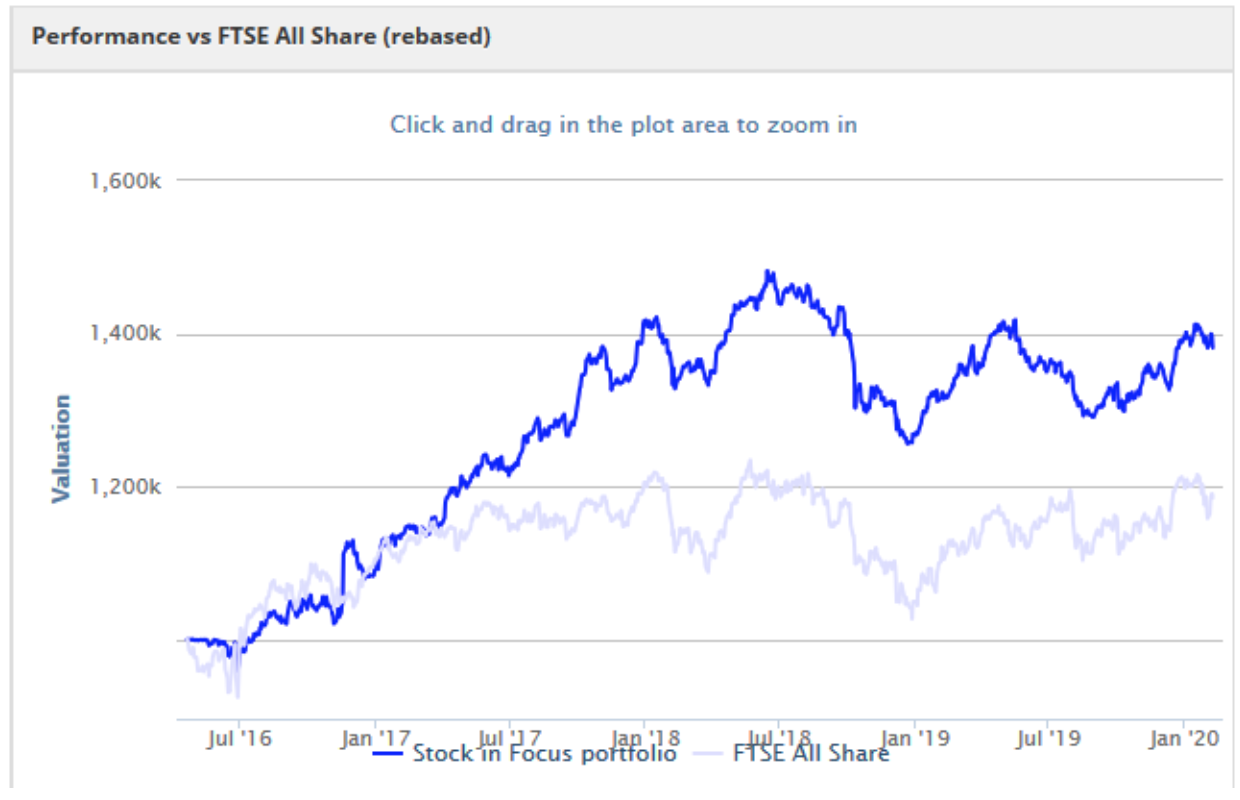
The portfolio has delivered a total return of 47.5 percent including dividends, or 36.5 percent based on capital gains only. Over the same period, the FTSE All Share has risen by 18.5 percent. Unfortunately I don’t have a total return figure for the All Share index over this period, but annual figures are available here.
As you can see, the market-beating gains which took place between April 2016 and July 2018 have not been repeated over the last 18 months. However, most of the portfolio’s current picks are performing well. I remain confident that my methodology should help me to avoid many of the market’s duffers and bluffers.
How do I pick stocks?
At the core of the SIF process is a requirement that all stocks must be selected using a set of screening rules. In this section I’ll show you the rules I use and explain how I select each new stock.
The rules
Stockopedia has an excellent stock screening system, so it’s quick and easy to build screens to look for companies that satisfy different criteria. In addition to my long-standing SIF screen, which is rarely modified, I often create one-off screens to filter stocks for particular situations.
(If you’re not yet familiar with Stocko’s screening system, you can find all the information you’ll need to get started here.)
When I created the SIF screen, I first had to decide what kind of companies I was looking for. I settled on the following requirements:
Market cap >£50m
Affordable
Profitable
Growing
Positive momentum
I christened this approach “affordable growth”. You can read about my original 2016 ruleset here, in my first ever piece on the SIF portfolio.
I’ve modified these rules slightly since then, but they remain largely unchanged. Here is a snapshot of my current ruleset.
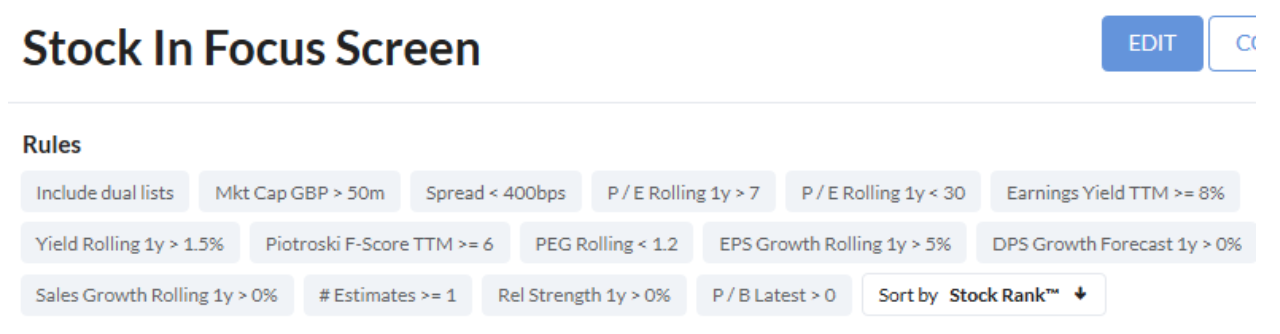
Here’s a direct link to the screen - you can make copies for your own use.
As you’ll see, my screening criteria are deliberately middle-of-the-road. I want to select sensible businesses that are doing well and reasonably priced. I don’t want outliers such as deep value stocks, blue sky punts or highly-rated growth stocks. All of these have the potential to deliver crushing losses and high volatility - not what I want.
Picking stocks
I don’t buy every stock which qualifies for my screen. But my approach is still fairly methodical. I aim to achieve a basic level of diversification by not buying multiple stocks operating in the same sectors.
To help me pick stocks, the screen’s results are sorted using their StockRank. I then work my way down the list looking for the first company that satisfies my diversification requirement.
In most cases, this will be the next stock I buy. But I do allow myself some room for personal judgement at this point. For reasons widely discussed on this site, I no longer invest in foreign companies with London listings. I also reserve the right to avoid certain sectors for fundamental or cyclical reasons. Examples include building/contracting companies and - currently - housebuilders.
I can buy a maximum of one stock each week. But my screen doesn’t usually provide that many results. On average, I probably add two stocks to the portfolio each month.
When I sell
Each stock in the portfolio is held for a minimum of nine months. During this time, I will only sell if the company issues a profit warning or if the share price doubles, when I would sell half the holding to maintain balanced position sizes.
At the end of each month, I review all of the stocks that have been in the portfolio for nine months or more. If they still qualify for my screen, then they stay for another month. If not, they’re sold.
Trading vs investment
I accept that this short-term approach means that SIF is more of a trading strategy than a true investment portfolio.
Following this strategy has helped me dodge some bullets, such as Bilby, Character Group and Staffline. But it also means I’ve missed out on a few really big winners. The most notable of these is IG Design.
I sold IG Design for a 49 percent gain in January 2017. But if I’d held on, my position would now be showing a gain of 307 percent. My records suggest that this single result would have increased my average gain per holding by 4 percent.
In practice, this wouldn’t have happened, because I’d have sold half the holding when it doubled to rebalance the portfolio. But it’s an interesting illustration of the benefits (and risks) of different approaches to investment.
Current portfolio stocks
Let’s finish off with a snapshot of the portfolio at the time of writing. Happily, most of the SIF fund’s current holdings are showing attractive gains, despite the recent China-led sell off:
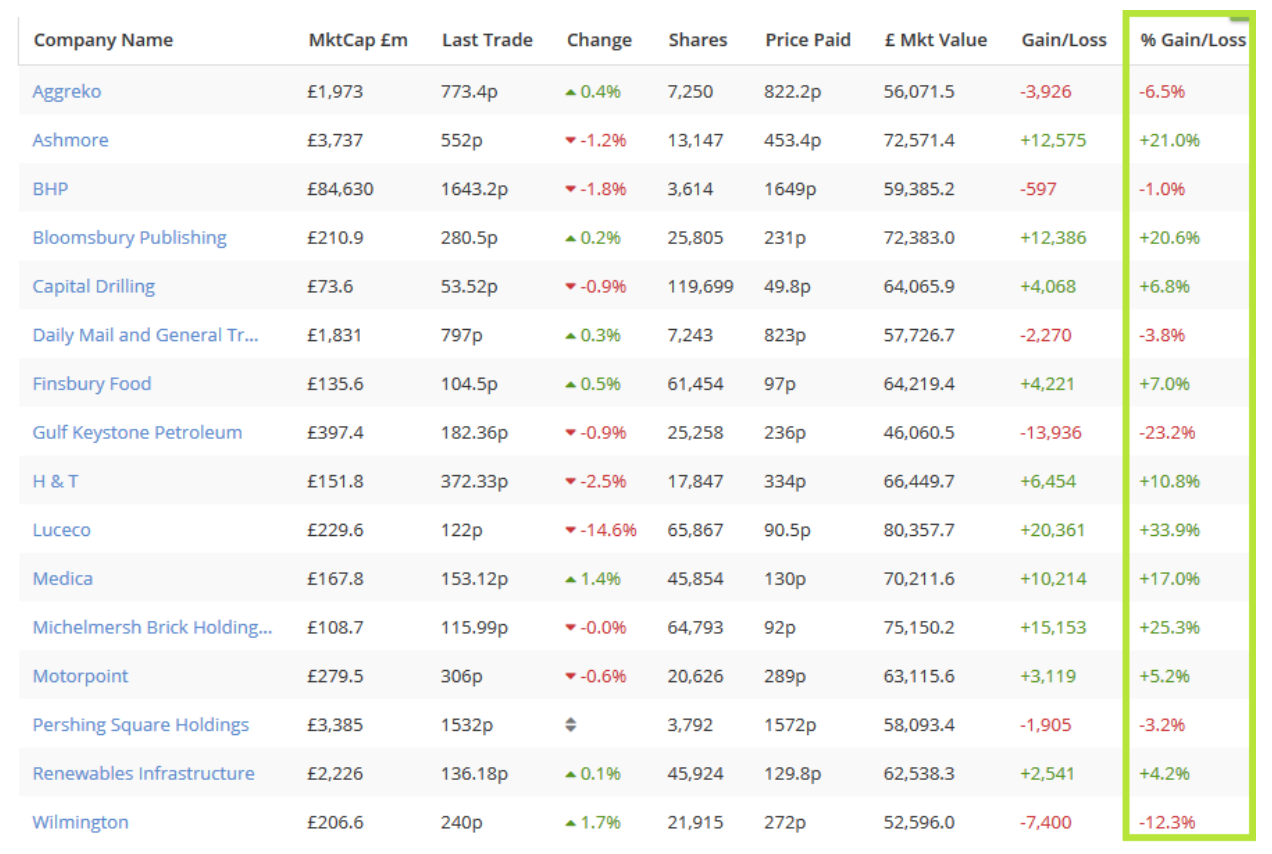
(Snapshot of portfolio on 10 Feb 2020)
You can find a complete archive of all my articles here.
Coming up...
That’s about all for this week. As always, I welcome any questions or comments you may have on my strategy or my stock picks. Feedback from subscribers is always valuable and I really appreciate the time you take to read and consider my ideas.
Over the next few weeks I hope to be able to add some new stocks to the portfolio. Alongside this, I plan to consider some possible changes to my rules for the year ahead.
Disclosure: Roland owns shares of all the companies listed in “Current Portfolio Stocks” except Pershing Square Holdings.
Disclaimer
This is not financial advice. Our content is intended to be used and must be used for information and education purposes only. Please read our disclaimer and terms and conditions to understand our obligations.

14 comments
This Folios only focus on UK stocks ? Any particular reason ?
H i ... Nice strategy ; l like the middle-of-the-road approach .
Would an equal - weighted approach achieve a better yield or safety net do you think ?
Best wishes , Robert .
Hi Robert,
Thanks for your feedback. Each of the positions in the portfolio is equally sized to start with, so in that sense the portfolio is equally weighted.
I don't have equal weightings across sectors, though. Many sectors are missing altogether. This does carry some risks, but also offers opportunities to benefit by investing in overlooked areas (I hope).
In terms of screening, I think I'd have to change my valuation and growth criteria to select equally across sectors. As a guess, I'd have to look at performance and valuation relative to peers, rather than using fixed screening thresholds.
There's lots of ways of approaching a system such as SIF, and I'm sure there are other equally good or better solutions. My hope is that my system will stimulate discussion and new ideas.
Best wishes,
Roland
I went to the rules copy link as posted above. I only get 6 results. Can you check the link pls?
Maybe there are only 6 qualifiers at the moment, these are picked over a long period but not all are added to the portfolio for various reasons.
Hi Susan123,
The number of stocks which qualify changes all the time. At the time of writing (Monday 17 Feb) there are only six qualifying stocks, so your results sound about right.
Regards,
Roland
Hi Roland
Thanks for an interesting journey these last couple of years and clear write up of all the changes when they occur.
Although you mention that you are taking momentum into account and I can see some momentum elements in the screen, as you only hold for a maximum of 9 months would bringing a stronger focus on share price momentum (in addition to earnings) help to capture more of the influence of sentiment in the market towards a stock as over a 9 month period I would think that sentiment towards a stock may have a much stronger influence than if this was a long term buy and hold strategy as per Terry Smith.
Hi Graham,
Thanks for your comment. I use 1-year relative strength (RS1Y) as a momentum measure at the moment, but I have been wondering whether I should consider more of a short-term metric, such as RS6m.
The risk with making changes is that it's very hard to know whether they will improve or worsen future results -- unfortunately I don't have the ability to back-test rules.
Regards,
Roland
Hi Roland,
As best as I can work out FTSE-ASX.TR closed 19/4/16 at 5664.1, and closed 11/2/20 at 7794.85.
According to my best workings, that's 37.6%
Geoff
Thanks Geoff, could I ask where you got the data? I've don't know of anywhere I can get historic daily prices for the total-return indices.
Roland
Are you still looking for this data Roland ? I have been manually recording it weekly in my spreadsheet since Sept 2012 - here's a copy, also includes FTSE100 TR.
Regards - Pete
https://docs.google.com/spread...
I say weekly - there may be the odd additional data point for 5th April and 31st Dec if these are mid-week
hi Roland,
what have you got against housebuilders? Their recent results were sound and seem to have good business momentum for now at least.
vivek
Hi Vivek,
Thanks for your comment. I do agree that there's still a case to be made for investing in
housebuilders. Certainly their results remain (mostly) very good, with no sign of serious margin pressure or slowing sales.
However, I can't help thinking we must be approaching the end of the current housing market cycle.
Unlimited cheap money (ultra-low interest rates and Help To Buy) have sustained the market so far. But this dependence worries me. Builders are also reporting some underlying cost pressure and tighter affordability (despite low rates) in London and the South East.
More and more, I'm seeing suggestions that 'it's different this time'. (e.g. this piece in the FT - paywall). As a value investor by nature, this seems like a warning to me.
I do still have some exposure to the housing market through brickmaker £MBH. For now, I'm more comfortable with this. Time will tell if I'm right!Cheers,
Roland
Ok fair enough, certainly agree with that late cycle feeling. I have a holding in Redrow (LON:RDW) , which I am keeping for now, although looking at results and capital return, think Barratt Developments (LON:BDEV) is perhaps the best in class operator.
House builders are cyclical and so by defintion they should go through ups and downs. I am comforted by one tangible difference, which is their balance sheet strength compared to previous cycles.