The Volex rerating: from recovery play to growth stock?

Volex (LON:VLX) is a 127-year-old cable and wiring company five years into a financial turnaround and strategy shift. Its legacy business deals in commodity-like cabling - a thankless task that led the group into trouble a couple of years ago - but its growing Cable Assemblies division offers higher margin products. This is where investors are seeing an opportunity.
The group says it is benefitting from a growing reputation of quality and customer care in its end markets. This shift in emphasis could transform the market’s perception of Volex - in fact, it appears as though this is already happening:
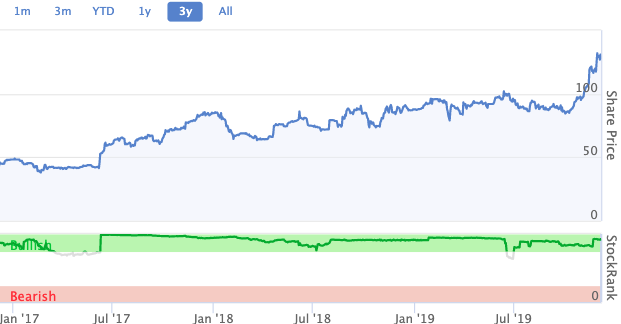
What we have here is an evolving investment case. Is the market scrabbling to play catch up?
The story goes that Volex is evolving from a recovery stock into a growth stock with a renewed focus on cash generative and higher margin business. With no debt and a more diverse customer base, the company is also considerably less risky than it was. It has even resumed dividend payments. The recent rerating is understandable.
But at just 0.5 times forecast sales and qualifying for two market-beating screens (one growth, one momentum) does Volex have further to run?
No sign of a moat...
I had wondered if Volex’s new strategy might spell the beginnings of an economic moat, but I don’t think this is the case. Volex certainly hasn’t had a moat in the past - that’s a part of why it ran into such big problems a couple of years ago.
There is potential, though, if it can develop value-added products and processes that are backed up by patents (Volex attributes about $1m of value to acquired patents).
What Volex is right now is a turnaround stock with a strengthened balance sheet that is moving (partly via acquisition) into higher margin, fragmented markets. There is execution risk in this, and, while the company can certainly grow, the question is whether it can grow profitably. Given its history of vending commodity-like products, this is a key concern.
Volex supplies some high growth markets such as electric vehicles and data centres, which both require complex cable solutions. This could be a significant source of growth going forwards, but will these areas in time also become commodified? And will the company need to continue investing large amounts of capital to meet the changing demands of its multiple markets?
The group’s five-year cash flow statement shows that Volex can have big swings in working capital. From the cash flow section of Volex’s Financial Summary, we can also see it regularly has to invest significant amounts of cash in capital expenditure:

Whether or not this level of investment is required solely for the group’s turnaround or is representative of its operations going forward is a key question to consider.
But still an opportunity?
Volex’s management is optimistic of the group’s prospects, of course. The group’s chairman, Nat Rothschild, owns about a quarter of the company and so is invested in its fortunes. Heading over to the group’s Director dealings page, you can see that Rothschild continues to pick up shares and the CFO's holding has also been increasing over time.
Volex is one of the largest power cord manufacturers in the world, so has some important geographic and financial scale benefits over competitors. It has a reputation for quality and safety among its premium customer base. Finally, it has more than a century of operating experience in its markets.
What’s more, the group remains attractive from a factor standpoint:
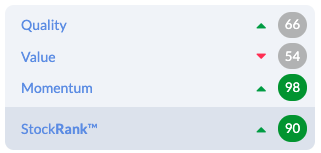
The group is making acquisitions which, if integrated well, should drive growth in the years ahead. As the Volex turnaround gathers pace, brokers have been consistently upping their EPS estimates. These estimates can often take a while to catch up with a company’s improving prospects. Despite the upgrades, the group’s shares trade on just 9.6x forecast earnings with a forecast PEG of just 0.6x despite being at multi-year highs.
So, not a company with a moat, but a turnaround story involving an old UK manufacturer aspiring to provide value-added solutions to a global customer base.
Execution risk is important in any turnaround. As a sign of confidence, though, Volex has just this year resumed dividend payments. The fact that its shares trade at c0.5x forecast sales (despite recent strength) means today’s valuation might offer some margin of safety.
The turnaround so far...
The Volex of 2014 was in big trouble: various management teams had led to a disjointed strategy and overinvestment in the wrong places.
It was a company characterised by razer thin operating margins (as little as 1-2%) and a concentrated, powerful and shrinking customer base. Against this stark backdrop, Volex also had $46m of debt to manage.
Nat Rothschild, who has owned about a quarter of Volex since 2008, joined the board in 2015. Within a month, he was executive chairman and had got rid of the interim chief executive and chairman.
A company-wide restructuring began. Rothschild wanted a greater sense of company ownership. He said: ‘It is difficult to generate positive momentum without consistency in management and the kind of commitment that comes with a clear sense of ownership.’
So, he set about assembling a team to turn Volex into a successful British manufacturer. Daren Morris, CFO, was brought in and has been instrumental to the group’s turnaround.
In 2018 Volex announced an oversubscribed placing at a price of 75 pence per share, in order to finance the £18m acquisition of cable harness company Silcotec at about 5.8x EBIT. In the years leading up to this placing, the group had been busy paying down debt. In FY14, the group had net debt of £32m but by FY19 this had virtually no debt and around £20m of cash.
As with any turnaround, the accounts are slightly messy and are populated with ‘one-off’ restructuring charges and various ‘underlying’ measures of profitability.
Looking through the accounts, it has been years since the group’s operating profit matched up to its underlying operating profit.

The group’s board structure also appears slightly unorthodox, with Rothschild as the executive chairman clearly quite hands on, no actual CEO, and Daren Morris acting as CFO, chief legal officer and company secretary. Beside them sit three non-executive directors.
Nevertheless, the 2019 version of Volex is a big improvement on the 2014 version, with signs of revenue and operating profit growth, a stable management team, a move towards higher margin products, and no debt. In FY20 Volex is aiming for sales of above $400m (FY19: $372m) and operating profit of above $30m (FY19: $22m).
Business model and strategy
Strategy
Volex’s strategy is to diversify its customer base (which it has been doing over the past few years via acquisitions and organic growth) and expand its presence in cable assemblies. It is achieving its first aim by increasing its focus on high-tech and higher-margin products and acquisitions. The second part of its strategy should also help broaden its customer base.
The higher margin Cable Assemblies division is becoming a more significant part of Volex with each passing year. Given the nature of the group’s recent acquisitions, this trend looks set to continue.

The cable assembly industry is a fragmented one and so could prove to be a fertile hunting ground. The company made three acquisitions here in FY19, all of which, management says, generate an ROIC greater than WACC and bring new customer relationships, geographies and sales teams.
Management argues that these purchases allow Volex to offer more complex integrated manufacturing solutions in high growth markets like the Electric Vehicle, Medical and Data Centre sectors. The question is, in a largely capital-intensive industry, whether Volex is acquiring businesses that are capable of generating returns comfortably above their cost of capital in future.
Business model
Volex is headquartered in the UK but operates from 12 manufacturing locations around the world, employing over 6,000 staff across 20 countries.
The group’s traditional markets for power cords are in decline due to changing technology. These days though, Volex’s business model is more based on adding value to customer products, delivered through its expertise in design and development, manufacturing and testing, and customer service.
Through the provision of these services it aims to create sustainable value for shareholders.
Operating segments
The group operates two distinct segments: the legacy, low-margin Power Cords division (blue below) and the growing, higher-margin Cable Assemblies division (red below).
Power cords
Volex is one of the world’s largest global power cable suppliers. It designs and manufactures power cords, duck heads and related products for domestic appliances. This is the group’s legacy business and sales have been slowly been falling here for years.
Gross margin, however, has been improved by the removal of negative margin products and improvements in productivity and scrap rates. Volex believes there are further gains to be made in this area and says it has a profitable future here if it can become more vertically integrated, like its competitors.
The underlying picture is one of declining revenues but improving productivity and profitability.

Cable assemblies
Here, the group competes by producing highly engineered, high-performance, application-specific cables, in close collaboration with its customers.
This division designs and manufactures a broad range of cables and connectors (ranging from high-speed copper and fibre-optic cables to complex customised optical cable assemblies) that transfer electronic, radio-frequency and optical data.
It operates in a fragmented market that is growing rapidly. Volex has several strong niche positions within data centres, telecoms and healthcare where customers utilise Volex expertise and manufacturing competencies.
The division’s product range here is split into two categories:
1) High-speed – cabling solutions for telecom and data centres that transmit data at rapid rates. This is seen as one of the key growth areas for Volex in the coming years. Global data centre traffic is expected to double in size from 2018 to 2021, to a total of 20,555 exabytes.
Volex makes one of the fastest data transmission cables available and continues to invest in R&D in this space.
2) Interconnect – bespoke cabling solutions designed to transmit data and DC power.
Revenue for FY2019 was $173.2m, up 45.8% on the prior year. This included revenue of $44.8m from three acquisitions, all of which are reported within the Cable Assemblies division. Excluding the acquisitions, revenue increased by $9.6m, an improvement of 8.1% on the prior year.

Looking forward, the Cable Assemblies division is targeting growth through new business development and further penetration of existing accounts. There are plans to be first to market with next-generation high-speed copper data cables that Volex thinks will be popular with data centre customers as demand for ever-increasing bandwidth continues.
Its recent acquisitions should also strengthen its presence in fields such as healthcare, where customers are looking to consolidate their dealings with fewer suppliers.
Risks and threats
There are certainly risks facing Volex, although the prize of being a world-leading, UK-based manufacturer of complex cabling is a noble aim.
The Group operates in highly competitive markets and faces competition from rivals operating at a lower cost base. Within the Power Cords division, many of the key competitors are vertically integrated.
Volex aims to differentiate itself through engineering know-how and quality and the acquisitions it has made should reposition the group towards the more value-added end of the market.
Customer concentration also remains a key risk, although steps are being taken to address this. The largest Power Cords customer accounted for 7.5% of revenue in FY19, down from 15.2% in the previous year. Significant attempts are being made to diversify the customer base and win new business.
One increasing risk is Acquisition integration. With more purchases on the agenda, finding and integrating bolt on businesses will be more important moving forwards.
The Group had a net pension deficit under IAS 19 as at 31 March 2019 of $2.4m (FY2018: $3.3m). The decrease was primarily due to the $0.9m pension contributions made by the Company during the period. This looks manageable but pensions are at best neutral for shareholders and can be counted on to bring the odd unwanted surprise (an example: Volex reported a one-off GMP equalisation charge of $480,000 in FY19).
Taking the above two points raises a third: the clarity of accounts. Turnarounds tend to come with messy accounting full of restructuring charges that can make it trickier to see the underlying picture. Volex presents its own underlying picture, of course, but we have to rely more on management judgement.
This table below shows a high level of adjustments in the group accounts.
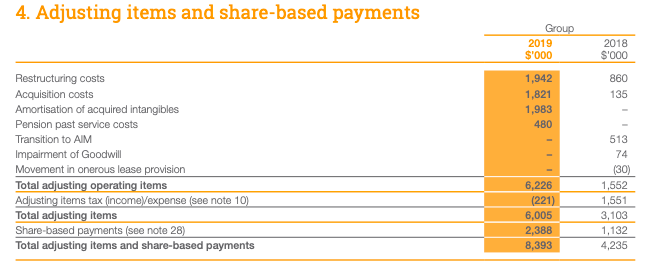
A turnaround situation that is coordinating multiple acquisitions at the same time also brings a fair amount of execution risk.
An additional point: as a result of the group’s past and current turnaround situation, it does not have that consistently rising cash flow profile that is the hallmark of high-quality stocks.
Technological development - Power and data cable markets are impacted by disruptive technologies which include wireless data transmission and improved battery lives. The Group says it is addressing this risk through increased R&D investment, acquisitions and an improved strategic marketing function.
Volex also has quite a concentrated shareholder base and has a reasonably low free float of around 65% of shares.
Conclusion
Tying it all together, I don’t think Volex offers the prospect of a long-term economic moat that I am looking for.
What it does present though, is an interesting turnaround situation. The resumption of dividend payments might be a powerful signal that this turnaround is working. Volex has strengthened its balance sheet with £20m of cash and is looking at fragmented industries with experienced eyes.
As a UK manufacturer that has been around for more than a century, it has to be respected. If it continues to execute as it has been doing, it is not hard to imagine the shares rerating further. The risk, of course, is that it doesn’t execute or moves into areas that fail to generate the long-term returns on capital that it seeks.
Volex acknowledges this difficult and competitive environment and believes it differentiates itself with a strong reputation for quality and customer satisfaction. A growing Cable Assemblies division should turn Volex into a higher margin operation (its operating margin has already improved from 1% five years ago to 7.5% today).
Market perceptions change slowly. With consistent earnings upgrades and its shares trading at less than ten times forecast earnings, Volex’s shares could continue to rerate if it can justify a growth multiple.
If you hold Volex or are considering a sale or purchase, it would be great to hear your thoughts on this company and its prospects. Is the turnaround working? How big can Volex get, and can it find a way to generate high long-term returns on capital?
Disclaimer
This is not financial advice. Our content is intended to be used and must be used for information and education purposes only. Please read our disclaimer and terms and conditions to understand our obligations.

9 comments
I hold Volex (LON:VLX) having bought before the share price took off after the interims last November. I top sliced my holding recently in the light of the Coranavirus outbreak and the potential for supply chain disruption., but have retained a reasonable position. However the share price has taken a pounding of late dropping from a high of round 167p to 129p at present. My best guess and it is just that, is the weakness is due to profit taking combined with fear regrading the impact of the Coranavirus.
Volex has 13 factories worldwide, 3 of which are in China, but it also has factories in Indonesia and Vietnam. The latter enabled it to mitigate the effect of the Trump tariffs and hopefully will help it to offset the disruption that will undoubtedly be caused by the current epidemic.
The stock is is inexpensive currently trading around a PE of 9 and prospective yield of 2% rising to close to 6%. It is financially sound with 25% of the equity being held by the Executive Chairman, Nathan Rothschild. This latter point may be seen as a positive or negative, depending on ones view. I appreciate I am talking my own book and may regret it, however given the potential for growth in medical, data centres and electric vehicles (Volex (LON:VLX) is the supplier of choice to Tesla) there is a reasonable argument that the current share price represents an opportunity.
Share prices are dictated by market makers who drive the price to encourage dealing. Invariably share prices overreact on the downside and the upside in the short term. Hopefully my assessment is broadly correct but I could be eating humble pie. Time will tell.
Finally I admit to finding the share price stability of Strix (LON:KETL) somewhat puzzling. It has 4 factories but the largest by some distance is in China, whether this suggests that something else is afoot at Volex (LON:VLX) who knows? I regard Strix (LON:KETL) as a good company but have sold recently as I was unable see an ability to mitigate the potential supply chain disruption.
All the best
I was just reviewing Volex (LON:VLX) and noticed that the FD, Daren Morris, has been steadily selling down his shares and options over the past few months. It's not a comforting sign from an FD (especially where the accounts contain a lot of adjustments, as mentioned above). Has anyone here heard an explanation?
I was just talking with Oli in the office about this. As far as we can see, the CFO has been selling shares that were granted from options but he is still a net buy over the period (increasing his stake from 0.44% to 0.56%). So, although he is not growing his position as quickly as possible he is still growing his position.
The may have a moat in the products for medical sector because “they are regulated by the FDA” (see minute 2:50 of video) but I cannot ascertain from a quick glance of the R&A how much of Volex’s turnover is in this sector.
I would also need to ascertain who are their competitors and the size of their addressable market (I would imagine it was several multiples of their turnover?)
Great article, thank you. Volex (LON:VLX) certainly merits further investigation.
Thanks, this recent Volex presentation is also worth a watch if you haven't already seen it:
https://www.fmp-tv.co.uk/2019/11/29/video-volex-plc-investor-presentation/
I add my notes from the Yellowstone Advisory Investor evening , held on the 5/11. Thank you for the above.
Daren Morris, the CFO and legal officer presented at the Yellowstone investor evening last night and ahead of interim results due 14/11. The upbeat AGM statement and $28.5m acquisition of Servatron ( cash, shares, electronic manufacturer, based in America) prompted meaningful upgrades and the shares have responded well. President Trumps policy of encouraging US companies to move production away from China is an underlying positive for Volex and their 13 global factories.
Volex has a £150m market cap and now listed on AIM. 2020e revenues are to be $420m, EBITDA $35m and a 1p dividend expected to be confirmed for the 1H,being around 3p for the FY, giving a 3.5% yield. $650m of turnover in the future was mentioned in the presentation.
Historical production of commodity cables (think kettles, TV cords etc) and power cords for Apple products became a big drag on Volex profitability and one that the past CEO tried to address but failed and left the PLC. Apple won the big fight. In 2015 Nat Rothschild became Executive Chairman (24.43% shareholder) and along with CFO together took a different approach to managing the Apples’ commodity cabling and pricing demands. Profitability returned as a result of operational improvements (layers of management removed, now direct orders to factories) and important changes in the business mix to higher margin products has helped the PLC’s outlook.
In 2014 Apple was 40% of revenues (rev $20m) and the top three were 50%. Apple is now 7% of revenues and with a more profitable working relationship established. Volex produced 125m cords last year. The B/S has cash and the financial ratios strong, all after a £35m rights issue some years ago. The AGM highlighted revenues were +12% for the Q1 period, helped by recent acquisitions and the power cord division should have a good 2H after contract wins. Margins are up too as better cost controls and higher margin products sold, as the product mix evolves.
The presentation touched on the historic customer pricing issues with commodity power cords for Apple products and the profitability turnaround since achieved. An unprofitable and dedicated Apple Chinese factory was offered to Apple to make a point but Apple declined it! A watershed moment, point proved. Power cords remains important but now with better margins and profitability. The medical cables division with Philips the main customer has high margins and the Philips finished products have FDA regulatory backed so do not get changed. The Washington based Servatron acquisition’s principle customers are in medical device production and aerospace. Boxed electronics. Data Centre cabling is growing with copper wires the best product for connecting optic roof cables to the racks of data machines in a centre, so long as less than 4 meters. Amazon designs their own data centres and Volex supplies the cables ( bought form Leoni) taking an ‘entrepreneurial approach’ to pricing. Amazon have been a customer for 2 years.
The highlighted and new customer source is EV (electric vehicles) charging cables with Tesla the big customer and on a 3 year cost pass through contract for supplying 2 pairs of home charging cables, in the truck. There cables are quality ones that cost $60 and not the historic $1 power cables Volex made and ‘quite big business’ Daren said about Tesla. Three times the amount of charging cables will be supplied 2020 v 2019 and revenues up 17% in 2 years. Tesla is the EV market leader and the established car manufacturers are now producing EVs in volume and using Volex charging cables. More news soon? Home charge cables cost is between $30-$100 a pair. Product development example from Dyson was given, going from lengthy coloured cables to no cables (only one cable product left) as the next generation has self charge housings and the product wand like with Volex making the charge points. The recent three acquisitions have all been customer lead, Daren told us and offering much more than power connectors for the PLC. The policies of President Trump are a help for Volex, as the 13 factories they have around the world can producing what was Chinese made and well situated for local markets and done quickly. The Mexico plant was highlighted as US cables manufacturing returns to North America and US customers benefiting from the short trip. The new Volex North America CEO was the owner of the recent US based Servatron.
Future FY Revenues of $650m were mentioned though N+1 ( brokers) has 2020e for $420m. The 1H, following from the positive AGM will see a margin discussion take place north of 10%’ in the future was mentioned
Thanks Stockwatch, that's some helpful detail.
Thank you Stockwatch very interesting