The Week Ahead (11-15 May): Middle East & UK politics in focus

US and Asian markets have climbed to new record highs this week, on hopes that the US will agree a peace deal with Israel to allow the Strait of Hormuz to reopen:
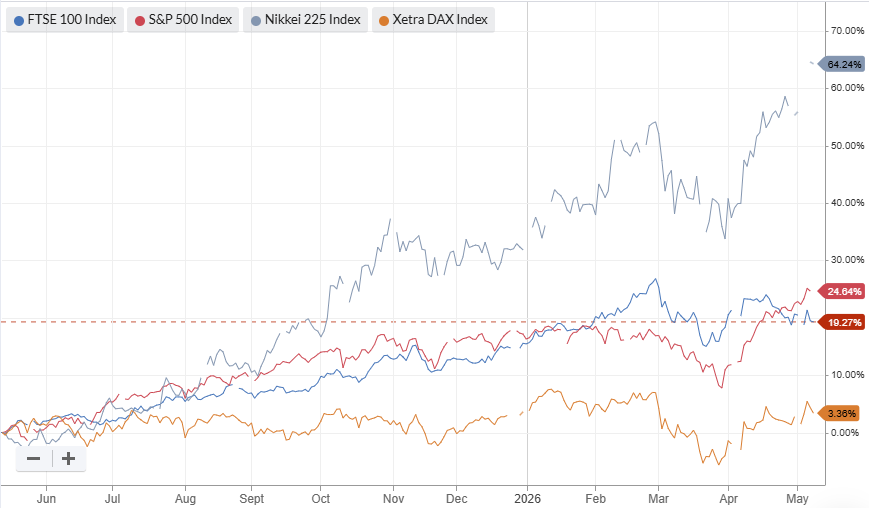
At the time of publishing, the US and Iranians both agreed that the ceasefire was holding despite an overnight exchange of fire. Negotiations are said to be ongoing around a potential settlement.
Commodity prices have fallen this week as fears of a supply crunch have eased (slightly), with Brent Crude dropping below $100 a barrel:
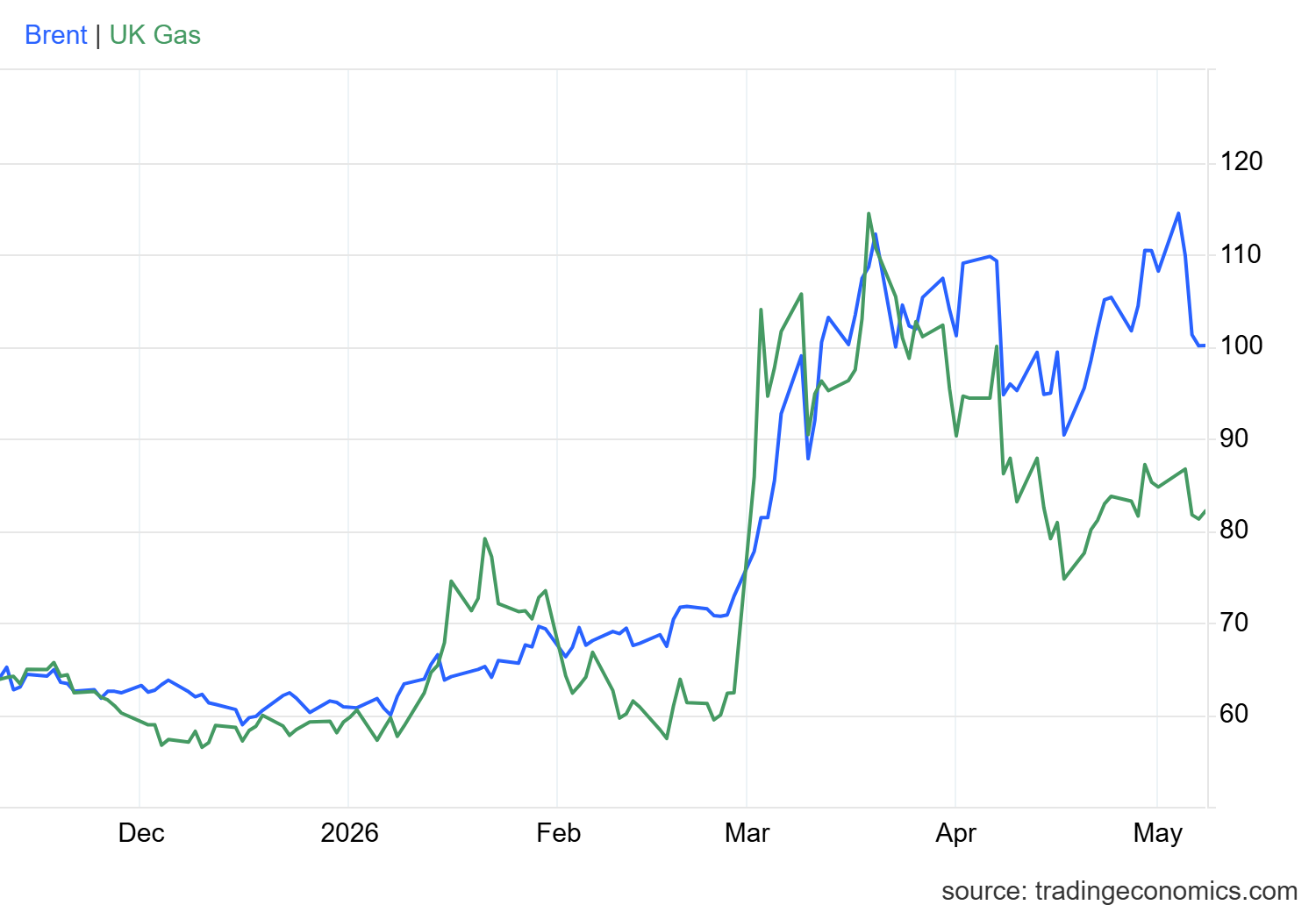
Press commentary has suggested that President Trump is feeling newfound urgency to bring an end to the conflict, which has lifted average petrol prices above $4.50 a gallon in the US. That’s likely to be unpopular with voters as the country heads into the summer driving season and could harm the Republicans in this year’s mid-term elections.
More broadly, projections suggest that commodity shortages could start to have more serious effects on the global economy if the Strait of Hormuz remains closed into June.
Global oil reserves fell at a record rate of 6.6m barrels a day in April, or around 200m barrels in total. This has happened despite a fall in energy usage; global oil consumption is now said to be around 5m barrels a day below pre-war levels.
The implied supply shortfall is 11-12m barrels a day – equivalent to more than 10% of pre-war global daily oil consumption. Such a large reduction in supply cannot be absorbed for too long without consequences.
If the disruption continues, shortfalls could become harder to manage and have a deeper impact than seen so far.
UK borrowing costs surge
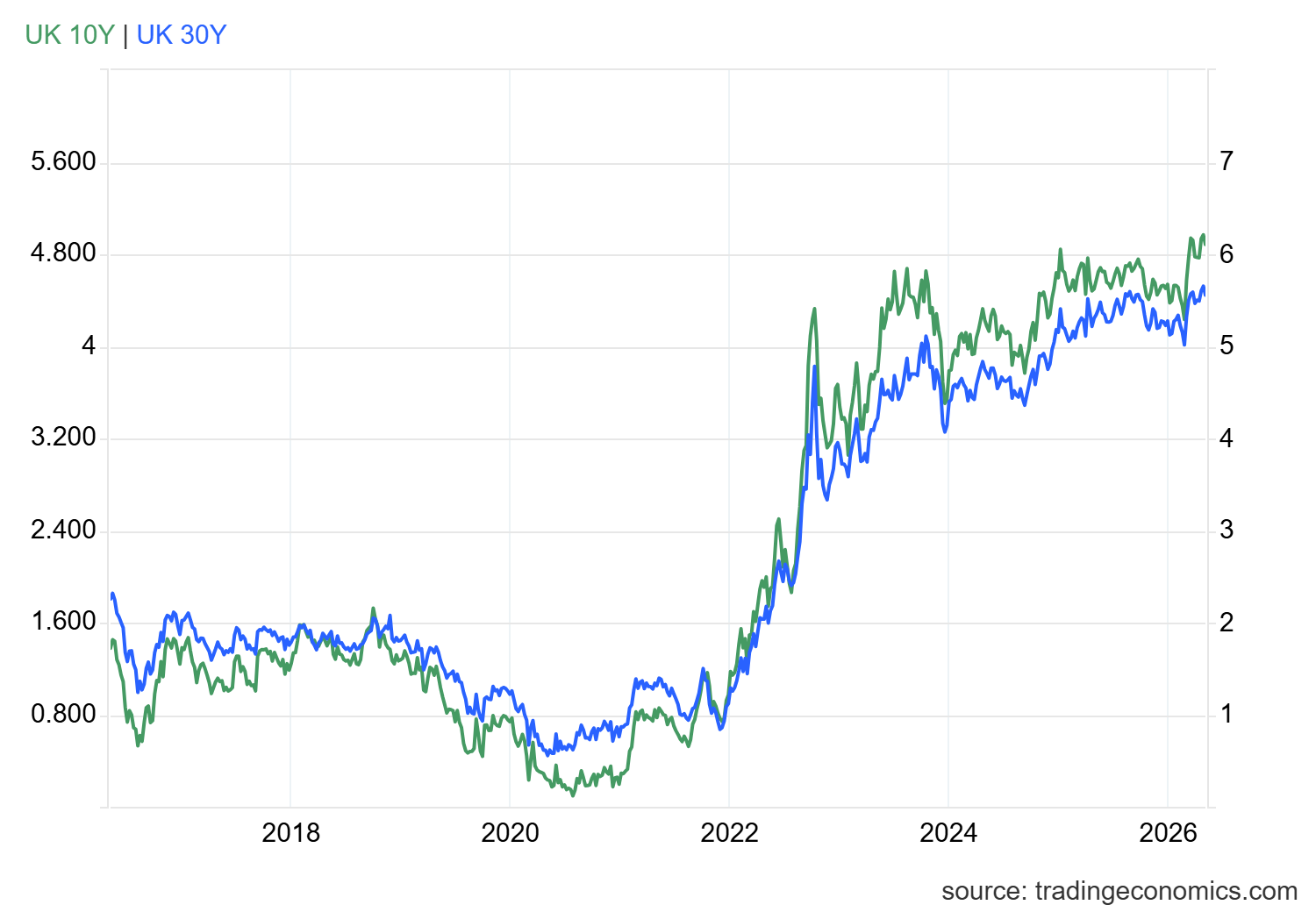
Closer to home, the Middle East conflict has combined with economic and political uncertainty to push up borrowing costs for the UK government.
The yield on UK 30-year gilts topped 5.7% at one point this week, while the yield on 10-year Gilts is approaching 5%:
A local election washout for Labour could also add to domestic volatility if the results heighten speculation about the future of Prime Minister Keir Starmer. At the time of writing it’s clear Labour has suffered significant losses, but too soon to know whether there will be any further impact on Starmer’s job security.
Economic news
Economic data for the week ahead is fairly routine but the geopolitical context means some data points may receive more attention than usual.
US inflation and unemployment data are both due next week and likely to be of interest given the pressure on consumer spending from higher energy costs.
In the UK, retail sales data may also be of interest, as will manufacturing data and the latest RICS House Price data.
Finally, data on US oil and gasoline stockpiles may provide some insight into the situation in the country that’s best equipped to withstand export shortages from the Gulf. Recent reports have suggested US producers are maximising their profits by increasing exports rather than using their home advantage to cap domestic fuel prices.
Company News
At home, results from big caps Vodafone, National Grid and Burberry are likely to be closely watched, while among smaller firms, Bytes Technology, Renew Holdings, motor dealer Vertu and publisher Future are likely to catch our attention in the daily report.
Enjoy the weekend!
Here’s a summary of what’s expected next week.
Economic Calendar
Date / Time (BST) | Country | Event |
11 May | ||
15:00 | US | Existing Home Sales |
12 May | ||
00:01 | UK | BRC Retail Sales Monitor |
10:00 | Germany / EU | ZEW Economic Sentiment Index |
13:15 | US | ADP Employment Change Weekly |
13:30 | US | Inflation |
17:00 | US | EIA Short-Term Energy Outlook |
19:00 | US | Monthly Budget Statement |
21:30 | US | API Crude Oil Stock Change |
13 May | ||
10:00 | EU | Employment Change |
10:00 | EU | Industrial Production |
10:00 | US | IEA Monthly Report |
11:00 | US | OPEC Monthly Report |
13:30 | US | Producer Price Index (PPI) |
15:30 | US | EIA Crude Oil Stocks Change |
15:30 | US | EIA Gasoline Stocks Change |
14 May | ||
00:01 | UK | RICS House Price Balance |
07:00 | UK | GDP |
07:00 | UK | Manufacturing Production |
13:30 | US | Initial Jobless Claims |
13:30 | US | Retail Sales |
15 May | ||
14:15 | US | Industrial Production |
18:00 | US | Baker Hughes Oil Rig Count |
Companies Reporting
Date | UK Trading Updates and AGMS | UK Financial Results | International Financial Results |
Monday 11 May | International Paper Co (LON:IPC) | Caledonia Mining (LON:CMCL) Compass (LON:CPG) Victrex (LON:VCT) | Constellation Energy (NSQ:CEG) Focus Xplore (LON:FOX) Petroleo Brasileiro SA Petrobras (NYQ:PBR) Simon Property (NYQ:SPG) |
Tuesday 12 May | Bridgepoint (LON:BPT) Chesnara (LON:CSN) Greggs (LON:GRG) IMI (LON:IMI) International Workplace (LON:IWG) Macfarlane (LON:MACF) Midwich (LON:MIDW) Public Policy Holding (LON:PPHC) | 3i Infrastructure (LON:3IN) Angling Direct (LON:ANG) Bytes Technology (LON:BYIT) Renew Holdings (LON:RNWH) Vodafone (LON:VOD) | Bayer AG (ETR:BAYN) Mitsubishi (TYO:8058) Muenchener Rueckversicherungs-Gesellschaft in Muenchen AG (ETR:MUV2) Siemens Energy AG (ETR:ENR) ThyssenKrupp AG (ETR:TKA) |
Wednesday 13 May | Amaroq (LON:AMRQ) Conduit Holdings (LON:CRE) hVIVO (LON:HVO) Ithaca Energy (LON:ITH) James Fisher And Sons (LON:FSJ) LMS Capital (LON:LMS) Marshalls (LON:MSLH) Savills (LON:SVS) Spirax (LON:SPX) TP Icap (LON:TCAP) Unilever (LON:ULVR) Vistry (LON:VTY) | Avon Technologies (LON:AVON) Vertu Motors (LON:VTU) | Alibaba Holding (NYQ:BABA) Allianz SE (ETR:ALV) Deutsche Telekom AG (ETR:DTE) Fortescue (ASX:FMG) Merck & Co (NYQ:MRK) RWE AG (FRA:RWE) Siemens AG (FRA:SIE) Sony (TYO:6758) Tencent Holdings (HKG:700) |
Thursday 14 May | Ceres Power Holdings (LON:CWR) Costain (LON:COST) Eurocell (LON:ECEL) Helios Towers (LON:HTWS) Inchcape (LON:INCH) ITV (LON:ITV) Lloyds Banking (LON:LLOY) Pensionbee (LON:PBEE) Quilter (LON:QLT) Secure Trust Bank (LON:STB) Shaftesbury Capital (LON:SHC) Spire Healthcare (LON:SPI) Standard Life (LON:SDLF) | Auction Technology (LON:ATG) Burberry (LON:BRBY) Future (LON:FUTR) Grainger (LON:GRI) 3i (LON:III) Land Securities (LON:LAND) Nexus Infrastructure (LON:NEXS) National Grid (LON:NG.) Microlise (LON:SAAS) | Applied Materials (NSQ:AMAT) Honda Motor Co (TYO:7267) ITC (NSI:ITC) Ross Stores (NSQ:ROST) |
Friday 15 May | Derwent London (LON:DLN) Grafton (LON:GFTU) LSL Property Services (LON:LSL) TT electronics (LON:TTG) Unite (LON:UTG) | Volvere (LON:VLE) | Mitsubishi UFJ Financial (NYQ:MUFG) Mizuho Financial (TYO:8411) |
Disclaimer
This is not financial advice. Our content is intended to be used and must be used for information and education purposes only. Please read our disclaimer and terms and conditions to understand our obligations.

2 comments
Looking forward to Secure Trust Bank (LON:STB) trading update. Fingers crossed! :)
Just a small correction"US will agree a peace deal with Israel" with Iran.