The Week Ahead (20-24 Apr): deal or no deal?

Welcome back to The Week Ahead. Headlines are currently dominated by the prospects of a more lasting peace agreement between the US and Iran. Talks are said to be underway ahead of the expiry of the current two-week ceasefire on 22 April.
Thursday night also saw Israel agree a 10-day ceasefire in Lebanon, which it’s hoped may be extended to tie into a wider US-Iran deal.
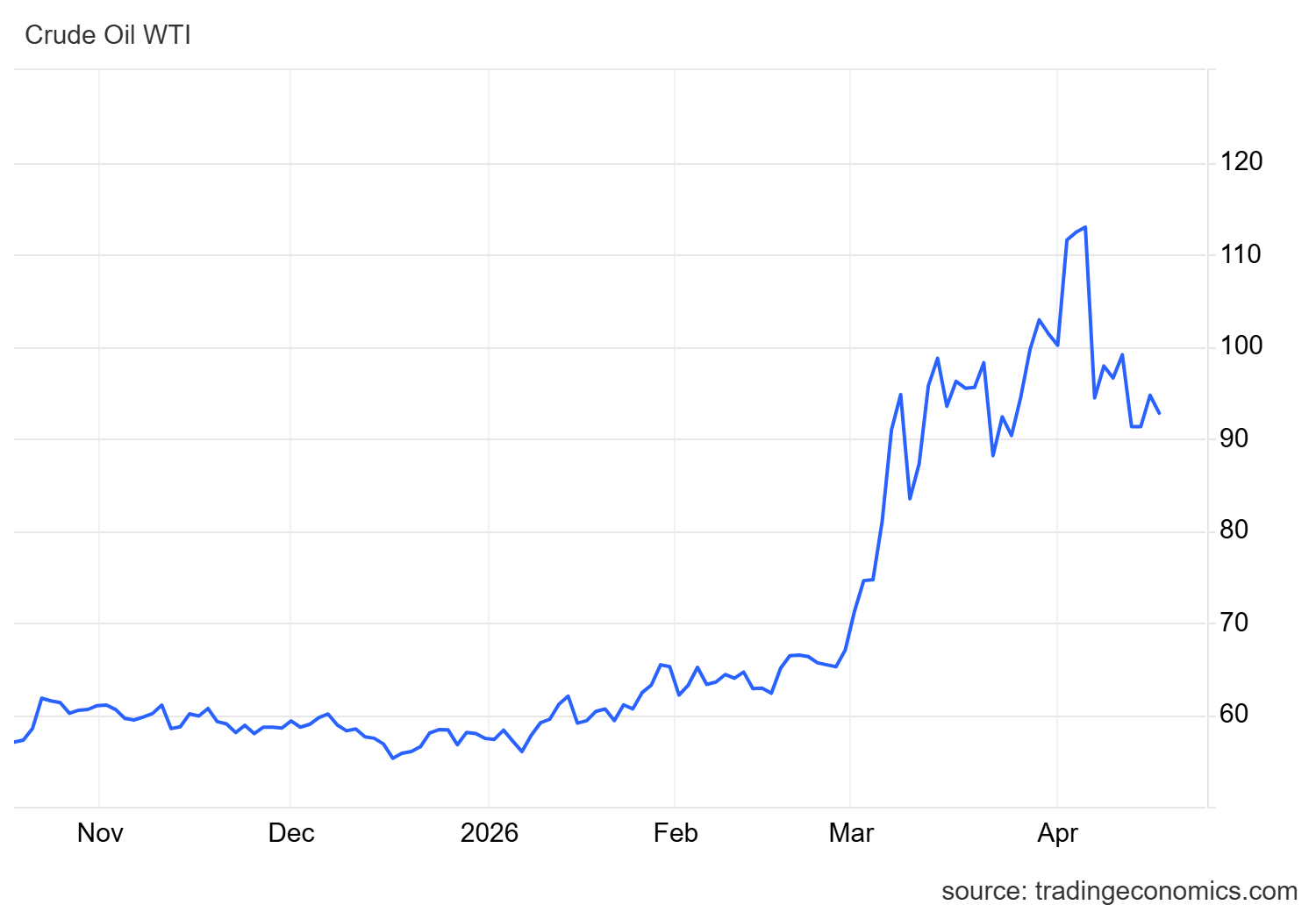
At this time there seems no way to be sure how likely a sustainable peace deal might be. Markets are taking what I’d describe as a relatively optimistic view. Oil prices have dropped back below $100 over the last week…
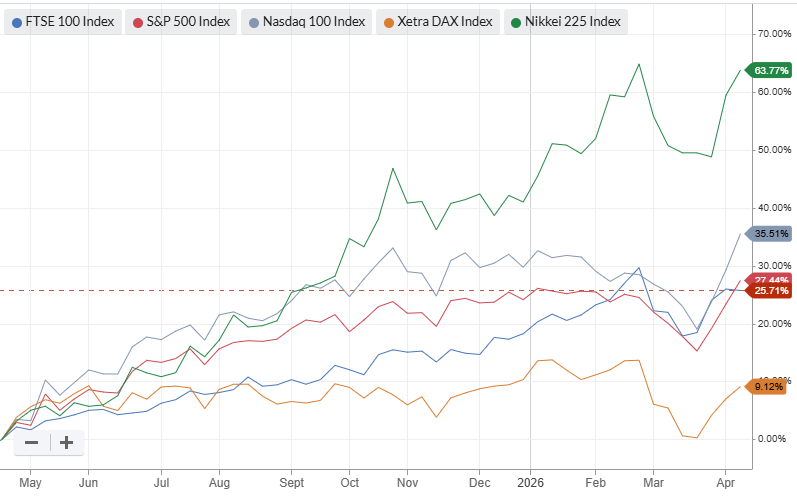
… while market indices have edged higher, with the S&P 500 making new record highs:
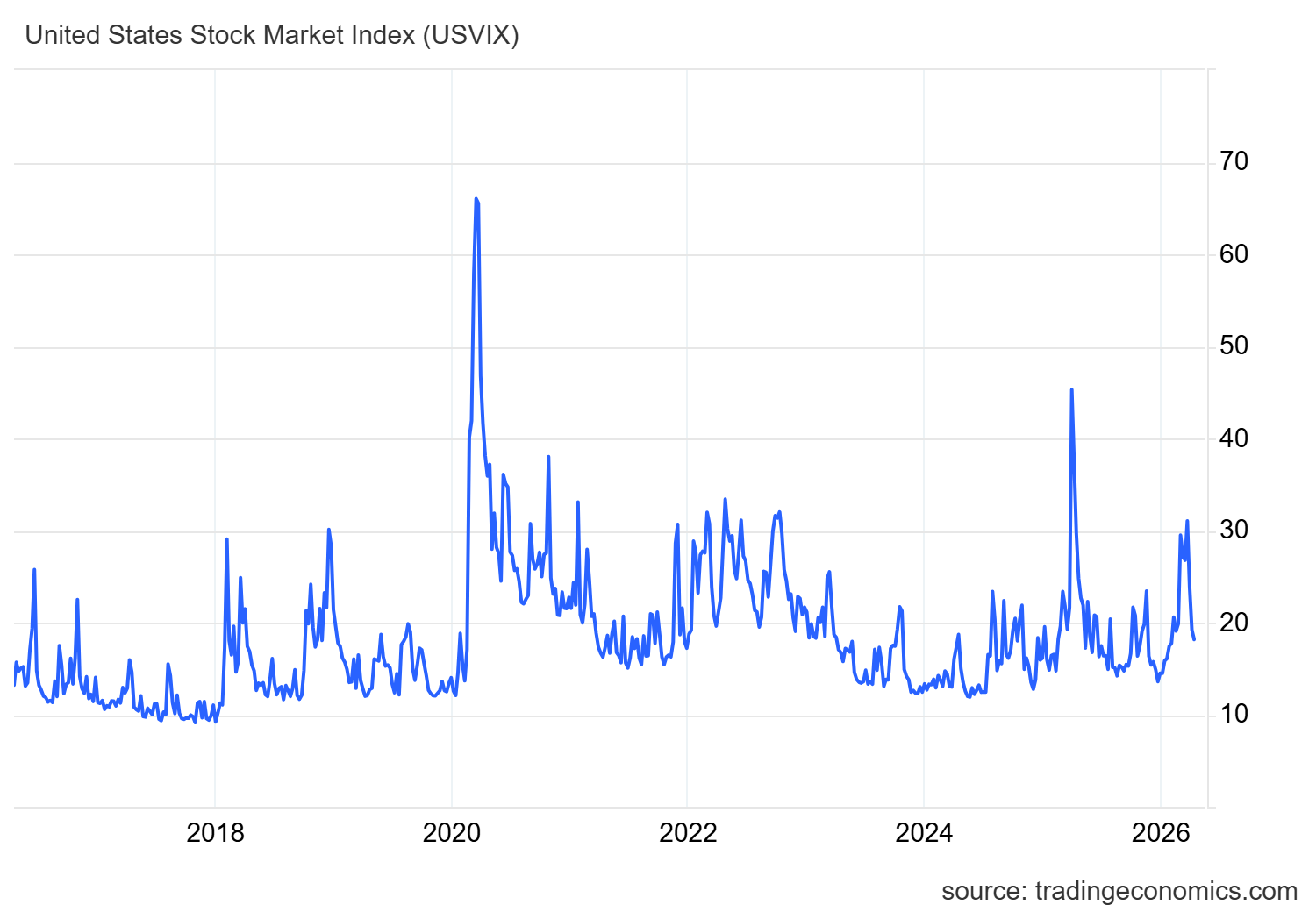
The US VIX volatility index has also continued to decline and now looks remarkably subdued to my eyes. Current levels are hardly any higher than the 10-year average:
Crunch time approaching?
While I am obviously hoping for a deal, I do think there’s a case to be made to suggest that markets are not yet pricing in the risks that could stem from further disruption to global energy supplies.
It’s worth noting that even if Hormuz was reopened fully tomorrow (it won’t be), refilling the global floating pipeline of tankers and resuming normal levels of deliveries would take weeks or even months. In addition, some refinery and terminal capacity in the Gulf has been damaged by bombing and will take much longer to restore.
Current restrictions on oil exports from the Gulf are currently thought to have cut global oil supply by 10%-15%. Unlike during the pandemic period, there has not yet been any corresponding reduction in demand.
While strategic stockpiles and existing inventories have cushioned the impact so far, the final tankers that loaded and sailed before the start of the war are expected to have unloaded by the end of April.
This situation could potentially see fuel shortages to start biting in Asia and Europe in May. That could see non-essential travel and industrial activity curtailed, leading to an economic slowdown.
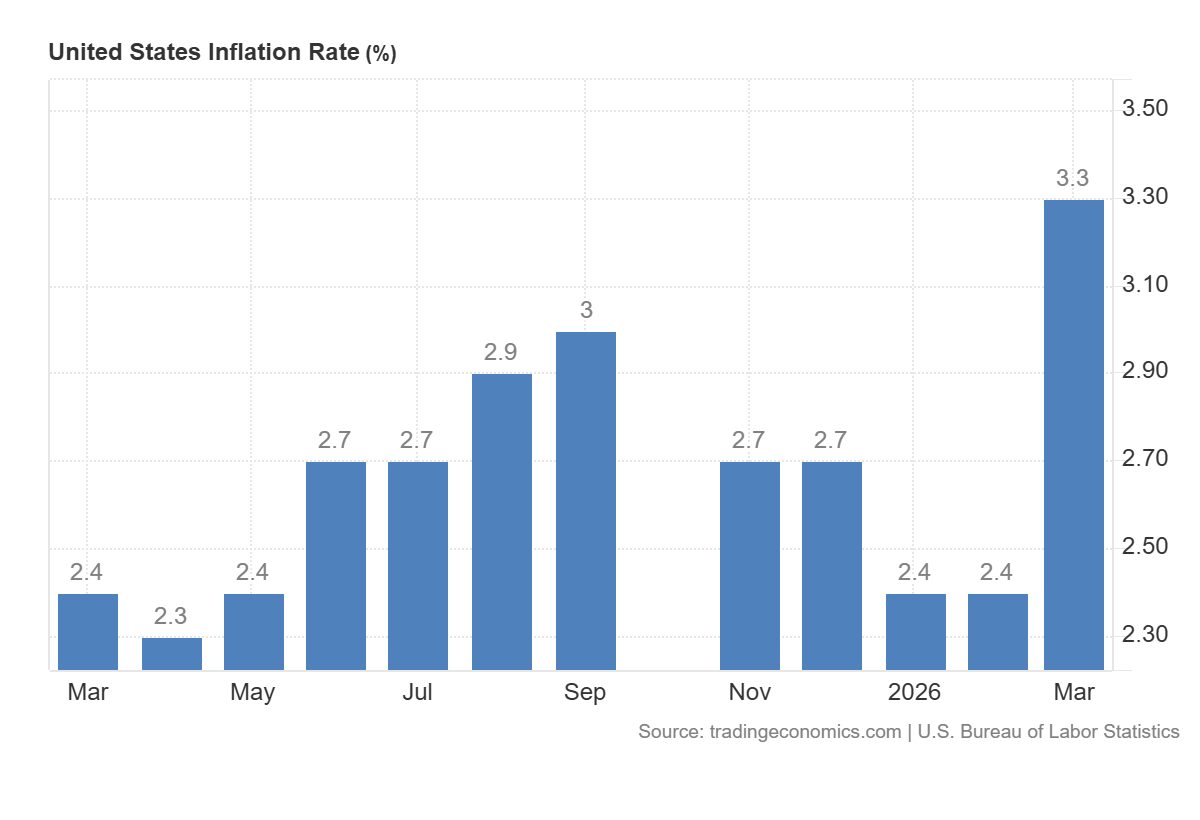
High domestic production would probably mean that the US escaped any physical shortages until mid-summer, according to analysts. However, US consumers and businesses are already facing the impact of higher energy prices. Average US petrol prices rose by nearly 20% in March, while diesel prices climbed more than 40%. This prompted a spike in inflation:
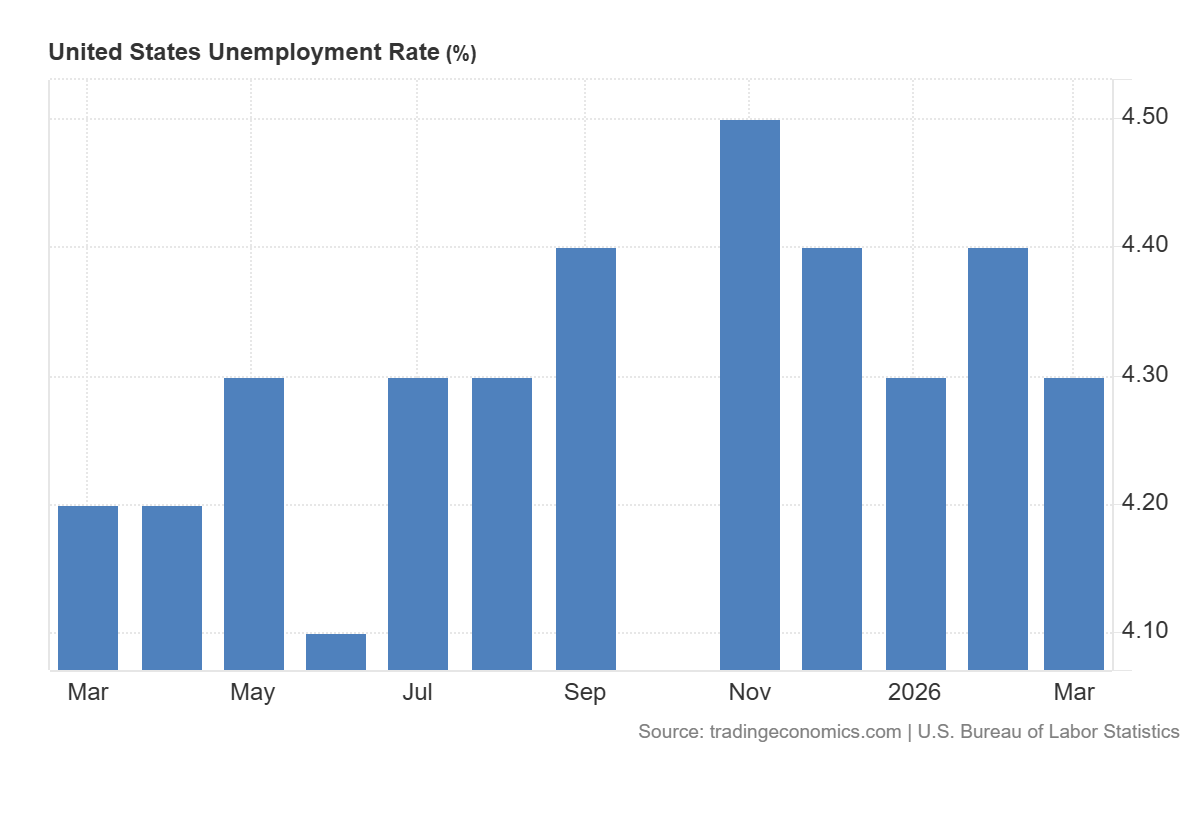
So far, rising energy costs haven’t yet resulted in any increase in US unemployment; the official unemployment rate fell slightly in March:
Here in the UK, inflation and unemployment data are both due next week, with forecasts suggesting similar trends of rising inflation but stable unemployment.
Food crisis risk
Energy shortages aren’t the only concern. Estimates I’ve seen suggest 20%-30% of global fertiliser supplies are dependent on exports through the Strait of Hormuz. The United Nations is concerned that if these supplies are curtailed for too much longer, a global food crisis could emerge later this year.
Fertiliser shortages during the spring planting season could result in markedly lower grain yields later this year. That could trigger rounds of food price inflation – PepsiCo CFO Steven Schmitt warned that “our assumption is that inflation will come” in an earnings call this week.
As always, emerging markets would be hit hardest and soonest. In a worst-case scenario, the impact of a widespread shortfall in food production could be very severe indeed, with global repercussions and the risk of further conflict and unrest.
Another TACO trade?
The US would probably be the last major developed market to be affected by energy shortages. I suspect the same would also be true in the event of global food shortages, given the country's large agricultural base and capacity for domestic fertiliser production.
This leads me to wonder if US-centric markets are once again relying on the TACO trade (Trump Always Chickens Out) to ensure that nothing really bad affects the global economy.
I think it’s up to individual investors to gauge whether this is a fair assessment of the risks involved.
But do I think it’s worth considering whether a wave of second-order effects could hit markets over the summer if President Trump’s breezy assurances about Iran’s desire for peace take longer than expected to translate into a durable settlement.
Company news
We’re between earnings seasons here in the UK and the flow of company news next week is expected to be relatively limited. Among the results likely to attract private investor interest are results from S&U, Pinewood Technologies, J Sainsbury and WH Smith.
US earnings may be of more interest to some, with first-quarter results due from heavyweights including Amazon and Tesla.
Here’s a summary of what’s expected next week.
Economic Calendar
Date / Time (BST) | Country | Event |
20 April | ||
00:01 | UK | Rightmove House Price Index |
07:00 | Germany | Purchasing Price Index |
21 April | ||
07:00 | UK | Unemployment Rate |
10:00 | EU | Economic Sentiment Index |
13:15 | US | ADP Employment Change weekly |
13:30 | US | Retail Sales |
15:00 | US | Pending Home Sales |
21:30 | US | API Crude Oil Stock Change |
22 April | ||
07:00 | UK | CPI Inflation |
12:00 | US | MBA 30-Year Mortgage Rate |
15:30 | US | EIA Crude Oil & Gasoline Stocks |
23 April | ||
05:00 | UK/EU | New Car Registrations |
09:00 | EU | S&P Global Services & Manufacturing PMIs |
09:30 | UK | S&P Global Services & Manufacturing PMIs |
13:30 | US | Initial Jobless Claims |
14:45 | US | S&P Global Services & Manufacturing PMIs |
15:30 | US | Natural Gas Storage |
24 April | ||
00:01 | UK | GfK Consumer Confidence |
07:00 | UK | Retail Sales |
18:00 | US | Baker Hughes Oil Rig Count |
Companies Reporting
Date | UK Trading Updates and AGMS | UK Financial Results | International Financial Results |
Monday 20 Apr | Nanoco (LON:NANO) M&C Saatchi (LON:SAA) | Alaska Air (NYQ:ALK) Steel Dynamics (NSQ:STLD) | |
Tuesday 21 Apr | Integrafin Holdings (LON:IHP) Nichols (LON:NICL) XPS Pensions (LON:XPS) | Associated British Foods (LON:ABF) Billington Holdings (LON:BILN) Ebiquity (LON:EBQ) Facilities by ADF (LON:ADF) MPAC (LON:MPAC) S&U (LON:SUS) | 3M Co (NYQ:MMM) Capital One Financial (NYQ:COF) Chubb (NYQ:CB) Danaher (NYQ:DHR) D.R. Horton (NYQ:DHI) General Electric Co (NYQ:GE) Halliburton Co (NYQ:HAL) Intuitive Surgical (NSQ:ISRG) Northrop Grumman (NYQ:NOC) Rtx (NYQ:RTX) Thales SA (EPA:HO) United Airlines Holdings (NSQ:UAL) Unitedhealth (NYQ:UNH) |
Wednesday 22 Apr | Beazley (LON:BEZ) BHP (LON:BHP) Bunzl (LON:BNZL) Croda International (LON:CRDA) Pensionbee (LON:PBEE) Serco (LON:SRP) | Fevara (LON:FVA) Pinewood Technologies (LON:PINE) Ten Lifestyle (LON:TENG) | Abb (SWX:ABBN) AT&T (NYQ:T) Boeing Co (NYQ:BA) CSX (NSQ:CSX) Brookfield (NYQ:BN) GE Vernova (NYQ:GEV) International Business Machines (NYQ:IBM) Kinder Morgan (NYQ:KMI) Las Vegas Sands (NYQ:LVS) Moodys (NYQ:MCO) Loreal SA (EPA:OR) Philip Morris International (NYQ:PM) Tesla (NSQ:TSLA) Texas Instruments (NSQ:TXN) United Rentals (NYQ:URI) |
Thursday 23 Apr | AJ Bell (LON:AJB) BP (LON:BP.). Dominos Pizza (LON:DOM) Hikma Pharmaceuticals (LON:HIK) London Stock Exchange (LON:LSEG) Relx (LON:REL) SEGRO (LON:SGRO) | Asos (LON:ASC) J Sainsbury (LON:SBRY) WH Smith (LON:SMWH) | Amazon.com (NSQ:AMZN) American Express Co (NYQ:AXP) Baker Hughes Co (NSQ:BKR) Caterpillar (NYQ:CAT) Comcast (NSQ:CMCSA) Freeport-McMoRan (NYQ:FCX) Thales SA (EPA:HO) Intel (NSQ:INTC) Keurig Dr Pepper (NSQ:KDP) Lockheed Martin (NYQ:LMT) Newmont (NYQ:NEM) PG&E (NYQ:PCG) Reliance Industries (NSI:RELIANCE) Safran SA (EPA:SAF) Sanofi SA (EPA:SAN) SAP SE (NYQ:SAP) Thermo Fisher Scientific (NYQ:TMO) Union Pacific (NYQ:UNP) |
Friday 24 Apr | Law Debenture (LON:LWDB) Mondi (LON:MNDI) | Empresaria (LON:EMR) | Eni SpA (BIT:ENI) HCA Healthcare (NYQ:HCA) Norfolk Southern (NYQ:NSC) Procter & Gamble Co (NYQ:PG) Slb NV (NYQ:SLB) |
Disclosure: Roland owned shares in S&U at the time of publication.
Disclaimer
This is not financial advice. Our content is intended to be used and must be used for information and education purposes only. Please read our disclaimer and terms and conditions to understand our obligations.
10 comments
I run a Week Ahead Reporting Scan each Friday on my site , can be a black art getting the names in the frame: 54 on the cards next week
I use a bit of technology in my analytics to baseline before earnings with a funda/tech analytics and quick one pagers with summaries from the last TU/earnings report
more at runprofits.com : I post stuff on X too here
By Sector (coloured bullish to bearish)
By Alignment of Funda to Technicals
Individual Peer Analysis (Price Mom 1M/3M)
Individual Funda/Tech Baselining
Paypoint is down to make a trading statement on Wednesday. Happy to the share the analysis and recommendations from ChartMasters
For LSE:PAY (PayPoint plc), the analysis as of April 18, 2026, reveals a stock in a high-conviction Stage 1 Bottoming Reversal attempting to transition into a Stage 2 uptrend. While it currently fails the strict Mark Minervini "Trend Template" (as the price remains below the 200-day SMA), the institutional "buyback footprint" and a significant fundamental restructuring provide the "wind at the back" required for a potential multi-month re-rating.
Technical Analysis: The 1-Day Chart (Last 10 Trading Days)
PayPoint has been one of the strongest performers in the mid-cap tech sector over the last fortnight. The price action is characterized by "v-shaped" recovery dynamics following the March restructuring announcement.
10-Day Price & Volume Data
Date (2026)
Price (GBX)
% Change
Volume Signal
Apr 06
575.00
+0.22%
Quiet absorption
Apr 07
583.04
+1.40%
Buyback support (Investec)
Apr 08
596.30
+2.27%
Pocket Pivot (Above 20-day EMA)
Apr 09
597.70
+0.23%
Consolidation
Apr 10
595.87
-0.31%
Low-volume pullback
Apr 13
602.50
+1.11%
Reclaiming 600p psychological level
Apr 14
615.50
+2.16%
Institutional "Nibbling"
Apr 15
611.00
-0.73%
Natural reaction
Apr 16
635.00
+3.93%
Breakout (High Relative Volume)
Apr 17
646.00
+1.73%
Strong Follow-through (640p Pivot)
The 10 Best Indicators & Signals
Weiss Wave Strength: Strong (8.2/10)
The Weiss Wave shows a dominant "Buying Tide" over the last 10 days. The cumulative volume on "Up Waves" is roughly 2.8x the volume of "Down Waves." This suggests that the £23.8m buyback program and institutional "value seekers" are successfully absorbing the retail supply.
Fundamental Review
Conclusion: Buy/Sell Recommendation
Verdict: SPECULATIVE BUY (Stage 1 Reversal)
From a strict Minervini perspective, PAY is not yet a "Stage 2 Winner" because it is below the 200-day SMA. However, for a Turnaround Specialist, the chart is building a beautiful "Rounding Bottom" or Stage 1 Base.
Recommendation: ACCUMULATE. PayPoint is exhibiting the "Institutional Footprint" required for a major multi-month trend. The yield provides protection, while the restructuring provides the growth kicker.
The free weekly PensionCraft email is calling it the most hated rally in history!
SSB comment: can't trust either side involved in this conflict. It's just as well for the UK that this is April (ie: we are heading into Summer) and not October. The response of this UK government is as pathetic as ever, focusing on foreign affairs they have no control over when ministers should be at home working on improving UK productivity and making the UK more self sufficient. Instead, they push through legislation to effectively take control of 10% of private pensions; what could possibly go wrong ?!
On the plus side, looking forward to the manager comments from Law Debenture (LON:LWDB) on Friday. Lots of experience and I always make a point of attending presentations by James Henderson and Laura Foll of Janus Henderson when at Mello or AIC conferences.
No deal
Add Elixirr International (LON:ELIX) Prelims Mon. 20th., Checkit (LON:CKT) Prelims Tues. 21st, Cerillion (LON:CER) preclo Wed. 22nd.
The Strait isn't fully open - ships have to use a route designated by Iran, & their Security Council has declared that US & Israeli associated ships would still not be allowed to cross the Strait.
Also, Iran announced the Stait would be closed again if the U.S. continues to try and block Iranian Ports.
Personally, I believe the U.S. has moved so many extra military assets into the region since the start of the ceasefire (over 75 transport flights no doubt fully laden with more missiles/bombs) that they fully intend to launch further unprovoked attacks sometime soon.
"It’s worth noting that even if Hormuz was reopened fully tomorrow (it won’t be), refilling the global floating pipeline of tankers and resuming normal levels of deliveries would take weeks or even months. In addition, some refinery and terminal capacity in the Gulf has been damaged by bombing and will take much longer to restore."
Who'd be a commentator eh Roland ! I just opened your article and was still listening to Bloomberg Radio and heard that the Iranian Foreign Minister had declared the Straits of Hormuz fully open to commercial traffic ;-)) At least it wasnt Trump saying it !
Keep up the good work Roland.
Agreed Helvellyn its come to something when you trust the Iranians more than the President of the United States.
And the headline on BBC news - Iran closes the Straits of Hormuz again.
Yes because the US are still blockading Iranian ports.