The Week Ahead (8 – 12 Jun): Euro rates, UK GDP & HPI, Paypoint, Wizz Air, Adobe

This week has been characterised by a slight risk-off bias in equities, driven primarily by renewed Middle East tensions and the associated oil price volatility feeding into inflation concerns. Overall, none of the moves in the indices or major commodities is anything to write home about.
As Graham has regularly noted in the DSMR, much of the commentary has focused on the upcoming wave of Mega-IPOs, such as SpaceX, and whether this is a sign of further US market advantage or late-stage bubble behaviour.
Here's what we can look forward to next week:
Economic Calendar
Monday 8 June |
||
05:00 |
Japan |
GDP |
Tuesday 9 June |
||
04:00 |
China |
Balance of Trade |
13:30 |
United States |
Balance of Trade Existing Home Sales |
21:30 |
United States |
API Crude Inventories |
Wednesday 10 June |
||
02:30 |
China |
Inflation Rate |
13:30 |
United States |
Inflation Rate |
15:30 |
United States |
EIA Gasoline Stocks EIA Crude Oil Stocks |
Thursday 11 June |
||
07:00 |
UK |
RICS House Price Balance |
13:15 |
Euro Area |
ECB Interest Rate Decision |
13:30 |
United States |
Initial Jobless Claims Producer Price Inflation |
Friday 12 June |
||
07:00 |
UK |
Balance of Trade Industrial Production |
ECB Interest Rate Decision
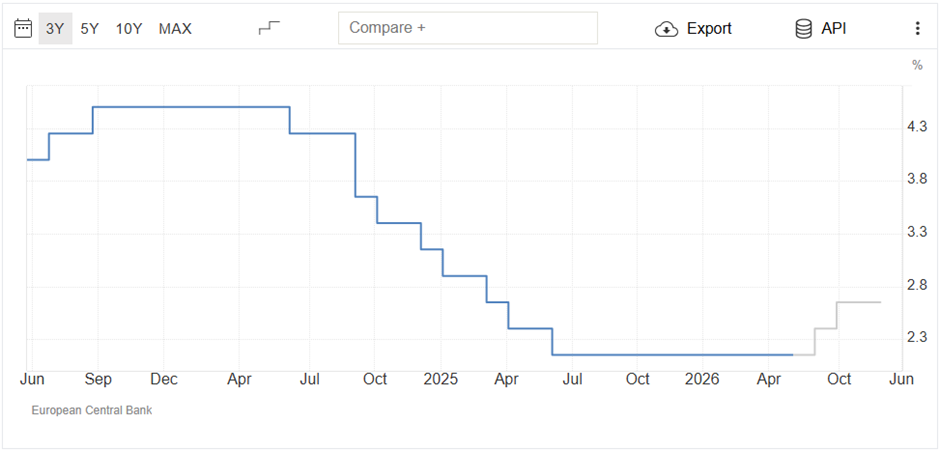
The next ECB decision is on Thursday, and markets are overwhelmingly expecting a 25bp rate increase, taking the deposit rate from 2.00% to 2.25%. The ECB held rates unchanged at its April meeting but explicitly highlighted rising inflation risks from higher energy prices and geopolitical disruptions. Eurozone inflation rising to 3.2% in May increased those concerns, with core inflation also moving higher, suggesting price pressures are spreading beyond energy.
[All charts in this section: Trading Economics]
With the rise considered in the bag, the key question for markets is not this decision but what Christine Lagarde says about July and September. Hawkish commentary would likely lead to higher bond yields and a stronger euro. Markets would begin pricing a terminal deposit rate nearer 2.50%-2.75%. Banks and insurers could gain on expectations of higher NIM and investment yields.
UK GDP
For UK equities, Friday's monthly GDP release for April is probably the most important UK macro event of next week, alongside any Bank of England commentary.
The market is looking for a modest contraction or a flat reading after the surprisingly strong March performance, which helped Q1 GDP grow by 0.6%. Economists generally expect the economy to have slowed sharply as higher energy prices, weaker consumer confidence and increased geopolitical uncertainty weighed on activity.
Recent surveys have pointed to soft industrial activity, and consumer spending appears mixed, meaning that the risks appear to be to the downside. Coming in above expectations would likely benefit domestic cyclicals, such as banks and housebuilders. Whereas a weak print could revive expectations of further interest rate cuts later in the year, leading to stronger demand for non-cyclical stocks.
UK House Prices
I continue to be fascinated by UK house prices as the disconnect between HP indices and housebuilder sentiment remains. On Thursday, we get to see the latest RICS House Price Balance Data. Since it is based on the views of estate agents and property surveyors across the UK, it tends to be the most forward-looking indicator.
So far, weak RICS data hasn't been reflected in house price index declines, and economists are expecting the highly negative number of April to improve to -15% in the May data released next week, followed by further improvements over the next few quarters:
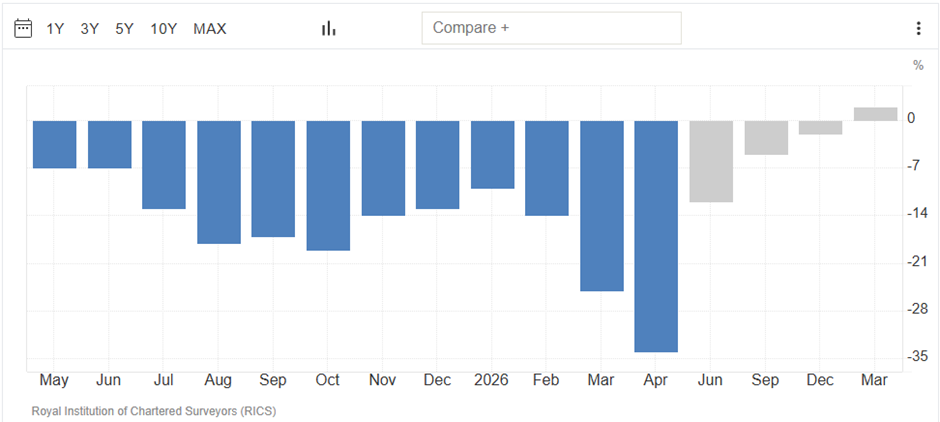
Again, it is the disconnects that are giving these datapoints extra focus amongst investors such as myself.
Companies Reporting
| Date | UK Trading Updates & AGMS | UK Financial Results | International Financial Results |
|---|---|---|---|
Monday 8 June |
Evoke (LON:EVOK) (AGM) |
Genincode (LON:GENI) (Finals) |
|
Tuesday 9 June |
Afarak SE (LON:AFRK) (AGM) Bellway (LON:BWY) (TS) Fevertree Drinks (LON:FEVR) (AGM) Georgia Capital (LON:CGEO) (AGM) Hochschild Mining (LON:HOC) (AGM) Invinity Energy Systems (LON:IES) (AGM) Jersey Oil and Gas (LON:JOG) (AGM) Poolbeg Pharma (LON:POLB) (AGM) |
LBG Media (LON:LBG) (Interims) Molten Ventures (LON:GROW) (Finals) Oxford Instruments (LON:OXIG) (Finals) Vianet (LON:VNET) (Finals) |
Caseys General Stores (NSQ:CASY) |
Wednesday 10 June |
Barclays (LON:BARC) (AGM) Concurrent Technologies (LON:CNC) (AGM) Frontier Developments (LON:FDEV) (Trading Statement) PWR Holdings (ASX:PWH) (AGM) Puretech Health (LON:PRTC) (AGM) R E A Holdings (LON:RE.). (AGM) Tullow Oil (LON:TLW) (AGM) Xeros Technology (LON:XSG) (AGM) Zinnwald Lithium (LON:ZNWD) (AGM) |
Diales (LON:DIAL) (Interims) Fuller Smith & Turner (LON:FSTA) (Finals) H-Power (LON:HPOW) (Interims) Motorpoint (LON:MOTR) (Finals) Pennon (LON:PNN) (Finals) VP (LON:VP.). (Finals) Workspace (LON:WKP) (Finals) |
Oracle (NYQ:ORCL) |
Thursday 11 June |
Jadestone Energy (LON:JSE) (AGM) M&C Saatchi (LON:SAA) (AGM) Oriole Resources (LON:ORR) (AGM) RTW Biotech Opportunities (LON:RTW) (AGM) t42 IoT Tracking Solutions (LON:TRAC) (AGM) Trufin (LON:TRU) (AGM) |
Halma (LON:HLMA) (Finals) NCC (LON:NCC) (Interims) Norcros (LON:NXR) (Finals) PayPoint (LON:PAY) (Finals) RWS Holdings (LON:RWS) (Interims) Safestore Holdings (LON:SAFE) (Interims) Wizz Air Holdings (LON:WIZZ) (Finals) |
|
Friday 12 June |
M P Evans (LON:MPE) (AGM) |
A very quiet week coming up for international results. UK newsflow continues to be dominated by AGMs, which often have accompanying trading statements.
As usual, let us know via the comments if you think we've missed anything of note.
PayPoint (LON:PAY)
The shares have been on a rollercoaster ride this year:
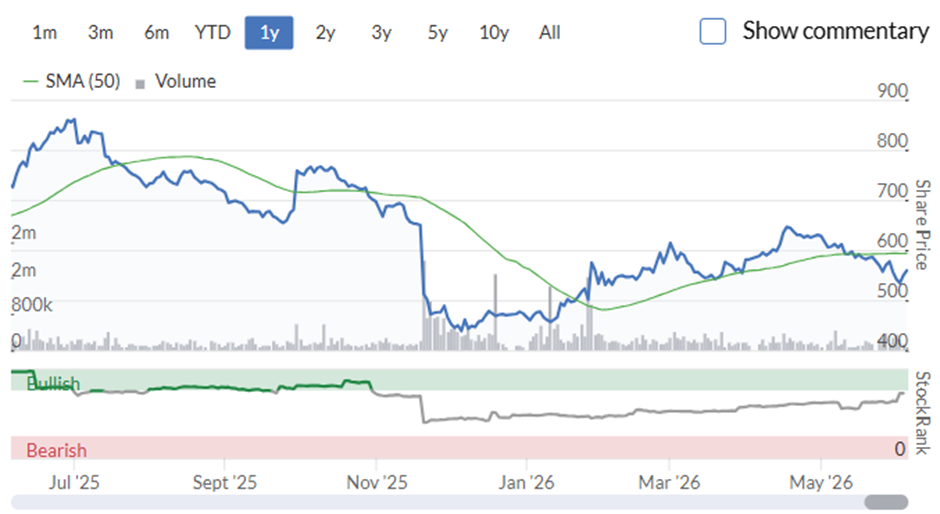
Their half-year results in November were particularly badly received, causing an unexpected downgrade to expectations:
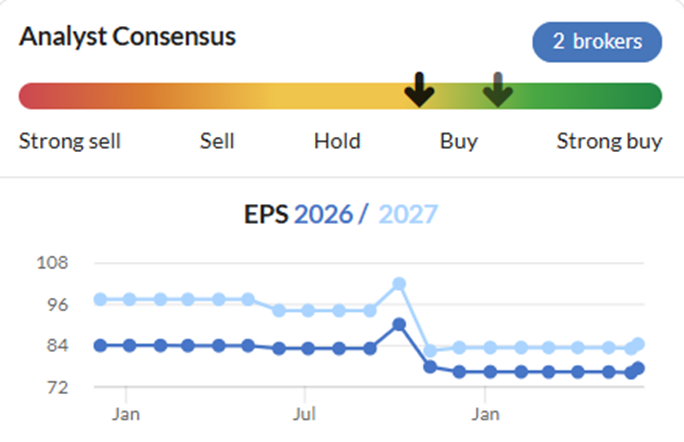
We are not expecting a big surprise this time, as in their March trading statement, management effectively pre-announced the year, stating that FY26 delivered a record financial performance and that results should be broadly in line with expectations. Therefore, the key things to look out for are:
- FY27 outlook and medium-term targets.
- Cost savings from the recently announced reorganisation.
- Parcel volumes and competitive pressures.
- Capital returns (buybacks and dividend growth).
- Progress in Digital Payments/Open Banking.
- Does management sound convincing that the new four-division structure can deliver sustainably higher earnings growth beyond FY27?
If management can deliver that expected growth, the shares are looking particularly good value:
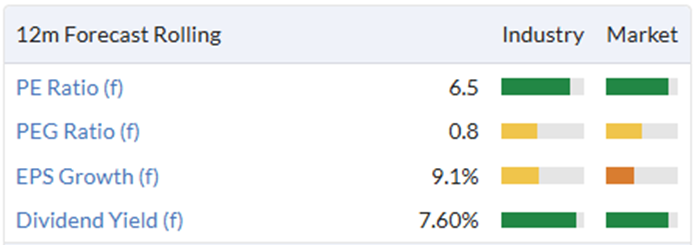
Especially as they intend to use their buyback to reduce the share count by a further 30% by the end of FY28, however, they have sometimes relied heavily on adjustments or financial engineering to hit the numbers, so I will be keen to check that the cash flow matches the headline figures.
Wizz Air Holdings (LON:WIZZ)
Wizz Air's results are likely to be closely watched by investors, as Ryanair CEO Michael O'Leary publicly claimed that Wizz Air and airBaltic could face bankruptcy by late 2026 due to soaring global jet fuel prices.
The company is not in immediate danger of going bust. While the airline faces heightened operational and financial pressures, it currently holds roughly €2 billion (£1.7 billion) in cash liquidity, providing a significant buffer against immediate collapse. Management has pushed back against claims of exposure to open-market oil price spikes, revealing that it has successfully hedged approximately 70% of its fuel needs at well below market rates. And while roughly 20% of its fleet was grounded for mandatory inspections on Pratt & Whitney GTF engines, the company maintains this is a manageable operational headache rather than a fatal cash crisis.
This hasn't stopped the short positions in the company from spiking in 2026. While they have reduced from their peak of over 16%, the current 10.5% of declared short positions over 0.5% means it remains one of the most bet against companies in the UK market:
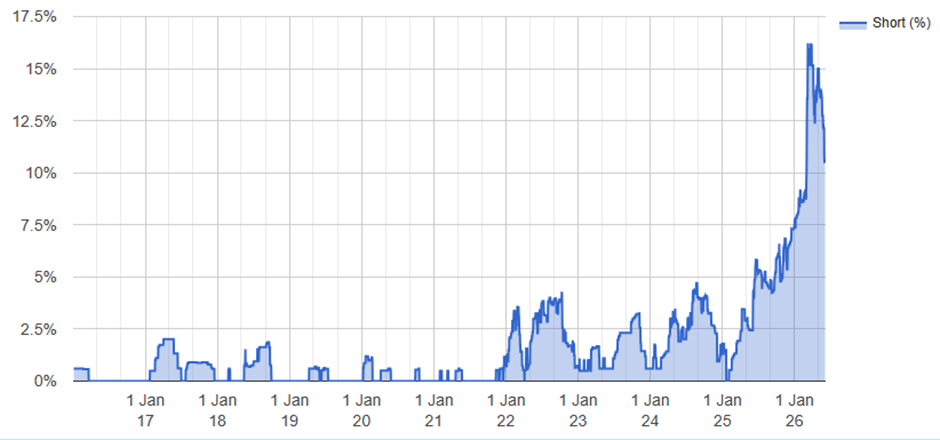
[source: shorttracker.co.uk]
As well as the balance sheet numbers, things to look out for next week are:
Middle East Profit Hit: The Middle East historically accounts for about 8% of Wizz Air's capacity, so watch how effectively they have redeployed these routes, and whether Summer booking resilience has helped soften the blow.
GTF Engine Grounding: The exact number of aircraft out of service and the timeline for their return. Details of any compensation from Pratt & Whitney or insurers.
Fuel Hedging for FY2027: The company may be largely protected for FY26, but what about future years? How does this impact forward guidance?
Adobe (NSQ:ADBE)
I continue to be fascinated by Adobe. This is a US software business that continues to be unloved by the market:
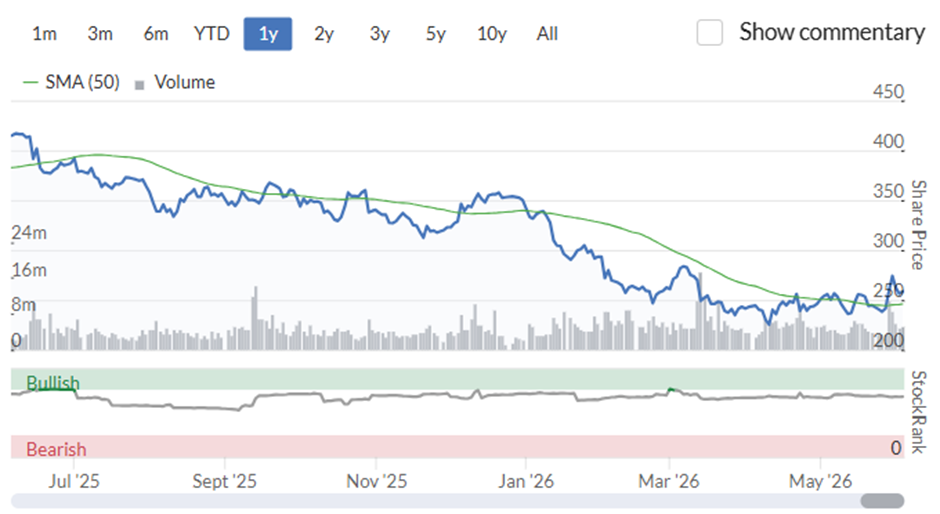
It has a P/E of 10, 30%+ operating margins, 50% returns on capital, and has grown consistently over recent years. The stock market is pricing in an "existential crisis" over generative AI disruption. Investors worry that text-to-image and text-to-video tools will make sophisticated legacy software like Photoshop and Premiere obsolete.
However, there is little sign of this in brokers' forecasts, which continue to show revenue and EPS rises. Recent results have met or exceeded expectations:
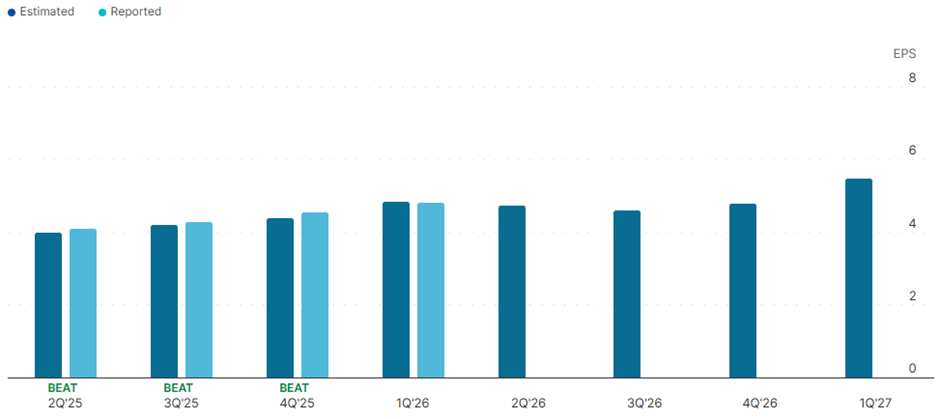
[Source: NASDAQ]
Beyond hitting the quarterly EPS, the key factors to look out for are:
- AI Monetisation: Is Firefly Generating Real Revenue? Management has been highlighting strong adoption of their AI tools, such as Firefly, Acrobat AI Assistant and GenStudio. Investors will be looking beyond user numbers to how much actual revenue AI is generating. Last quarter, Adobe stated that AI-related ARR was running ahead of its $250m FY25 target and that Firefly subscriptions had grown strongly. An upgrade here would be a bullish sign.
- Digital Media ARR Growth: Last quarter, this grew 12% year-on-year to around $18.1bn. Investors want to know whether Adobe is still adding customers and growing spending per customer. If ARR growth slows materially, the market is likely to conclude that AI competition is becoming a genuine threat.
Disclaimer
This is not financial advice. Our content is intended to be used and must be used for information and education purposes only. Please read our disclaimer and terms and conditions to understand our obligations.
17 comments
I was surprised by Berkshire Hathaway (NYQ:BRK.A) getting involved in the Alphabet (NSQ:GOOG) fund raising. The following is from the weekly Pensioncraft email....
Type a question into Google and, for the last twenty years, it found you an answer. This week, Google typed a question into Wall Street: "got a spare $80bn?" And Wall Street, never one to leave money on the table when it could leave it on Google's, came back with $84.75bn instead. The equity raise was so heavily oversubscribed that Alphabet upsized it on the spot.
Alphabet hasn't sold a share to the public in two decades. This is the company that more or less defined the buyback era, returning cash to shareholders by the truckload. Now the truck has been put into reverse. The $70bn-odd of free cash flow Google has been printing each year is expected to all but evaporate, poured instead into concrete, silicon and android dreams.
Dreams, it turns out, are capital-intensive. Alphabet now plans to spend more than $180bn on capital projects this year, double the $91bn it managed in 2025, which was itself far above 2024's $52.5bn. In the first quarter alone it shovelled $35.7bn into the ground, more than double a year earlier. The finance chief has promised 2027 will be larger still.
So why has Google decided to sell shares now? The company is hardly skint, and it has happily borrowed on the bond market before. Its long-term debt leapt from $46bn to $77bn in a single quarter. Turning to equity, rather than more debt, keeps the balance sheet looking pristine and locks in money before interest rates have any further opinions.
That is the charitable reading. The less charitable one, offered by analysts at UBS and Rosenblatt, is that tapping equity markets hints at capex even bigger than the market fears, and free cash flow burning faster than anyone has dared model. When a company sitting on this much cash starts raising more, it's worth wondering what it knows that you don't.
Stranger still is who put up the money. Anchoring the deal with $10bn is Berkshire Hathaway, the conglomerate built by Warren Buffett on a near-religious aversion to overpaying for growth. Whether Buffett himself is on board with the most expensive infrastructure bet in human history is uncertain. The Oracle of Omaha stepped down as Berkshire CEO in January, but remains Chairman. He recently warned markets are starting to resemble “gambling.”
“We've never had people in a more gambling mood than now. But that doesn't mean that investing is terrible. It does mean that prices for an awful lot of things will look very silly.” — Warren Buffett
Let’s start with the bull case. Google Cloud grew revenue 63% last quarter, its backlog of signed-but-undelivered work nearly doubled to over $460bn, and its margins are fattening at an indecent rate. CEO Sundar Pichai says Google is "compute constrained," forcing it to turn away business it cannot physically serve. With apparently abundant demand, and rich competitors trying to eat your lunch, why wouldn’t you build capacity as fast as humanly (or non-humanly) possible?
But you know what I really want to talk about is the bear case. Every infrastructure mania in recorded history — canals, railways, fibre — has ended in a glut, with the surviving firms able to buy up assets at a fraction of the cost. The cash flows that made Alphabet a compounding machine are now being reinvested into kit that starts ageing the moment it's switched on. Today's cutting-edge chip is next year's paperweight.
And Google isn't even the biggest spender in the room.
The big four hyperscalers will spend more than $700bn between them this year — roughly the GDP of Belgium — and Morgan Stanley reckons AI firms could issue up to $1.5 trillion of debt in the coming years. Nvidia, never knowingly under-excited, pencils in $3-4 trillion of annual AI spending by 2030. If you own a global tracker, you've effectively co-signed the cheque. The Magnificent Seven are quietly swapping shareholder-friendly buybacks for capex and dilution, and trusting you'll thank them for it. Google's latest move is the largest equity raise on record, surpassing Petrobras’s $70bn stock sale in 2010, and higher even than the $75bn SpaceX is hoping to secure.
None of this is necessarily mad. Companies with more demand than they can serve, spending to serve it, is just capitalism doing its thing. It only turns mad if the demand was a mirage. And by the time anyone can prove that either way, the trillions will have already been spent.
It's worth remembering where all this money actually goes. Google pays Nvidia and Broadcom, their record revenues justify the next round of spending, and everyone’s share price happily rises. It's a magnificent machine, right up until someone asks what it produces besides more of itself. Perhaps the answer is the future. Perhaps it's the most lavishly funded game of pass-the-parcel in corporate history.
But history is reassuring. Sort of. The reassuring part is that the canals, the railways and the fibre all got built, and the world was richer for them. But the people who funded the building weren’t always the ones who got rich.
I just hope this bubble deflates before our portfolio blows up, the robots destroy humanity, or any of us have to learn what Broadcom actually does.
The highest profit margins of that 2026 $0.7T spend goes to semiconductors. And unlike canals, rail and fibre, in a few years they'll need to spend again to upgrade them all. AI token use is up c. 20x in just one year and widespread adoption has barely started.
You only get 10 likes on here since yesterday. Ok Sunday but they are too focused on China knock off shoes company Shoe Zone (LON:SHOE)
Adobe (NSQ:ADBE) l can't see how AI will make Photoshop obsolete. It uses AI, so does most photo editing software. Some don't like the subscription payment. There is more competition now, even some free software is meant to be quite good.
I'm not a fan of subscription payments. Photoshop costs have increased considerably, in the last year, basically doubled as you have buy it with Lightroom now. It is about £20 pm, now. Before it was around £11 pm, did not have to have Lightroom.
I have held Adobe (NSQ:ADBE) in the past, did quite well, did not realise how far they have fallen. Will have another look at them.
Adobe has been price gouging its users for years, forcing them to buy overpriced subscriptions for packages of apps that most dont use much. A lot of the editing of video and photos can be largely automated by AI now so Adobe loses user seat count and pricing power. SaaS is now a dead business model in many cases and Adobe is a prime example.
As a user I feel angry at price gouging- they got really greedy when they doubled prices on the subscription. The products are really good just far too expensive for most creatives. Others are coming in like Affinity and even Davinchi with free or fairer pricing. I’m waiting to jump when I can, they are relying on me sticking as I’ve a huge archive tied to them by edits but I know soon enough I’ll be able to move my archive edits and all elsewhere. I’m already gone from Premier Pro. Greed is eating itself.
Yes the price went up for Photoshop but Lightroom hardly has, it is about £11/$11, most people seem to use that rather than Photoshop. If you have been a subscriber since, 2018, l think, the price was frozen, they anre only paying around £8 pm, you get LR and PS for that.
l only use CS6. I use DxO now for RAW conversion. Looking at Capture One but that over £300 or £16pm.
I did use Topaz AI but had to stop using it because of so many problems. That has gone subscription now £19pm. I only use Sharpen AI now.
On forums there is a lot of anti AI going on.
Interesting, my subscription went up to £16 from £10 and I’ve been a subscriber of LR and Photoshop for a decade or so, post Aperture. Affinity by Canva is becoming viable- it’s free now. Personally I’d rather buy a one off product or pay a small fee, I was happy to pay the £10, and have lost trust with Adobe. I’m hoping a European solution comes forth- and would be a more culturally aligned company - and less of my money heading to USA.
Still use my Adobe Lightroom 5.0 that I paid £50 one off 10 years ago. Monthly subs for essentially the same thing is an egregious rip off for little value add.
There are grandfathered plans, price does not increase for those, this is trotted out by long term subscribers, every time people complain about Adobe pricing. Apparently is $10/£10pm, for Photoshop and LR.
You may need to contact Adobe, seems like you should have been "grandfathered".
Looking into Affinity, there does seem to be some limitations.
I tried Darktable but could not get on with it.
I may try LR, it does have some new features, that would be useful to me, such as masking and selections, then l could import it into my old CS6 for layers.
I will give Affinity a go, as well.
RWS Holdings (LON:RWS) Half Year 2026 Earnings Release 11/06
Added, Thanks.
If this had come up from my list, I may have reviewed it as it is a fascinating situation. Superficially very cheap on a forward P/E of 7. However, this is on a consensus that gets continually downgraded and requires heavy adjustments. This half finally looks to be showing organic revenue growth again, so maybe the bottom is in?
However, their recent acquisition is punchy, to say the least. They are paying between £16.5-40m for a business that was founded two years ago, turns over £2.5m and lost £1.5m. Paying between 6.6 and 16x sales for a start up, smacks of a certain desperation from management. I guess we'll find out next week if this is a sign that they are looking to the future again, or a desperate last roll of the dice to stay relavent in one of their most profitable areas.
If they had spent £40m buying back shares over the last 6 months then they'd have 10-15% less share count and the P/E would be approaching 6 for the existing business. That they don't see this as a priority (having bought back shares much higher a few years ago) and prefer to buy a loss-making start-up instead suggests the threat to their core business is real and significant.
Add Diales (LON:DIAL) Interims Wed. 10th.
Added, Thanks.
Another intersting one to me, despite being very small. H1 looks to have been strong, finally. This is a company that kept saying that COVID would see a rise in construction disputes over the last few years and this never arrived. Plus the cash is building agian after a few years where the accounts suggested they were struggling to be paid (at least anytime near when they billed customers). They even had to sell off some of thier Middle-Eastern business to someone who had more chance of being paid.
Market expectaions don't make them look particularly cheap on a 14x P/E, indeed this would normally be very expensive for this kind of people business. However, the H1 trading update makes it look very likely that they will beat these expectations. This is another company that adjusts it's way to success, with share-based paymnets regularly excluded from results, despite managemnt being very clear that, as a people business, these share options are required to motivate and retain key staff.
The FY guidance may make more of a difference than the scale of the adjustments next week. The recent share price performance suggests that the market has already priced in the beat, so merely in-line would be met by a sell-off. However, if they suggested that H2 was performing in line with H1, this would be a signifcant upgrade and could encourage buyers.
I downloaded the RICS balance of agents reporting price rises minus price falls for the last 24 months.
It seems the Iran war in February had a major impact. No wonder housebuilders are in the doldrums.
Thanks Mark for the week ahead overview, always very useful.
I am looking forward to the Paypoint RNS to see what the market reaction is. I've been in this for a number of years, and averaged down, but always maintained it as a holding because of the dividend/buyback policy. Sadly for me, I am still down on the capital side of things after my average down purchases. So, it would be good if this unloved share could uptick.
I did wonder whether the recent Morrisons decision to close some of their previous small stores acquired under the McColl banner might impact on Paypoint, as I believe these usually featured installed Paypoint systems?
It's interesting scuttlebutt, thanks for sharing. However, I doubt the materiality overall. 100 stores out of 18k EPOS systems is around 0.5% and shouldn't change the financial results significantly, even assuming a bit of negative operational gearing.