There are 10 types of investors: those who understand binary…

…and those who don't.
That classic joke has come to mind more than once as I've written about companies recently. We seem to be seeing increasingly binary outcomes in the markets at the moment.
Continuum Investing
Most investing is based on continuums. Investors judge whether a company looks cheap, expensive, or somewhere in between on a given multiple. We take a view on whether a company will beat or miss expectations, and by how much. When news arrives, we adjust our priors and update our view.
Ed's recent research on Clear Trends shows that investors like continuums, especially as good news tends to follow good news. However, our investing lives are rarely that simple. Step changes in prospects happen far more likely than we'd prefer.
Binary marmite
Especially in smaller companies, a single outcome can have an outsized impact on the value of a business. Perhaps an oil company is drilling a major well, a company is seeking regulatory approval for a blockbuster product, or a key contract is up for renewal. In these situations, and many similar ones, investors will see their fortunes rise or fall based on a single RNS.
It is tempting to think that investors hate binary situations, and it is logical to avoid them at all costs. However, the reality is more nuanced. Many investors have a love-hate relationship with binary outcomes. Our reactions aren't consistent and tend to be determined by how a scenario is framed. Several behavioural biases mean our decision-making becomes flawed.
Loss Aversion
If I simply told you that investors hate losses, I'd be labelled Captain Obvious. It is the scale of how much we hate losses compared to the equivalent gains, and the lengths we will go to avoid taking a definite loss, that are surprising. Most studies put the pain of a loss at twice the joy derived from an equivalent gain.
We tend to quickly back away from any binary situation where we face big losses if the news flow goes against us. I think one of the main reasons we avoid these is due to ego protection. We feel stupid if we buy a stock that quickly loses most of its value. Most of us would rather avoid the feeling of being stupid, and many investors will recognise that revulsion towards anything that feels binary in its outcome, even if the overall risk-reward is positive.
Lottery-preference
However, our revulsion turns to attraction when the binary outcome is framed as the possibility of a large gain. Lottery-preference is the well-known tendency for investors to pay disproportionately high prices for assets that offer a small chance of a very large payoff, even when the expected return is unattractive. Lottery-like stocks typically have some combination of high volatility, positive skewness and uncertain outcomes. Many of us fall for the story of early-stage biotech firms, mineral explorers, and speculative technology companies. However, even without the narrative, we tend to find large-upside binary situations quite attractive.
Is this logical?
On the surface, there is something to be said for exposing ourselves to situations where the upside is large and avoiding those where the downside is sizable. After all, it is often quoted that a 90% loss requires a 10-bagger to recover from.
However, our asymmetry toward binary outcomes falls foul of our ability to accurately weight the probability of outcomes. Psychology researchers Daniel Kahneman and Amos Tversky developed Prospect Theory as a more general framework for understanding how we make decisions and the source of our biases. This suggests people do not treat probabilities linearly:
- Small probabilities are often overweighted.
- Moderate and high probabilities are often underweighted.
It probably won't surprise subscribers that the corollary of this theory is that blue-sky stocks tend to be overvalued. One of the reasons Ed started Stockopedia was to help investors avoid the kind of "story stocks" that have attractive narratives but terrible financials (and hence a very low Stock Rank).
However, the flip side is that stocks with a well-publicised but low-probability downside event are likely to be undervalued by the market. The market's revulsion towards known downside risk leaves many investors avoiding these scenarios at any price.
Just because a possible downside is well known doesn't make it any more likely than unknown bad news. Every company is capable of issuing a surprise profits warning, or worse. As Baz Luhrmann famously sang:
The real troubles in your life are apt to be things that never crossed your worried mind; the kind that blindside you at 4:00 pm on some idle Tuesday
Examples today
SAAS-pocalypse
Perhaps the most pervasive example at the moment is the market's reaction to the possible impact of AI on software companies. Historically, software has been one of the most resilient and highly valued market segments. However, you only have to look at the typical chart of a pure-play SaaS business to see how that perception has changed in the last year:
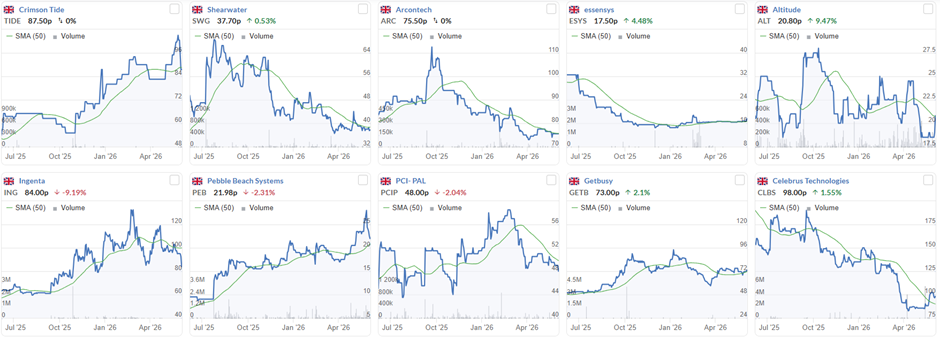
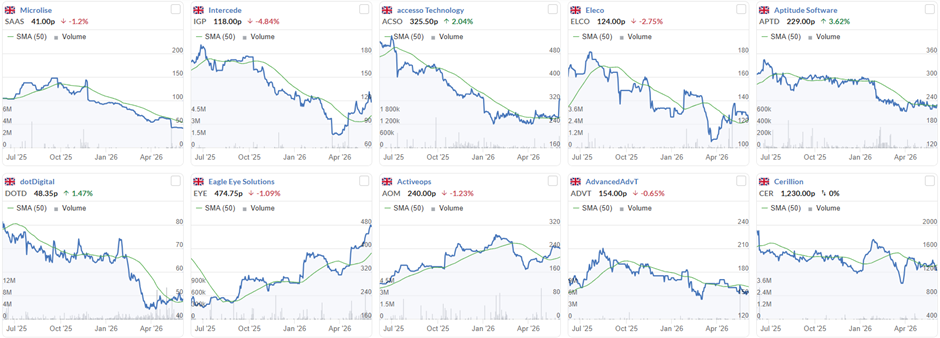
The narrative is that AI represents an existential threat to these businesses. The ability of AI to guide individuals in creating quick and robust coding solutions will see companies' lunch eaten by "vibe-coded" startups. If this happens, it may well put an end to these businesses. However, this outcome would seem to be low-probability; it assumes that the same benefits of rapid product development and delivery don't accrue to incumbent businesses with existing strong customer relationships and distribution networks. However, the AI threat leaves many investors unwilling to invest in the sector at all. Not every company in the sector is going to be a buy, but pockets of undervaluation are more likely when a sector is extremely out of favour with investors. This is one sector where careful research may pay-off.
Kooth (LON:KOO)
I recently wrote a Stock Pitch article on this holding of mine. I won't repeat the bull/bear arguments here, except to note that this appears to be a binary situation. Here is an excerpt from my summary of the article:
The market has decided that there is a high risk that the California contract will end in FY27, with a knock-on impact on the business's ability to grow elsewhere in the US. There is strong evidence that the risk of this is overblown. The embedded infrastructure is strong, and competitors will struggle to wrest this contract from Kooth without significant expenditure…
…Some investors may not be able to cope with the binary nature of this outcome, but overall the risk-reward ratio certainly favours the holders at the current price.
Since then, the share price has bounced, mainly due to a well-known fund manager pointing out that California Governor Gavin Newsom had publicly supported the company's platform. (Not the behaviour you would expect if the company was about to lose its key contract.) Despite this, the market still seems to view it as largely a binary outcome. The California contract remains a key risk, but, as brokers and fund managers point out, the scenario is far less binary than it may appear.
Gold explorers
On the flip side, one cannot ignore the sheer number of junior gold explorers that have listed in response to recent gold price strength. When reviewing results on the DSMR, I am consistently surprised by the market cap ascribed to many of these companies that are early in the mining process.
These companies may have great licenses and prospects, and I think there are several reasons to be bullish on gold (such as central bank demand and the trend towards de-dollarisation). However, there is no escaping that gold mining is a cyclical industry, and if prices remain high, this will eventually encourage much greater production, which will lead to price falls.
If a company is only now gathering rock chip samples at their tenements, they are likely too late to the party. Even if they can prove up a large resource, jump through all the regulatory hoops, and secure funding without diluting shareholders, they will be in production a decade later. Probably just in time for the cyclical lows in the gold price! Binary-loving investors often get blinded by g/t and forget about market cycle dynamics.
Ways to play binary
Position Size
If investors are worried about downside risks, the logical solution is to set a position size that allows them to withstand the loss if the binary outcome goes against them. If investors can identify enough situations where the risk-reward is favourable, then they will generate strong returns even if any one investment underperforms. A basket approach can often make more sense than single-stock exposure.
When the downside risk is technical obsolescence or significant debt, investors would be very wary about averaging down. Hedge fund manager John Hempton found that the biggest mistakes Value investors made were averaging down into over-leveraged stocks or those facing technical obsolescence.
Options
Cornwall Capital is a hedge fund founded by Jamie Mai and Charlie Ledley, and made famous by their appearances in Michael Lewis's The Big Short and Jack Schwager's book Hedge Fund Market Wizards.
Cornwall specialises in highly asymmetric, "right-skewed" trades, in which it risks a small amount of capital for a massive, outsized return. They often use options to achieve these characteristics. This is because they realised that many options writers use standard financial models to price options based on historical behaviour. These models often don't account for the fact that binary situations are not well priced by typical options pricing maths. By buying these options, Cornwall captures huge returns when things go its way. More than enough to overcome the impact of the ones that don't.
Straddles
Advanced investors may profit from binary events by buying a straddle. This is a market-neutral strategy in which an investor simultaneously buys (or sells) both a call and a put option on the same underlying asset, with identical strike prices and expiration dates. The catch is that to profit, investors need the price to move (in either direction) far enough to pay for the combined premiums on the options. These can be especially useful when a crunch date is known for a specific binary outcome, allowing investors to position themselves ahead of it.
Controlled-risk positions
A simpler strategy that may be more suitable for individual investors is to use controlled-risk spread bets. Any leveraged trading has risks, and investors really need to understand what they are doing and what their exposure is. However, positions with guaranteed stops at least limit their downside, which is their attraction in binary situations. For example, I recently spotted that Tate & Lyle (LON:TATE) was available with a major spread bet provider with a guaranteed stop 10% below the current price. This is perfectly normal for companies of this size. What stood out here was that the company had already received a possible takeover offer at around £6.20. At around £5, the downside was about 50p due to the 10% guaranteed stop if a firm bid didn't materialise. (Without this guarantee, a failed bid would likely see the share price drop by 100p or more, to the undisturbed price.) However, the upside was 120p, making the risk-reward very favourable. As it turned out, a firm offer did arrive. The market is still somewhat sceptical due to the need for regulatory approval, but this remains a highly profitable trade given the protected downside.
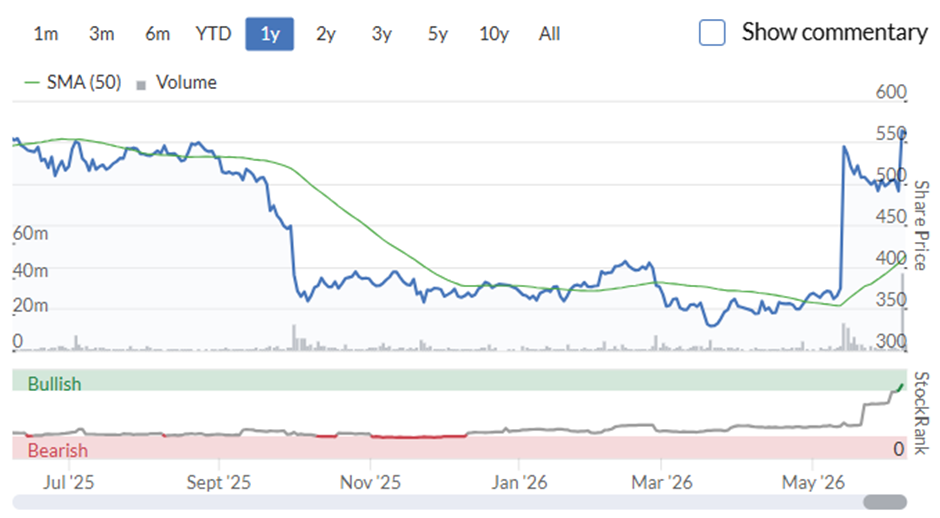
This type of strategy is not entirely risk-free. If the share price had retraced to trigger my stop before the offer arrived, I would have lost money and my upside exposure. Plus, I still have funding costs while the position is open. However, I am consistently surprised by which shares I can still access controlled-risk positions on.
Another possible example is the riskier housebuilders. Crest Nicholson Holdings (LON:CRST) share price recently collapsed on news that it couldn't sell enough of its land bank and needs a banking covenant waiver:
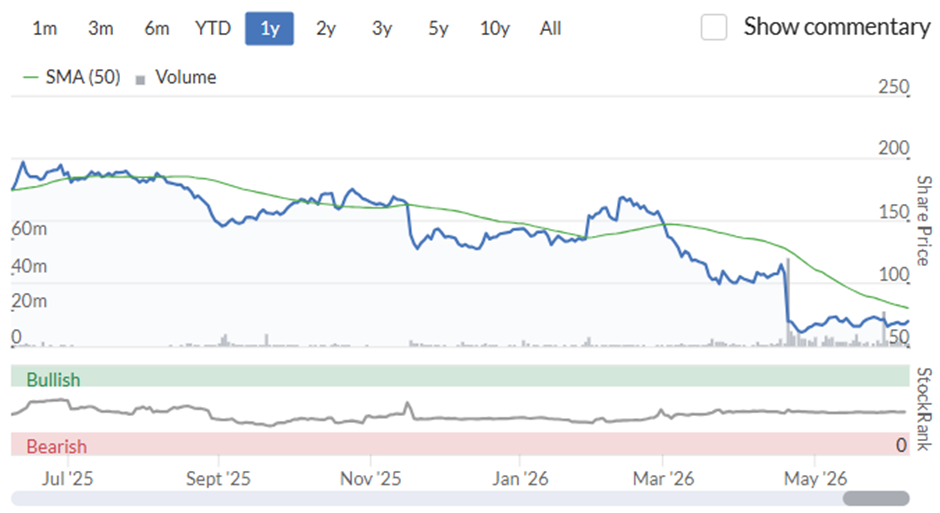
If they don't get this waiver, they are a zero. If they do, the scale of the discount to NTAV and the outsized short positions mean it will likely trade back above £1. The risk-reward may not be favourable at the current price, unless one can limit the downside via controlled risk positions, and let someone else take the ultimate downside risk!
Conclusion
We seem to be seeing increasingly binary outcomes in the markets at the moment. The abundance of takeovers and companies in financial difficulty makes many investment outcomes highly uncertain in many cases. In these cases, moves are sudden, and there is little opportunity to trade at a price that hasn't already priced in the news. When potential news flow leaves investors exposed to significant downside, they naturally back away from these situations. However, the biases that lead investors to overvalue blue-sky stocks may result in material undervaluation in stocks where a significant risk is well known in advance.
The reality is that many investors don't want exposure to binary situations like these. However, that spells opportunity for those able to stomach the ride. Position sizing and diversification across multiple opportunities can help investors manage risk. For more advanced investors, the use of options or controlled risk spread bets may make the risk-reward so strong that investors will learn to love binary again.
[Disclosure: At the time of writing, Mark owns shares in Kooth (LON:KOO) and has long positions in Tate & Lyle (LON:TATE) and Crest Nicholson Holdings (LON:CRST) ]
Disclaimer
This is not financial advice. Our content is intended to be used and must be used for information and education purposes only. Please read our disclaimer and terms and conditions to understand our obligations.
12 comments
There are 10 types of investors: those who understand binary…
…and those who don't.
That classic joke has come to mind more than once as I've written about companies recently.
I think you heard it here first Mark in reply to your excellent article last year, glad to be of help :-)SamsgrandadJoined 2016383 postsAug 14, 2025
Nice article. I'm impressed with a first in maths. I really struggled with higher level maths when studying engineering but found my niche in computers where understanding the binary number system is important. There are 10 sorts of people in the world, those that understand the binary number system and those that don't.
Re investing in junior non producing miner explorers - your binary joke description certainly fits!
If you were to add there are ten types of promoter for a junior non producing miner explorer for every successful mine Id guess you were short of the mark, Mark !
Interesting, and correct about having enough confidence in your analysis to accept a high number of losers if the rare winner compensates, and volatility is bearable.
When I was sports betting, my long shots returned huge positive ROI, over 100% at the highest prices, and much higher than the couple of percent at the shorter end. Obviously, wins were infrequent and being the wrong side of a photo finish hurt more than a favourite being beaten on the nod.
My data and analysis were proven and my edge was real. During a successful period for long shots, I would sometimes abandon my process, searching the bigger prices first and making excuses for data points that didn't quite fit. That didn't work at all and I soon learned to stick rigidly to the process that worked. It didn't stop me drifting back into poor habits from time to time, but I spotted and corrected it faster, meaning my overall ROI went up over the years.
Back to share picking, I try to bring a similar approach. I don't yet have the same volume of data, or confidence in my model, but I have no fear of an individual failure with a binary "bet". With each one, I learn something new. Failing is part of the process of learning and it reminds me of the poker quote that "scared money never wins". I think as long as I have a written strategy, process, and I am risking an amount I can afford, I am giving myself the best chance of a positive outcome. Controlling my emotions when things go very well will still be a challenge though.
"Interesting, and correct about having enough confidence in your analysis to accept a high number of losers if the rare winner compensates, and volatility is bearable."
- Sometimes the rare winner never comes if you're that end of the risk spectrum - you still need to be able to survive.
Agree, hence the need to play across the whole range of opportunities and not force myself into one type of investment, sometimes accepting a smaller margin in exchange for a higher probability of a positive outcome.
Another interesting article Mark and how true I have found the loss aversion studies you refer to suggesting that the pain we feel as investors to reduced valuations in our holdings is likely to be far higher and prolonged than the joy we get from increases. I only have to look at RPI and one or two others in my Naps portfolio recently subject to massive increases in purchase price following publication of annual results and increased profit forecasts and remember my satisfaction at these, which on the day made up for a fall in value across my whole portfolio, but over a few days during the last couple of weeks these have suffered from a series of smaller incremental falls causing me enough anguish to study each carefully and remind myself of the wonderfully large gains they have made over an extended period and note that institutional investors have clearly not shared my misgivings.
Yes, it is amazing how painful a small retracement in some long term winners can be, and I've certainly had a few this week, such as Goldplat (LON:GDP) and Ingenta (LON:ING) . I have to repeatedly remind myself of the long-term investment case for businesses such as this, and the very low valuations. It doesn't do much to remove the feeling in the moment, though!
Very interesting Mark. My stockbroker introduced me to option trading in the 1985, after a few months I though I knew what I was doing, I didn't. During 1987 I'd become over confident. too brave and too leveraged. On the 19 October the world changed for this Put Option Writer, we were lucky to keep our house but a business and all other assets had to go in almost a fire sale to meet the losses on shares I had to take. My long relationship with Barclays meant nothing when my bank manager said they had bigger problems than I had, and made me take out a life policy payable to them. The capital losses were a great help for many years but I sleep much better at night now after joining Stockopedia and taking advice from better investors. I do not do any option trading but recognise my big mistake was being too greedy in not buying loss limiting positions. I'm still with Barclays!
Intersting story, thanks for sharing. Pleased you survived the experience. I certianly wouldn't be writing any options personally, and your story just confirms why!
It doesn't sound like Barclays deserves your loyalty - I'd have dropped them at the soonest opportunity out of principle if nothing else.
Sadly the only difference between the banks is the name: they all act the same.
Yes, I'd still walk when they do.