Three QM stocks: Judges Scientific, Codemasters, and Quartix

There have been some exciting updates from promising companies over the past few days. Judges Scientific has made an acquisition, Codemasters agreed a promising licence with the World Rally Championship, and Quartix has updated on trading.
Judges Scientific (LON:JDG)
- QM Rank: 96
- Share price: 5,560p
- Market cap: £355m
(I have an interest in this company)
Judges Scientific (LON:JDG) is an AIM-listed company specialising in the design and production of scientific instruments. It acquires top-quality businesses with established reputations in worldwide markets.
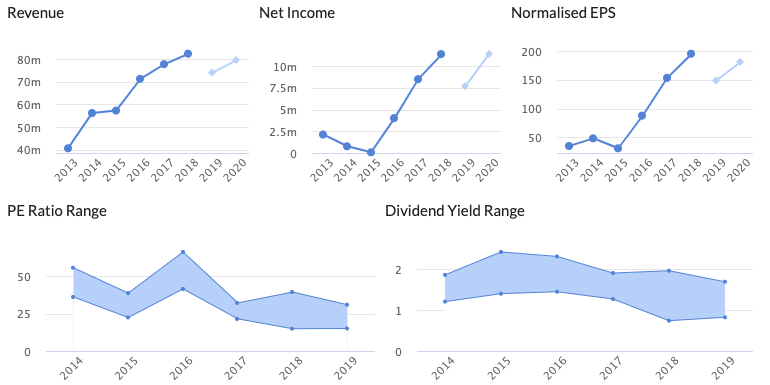
JDG is a great company. One small catch: it is always expensive, as you can see from the PE ratio range in the graphics below:
A lot depends on your view of the long term potential at Judges.
Some wonder whether there is a natural ceiling to Judges acquisition-dependent growth model. This view is justified - the group’s CEO himself has warned that deals above the £1m EBIT level become much more competitive. If Judges has to pay more for larger acquisitions, that will act as a serious drag on long term returns.
But Cicurel is a canny and experienced operator - and such operators know that if you want to impress, you should underpromise and overdeliver.
My hunch is that all this talk about running out of deals is Cicurel et al trying to manage shareholder expectations - understandable for a company whose share price typically trades at a steep premium.
If you flick through the reports, management regularly cites a large and fragmented global opportunity.
Recent trading
Since I last looked at the group, JDG has released FY19 Final Results. To recap:
- Revenues +5.9% to a record £82.5m (5.6% organic growth);
- Adjusted operating profit +18% to £17.4m;
- Adjusted basic EPS +21% to 222.5p for an adjusted FY19 PE ratio of c25x;
- Final dividend of 35p, totalling 50p for the year, an increase of 25% (this excludes the special dividend of £2 paid on 10 December 2019); this is an FY19 yield of 0.9% (4.5% including the special dividend)
- Organic order book at 13.2 weeks (1 January 2019: 14.4 weeks); total order book 13.6 weeks;
This order book has since come down a bit though. The group’s AGM Update shows organic order intake as of 15 May was down 18.5% year-on-year “caused by the closure of universities, the cancellation of scientific conferences and our inability to travel.”
Not ideal, but this kind of tough environment generally benefits quality operators in the long term. Perhaps COVID-19 will throw a few more promising acquisition opportunities Judges’ way than would otherwise have been the case.
29 May 2020 - Heath acquisition
And then we have Judges most recent piece of news: last week’s “immediately earnings enhancing” acquisition of Heath Scientific. To recap:
Rationale:
- Heath Scientific is “a world leading maker of calorimetry instruments” that specialises in the instruments used to measure the thermal properties of lithium batteries and other reactive materials. This is a growing market.
- The science underlying Heath's products is similar to the scientific fundamentals of Fire Testing Technology (FTT), the Group's first acquisition in May 2005
- The Board believes the interaction between the two companies will be “constructive.”
Moorfield Nanotech vs. Heath Scientific
Unless I am missing something, JDG appears to be paying higher multiples for Heath than it did for its preceding acquisition, Moorfield Cryosystems. Perhaps this is because JDG sees more value here seeing as it already owns FTT.
Here is what Judges paid for both companies (in £m).
Date | Price Paid (£m) | Potential earn out | Total | |
Heath | 29.05.2020 | 5.3 | 2 | 7.3 |
Moorfield | 04.12.2019 | 2.3 | 2.3 |
There was a £0.7m earn out for Moorfield, but this was included in the RNS in the £2.3m price paid so that’s where I’ve left it. Here are the deal multiples:
Revenue | Operating profit | Operating margin | PBT | PBT margin | Revenue multiple | Operating profit multiple | PBT multiple | |
Heath | 4.4 | 0.879 | 20% | 0.7 | 16% | 1.66 | 8.30 | 10.43 |
Moorfield | 2.5 | 0.6 | 24% | 0.6 | 24% | 0.92 | 3.83 | 3.83 |
Great company, good acquisition, but fully priced?
I’m sure this is a good deal for Judges with potential synergies and business opportunities with FTT, but I wasn’t expecting the strong share price reaction. This is just Judges doing what it’s always done, after all. The shares strike me as fully priced given the economic backdrop.
I’m happy to hold though - JDG has a robust business model and a large pool of targets. Its track record over the years has been stellar, with all seventeen acquisitions since May 2005 proving to be earnings enhancing; seventeen acquisitions since May 2005. It operates in a market with strong long-term growth drivers (in higher education and process optimisation) and its businesses are well diversified by geography and by scientific application.
There is also a reassuring culture that focuses on shareholder value via profitability, cash generation, debt reduction, dividend growth and return on capital.
The question is whether at 35x forecast earnings there are more attractively priced opportunities out there.
Codemasters (LON:CDM)
- QM Rank: 95
- Share price: 332p
- Market cap: £504m
(I have an interest in this company)
Some interesting news over at Codemasters Group (LON:CDM) as well: it has signed a five-year licence with WRC Promoter for the exclusive rights to develop and publish the FIA World Rally Championship videogames and esports tournaments.
This video game developer specialises in high quality racing games and has a 30 year track record. I think this specialisation and leading position in a staple genre gives it an attractive niche, with its proprietary software optimised for such games.
The WRC tie up sounds like a material expansion of the portfolio: the 2019 FIA World Rally Championship achieved 1.4 billion online impressions, a cumulative TV audience of 836+ million viewers across 150+ TV markets, and 4+ million spectators attended the 13 WRC rallies.
CDM expects to release its first WRC in the financial year ending 31 March 2024. This means a step up in CDM’s off-road racing releases from one per year to three per year. The current version of the game (WRC 8) appears to have been successful, which should de-risk the project somewhat.
CDM’s potential position in esports and beyond is also attractive. Racing games are huge for the casual gamer, but they are also fiercely competitive at the professional level and now we are even seeing these games prove themselves as a viable alternative to the real thing, with Formula 1 and E racers competing virtually during lockdown.
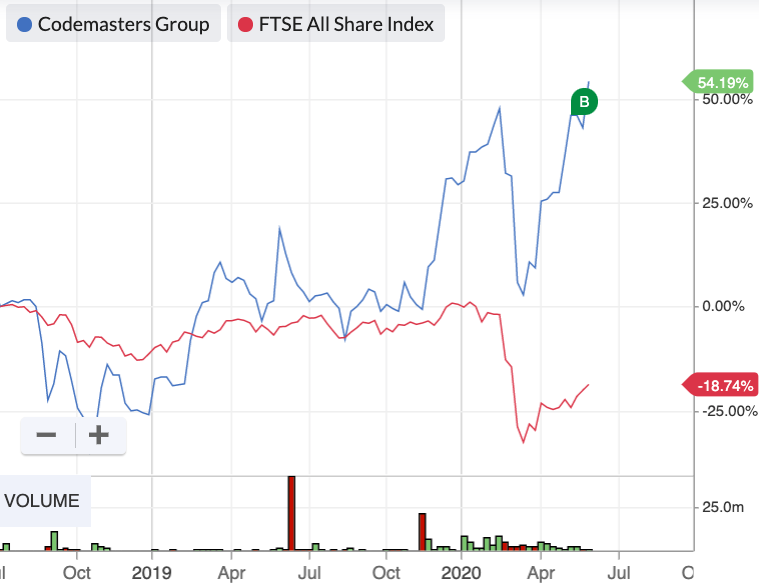
You can see the company is hitting new all-time highs on the news.
My view
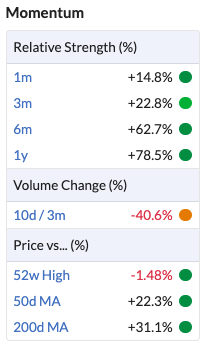
I continue to think the video games space is a good place to be in the years ahead. The market will grow and grow, making it easier to win as an investor. To mix my metaphors: why swim against the tide when you can sail with the wind at your back? The momentum is certainly encouraging at a company-specific level:
It’s not without risk. Any newly listed company is less well known to investors but CDM and the rest stand to benefit from lockdown.
There is also an issue with free cash flow:
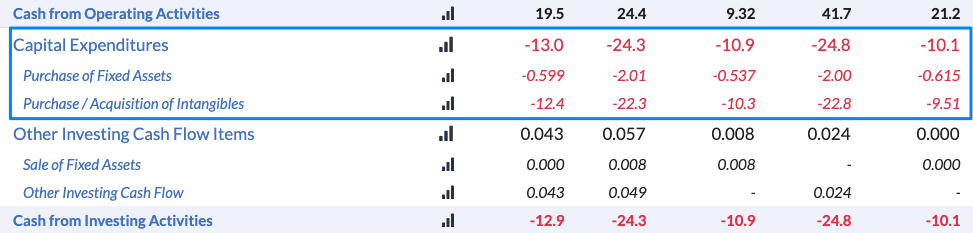
This has previously been flagged by a commenter and I’d like to see CDM be more free cash flow generative in future. On a general note, there is a level of subjective accounting estimates that come with this kind of software-heavy company. It’s something to keep an eye on. DYOR.
That said, given the group’s growth prospects and leading position in an established niche, I think the share price valuation looks quite attractive at c330p.
This news, alongside the recent F1 contract extension with Liberty Media, the deal with NetEase in mobile, and the acquisition of Slightly Mad Studios adds to the visible growth profile of the group. A growing pipeline of racing games might also lead to a degree of operational gearing, as well.
According to brokers, each game in CDM’s DiRT franchise generates over £25m+ of lifetime sales meaning that, overall, the franchise is approaching £300m of total revenue. Meanwhile, the group’s F1 range was achieving revenues of around £35m a year pre-lockdown. The WRC opportunity is presumably similar in scale.
Quartix (LON:QTX)
- QM Rank: 98
- Share price: 376p
- Market cap: £185m
Paul is covering Quartix Holdings (LON:QTX) today so I won’t spend too long on it.
This is another high QM stock: one of Europe's leading suppliers of subscription-based vehicle tracking systems, software and services. It’s expensive, but then again it’s always been expensive:
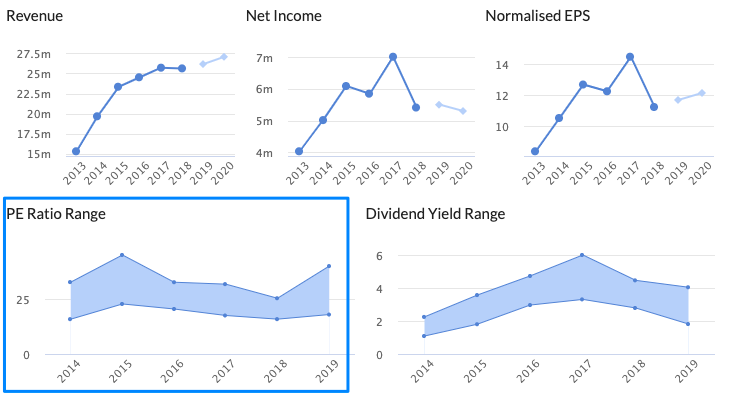
Its share price hasn’t gone anywhere in a long time, although there is clear recent strength as it bounces back from the March/April lows:
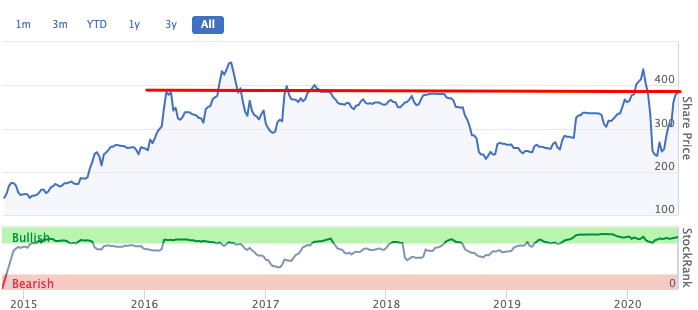
Meanwhile, growth over the past five years has been good but not great:
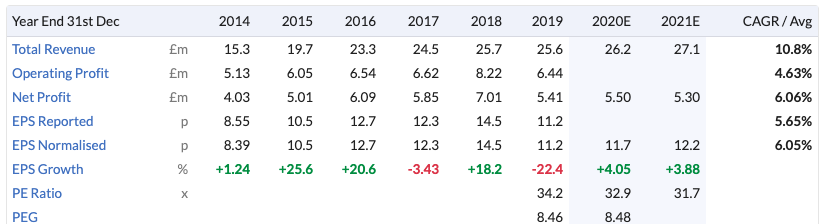
So my immediate impressions here are lukewarm - it seems as though QTX is a quality operator, but one that is expensive and that has struggled to grow.
That’s just my initial impression though - perhaps there is more to this story.
Trading Statement for January to April 2020
The group says that the first four-month period to 30 April 2020 was strong, and ahead of the equivalent period last year. The Company's cash balance was £9.5m at 1 June. It sounds as though trading has not been disrupted due to the group’s recurring revenue model.
New fleet installations in April were 60% lower year-on-yea (1,500 installations compared to 4,200). New installations in May were 25% down (2,740 vs 3,630). More detail will come in the interim results, which will be released at the end of July.
QTX gives some useful insight into recovering fleet utilisation in the UK and France, which together represent 85% of its recurring revenues. Using the first working week of March as the baseline (2 - 6 March):
UK vehicle mileage fell by 54% to its lowest point during the working week 30 Mar to 3 April and had only partially recovered to 32% below normal levels by 22 May. Construction, representing 31% of the Company's base, fell by 60% in the early stages of lockdown but is now recovering well. Other site-based services and manufacturing, representing a further 24% of the Company's base, were still operating at 40% below normal levels on 22 May.
In France, vehicle mileage fell by 63% to its lowest point during the working week ending 23 - 27 March, one week before the UK. Activity rates appear to be recovering at a faster pace than in the UK however, with the aggregate level just 9% below the baseline by 22 May. This is an encouraging bounceback.
Quartix looks like a well run company but I can’t get excited right now given the lack of growth and high valuation. I’ll continue to monitor it though. What do others think - is QTX expensive or does it justify its premium rating?
Disclaimer
This is not financial advice. Our content is intended to be used and must be used for information and education purposes only. Please read our disclaimer and terms and conditions to understand our obligations.

5 comments
Thanks for the recommnedations. I went with Codemasters Group (LON:CDM) as a gamer myself. 5% up in two days is always nice.
Great article, Jack. As a newcomer to the world of share analysis and its varied terminology, it is refreshing to read your in-depth and clear company research. It is always incredibly thorough and allows the reader to navigate through the relevant metrics for each share. I am big fan of CDM and its innovative approach (I am long - always wanted to write that!!). Look forward to the next batch of forensic examinations!!
I held JDG some years ago. Bought from £8 and averaged up all the way to £22. My first ‘bagger’. Should have kept them.
More recently (yesterday) I opened a position in CDM as I like the fundamentals, and it seemed to have broken out to a new all time high on monday morning after gapping up on the open (due to WRC news).
Super article, many thanks. Of all the gurus, who would you say adopts a quality momentum approach?
Thanks as always for another great article. As a holder of QTX myself I wonder if you are factoring in the company's conscious decision in recent years to move away from the low margin insurance business, so you see revenue growth stagnant but you are starting to see the rise in margins, although 2019 was not great for margin growth per your screenshot above.