Trading Made Easy - My Strategy For Buying Stocks

would like to share my investment strategy with you, which has been working really well for me after I changed it a couple years ago.
After reading some books, attending several courses and making many mistakes, I finally understood that the best method is KISS:

I will start by teaching you the methods I use to search for the stocks in which I want to invest and, once selected, how I open position and set a stop in losses.
My idea is to publish other posts with stocks that match the criteria that I will be presenting in the following paragraphs. These should help you get started with my methods and give you some companies that you could potentially invest in.
As a sample: 3 stocks I own
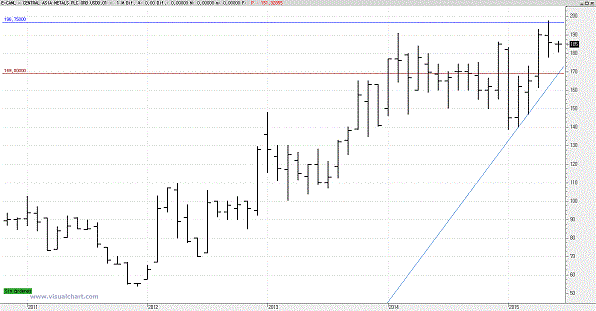
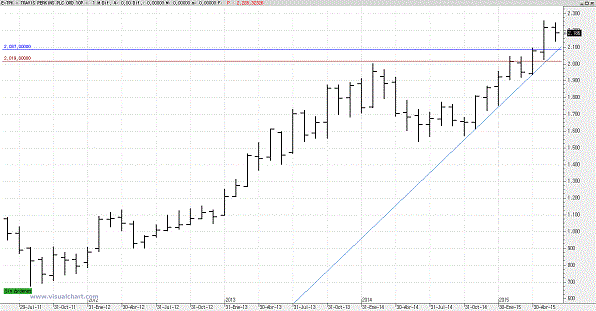
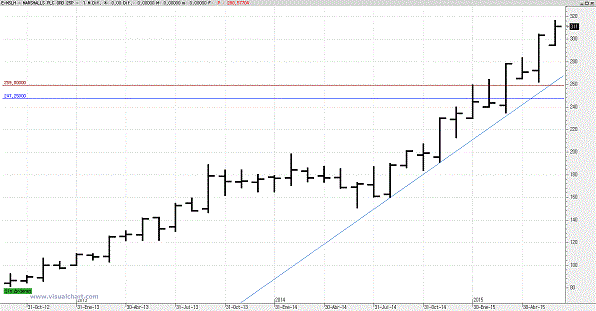
Theory is fine. But as an introductory example, first of all I would like to show you 3 of my current stocks I own. Blue line is entry point, red one is stop level. It is true that in 2 of them the Exchange market size is lower than the required, but as an exception I assumed the risk (explained later in this article).
1) Stocks that have no profit yet: CAML.L Central Asia Metals Plc.
2) Stocks gaining some % but still in danger if stop is touched: TPK.L Travis Perkins Plc.
3) Risk free stocks (under normal circumstances): MSLH.L Marshalls PLC.
Macro uptrend
First thing I have into account is the macro uptrend: if we are in a negative trend market, for me the best option is to go out of the market, or open short positions.
Historic peaks in the
last 12 months
I limit my search to those companies that have reached record highs in the last year (52 week breakout). I believe that these companies have a very good chance of starting upward trends in the future.
Small – Medium Caps United Kingdom
UK has a large variety of firms of all sizes.
I started investing in this market because I read several books that dealt with it and it seemed full of opportunities. After vast research I came to the conclusion that this market has high liquidity and is not as volatile as the American market (where stocks can open up with a 20% difference).
CFD’s with Ig Markets
I must start by saying that I have no advertising deal or am in any way affiliated with Ig Markets. I chose them because they have good reviews and a lot of the companies that match my search criterions. They have worked very well for me up to this point.
I would encourage you read the part where they explain how CFD’s work http://www.ig.com/uk/cfd-trading
The basic idea behind CFD’s is that you never own the stock. This is an independent market so now I will explain how you can profit. You “buy” a stock at a certain price and you will profit whenever the stock price rises (as in the actual stock market) and lg Markets will benefit when the price of your stock decreases since you will sell for less than what you initially purchased.
I am living in Spain, but spread betting, for UK customers only, is a good alternative. As Etxcapital says: 'One of the advantages of spread-betting in the UK is that profits are tax-free. Since spread betting is currently considered to be a form of gambling by HMRC, no Capital Gains Tax is due on proceeds. This means that if you win you get to keep 100% of your profits, untaxed. However, losses cannot be used to offset taxes'. http://www.etxcapital.co.uk/spread-betting/
One advantage of this kind of investing is that you can operate with much more money than what you actually put in so you will benefit in proportion of what you put in if the stock price increases. The more capital you operate with, the more risk that comes associated with it. It is an exponential relationship. For example, if you put in £45,000 and are operating with £450,000 you would be out of business with a 10% loss since your £45,000 are gone so that is why you have to be very careful since you can lose much more money than what you put in.
You need to calculate the maximum leverage that you are willing to work with. If you dispose of £50,000, I would recommend you operate with £100,000 or a 2:1 ratio. A grand majority of the accounts that will open today will be gone in three months and this is mainly due to people’s abuse of leverage. Investing is a long-term game so you want to be cautious with your actions since the ones who win are the ones who stay longest in the game.
You need to set stops from the beginning in order to minimize losses. Your stops should be adjusted frequently since the market will vary and you will be willing to assume different risks at different points in time. For example, if a stocks price is going to decrease because a firm is going to give dividends, you should decrease your stop since there is no reason to sell.
I strongly believe that we can form a small community that can highly benefit from this type of trading.
How I operate (example)
There are a large variety of websites that inform you of the latest breakouts so I encourage you to find your favorite one.
I am going to use one of my stocks for this example (Taylor Wimpey PLC (TW.L)) that just recently reached its historical peak in the last 12 months.
In each stock I typically invest £7,110 which is the equivalent of €10,000. The reason I chose this amount or multiples of it depending on each stock is that I like to diversify my investments since I believe that this is the safest way to do it. I prefer to have smaller amounts of money in more places than more money in fewer places.
Once I find the stocks that have reached their historic peaks in the last 12 months I go to finance.yahoo.co.uk to look up some values.
1) Check that the graph actually resembles this peak
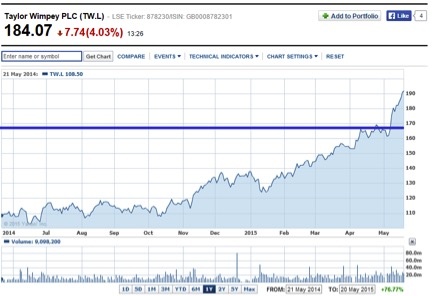
The blue line resembles the value at which I bought the stock and as you can see, this investment is going fairly well.
2)
Make sure that the spread is < 1%
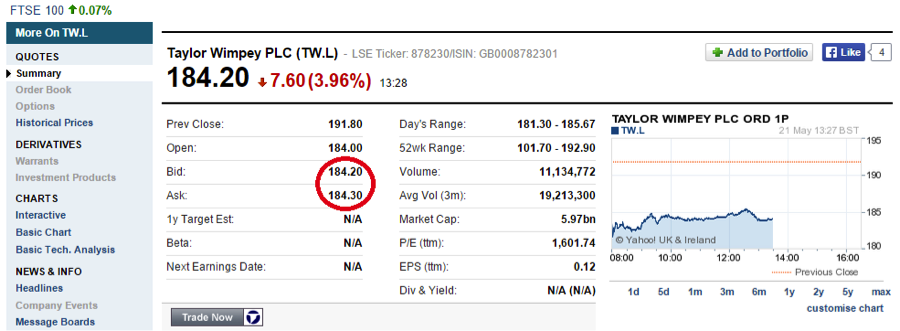
Spread = ((184.30-184.20)/184.30) x 100) = 0.054%
This means that when I sell after buying, I am going to lose 0.104% which is very reasonable. On the other hand, if the spread was 4%, you would lose 8% just from buying and selling.
3) Can I buy all the stocks that I want to?
I am planning on investing £7,110 and each stock costs £1.8220 which means I can buy 3,902 stocks. Since I am feeling generous I will round this number up to 4,000. Check the London Stock Exchange (http://www.londonstockexchange.com) to ensure that you can buy this many.
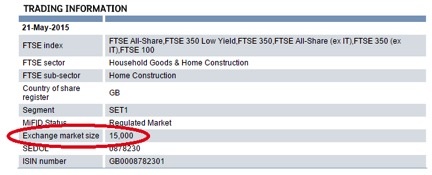
In this case, buying or selling 4,000 should be no problem since it lets us do this with up to 15,000 stocks.
Sometimes, depending on your interest in the stock, you can buy a bigger number than the Exchange market size, if you assume that there can be a slip in the price if the broker will not be able to buy or sell so big number of stocks.
4) Observe the fundamentals
Available in Yahoo – Key Statistics
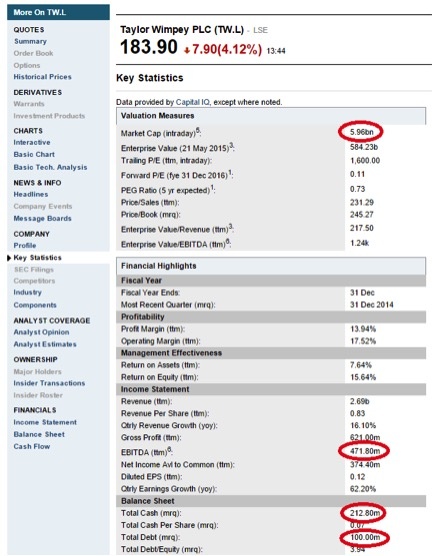
Three questions I should ask myself:
1- Does the company make money (Is EBITDA positive)?
Yes, £471.80 m.
2 – If I had enough money to buy the company, how many times EBITDA would I have to pay?
The reasonable is between 10 and 20 times. In this case Market cap is £5.96 b and EBITDA is £471.80 m so it is 12.63 which is reasonable.
3 – Is the company’s debt less than 3 times EBITDA?
We would not want to invest in a firm with massive debt for obvious reasons. In this case the debs is £100.00 m and the cash is £ 212.80 m meaning that the firm actually disposes of £112.80 m since the debt is negative.
5) Open positions with your Broker
The firm has passed all the filters so it is now time to proceed to buy the stock. I am not going to place a stop immediately but I use 10% by default.
6) Edit the graph in Visual Chart
You can download it here http://www.visualchart.com/downloads/. Visual Chart is an app that enables you to see the stocks graph in a very simple way. You can use it for free if you don’t have live tracking of the stock and this works perfectly well for this kind of investing.
The Graphs of the London Stock Exchange are
usually saved with an E in front so we would search for E-TW.
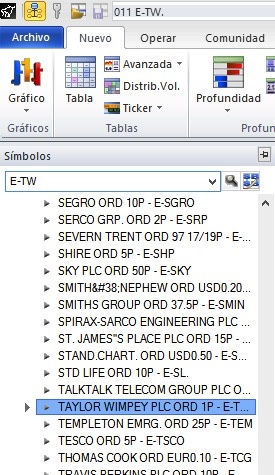
I generally use the monthly bars unless it’s a recent IPO. In this case, I would use the weekly ones. There is no other way to visualize the tendency.
I zoom into the last part of the graph and try to draw an upward trending line.
I encourage you to visualize the graphs in a logarithmic scale. It is is good to trace the theoretical profits that we could expect in the next year if the upward trend is followed.
The vertical line lets us calculate absolute
terms or percentages in the two terms that we have selected. We only have to
place ourselves on the tendency line and displace the to the values that we
want to perform the calculations.
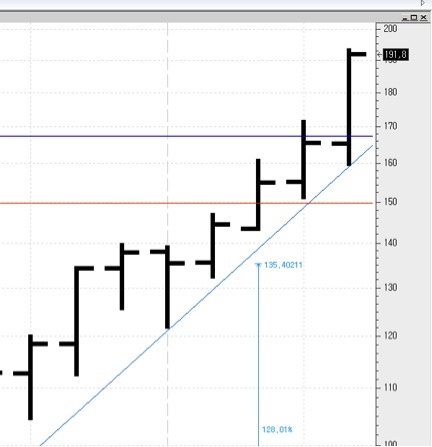
I bought the stock at 167.4 (blue line) and it is now time to determine the stop. My default value is 10 %
Stop = 167.4 x 0.9 = 150.66
I do not encourage you to place stops at nicely rounded
numbers so I am going to keep the stop at 149.75 (red line).
The minimum expected profit within the next year is 128% if the tendency line is respected.
7) Let the broker know the stop point
After calculating the stop, we need to let our broker know or else all these calculations will be futile.
Next Steps
I would not advise you to constantly check the stock market or to compulsively buy and sell stocks. As Warren Buffet says, “the majority of investors can’t resist the temptation of compulsively buying and selling stocks. You can.”
If the tendency goes in our favor we should raise the stop prices and they should always be under the tendency line.
I will let you know of future opportunities for you to invest in my next posts.
Disclaimer
This is not financial advice. Our content is intended to be used and must be used for information and education purposes only. Please read our disclaimer and terms and conditions to understand our obligations.
32 comments
I know Pcarrallo,
Yes its always interesting to see other investors stategies, I would be interested in what other shares you hold. I have a few 52 week high shares although I bought most before that point, I think Clarkson (LON:CKN), maybe fit in your system?
My main concern would be how reliable is EBITDA?
I know some are very wary of EBITDA figures.
I personally do not use EBITDA and get wary of any company that continually promotes that figure over anything else.
But a wikipedia page mentions the Debt/EBITDA
Leverage: Debt/EBITDA. This metric measures the amount of debt in relation to the EBITDA (i.e., how does the debt relate to the operational profit generating ability of the company). Whilst there is no absolute target and whilst leverage ratios differ widely, it can probably be argued that a leverage >3 is unhealthy for most businesses.
http://en.wikipedia.org/wiki/Earnings_before_interest,_taxes,_depreciation,_and_amortization
Good stock herbie47, everything is ok except that I would need something bigger in terms of Exchange Market Size (150) because I would buy 150 * 25,98 Gbp = 3,897 Gbp, lower than my usual budget of 7,300 Gbp (10,000 €).
I think Ebitda is an excellent indicator about how the company is going. Also compared with debt, in order to know the leverage level of the company.
I see but does this not exclude many small and mediun size companies?
Re Ebitda, I have read several articles about it, all negative, also Warren Buffet and Paul Scott I believe are not keen on it. But I'm not an accountant.
Yes, it definitely excludes a lot of stocks, under my point of view there are so many that the key is how to select the better ones: some days it is impossible to find any... but it works so far today!
Pcarrallo,
It looks as though much of your strategy is based on Naked Trader, but with your variations.
I wouldn't get into any debate about whether this is a trading or investing strategy. I have been there and it's a debate to go on forever.
I am a firm believer that success using a leverage account is all about diversifying across a range of stocks, following the major trend, supported by some basic fundamental criteria for each company. Profitability, growing sales, low debt, positive outlook and of course a final protection of the stop loss.
I notice you are based in Spain so CFD is a sensible way to apply your leverage trading. (Spread betting I believes for UK customers only).
Good luck to you and best wishes with your working strategy to make money and thanks for taking the time and effort to share it with us.
Hi Grindertrader,
Yes, I think Naked Trader has many good ideas, I have included some variations. Good read!
I completely agree with you on the strategy, thank you very much for your encouraging words!
Regards,
Pablo
Hi
Interesting article, but I'm not clear on a couple of points.
Why you would use CFDs rather than spreadbets? I appreciate that the cost of a spreadbet is in its wider spread, but CFDs incur % dealing costs. My understanding was that the overall frictional cost of trading was essentially the same when comparing methods. If you are confident of the outcome, why would you want to risk paying CGT on any profits by using CFDs?
You also say:
"On the other hand, if the spread was 4%, you would lose 8% just from buying and selling"
Is not the spread just that, the spread? It doesn't double when you come to sell, unless the absolute spread value changes?
Rgds
David
See his profile, he's in Spain. UK taxation of spread bets as gambling thus doesn't apply. In most countries CFDs and spreadbets are taxed the same, so you pay CGT (or get a tax credit for losses) either way.
Hi David,
Yes, I´m in Spain, I would really love to have the same taxation system as UK for Spread Bets, but I´m afraid we are going exactly to the opposite :-(
What I'm trying to say with the spread is that if the difference between bid and ask is 4% in both moments (when you buy and when you sell) you are losing 8%, globally. It is true that in 2 different moments, but more or less would be about 8%.
Regards,
Pablo
Hi,
Not sure I can make any sense of the following sentence ;
" In this case the debs is £100.00 m and the cash is 21st Century Oncology Holdings Inc (FRA:212).80 m meaning that the firm actually disposes of £112.80 m since the debt is negative."
Hi stepone, thank you for the warning. It was a HTML format 'trick', I've already changed it.
If you are using a maximum leverage of just 2:1 on your CFDs, why not buy the stocks directly and not use CFDs at all? That way you would reduce your risks, reduce your trading expenses, and have the advantage of receiving dividends which you can reinvest.
With CFD´s I have the possibility to increase leverage in certain moments.
They also pay dividends, unless you are short that will charge you for them.
But it is true that they also apply interests everyday.
Other brokers give you the possibility of leverage without CFD´s.
Some people distrust Ig because they are market makers, I completely understand them. But for me works so far today.
There are so many options as brokers are, of course.
You should bear in mind that the majority of traders of CFDs lose money over the long run, so the odds are against you if you use CFDs.
So do most retail investors into the stock market.
I agree
Pka, I completely agree with you.
That´s their business in fact, the people who open an account, apply super-leverage and loses everything, in just a couple of months!
But I am happy to say that I am using Cfd´s since 2012 and my account is still alive! ;-)
"But I am happy to say that I am using Cfd´s since 2012 and my account is still alive!"
That's good news. But the stock market over the last few years has been relatively calm by historical standards. Have you thought what would happen to your CFDs if there is another stock market crash like the one on 'Black Monday' in 1997? Stop losses wouldn't help you on a day like that:
http://en.wikipedia.org/wiki/Black_Monday_%281987%29
Well, it depends on if it gets you when the market is open or closed. Obviously, the second scenario is worst. Ig also allows guaranteed stops, they work fine, but it will cost you about 0.3%-1% more.
"Ig also allows guaranteed stops, they work fine, but it will cost you about 0.3%-1% more."
IG Index is probably OK. But from what I've read about them, I suggest you don't use Plus500 as your broker!
I'm a bit confused by your article. You talk about small medium companies but then you say spread should >1, well that will take out most small companies? Then you give an example of Taylor Wimpey. How do you judge the spread, is it historical average or just when you check it, because some companies the spread is very varied, take Dialight (LON:DIA), it is narrow at moment about 4p a few minutes ago it was 1p but I have seen it around 30p depending on trading and market makers. I think much of the TW sp rise was due to the unexpected election result. I feel TW has peaked but could be wrong. Historical peaks, are you buying 52 week highs or is this all time highs? TW. according to my info. was 379p in 2007.
Hi herbie47,
Thank you for taking the time to comment the article.
The idea is that the spread should be smaller than 1%, it is true that this will limit the number of small caps to invest.
It is difficult to predict when the spread is going to vary, but for the moment I had no problem with this. For example, TW is now 183.80-184, .20 = 0.11%.
Thanks for reminding me to clarify the 52 week breakout concept, the change has been already included in the article.
Good luck to you but take care - this is a trading strategy, not an investing strategy. (leverage, stop-losses, CFDs, technical analysis -> trading).
Thank you very much for spotting the error and notifying me, Graham. I have already changed it
It's a form of momentum (the 52 week breakout thing) with a quality/value filter (point 4). In essence, it's similar to systematic Stockrank investing (or is it trading?).
It has some shared elements with StockRank, that's right.
Graham N, StockRank looks interesting, I will definitely check it out. Thank you for the tip.
It's a form of momentum (the 52 week breakout thing) with a quality/value filter (point 4). In essence, it's similar to systematic Stockrank investing.
This isn't really like a stockrank strategy which is much more broad in its criteria. I doubt 13-23 x EV/EBITDA provides exposure to any value premium or EBITD +ve provides any exposure to quality premium.
There is academic evidence that a 52-week high strategy can generate some excess returns so this is likely to be the only true return-enhancing component.
What concerns me most is what a bear market would do to a 2:1 leveraged portfolio. A 10% stop loss is equivalent to a 20% loss of capital. You 'd need to significantly reduce leverage when you stop out to avoid wiping out capital in a down-turn.
Hi dangersimpson,
In my case, to be sure I will not be stopped in all my stocks, I only open new positions if some of the stocks have already gone up and, in case of stop exit, I will not loose money with them...
Regards,
Pablo
In my case, to be sure I will not be stopped in all my stocks, I only open new positions if some of the stocks have already gone up and, in case of stop exit, I will not loose money with them...
Wise to consider your downside protection however that limits you loss to 20% on one set of stocks only since it certainly is possible that all your stocks could be stopped out with a 10% correction, in fact I'd go as far as suggesting that this is almost certain to happen at some point in the future given how tight 10% is compared to the volatility of the average stock and correlations between stocks.
The question is what you do you do then? If you truly want to limit your downside to 20% of capital then you need to have the nerve to give up share trading and never trade again. If you can't or won't do that then you have to face the reality that trades can continue to go against you for quite some time and your loss potential far exceeds 20% of capital.
Rather than an all or nothing approach a far more sensible approach would be to vary your gearing according to market conditions going from significant cash when very little is hitting 52 week highs to your maximum of 2:1 when in a bull market as we have been in the last few years. The key is to have the discipline to cut back exposure as things go against you and add it back only when things are turning otherwise there is a high chance of a total wipeout at some point in the future.
Hi dangersimpson. Yes, you have to very disciplined about cutting losses. I always check that we are on a bull market, otherwise I will be out of the maket for some time.
I forgot to include this in my article, I have alredy done it in the first part of it:
Macro uptrend
First thing I have into account is the macro uptrend: if we are in a negative trend market, for me the best option is to go out of the market, or open short positions.
Thank you for the tip!
Regards,
Pablo