Trading the Trend - Buying pullbacks

We looked at the power of the breakout last week, and the 52-week high screen. By using this screen we can find stocks that are trading close to their 52-week highs and can alert us to stocks that are also close to breaking out.
We can also use this screen to find stocks that we can buy on a pullback too. In bullish markets, breakouts are excellent, but buying the dip is a tried and tested strategy that traders can employ.
This works because we are getting onboard a trend that is on a slight pullback. We can tighten up on our risk because we are entering at a point where there is clear support and demand.
Remember, charts work because everyone looks at the same points on a chart and sees support and resistance. “It’s like one big groupthink”, I hear one critic at the back say. Well, yes. Yes, it is. But if you can use it to gain an edge – why would you not use it?
Here’s an example of Games Workshop – a stock I’m sure you will be familiar with.

In November 2019, we saw a breakout and the stock tested the 20 EMA (orange line) in December. Then in 2020, we saw the stock test it twice again, before its collapsed in late February. The stock has since recovered, and in April 2020 we saw the stock bounce off the 20 EMA again, and in May, June, and July. Anyone who had picked up on this point as a potential entry into an uptrending stock or an investor who wanted to use technical analysis to add to their position at an optimum point would so far be quite pleased.
That’s not to say support always works – it doesn’t. But by looking for pullbacks we can get onboard a quality stock or more importantly an uptrending stock, and scale down our risk because we are entering at a point of high probability.
One of the great features of IG Index’s Direct Market Access is that for SETS traded stocks we can input our orders onto the Level 2 orderbook. We can set our orders in advance and put these into the market. By doing this in advance in removes any emotional overrides – we pick a level we want to do business at and we enter the order. The beauty of this is that we have ultimate discretion over price and size. We can enter one order, or work a series of entries in what I call layering the book. For example, if we want exposure to the stock, but we don’t want to pay a high price, we can put an order higher onto the bid, and two more orders at different levels below this.
This could be argued as averaging down (and technically it is) but what we are doing is paying a higher price for stock than we’d like so that we get immediate exposure, but also we are able to set a slug of stock at a lower price to even that average out. Sometimes you just want to be in a stock, and working an entry by layering the bid like this is a good tactic.
Let’s take a look at some stocks the screen has thrown up
Computacenter (CCC)
Computacenter (LON:CCC) is a provider of information technology (IT) infrastructure services, and it has featured in this column previously.
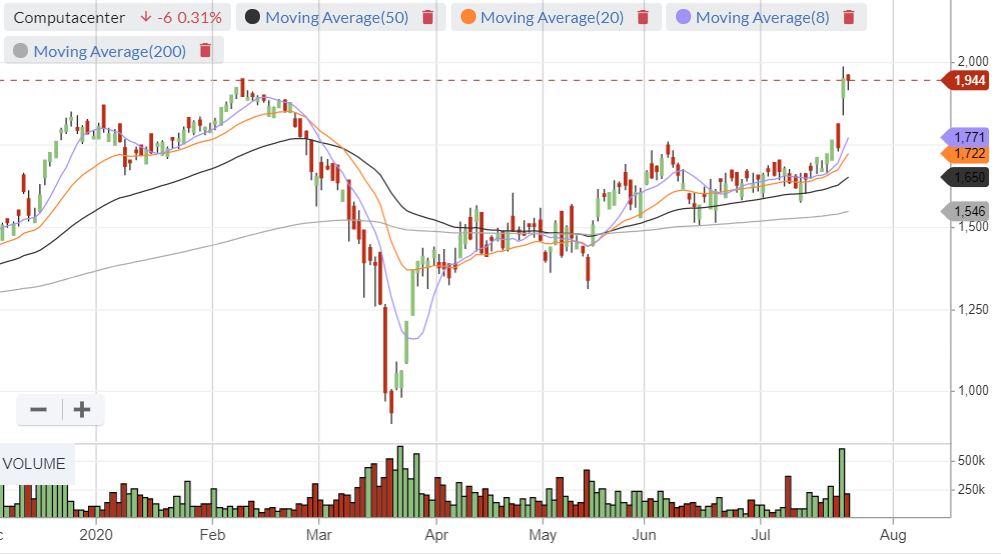
I bought on Wednesday because the RNS showed that “The Group's adjusted profit before tax in the first half of 2020 has turned out to be substantially ahead of the same period last year”. This has seen a move in the price and a test of the 1950p resistance. I think the psychological resistance will be 2000p, and if the stock can break through that then it will continue to rally.
I did notice that others had mentioned broker notes significantly upgrading earnings, but in my opinion you should always ignore broker notes. I don’t believe they provide me with any edge, and so therefore are useless. I have no doubt that there are many smart analysts out there (much smarter than myself), but analysts are not free to put what they really think. This is because if they are conservative, or flock to around what other analysts are putting, then they can’t be blamed. If one gets it wrong – but everyone is wrong – the analyst doesn’t stand much risk of losing his or her job!
I also suspect that some broker notes are also released in order to provide a short-term fizz to the share price and help friends or clients out of positions (think how often you’ve heard the Fevertree bid rumour doing the rounds in the press). So basically, I ignore them.
I am long Computacenter, with my stop around 1800p.
IG Group (IGG)
Here is a company that I would be wary of buying the dip. IG Group (LON:IGG) is one of my main brokers, and its business model does not benefit from client losses unlike others.
I believe it’s the market leader, and has a resilient business model. There are always going to be traders and with the trend of people doing their investments themselves rather than appointing ludicrously expensive fund managers (most of whom fail to beat their own respective benchmarks anyway) there should be a continuous stream of new customers.
However, this is a dip I would not be rushing to buy. Here is the chart.
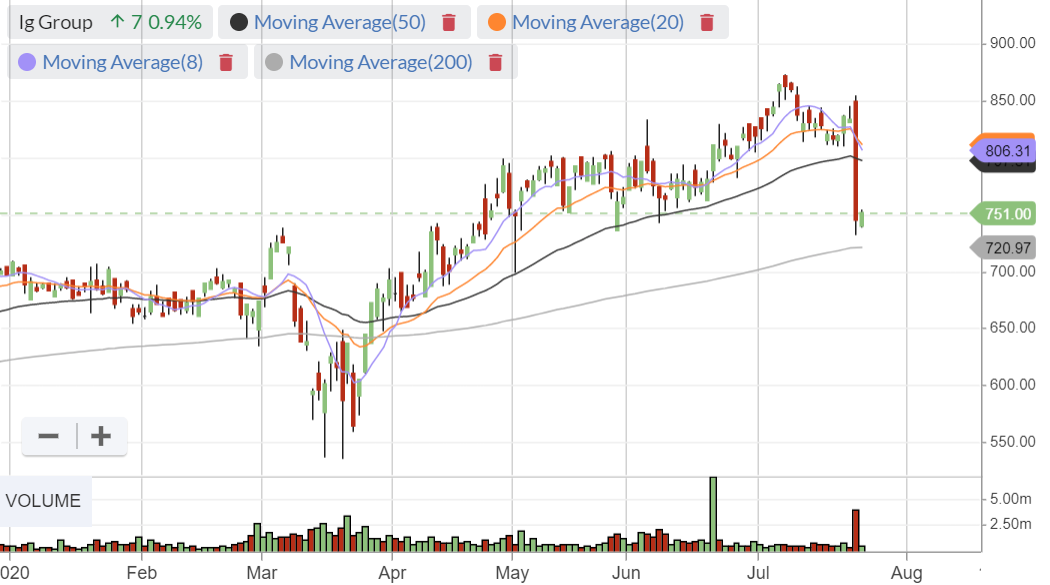
That’s a big volume sell-off. What’s happening here is institutions are likely using the volume in order to sneak out. If there were no big sellers, the price would not have fallen as much, nor would the volume be so high. Volatility and volume have spiked, and so this is a dip that I would avoid.
Ideally, volume should be light on pullbacks, and larger on blue days. This is because we want to see accumulation take the stock higher. As Mark Minervini once said.. “We want tennis balls, not eggs”. Tennis balls bounce. And eggs go splat. Luckily, we can use the chart to steer clear of the latter.
Finally, I’ve released my UK Stock Trading Course, which covers lots of topics that were not able to fit into my books, and it outlines how I trade the UK stock market. I intend to add to the course and grow it, and Stockopedia users who subscribe today will receive all future content for free.
If you have any questions about the course, I’m happy to answer them via email (michael@shiftingshares.com), but I can’t promise that it will be a quick fix or make anyone speedily wealthy. Trading is a constant process of time and effort, and finding new stocks to trade, and I think it’s important to be realistic about expectations.
You can download your copies of Michael’s books at www.shiftingshares.com
Twitter: @shiftingshares
Disclaimer
This is not financial advice. Our content is intended to be used and must be used for information and education purposes only. Please read our disclaimer and terms and conditions to understand our obligations.
10 comments
I liked your comment on broker notes. I do find a positive narrative a good starting point to research a stock. I Ignore the target price and buy recs
Thank you. I'm sure it'll annoy some analysts, but it's nothing personal and just how I see their utility in terms of my trading.
Hi Michael,
I enjoy your articles on Stocko, mainly daily charts, however the example on your website is day trading, looks like you have used CFD's. A couple of questions please
Is your trading course for day trading ?
Why use CFD's rather than SB's for such short time frames ?
Can you remember how much margin were you playing with on the 18th ?
Seemed like a busy day, no time for lunch, is this level of activity typical for you. ?
Thanks
Hi Mike - thank you!
My course does include some day trading strategies but it is not specifically a day trading course. I do intend to add to the course and grow that side of it, as well as what members who are signed up want to see.
CFDs are similar to spread bets in the way that they mimic the underlying instrument - like a mirror for exposure. However, there are two key differences. First, CFDs are taxable, and more importantly CFDs allow you to trade with direct market access as well as quotes on the RSP, so pretty much how you would with stock but only it's a leveraged product. You can get far more competitive prices, and have greater discretion on orders (parent and wave, icebergs, limits, stop market etc).
The problem with spread bets for scalping is that you can never deal inside the spread. For example with a CFD I can have a buy order close to or on the bid, and a sell order close to or on the ask, whereas with spread bets you pay the ask and sell the bid. I can also make the spread too.
When dealing with larger sizes on spread bet I'd suggest to call up and place the trade with a broker. This is because the buy price can fluctuate - for example, let's say you want to buy 5,000 shares of BOO at 255p. However, just as you're about to click, the ask moves to 260p. Instead of paying £12,750 you're now paying £13,000. You also pay a bit on the spread, and so whilst spread bets don't have any commissions, you end up paying more because you pay a much higher price. If you call, you'll be given a price, with which you can accept or decline.
Some have suggested that there is a way around this - by putting up stock on the orderbook and using this for the spread bet - but one man (Barnett Alexander) went to jail for exploiting this so I would definitely not recommend to do it.
Re margin, I funded the account with £20k as I wanted to test something out. Things can work in theory but reality is a different story, and I believe the positions were around 3k-6k. I spent a lot of time looking at charts from 2008, 2015, and 2018 to find commonalities. I used the 1m chart and the 50 EMA, and monitored the orderbook for supply and demand, so there was some discretion in there too.
This activity was typical in March and early April but as the market changes I change too. At the moment I'll trade fewer stocks but make a lot of trades in those stocks as I trade a core position. For example, SHI trades in a range of around 30-38p. So I have a core position but I'll actively be putting buys and sells onto the book and taking a few pence here and there. If you can find a volatile rangebound stock this is a good strategy so long as you keep the downside risk low.
If we see a raging bull market (preferred market), I'll go back to swing and trending longs, and if we see a falling market I'll be trading swing shorts as well as scalps.
A big mistake in 2017 was that I traded for the sake of trading. If I did less than 10 round trades in a day it was a quiet day, and I was paying easily a grand a month in commissions at some points. Now I realise that activity is to be scaled up or down when required, rather than just looking for a trade constantly. Hope this helps!
Thanks for such a detailed response Michael.
Cheers
Mike
Michael, re the link to your UK Stock Trading Course, I think it's wrong to quote a daily profit figure from 18th March 2020 as part of your advertising. This was a period of extreme volatility which created many trading opportunities. Those were certainly not normal or average market conditions, especially for some of those smaller companies on your p/l statement which often have wider spreads and are not suited to day trading/scalping without news. 36 trades in a day is also unlikely to be an average day in normal conditions.
Your trading stats from that p/l statement show good risk control and a good av profit/av loss ratio so I'm sure you have lots of useful info to pass on to newer traders. However, for some people the total p/l figure for one day may be a bit misleading.
Hi Goals, I actually chose that because so many were FTSE 100 companies, such as Marks & Spencer, Ocado, easyJet, Rolls Royce, Royal Dutch Shell etc, rather than small caps which can be subject to manipulation. There are people that buy a load of stock to tick it up, watch it get chased, then dump into the volume they create.
Yes, it was a period of high volatility and a good market to trade, but it explicitly states I have lost more than that in a single day right underneath it too. Nowhere do I claim that anyone can simply take my course and become profitable overnight. I also mention that I lost more than £30,000 in a single month elsewhere and so the risks are real.
Right at the very top, it highlights the failure rates of traders, that the course isn't a quick fix to anyone's problems, and that it's a long term commitment and process.
Those sentiments are echoed elsewhere.. "If you are not willing to treat trading as a business, then I would suggest you should consider whether trading is for you before purchasing this course."
"Whilst trading is a skill that can be learned, not everyone is mentally strong enough to handle the emotions that come with trading, and not everybody wants to commit to the hours required to succeed. Trading is not for everyone."
I've highlighted the risks and time investment required far more than any potential gains (and in this article too), but I'll make a note of your feedback.
Hi Michael, there are also many midcaps on that list which aren't great day trading stocks without news or wider market volatility. I just think it would be more realistic to show figures from an average day, week or month rather than from an unusual period of day trading opportunities.
Would you wait for the turn (say previous days high to be exceeded) or place an order at the moving average and a stop x% away in case the fall continues or enter towards the end of the day?
I wouldn't wait for the turn, I'd be hoping to be filled into the dip and then watch and see what the price does.
When buying the dip on SETS stocks I like to place my entry where stops are likely to be triggered. This gives me a nice entry and I'll know pretty quickly if the stock is rebounding or not. If not - I'm out.
This place is usually below the moving average or below the support level, as the price will usually always dip through the support line and test liquidity underneath it.
Buying the dip on SETSqx stocks I find it best to wait for the stock to calm down in both volume and volatility, and wait for it to start ticking up before getting on board. You can then place your stop right underneath the low of the base.