Trading the Trend - Hedging with SUK2

Last week, we looked at volatility in the market and how a rising market lifts all boats in the harbour. It makes one feel like a good trader in the market rather than being a trader in a good market.
Hopefully, readers of this column have fared better due to this warning, as I wrote that we should not forget about risk management and stop losses, and that we should ensure we have exit plans for our positions. Many of my stops kicked in over the course of this week, and I’m now looking for shorts.
This week has no doubt seen many new traders become long term investors, and many investors who feared they were missing out now nursing large losses. Emotions are the trader’s greatest enemy. They deliberately play tricks on us; they lure us into temptation and seduce us into moving our stops just that little bit wider.
Having clearly defined exit plans and strategies is something I believe that can improve a trader’s P&L instantly.
Looking at last week’s mentions, all of these ran up nicely into profit – yet less than a week later all of these stocks have now given back their gains and more. Stocks require vigilance.
One way to hedge a falling market is to buy the L&G FTSE 100 Super Short Strategy Daily 2x UCITS ETF. That’s a mouthful, but luckily its EPIC code is much more palatable: £SUK2.
What SUK2 does is act as a levered short play on the FTSE 100. However, this is available to buy in ISAs. As the FTSE 100 itself is a derivative of the top 100 UK listed companies, SUK2 is a tradable asset, which means that the price is not necessarily correlated to the FTSE 100 but to the opinion of people buying it, which makes it a derivative of a derivative.
If you want direct exposure to the FTSE 100 then it makes sense to open a spread bet short, but if you are bearish and wish to hedge your existing holdings as an investor, you can buy SUK2 and there are no interest fees as it is a stock. The correlation is not perfect, but SUK2 does provide good returns in falling markets.
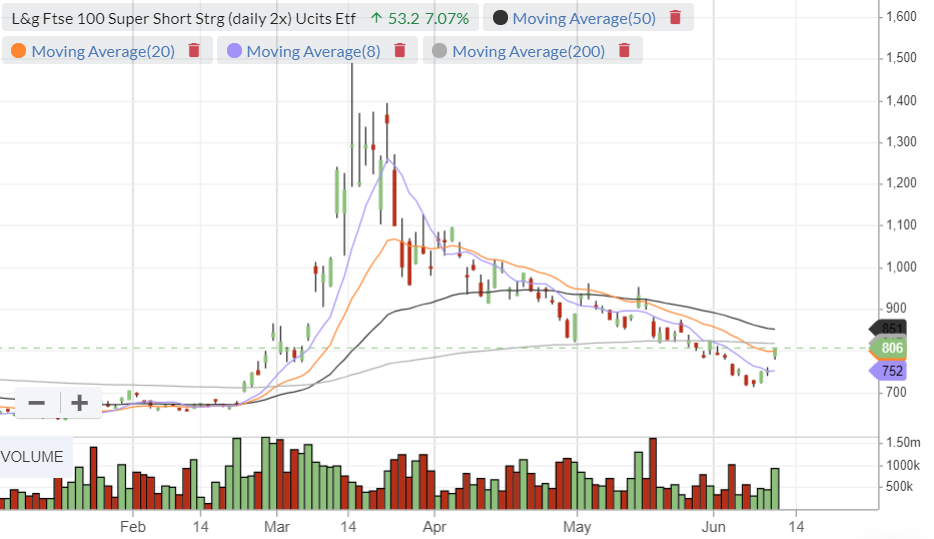
Here is a chart of SUK2. I bought on Tuesday, when I was stopped out of many positions and sold more, as it seemed that if the market was going to turn I would be well positioned. I could also put a stop in below the recent low, so that my risk was limited.
Here is the same chart of SUK2 with the FTSE 100 drawn across it. This gives us an idea of correlation.
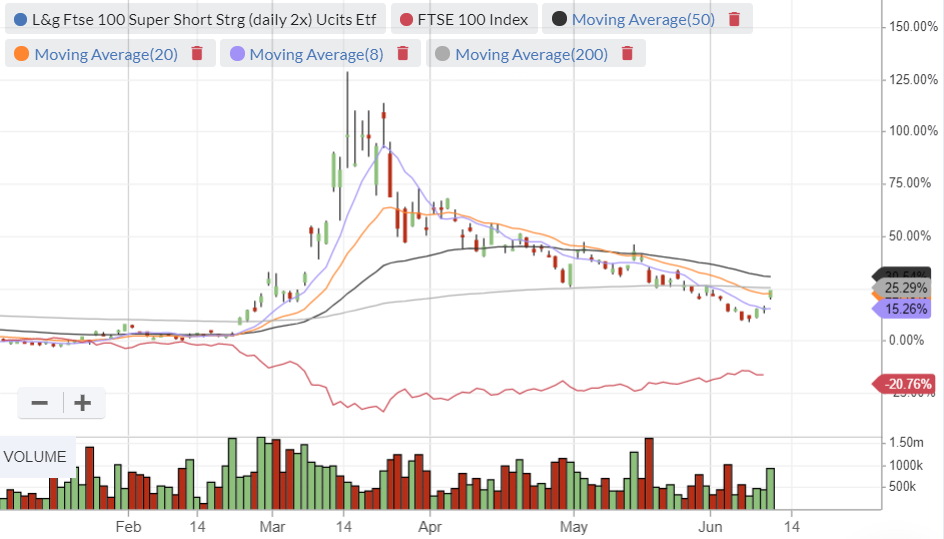
The correlation then is not what one may originally think it may be, and so it’s always worth looking into stocks deeper. It’s easy to think “Oh, this is a 2x short on the FTSE 100 – therefore I’ll make double what the FTSE 100 goes down by” but this is clearly not the case. This is an example of our heuristics bias. Mental heuristics can be good – for example, if we saw what looks like a bear in the woods, it’s safer to assume that it might well be a bear, quickly do a 180 degree turn, and jump onboard the Shoelace Express rather than sticking around. But mental heuristics in trading can be incredibly dangerous, hence the need to understand what we trade.
However, if you want to hedge, here are some things to consider for SUK2.
It’s available in an ISA, therefore all gains are tax free
There is no actual leverage on the product
If you want to hedge any investments, or want to put the cash to work, SUK2 can provide gains in a falling market
As long as you’re aware that SUK2 moves on market sentiment – like any other stock – and not its actual fundamentals, then it’s definitely worth becoming acquainted with SUK2. But for more correlated exposure, then shorting the FTSE 100 index itself should be your product of choice.
Of course, the best hedge for a trader is cash. It’s 100% correlated to the equity you’re selling.
Eco Animal Health
I bought into this stock ECO Animal Health (LON:EAH) on Wednesday due to its excellent trading update. The stock had the phrase “Group revenue and EBITDA expected to be significantly ahead of market expectations”, which means the stock is trading better than expected and now must price in the new information. However, sometimes you learn more about what a company doesn’t say, rather than what they actually say.
Notice that the company didn’t say that profit is significantly ahead of market expectations. Why? Well, one can only assume that the company didn’t is because profit isn’t significantly ahead of market expectations. Instead, we get top-line growth, and EBITDA. That’s good, but EBITDA is a theme park for discretionary numbers. So, who really knows how the company is performing? Luckily, as traders we don’t needn’t concern ourselves too arduously with such frivolous matters.
Looking at the chart, we can see that the stock has run up and is now tagging resistance.
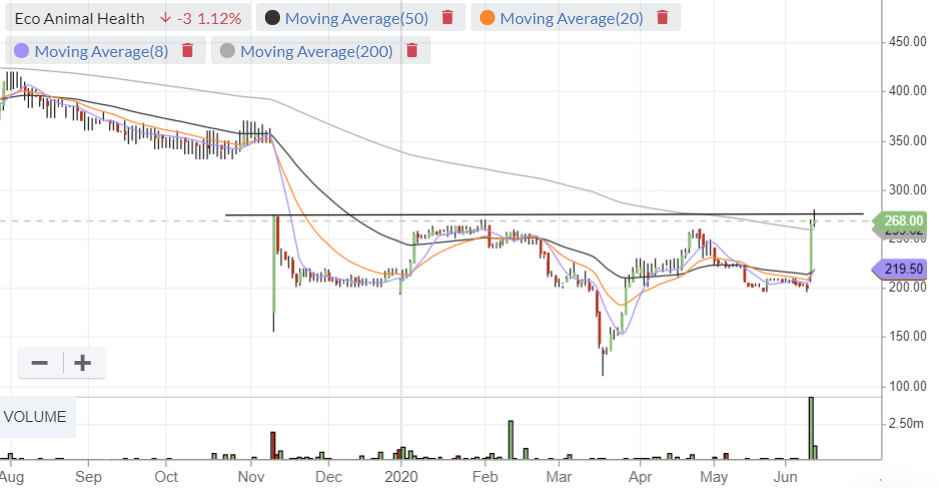
I’ve taken some of my position off the table, but would buy it back higher if the stock takes out this resistance. In my opinion, strength should be rewarded, as in a tough market strong stocks stand out.
However, rather than finding longs, I will be looking for stocks that are going to break down through previous levels of support to then try and short them. Stocks can fall quickly when fear strikes, and so this is why I like to short as the position can move quickly into profit. Risk management is key on all positions – but even more so on shorts, as an unattended short without a stop can be disastrous!
A nightly habit of mine is reviewing my positions, editing the stops, and thinking about what can happen. Taking the time to do this will improve your results over the long run. A day can be a long time in this market – never mind a week.
You can download your free copy of Ten Habits of Highly Profitable Traders from Michael’s website at www.shiftingshares.com
Twitter: @shiftingshares
Disclaimer
This is not financial advice. Our content is intended to be used and must be used for information and education purposes only. Please read our disclaimer and terms and conditions to understand our obligations.
23 comments
It seems this ETF is 2 X leveraged, but it moved 4 times the FTSE? I assume it's due to the volatility jumping? I use 3UKS, it's 3 X leveraged, but it moves very close to 3 times opposite to the FTSE.
ShiftingShares
Many thanks for this article. Although invested for many years this has been very educational for me, and have filed it for future reference
Thanks again
Steve
Great to hear, Steve! Thank you.
excellent post, thanks!
Here is a portfolio made up of 1 x FTSE and 0.5 x SUK2 (shown as π in the plot) from 2018-2019:
The volatility (σ) is 3.2 (extremely low) and the portfolio loses about 5% a year due to fees and rebalancing effects.
Now here is what that portfolio did so far in 2020:
The volatility of the portfolio is 29 which is huge for what should be an approximately market-neutral portfolio. However SUK2 would have provided a useful hedging effect during March-May if you had used it early enough.
Thanks for sharing Nick!
SUK2 is my proxy for shorting the markets. It has a tight correlation with the VIX. Narrow spread and good liquidity, but timing is crucial, as with all shorts.
SUK2 is available on Ig Index I have used it, but never let it run for more that 2 days.
Yes I think an extended holding period isn't a good idea, as someone else in this thread has JohnEustace has mentioned rebalancing.
Monevator doesn't like short ETFs:
https://monevator.com/short-etf-maths/
I have used £SUK recently. The SUK2 geared version is fine if the market falls smoothly every day but that doesn't often happen. If it whipsaws from day to day then the daily rebalancing messes with your return if you hold for any length of time. It's best viewed as a daily tool for traders. Over time it tends to zero.
spread bet is cheaper to short the FTSE100 etc and tax free profit. I wouldn't do it though with trillions of dry powder sitting around waiting for a home yielding higher than zero. Anyone who can time the fluctuations of this market is a genius or jammy, most likely the latter.
Michael, no offence but you probably need to explain that leveraged trackers dont track the indices because of daily rebalancing and the compounding effect that has. If the market is trending thats ok but volatility can wipe out your initial outlay. Otherwise we’d all be investing in the x3 leveraged index funds. SUK2 etc are only designed to be short term holdings.
https://www.proshares.com/fund...
It’s not a hedge. It’s a bet. . Good luck with it.
Hi maillotàpoisrouges - I did point out that SUK2 doesn't track the index by highlighting it on the chart.
I don't know exactly how the leveraged tracker calculates itself and in all honesty that's not my concern - I just need to know how it moves in relation to what it's supposed to track.
Hi Michael, another good post thank you.
Firstly I am glad to hear that I am not the only one with triggered stops this week. Whilst it still feels painful when they trigger, and obviously there are the usual "why did I not sell yesterday?" and "why did I not have a narrower stop?" questions in my head. As you keep noting you have to take the emotion out of the decision and remember this is protecting capital rather than hoping (against hope) that tomorrow will be a bounce - learning from things that just kept falling.
I would like to ask about adjusting your stops.
Simple example I buy 1000 shares of A1B2C3 @ £1.00. Initially I set my stop at £0.90 looking at trading ranges in the last month and being prepared for a 10% loss. The share typically has a spread of +/- £0.01.
Ideally A1B2C3 raises in price to £1.10, where I would normally raise my stop to £1.049, so tightening to 5% on the basis that I want to stop out with some of my profit. Similarly it raises further to £1.20, I would raise again to £1.14 though depending on what my target sell price was I might tighten my stop further to 2.5% hence £1.17.
Now for the more normal tale, which is the case here, I had a number of stops trigger this morning in the initial 08:00-08:30 turmoil, several of which have since bounced back comfortably above the stop value such as Revolution Bars (LON:RBG) £FEVR and £BP. .
So whilst I am telling myself to be calm and accept this as part of the process. I want to learn and see if next time there is something I can do better next time.
So taking A1B2C3, it has gone down in value and was at £0.92 at close. My stop remains at £0.90. You know with the spread and churn there is a risk that you will be stopped out in the morning, but also you feel there is a good chance of the market bouncing, how do you approach your stop?
Do you just hold firm and say my first decision was correct? As I could keep dropping and dropping the stop, and this is the first step in a slippery slope to a big loss.
Do you just sell at £0.92 and get out now? (obviously market has closed so a bit late for that).
Do you consider changing your stop? For example tighten to 5% but do this off £0.92 so your stop would be £0.874. So you risk a £26 greater loss if the slide continues but at the same time if there is a recovery you have a better chance not to be stopped out?
Whilst I know there is not a correct answer, I would appreciate your thoughts as someone who has been doing this a lot longer and a lot more successfully than me.
Thank you
Tom
ps. Do you think Mr Bezos has stopped out yesterday, or is a few $bn just pocket change that he does not notice?
Hi Tom - it's a good question.
Personally, I never revise my stops down.
This is because once I make this a habit it becomes very easy to lose discipline and start moving them down regularly. That's not something any trader should be doing.
Having a blanket rule of "never move stops down" means that you will never move your stop down. And you'll never keep moving a stop down and down until you're 50% in the whole.
Rather, consider this when moving your stops up. If the market is gradually trending, I'll keep them wide to avoid being stopped out.
However, if the market is volatile and I want to protect my capital I'll tighten them up. It is, of course, discretionary. It also depends on time frame. It's not often I'll hold a stock for more than three months.
Re Jeff Bezos - I'm sure he won't lose any sleep over it!
Thank you Michael
took a look at the long term chart for SUK2. And yes, it’s well named.
I am enjoying your posts Michael. I think I have a similar trading style to you.
Before the coronavirus outbreak I was using a blend of Stockopedia ranks, Zulu and Minervini, with "stricter stops" (hard to do!), technical chart analysis and a weekly tab on my personal performance.
Now I am concentrating on the technical chart anaylsis more as Stockranks and Zulu principles are not so useful.
May I ask which broker you use? I am finding that with Interactive Investor, (ISA portfolio), the automatic stops can often trigger way below my original stop values and it is dangerous to use them! My Spreadex account is far more accurate and offers guaranteed stops.
Many thanks
Marcus
Hi Marcus.
I am with Halifax. I don't recommend and I am in the process of researching my own move for ISA and Share accounts.
The standard text that they have on Stop Loss function, and I assume that Interactive Investor has exactly the same somewhere in the small print if you can find it, is that once the Stop value has been crossed your trade is automatically triggered and they will get the best market price they can at that point.
So if your stop was £0.90, it was £0.92 at close and in the opening trade the Market Makers are offering £0.86 then your stop will trigger and you will get £0.86. Painful, but this is part of my question back to Michael above on the setting and adjustment of stops. In a normal market day unless there is a big spike, e.g. a major seller or a Market Makers Shaking the Tree, you would get back somewhere around your stop.
The other parts which you have to consider are the liquidity of the share and the typical spread. If you are talking of British American Tobacco (LON:BATS) so highly liquid, high volume and usually small spread so you are likely to get somewhere close to your stop unless it opens significantly down due to say from a bad 07:00 RNS. If you are talking about Solid State (LON:SOLI) so fairly low volume, low liquidity and high spread then you are likely to get a long way below your stop when this stops.
The last part, whilst I do not have a Spreadbet account myself so this is not gospel, you don't actually own the physical shares, so you are not actually buying / selling so hence there is no transaction in the open market with the vagaries stated above. It is just an electronic algorithm so it just draws a line.
Thanks
Tom
Marcus - I think the Momentum rank can be useful in identifying stage 2 stocks. These offer breakouts and cup and handle trades so it can be useful getting these good stocks on our radars.
I use several brokers, I do a lot with IG and Spreadex, less with HL (probably going to move these funds elsewhere as I'm not the biggest fan). These are my main execution only brokers.
IG and Spreadex offer guaranteed stops, which is handy. However IG don't offer stops in SETSqx stocks in ISAs, which sucks.
IG's L2 Dealer is great for trading SETS.
Thanks Michael for the tips.