Trading the Trend - is it time to go long?

I’ve read before that you should never begin an article with a question, as it offers the reader a chance to say “no” and not read the article. But 1) I am not a journalist, and 2) this is a very relevant question for all of us.
In fact, it’s a question I ask myself every day as stocks fall further. Certainly the risk/reward is much better when shorting at the start of the move. But does that mean we shouldn’t short lower down? Should we be buying? Well, volatility often increases as shares fall further. This is all to do with human psychology.
When shares begin to fall, investors go through various phases.
The phases are as follows:
The “buy the dip” phase
The “this is starting to worry me and I’m not going to add yet” phase
The “wow, this is really tanking” phase, where investors begin to throw in the towel
The “I can’t take it anymore” phase, which is the capitulation stage
The first stage has historically proven a good strategy over the long term. Quality stocks are often correlated (over the long term) with rising share prices.
However, this builds a conditioning not only that every dip must be bought, but that every dip will also go up (similar to Pavlov’s dog). And whilst they usually do – we have seen share prices over the last ten trading sessions crater. It also increases complacency, which comes as a big shock when share prices fall.
Increased volatility makes investors nervous. Everyone loves volatility to the upside, but nothing is more stomach-churning than seeing large positions haemorrhage points. I had this experience myself in 2017, where I lost huge amounts because I had no exit plan. Unlike you, who are likely to be the owner of quality shares, I was the owner of absolute garbage.
Next comes the beginning of capitulation, where more and more sell, and prices fall further and further. Very often, stock prices overshoot both to the upside and to the downside.
This is because buyers are buyers because they think the stock is going to go up. And when it goes up – this is confirmation of their opinion. Therefore, they must be right, and so they buy more and others buy more too. This is why we get stocks like Versarien that trade at a market cap of £300 million – it’s a positive feedback loop.
And when it comes to the downside, we as humans are risk-averse. Rather than locking in a sure loss, we tend to take on more risk in the hope of “selling out at breakeven”.
But eventually, this becomes too much. People sell. Prices fall further. We reach the capitulation stage where volatility begins to increase, because when stocks move to levels that nobody had expected, people react emotionally. It’s usually this phase that I call the “puke point” – when the pain of loss is too much to bear. It’s the emotional stop loss.
To come back to the original question: is it time to go long? The honest answer is I have no idea.
I’m no expert virologist or global macroeconomist.
But what I have learned in trading the markets full time is that you have to trade the trend. Failing to respect this one basic rule means you’re gambling that this could be the bottom/this could be the top.
Look at Royal Dutch Shell B Class yesterday.
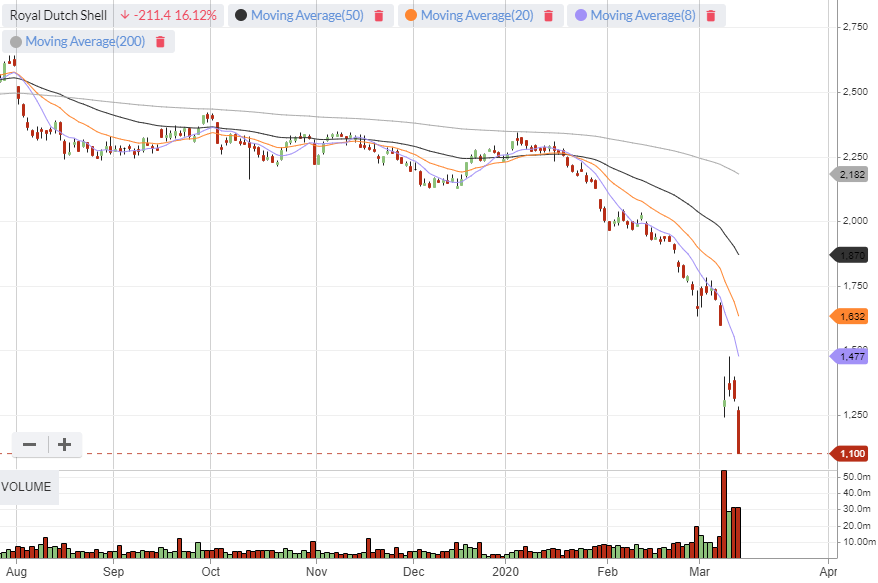
On Monday, we had the unprecedented oil move downwards (which almost certainly sent both individuals and institutions to the poorhouse), with many on Twitter claiming Royal Dutch Shell (LON:RDSB) was the ‘bargain of the decade’ or a ‘once in a lifetime opportunity’.
But it still puked another 30%, with the stock down 16% on Thursday alone.
I tried to trade this long twice intraday and got stopped out. I made a mistake because I should’ve flipped and hit the bid, and taken the short side. The trend is your friend for a reason.
Even now, with stocks having fallen by so much I’m still looking for shorts. I went short on various stocks on Thursday morning as the US halted European flights, and the stocks I hesitated because I was worried that they’d gone down too much fell even further.
The reality is this market could fall a lot further. But with Fear & Greed at 2, I think the only certainly anyone can say is that we are closer to a bounce than we were yesterday.
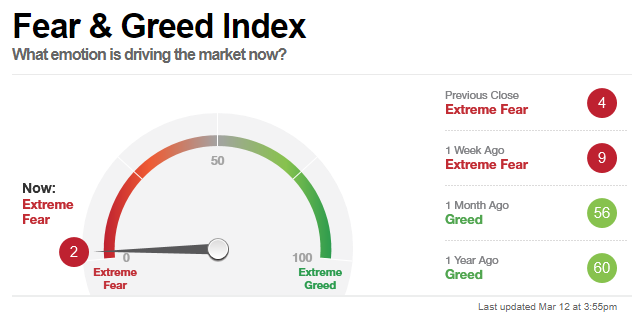
Stocks often revert to the mean, and with such a volatile downwards move, we are likely to see a big snapback rally. What happens after that is anybody’s guess.
For now, I’ll be trading the short side until the trend changes.
The stocks identified last week as avoids are all massively down. However, before I announce myself as the next Paul Tudor Jones I could’ve asked my baby niece to pick a stock that she thought would go down – and she would’ve been correct.
I still maintain that Marks And Spencer (LON:MKS), Card Factory (LON:CARD), and Restaurant (LON:RTN) (of which I am short MKS and RTN) are avoids.
Here is another stock that I shorted this morning: Domino's Pizza (LON:DOM) .
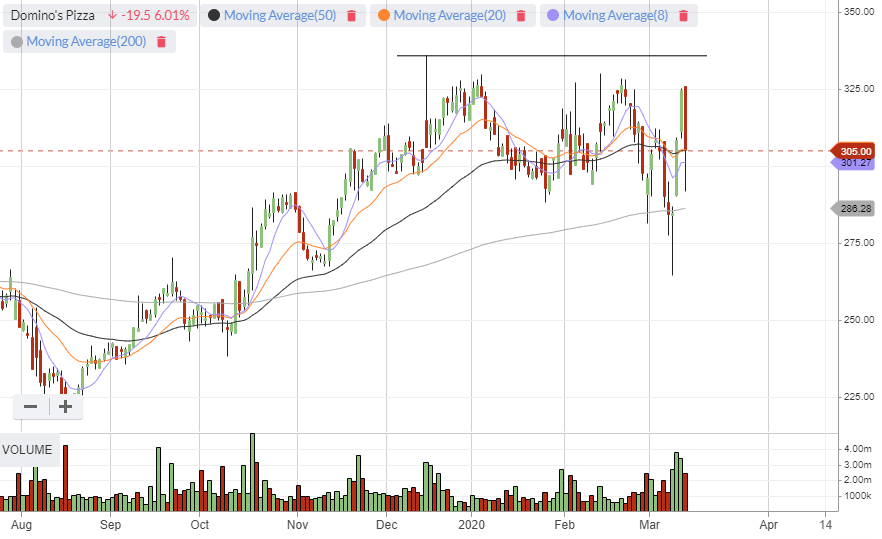
It’s odd that this stock has held up relatively well, but the Domino’s model is broken. It makes more money from product and ingredients than it does franchisees, which shouldn’t be the case. I think its fundamentally weak stock, that hasn’t seen much price movement. With President Trump’s travel ban yesterday evening, the green light was on for shorting anything and everything like fish in a barrel. I believe that this stock has further downside as, like many businesses, it will be hit hard by a heavy coronavirus outbreak which is almost certainly coming now.
I also don’t think that the market has seen that much pain yet. I wasn’t around in 2008, but people were talking about banks collapsing and money being worthless. Some people are talking of food shortages, but is it the same? We’ve had a huge lurch down in two weeks. The 2008 Financial Crisis lasted months. I don’t think it’s comparable. If you were around back then and have any stories to share, or know of any other good shorting opportunities, please do so in the comments!
You can download Michael’s free trading handbook from his website at www.shiftingshares.com
Disclaimer
This is not financial advice. Our content is intended to be used and must be used for information and education purposes only. Please read our disclaimer and terms and conditions to understand our obligations.
39 comments
If you are into TA then I think, that the market has turned the corner, when the price goes above the 200DMA, Just my opinion
If you're in for the long term (i.e. buying with at least a 1 year horizon), then how would you consider timing a long position in a market like this? Honestly with a long enough horizon it feels like any good quality stock is a bargain already (and likely to be an even better bargain in the near future). Would appreciate any thoughts or tips on how you think about it.
Its a great question David and I hope this thread will develop into a discussion on that. When exactly do we think the right time to buy is? (given that we know that we can't predict the bottom as we don't have a working crystal ball) what do we think the indicators for the bottom might be?
I have no current answer to this except that I think we are several weeks or more likely many months away from that point.
I would love to get the opinions of those on here maybe with some method to predict the bottom rather than just an opinion?
I have tried to give some indication with statistics.
There is an initial sell-off which when it reaches 20% attracts headlines because it is 'officially' a bear market. Then there is some kind of bounce, followed by other sell-offs and other bounces. We are about a month in and the average shown in my post is 27 days.
What is more important to retain is that the 20-25% drop is initially 'Support' in Technical Analysis terms but as time goes on becomes 'Resistance'. People sell at the -25% level just to get their money back, there are few buyers above that level.
After that 50% from peak to trough is possible.
In recent days I have bought and sold at profit in numerous issues, so there are already bounces. My profit is small but I keep liquid in this way for more falls and bargain prices. They are excellent companies, I am sorry to part with them so cheaply but in many cases hold on to core positions.
See my above response Carey - I don't believe in predicting the bottom. I think it's definitely best to wait until the bottom shows itself first.
I generally hold for at least 6 months. I am out of the market at present and am considering doing some buying. My rules are 1) Must be very good value 2) Need to have confidence that the business will still exist in 12 months eg No debts 3) The price has not been falling for about a week. A good plan is to develop a watch list of which companies you would buy when condition 3) above has been satisfied. This point tends to stretch my patience because I want to get on with buying some bargains. But catching a falling knife is not a good idea.
David - I don't buy for the long term, as in one year plus, so I personally wouldn't consider long term timing in a market like this.
The difficulty is that this crisis is hard to quantify, therefore it's hard to actually work out a fair and realistic value per share for a business - at least in my view.
If I were a long term buyer, then I'd look at the charts of the stocks. I'd wait for these to bottom, and begin an uptrend. There's plenty of time to get onboard once the trend is confirmed, and with a much lower risk too.
it's like trying to catch a falling knife.
Sorry, I don't understand it either, which markets are they and what are the numbers, please?
Critics of the new site take note: Those stats from Word and Excell could never have been reproduced on the old site.
Stockmarkets never reach a peak, or plunge from top to bottom in a straight line (see below). Be it a bull or bear market, there will be numerous peaks and troughs. Investors are a varied bunch, with different or even opposing philosophies which match buyers and sellers at the right price.
Some kind of bounce from the latest slump is inevitable. Predicting precisely when and by how much is difficult, however.
The Oil price. Some brilliant contributor published these stats in 2015:
:
Year
Event
Increase in oil price one year from low
1986
Saudi market share war
79%
1988
Oil glut
58%
1991
Global recession/Gulf War
5%
1998
Asian crisis
136%
2001
Global recession
46%
2008
Global recession
135%
Average
76%
Year
Event
Decline in oil price
Duration of decline
1986
Saudi market share war
-67%
82 days
1988
Oil glut
-44%
295 days
1991
Global recession/Gulf War
-57%
90 days
1998
Asian crisis
-60%
484 days
2001
Global recession
-53%
290 days
2008
Global recession
-78%
119 days
Average
-60%
227 days
Markets do not go down in a straight line. Some brilliant contributor published this early 2019:
Great article well done, I to went long on RDSB twice also- quickly learnt follow the trend.
Thanks Hardeep. Will be long again at some point but no point trying to fight bigger bankrolls than both of us here.
For me the COVID19 crisis actually feels quite similar to the 2008 financial crisis. Neither came out of the blue. Both were proceeded by disconcerting rumblings, which were widely ignored by markets for several months. Both seem to be unfolding quite slowly, unlike for example the 1987 or 1929 crashes (although I wasn't around for that last one!)
The oil price collapse feels like our Lehman's moment. It is similar feeling that events are out of anyone's control. And it is worth pointing out that the FTSE dropped to around 5000 immediately after the Lehamn's brothers collapse, but did not bottom out until 6 months later when it almost hit 3500. In other words, around half the market drop occurred after the start of the crisis!
I am not saying that markets will definitely fall further, but they certainly could. There are a several things that could trigger further market panic.
One is that global health systems become completely overwhelmed and people, mainly older people and the already infirm, will start dying because they can't get adequate treatment. Indeed, looking at Italy, this seems inevitable. Apart from beng a human tragedy, his will weigh very heavily on consumer sentiment.
Another is that the global tourist and hospitality industry is going getting absolutely crushed. There is a big question of how, not just airlines, but millions of small businesses around the world are going to survive a huge collapse in demand. Will Spain for example, need to ask the EU for some kind of bailout and if so how will the EU respond? And will other EU countries back such a bailout just at the point when their own health systems are in a state of collapse.
I also think that the UK government's response to the crisis is extremely risky in terms of global politics. As far as I am aware, they are the only government who are saying that the virus can no longer be contained and their strategy now is to delay its impact. Even if the containment approaches taken by other countries are inefffective, the UK's contradictory approach could result in it becoming a global scapegoat. It has the makings of an unmitigated diplomatic disaster, just at the point when the UK needs as many friends as possible.
It is for these reasons I am extremely wary. I reduced my exposure to stocks to 25% after the first 10% drop. That has now reduced to 20% without me even doing anything!
I think quite a few other countries are using delay tactics such as closing schools, cancelling events etc. South Korea, Italy and Spain certainly are and we may move to delay soon although there does seem to be so confusion now. The US is also using delay tactics, schools closed in some states, Broadway closed for 1 month. But the UK seems to be playing a waiting game, we will not do that yet, waiting is not a good idea, just look at China and Italy.
Great post....and I totally agree. I watched an interview on CNBC recently with Nouriel Roubini which also highlighted the likely continued negative impact of the virus and the continuing downward trend of the markets....
Interesting times.
How do you short ? Are you able to borrow the stock you are shorting or do you use CFDs or another method ?
The easiest way to go short is to use a spread betting site (IG, Spreadex, Spreadco etc) and sell instead of buy.
I use IG with spread betting and CFDs for DMA, as well as Spreadex for spread betting too, who cater for the smaller end of the market.
I found this article interesting until I read "Everyone loves volatility to the upside, but nothing is more stomach-churning than seeing large positions haemorrhage points. I had this experience myself in 2017, where I lost huge amounts because I had no exit plan."
Surely on a website like this it is possible to find illustrative examples. Without such context it will not be possible to evaluate its usefullness
I would have to revisit my trades from around 2017 23jez, but one in particular in Anglo African Oil & Gas - I was levered on that and they announced that the workovers, which had a 100% success rate - unfortunately did not succeed. It promptly tanked.
I don't know if it is time to go long but I have bought a few shares recently such as BP (LON:BP.) and Royal Dutch Shell (LON:RDSB), I thought there had fallen too much, there have halfed in the last 6 months or so. This oil price could be fixed quite quickly unlike CoronaVirus, this is a dispute between Saudi Arabia and Russia, it is not in their interests to be selling oil at these low prices for long. I'm also looking to buy back a few I did manage to sell before the crash such as Softcat (LON:SCT).
yes I have done the same and also bought £RRE. Just incredibly cheap at 700 although I paid more
I found the article interesting until I read this " Everyone loves volatility to the upside, but nothing is more stomach-churning than seeing lauoulullrge positions haemorrhage points. I had this experience myself in 2017, where I lost huge amounts because I had no exit plan."
Surely the resources available on this website enables you to identify a reference example. without this context the comment is not very useful.
23 Jez
Written from the perspective of a trader, Mr Taylor’s article has much to help the long term investor as well.
Before mid February you had a plan to anticipate the sudden bear market (did you not?) Appropriate asset allocations such that you could accept a large fall without selling out.
Clearly now is too late to sell further; but it is not necessarily the time to buy: this bear market may last until 2021 with further falls of 20% from here.
Mr Taylor has the skill to trade in and out taking advantage of volatility; as do many Stockopedia readers. For myself I shall wait until we have signs of the final turn, knowing you can never time the bottom; and then gradually buy in to high Quality stocks (via ITs). It will not get me back to the £p I had in mid February, but you play the hand the market gives you.
Clearly now is too late to sell further; but it is not necessarily the time to buy: this bear market may last until 2021 with further falls of 20% from here.
That the market may fall 20% from here is surely a great reason to sell.
Thank you Lawman. I never know when the market is going to change, but I do build that into my plans.
I gave a talk once where I said I'm not worried about a bear market, because I know where I'm getting out on every position, and my stops will get me out of the market. That's exactly what happened. Unfortunately, it took me far too long to start shorting.
I agree with you on timing the bottom. Nobody can do this, and I can do it short term looking at the chart, but never the absolute.
One possible indicator of the "bottom" could be when gold stocks, which had a lot of investment a month or two ago, then began to be sold. For me it was an indicator that those who held gold stocks and believed that they had stopped climbing, moved out and into cash to await the turnaround.
I was behind the curve so ended up with a smaller gain. However, switching to gold when stocks are vulnerable may be one way of avoiding going into Bonds which are safe but little else. So tell me I was just lucky?
I am only making Short trades for the last week Today I shorted RDI Reit (LON: RDI).
I like the comment ( the “puke point” – when the pain of loss is too much to bear. It’s the emotional stop-loss.)
The market going down so, ALWAYS trade with the trend. No one can tell when we reach the bottom, so keep shorting until we see an upturn.
I agree Terry. I'm not smart enough to predict what's going to happen, and I allow the charts to tell me what I should be doing and which way I should be trading.
Please can you explain the thinking behind your comment that
"The reality is this market could fall a lot further. But with Fear & Greed at 2, I think the only certainly anyone can say is that we are closer to a bounce than we were yesterday." An alternative conclusion could be that, because the F&G is so low, that we are much more likely to see further falls.
That's a fair comment WarrantStar. Usually, when the Fear & Greed index hits a low single digit number, there is a large bounce. So far, that has been the case. But nobody can ever predict when exactly!
I am in the Takeaway business and we are seeing increased delivery as people will stay in more. I think Dominos and other providers of Takeaways should do well while the panic remains.
They do OK whilst they have the staff available to work, once the virus kicks in they ll have lots of shops closed
Any idea how takeaway businesses are affected by the lockdowns in Italy, France, and Spain? I imagine they might be allowed still by governments to help people have food and at least some luxuries in an otherwise difficult situation?
According to this English language Italian website they seem to be mostly unaffected:
" Can I order a takeaway?
Yes. This was a concern for many of The Local's readers as the rules changed on Wednesday night, but the government has said home deliveries are permitted, and this includes cooked food from restaurants and pizzeries, as well as groceries from the supermarket, despite the fact that restaurants are currently closed to the public.
Many other food shops including butchers, fishmongers and gelaterias have also now announced a home delivery service.
You can't pick up a takeaway from your favourite restaurant, however - you'll need to call and request a home delivery.
Some restaurants and pizzerias have however decided to shut down completely on Thursday."
Is there not a risk that the deliveryman could spread the virus?
I hear Ocado is not accepting new customers.
Thanks for the scuttlebutt Manbre. As we can see the price has held up well, as it's currently 273p.