Trading the Trend - two telephony trades

This week I’m looking at two stocks that are in the business of telephone solutions. There is possibly a more technical and correct term for this, such as communication technology, but telephone solutions seemed to make more sense to me. Communication technology can be anything.
Loopup (LOOP)
The first of these is LoopUp.
Loopup is, according to Stockopedia, a “software-as-a-service provider of remote meetings” (there’s the more technical and correct term!). It’s the UK’s equivalent to Zoom and trading has been going splendidly.
The company announced its Half-year Report on 23 September 2020.
Here are the highlights:
- Revenue growth of 43% to £31.9 million at a gross margin of 71.4%
- EBITDA growth of 247% to £12.2 million at an EBITDA margin of 38.2%
- Adjusted operating profit growth of 664% to £9.2 million
- EPS growth of 1,164% to 13.9 pence
- Strong cash position as at 30 June 2020 improved to £8.3 million
- Materially-reduced net debt to £5.3 million
The company’s half-year ended in June. We went into lockdown at the end of March. I’d be willing to bet that leads surged once lockdown was confirmed. Remember, in January nobody cared about Coronavirus. Even in February equity markets were at all time highs. Then at the end of February came the brutalisation of many a portfolio and the general madness that ensued.
Here are two questions:
How well was Loopup trading in January when nobody cared?
How well could Loopup be trading now if the sales growth (which could be higher than stated) has continued?
However, these questions are for the more fundamentally talented. That’s not my bag, but I’d argue that it’s not completely unlikely that Loopup has continued to have a nice tailwind behind it.
Let’s look at the chart:
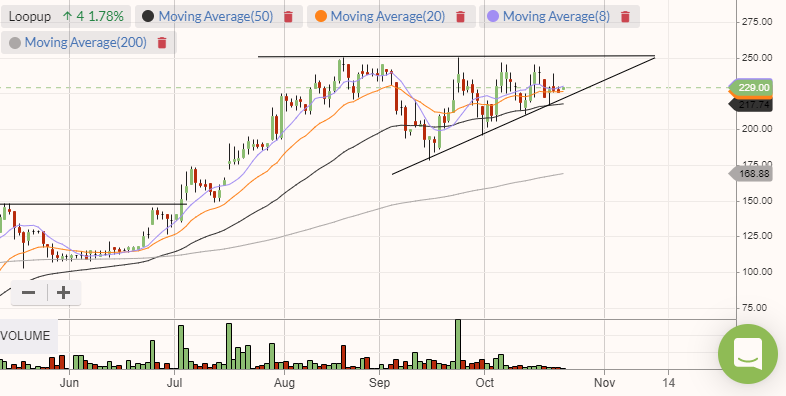
But to me this is starting to look like an ascending wedge. Notice how the stock has repeatedly failed to break out, yet the lows are printing higher and higher. That’s a good sign. It’s a good sign because that means there are market participants (traders and investors) watching the stock and bidding it up when it falls too low.
There’s currently a seller in the market, but what happens when that supply dries up? Hopefully, the stock will take out the resistance level and shoot towards 300p all being well.
We’re into multi-year highs here, and the business has some real momentum behind it. We only need to see what stocks like £G4M can achieve when the business fundamentals change and the environment becomes more favourable.
I currently hold a position in Loopup and want to add to this if it can break the resistance.
For anyone looking for a more fuller idea of LoopUp (LON:LOOP) and its fundamentals, Jack has written an excellent piece here.
Cloudcall (CALL)
Cloudcall has been listed for what seems like an eternity and never achieved much in terms of value for shareholders. That said, it’s been a delight to trade at times over the years. It’s one of those typical AIM stocks that you can swing trade every now and again but never one to fall in love with.
Here’s the chart.
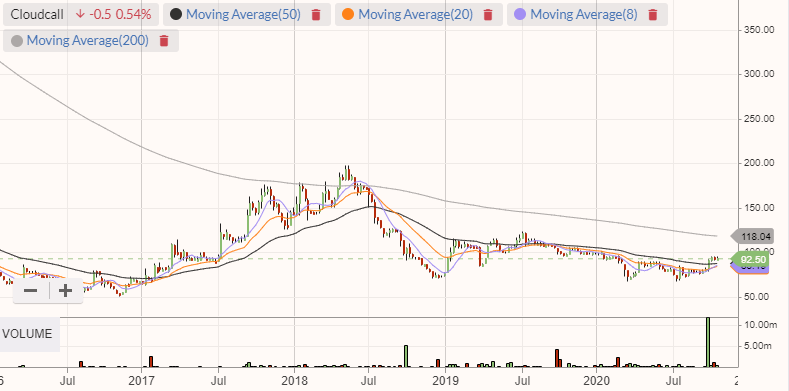
It goes back all the way to 2006 where the share price was almost 75x higher than the current price. I don’t know if that was the original listing for Cloudcall but even since 2017 there has been opportunity.
In the last year the stock has traded in what looks like a stage 1 base. This is an assumption of course, as we haven’t seen the stock yet stretch its legs and enter stage 2.
Last year, the company raised a huge amount of capital (£12m before fees) at just a small discount to the then-current stock price.
One of the main attractions of Cloudcall is its highly scalable business model. Last year in the pre-Covid world it was seeing a long-term value of a customer worth 7x the cost of acquisition. This meant that every £1 invested into customer acquisition the company was seeing £7 back.
However, we need to be careful as these are averages. Averages can be highly skewed on either tail, and so what may look like an attractive average may completely change if 10% of the sample is removed. Looks can certainly be deceiving.
Another point that was highlighted in the RNS and by Paul yesterday in his SCVR is that the company is seeing a sales to conversion ratio of 56%. Therefore, we can deduce that the company is targeting the correct customers for its product and that the product is appealing.
I think, if Cloudcall can continue growing and scaling, then it’s a multibagger. I already hold a small position here but would like to add on chart strength.
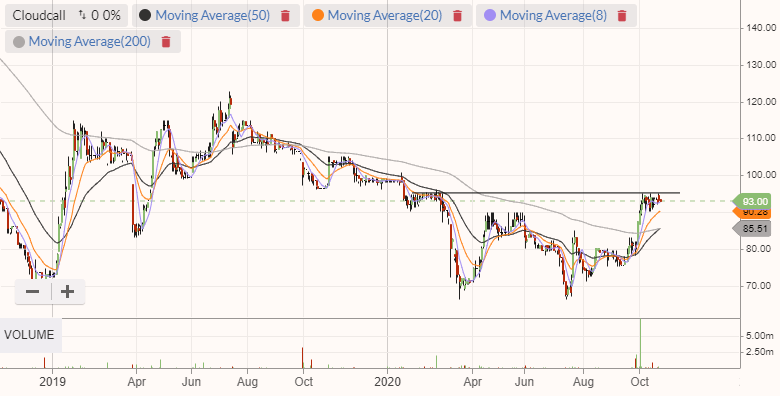
I’ve drawn a line where I see a key level of resistance. The raise was done last year at 100p, so it’s still below the placing price, and there is another load of resistance at 100p.
Ideally, if the stock can break 120p (120p a previous high with the stock almost double from the sub 70p lows) then I’d like to add to my position as this would give me confidence the stock is now going for a run.
You can download your copies of Michael’s books at www.shiftingshares.com
Twitter: @shiftingshares
Disclaimer
This is not financial advice. Our content is intended to be used and must be used for information and education purposes only. Please read our disclaimer and terms and conditions to understand our obligations.
6 comments
I don't study technical analysis so please forgive this naive question. Has the recent fall in share price for Loopup (LON:LOOP) destroyed the rising wedge analysis in this article and therefore greatly reduced the likelihood of an upside breakout?
Has today's news changed anything for anyone regarding LoopUp? Interesting conundrum. I personally think great value now for a semi permanent shift in working patterns.
Who do I loop into the Investment Club please??
CALL has good institutional support, unusual for such a small company. The spread is only about 1%, so tradeable. The CEO SimonCleaver started buying in 2012 and now has 852,000 shares 2.2% of issued capital.
Now since 14/10/20 also listed on the New York market. Looking at the chart, the Minervini fans will be looking for the next breakout to a new high. Worth a punt I think.
Hi zeibots,
I think that is better stated 'traded on A New York market' rather than THE New York market - as the OTCQX Market preserves Inheritance Tax benefits whereas a dual listing on NYSE would not. This is important for some investors planning ahead.
It'll be interesting to see what demand there is for CALL on this market.
Just wondering how much dilution has taken place over the last 14 years for one share to be worth one seventy-fifth of the 2006 price, and how well the directors of £CALL have prospered over this period. Earnings per share has been consistently in the negative and dividends absent. Yes, it could run if it has legs, that is.