UK retailers: Challenging bearish conventional wisdom

Conventional wisdom has continued to hold a bearish view of the domestic UK economy for some time now.
We have all heard about the bankruptcies on the UK High Street including Toys R Us and Maplin. We have also heard of the difficulties of a host of bricks-and-mortar retailers including Mothercare (LON:MTC), and more recently Dixons Carphone (LON:DC.) .
Nevertheless, there are signs of improvement in the outlook for UK households, and by extension, for UK retailing...
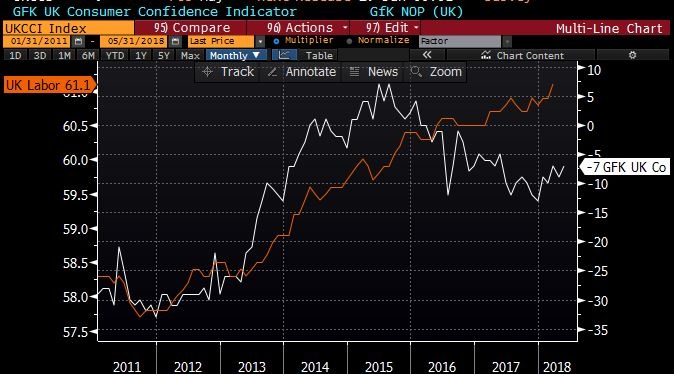
In the chart below, the white line representing consumer confidence shows quite clearly that confidence bottomed out at the end of 2017, and has been on a rising trend since then. The orange line demonstrates that the UK employment ratio (the proportion of the age 16+ population that is working) continues to rise, hitting a new all-time high of 61.1%!
1. UK consumer confidence is improving, UK employment still going up
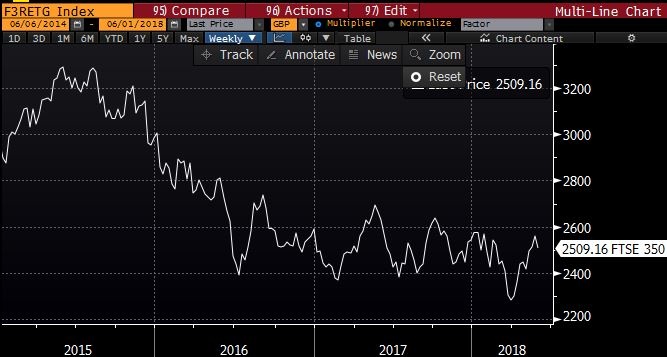
At the same time, we can also see that the UK non-food retailing sector as a whole has been bottoming out over the last few months, trading sideways since the mid-2016 Brexit vote.
2. UK retail sector no longer falling...
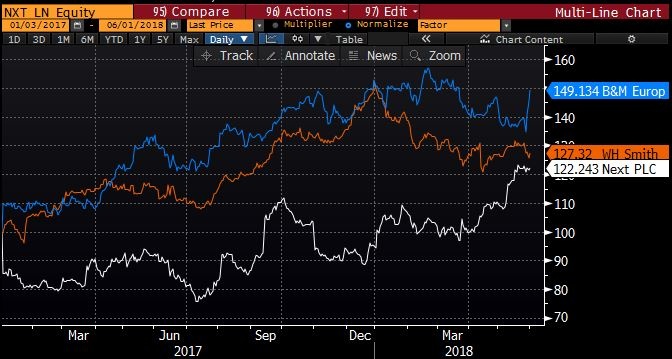
In particular, there have been impressive recoveries/growth in some of the better-run UK retailers such as Next (LON:NXT), WH Smith (LON:SMWH) and B&M European Value Retail SA (LON:BME) of late.
3. Decent performance since 2017 from Next, WH Smith and B&M
Perhaps most surprising of all is the performance of Dixons Carphone (LON:DC.) Despite a profit warning 2 days ago on May 30 and a host of subsequent downgrades from brokers, the Dixons share price seems to be remarkably resilient, rallying over 20p from the intraday low.
There is clearly value in the UK non-food retail sector right now, with attractive dividend yields on offer from Next, Marks & Spencer and Dixons to name but three. It is still an out-of-favour sector in general among institutional investors (frankly, the whole UK stock market remains out of favour among international investors thanks to Brexit uncertainty).
But I see value that may be increasingly realised thanks to a recovering domestic macro situation, the potential for mergers & acquisitions activity to pick up and the fact that investors are paid to wait by generous dividend yields, which are in general well-covered.
I have unfortunately been invested in Dixons Carphone (LON:DC.), so have taken a hit there but remain optimistic on the turnaround of Carphone Warehouse in particular, Next (LON:NXT) is well on the recovery path with more and I see recovery potential too both in Marks and Spencer (LON:MKS) and Superdry (LON:SDRY).
This is not even to mention the pure online retail plays like Boohoo.Com (LON:BOO), which should continue to take overall market share to fuel strong top-line and profit growth.
So perhaps a time to buck conventional wisdom and be more positive on UK domestic plays?
Disclaimer
This is not financial advice. Our content is intended to be used and must be used for information and education purposes only. Please read our disclaimer and terms and conditions to understand our obligations.
3 comments
Hi Edmun
An interesting set of graphs, thank you.
Picking up on the specific point you make about the online pure plays whereby you wrote .....
This is not even to mention the pure online retail plays like Boohoo.Com (LON:BOO), which should continue to take overall market share to fuel strong top-line and profit growth.
This article caught my attention whereby one paragraph highlights the sorts of transactional figures which are moving into mobile, in this case citing ASOS (LON:ASC). The paragraph explains ....
Brian McBride, Chairman of ASOS and former CEO of Amazon UK, stated that retail focus has shifted to the mobile phone. 70% of all orders received by ASOS come from a mobile device ASOS, 2017 and those retailers who didn’t recognize that shift were going to be left behind. Whilst you will be hard pressed to find a retailer who doesn’t have a web presence, not all retailers have been as quick as Amazon and ASOS to recognise the importance of the mobile phone app. The ASOS app has been installed over 11 million times since its launch (ASOS, 2017); that is a huge customer base.
The article is here comparing £AMZN and ASC approaches to online sales approaches.
http://www.cmg-change.com/insi...
Regards
Howard
Edmund. I Think that you make some good points. It's also worth bearing in mind that some of these retailers also have growing international operations.
I only hold two UK retailers, Next (LON:NXT) and Superdry (LON:SDRY) both have short term property leases and rapid growth of overseas/non store revenue on lower margins but a capex light model.
Don't intend to buy others in this space although I may consider the discounters who will hold up better in an economic downturn. If you think the High Street looks bad now wait until we enter a recession which will happen sooner or later.