Using an investment checklist to value Shell

We’re all feeling the pain of high petrol and diesel costs at the moment with prices at the pump hitting more than 150p per litre in some places. I know that some investors like to hedge their bets and own shares in companies that do well at the expense of the rest of us, so today I’ll be putting Royal Dutch Shell (LON:RDSA) through my investment checklist to see how it stacks up.
Safety of Principle
My first consideration is always safety. I don’t want to be taking on big risks and I don’t want to be kept up at night like Game Group investors, wondering if the company will go bust at any moment.
Diversity – Hold a diverse portfolio of diverse businesses
Diverse portfolio - One of the keys to staying safe is to stay diversified. I already hold BP shares in my portfolio, so I would need to think about whether I wanted to own another energy and petrochemical company. Generally I would say yes but that would be it. I wouldn’t want to own more than two very similar companies because they are often susceptible to the same risks; an example in this case would be falling oil prices.
Geographic diversity – This is also important, as it can help reduce the risks of being affected by a bad economy or disaster in one part of the world. Shell is a global company which has operations in over 80 countries, so it is very geographically diverse with about 40% of revenues coming from Europe, 30% from Africa and Asia and another 30% coming from North and South America.
Operational diversity - The final piece of the diversity puzzle that can be important is operational diversity which can aid operational robustness. What I’m looking for here is a company that preferably has many customers, suppliers, products and services.
What I don’t want is a company that relies on a single customer (like farmers selling to Tesco) or supplier (like a distributor who only distributes one company’s products), or a company that relies on one superhuman member of staff (like Berkshire Hathaway and Warren Buffett).
Looking at Shell, none of these factors are obviously a problem. There are many millions of customers, many sources of fossil fuel supply and 90,000 members of staff, none of whom could be singled out as being critical to the company’s success.
Quality – Own successful businesses
Another step on the road to safe investments is to invest in successful businesses. It sounds so obvious, but many investors forget it entirely when they unsuccessful businesses going ‘cheap’.
Market leading – Most industries have a market leading group of three to six companies that dominate market share. In the oil and gas business there are six and they’re known as the ‘supermajors’ and they include BP, Chevron, ExxonMobil, Shell, Total and ConocoPhillips.
Profitable – This is perhaps the definitive sign of a successful business, the fact that it makes money. To really be successful though this profitability needs to stretch back over many years. In my case I’m typically looking for 10 or more years of unbroken profits and, because dividends are a part of investor returns, I also look for a long history of unbroken dividend payments. Shell stands up to both of these tests.
Stable – Although stability is not a requirement for successful businesses, it’s certainly makes the life of an investor much easier when trying to value a company. Companies that have stable historic sales, earnings and dividend payments are more likely to continue that stability in the future. This makes it easier to work out what sort of return an investor might get in the future. It’s also much less stressful to own stable businesses and a low-stress, low-risk approach to investing is important to many investors.
You can see the results per share in the table below.

Other than the spike in 2008, those results look relatively stable to me.
Competitive advantage – Most companies that have lasted for more than a century and which are in the market leading group have some kind of competitive advantage. In Shells case it’s likely to be a mix of scale, brand and expertise, although I think most of their advantage is likely to be scale relative to any company that isn’t a supermajor.
Prudence – Look for conservative finances
No matter how good a company is, if it carries a lot of debt then it’s risky. Good companies shouldn’t need a lot of debt to operate well, so this is one risk that should be easy to avoid. The total amount of interest bearing debt on the balance sheet is currently just under £24 billion, which is about 3.5 times the latest adjusted net profits of £6.7 billion.
Generally I’m happy with anything where the total borrowings are less than five times earnings as this should be a manageable amount in the majority of cases.
Consistency – Avoid change where possible
Change is inevitable. It’s also one more factor that complicates the lives of investors. It’s a favourite tactic of Warren Buffett to invest in companies that will be doing in 2050 what they were doing in 1950, or as he put it “I don’t think the internet is going to change the way people chew gum”.
I like to break down consistency into three parts:
The past – Shell has been involved in the oil, gas and energy business since 1890 when the Royal Dutch Petroleum company was set up. Since then it hasn’t deviated significantly from that core business.
The present – There aren’t any obvious signs that the company is about to move out of energy and chemicals any time soon. My assumption is that they will stay in this business for as long as it makes sense to.
The future – It’s pretty clear that more people will want more energy in the future. From that point of view it’s likely that Shell has at least another 100 years ahead of it. However, those 100 years are likely to look very different from the last 100. With both peak oil and climate change looming, the next few decades should be a fascinating journey for anyone interested in energy production.
However, although I do think that both peak oil and climate change will have a massive impact on energy production, I still think it’s likely that the existing supermajors will dominate for some time to come.
Market beating returns
It seems pointless to me for someone to invest in a company that they don’t think will provide market beating returns. So now it’s time to look at what sort of investment Shell might be. There are three key drivers of equity returns (four if you include inflation) which I’ll go through one-by-one:
Growth – Most people think of the share price when they think of growth, so let’s have a look at how an investment in Shell has done over the last 10 years:
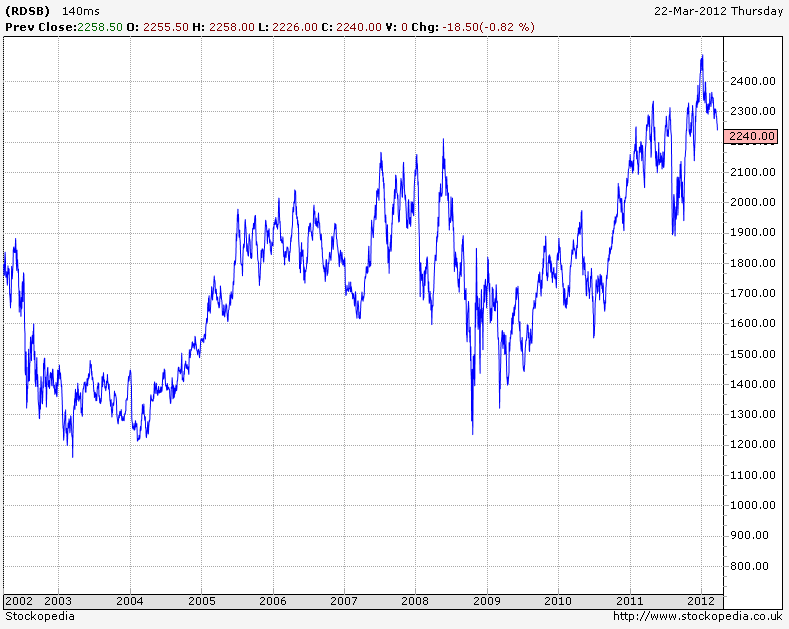
That’s not too bad. A rise from about 1,800p to 2,240p which is about a 25% increase, plus there will be dividends on top. However, historic share price growth is not what I’m looking for, in fact typically the share price of attractive investments will have gone sideways or even downwards over the past five or ten years.
What I’m interested in is earnings growth and you can see from the results table above that earnings have grown much more than 25% in the last decade. In fact they’re up by something like 80% in that time, which is around 6% a year. So while investors have seen the share price rise, the underlying company has in fact done much better than the share price alone would indicate.
The reason for the poor share price performance is valuation. Over the last ten years the valuation multiple that investors have used to value Shell has fallen, and in the medium-term valuation is the most important factor in what returns investors get.
Valuation – Today Shell is valued at around 12 times its 10 year average earnings. Ben Graham often suggested a sensible limit of 20 times the average earnings, so it’s well below that. In fact this valuation is well below that of most large companies. The 200 companies that I track in detail have a median price some 18 times their average earnings.
One of the most important reasons to look for low valuation companies is to avoid the fate of a falling valuation. Profitable businesses tend to have valuations that hover around some sensible level. At any point in time they might be valued too high or they might be valued too low, but eventually they reach a sensible price, if only for a short while.
If you buy on the high side, as investors did to some extent with Shell in the past, then future returns are held back as the valuation reverts to its average. If, on the other hand, you can buy when valuations are low, there is less chance that they will fall further and at the same time there is more chance that they will go up, adding to returns rather than taking away from them.
Buy low, sell high is a cliché for a very good reason.
Dividend yield – Dividends are an important feature of investments for many reasons, but mostly because they are always positive and in the long-term contribute massively to total returns. At the moment Shell is yielding just under 5%, which is a very healthy cash income from such a long-lived FTSE 100 company.
Just as important as the size of the dividend is its sustainability, and in this case there is no obvious reason why Shell should cut their dividend in the near future. In fact the company expects to raise the dividend again next year, much like it has for almost every one of the last 10 years.
Are market beating returns a reasonable assumption?
It’s easy to compare a company’s past and present results against the index that most investors are trying to beat. In the table below you can see Shell and the FTSE 100 go head to head in terms of 10 year annual earnings growth rate, price to 10 year average earnings ratio and current dividend yields.
On each of the three drivers of equity returns, Shell has the advantage; the growth rate is a little higher, the valuation is slightly lower and the dividend is almost 50% higher.
On the negative side I would say that Shell is a cyclical business and with oil prices still over $100 per barrel, times are good for now, but at some point the cycle will turn, high prices will have drawn in supply side investment and prices will drop. Or at least that’s the conventional thinking, but with Peak oil and China on the horizon I’d hate to try to guess the turning point.
Instead I prefer to stay diversified and buy good businesses when they look cheap by long-term measures, and for now Shell definitely fits that description.
Disclaimer
This is not financial advice. Our content is intended to be used and must be used for information and education purposes only. Please read our disclaimer and terms and conditions to understand our obligations.
10 comments
Thank you to all those who have responded to my question I now have a better grasp of some of the differences as Peterg and tournesol say it a bit more complicated than one might think. Anyway thanks for the pointers.
Not read this thread before.
Might I suggest that the person who started the thread and anyone else wanting to get their heads around any of the oil majors avoids the trap of looking at Shell et al as single megalithic businesses. Integrated oil majors are confederations of separate businesses which are linked together by surprisingly tenuous linkages.
The main headings/segments I would suggest are
1) Exploration
2) Production
3) Refining
4) Transport & distribution
5) Trading
6) Retail marketing
7) Speciality products e.g. lubes and chemicals
8) other - e.g. alternative energy
Typically each of these segments will, at any given time, be in a very different place in terms of its profitability, its future prospects and its risk profile. The fact that Shell sells petrol to 50 million motorists provides zero comfort against the risks inherent in oil exploration or the political risks bubbling up in far flung places.
So if you want to compare and contrast majors - as the OP seems minded to do with Shell and BP, then you need to get your mind around the relative weightings of each segment. A major which has no exposure to refining might be a very good complementary fit with one that has a major exposure there for example.
Then you need to get hold of the factors driving the profitability of each segment. High oil prices might be good for E&P but are bad for the retail sales division. Petrol stations have to pay more when the price rises. It has often been said that Petrol stations make more profit in absolute terms from sandwiches than they do from petrol. That might easily be true.
So if you figure out the weighting of each segment and the factors which influence its profitability and future growth potential, then you can start to make a reasonable attempt to compare them. But if not, not.
Picking up on just one detail, I would strongly suggest that applying simplistic non-specific benchmarks like P/E ratios to any resource company is both meaningless and very dangerous.
Consider 2 companies.
Company A has got 100 million barrels of oil in the Norwegian sector of the North Sea but has not started producing it yet, so has no income at all. Production will start next year and will run at 20,000 barrels per day.
Company B got 10 million barrels of oil in Egypt and has been in production there for some years. It currently produces 20,000 barrels per day but that will reduce progressively as the reservoir is depleted.
Which of those will have the most attractive looking P/E ratio?
Which is the most valuable?
Which is the most risky?
When it comes to oil or mining companies, it's never about the standard ratios, it's always about the reserves and the specifics. If you fail to get your head around those things then you'll expose yourself to risks you never considered.
Very true, as this article amply illustrates: http://www.fool.co.uk/investing/2014/05/12/play-the-percentages-with-bp-plc/
RDS seems to have two shares, RDSA and RDSB. I wish some one would tell me the difference between them and what are the points that would make one a better investment than the other?
RDSA = US dollar dividends.
RDSB = US dollar dividends converted to UK sterling dividends.
So currently as sterling is rising against the US dollar you might be better off in RDSA.
But this could reverse.
RDS seems to have two shares, RDSA and RDSB. I wish some one would tell me the difference between them and what are the points that would make one a better investment than the other?
Thanks
In short the RDSA shares pay a dividend, in euros, subject to Dutch witholding tax - the RSDB pay a UK dividend with no withholding tax, and a tax credit, in £. So if not Dutch based you are almost certainly better off with RSDB.
It's a little more complicated that in fact, and you can read up here:
boards.fool.co.uk/what-is-the-difference-between-the-two-classes-of-9815858.aspx
and here
shell.com/global/aboutshell/investor/share-price-information/difference-a-b.html
Peter
ee, there was a 3 page article in the 16th March MoneyWeek, about governments making a grab for oil and commodities. Says that "big oil" and the mining companies are finding it harder to hold onto their profits and that the problem of "resource nationalism will continue to get worse as oil and mineral prices go higher.
It gives a well reasoned switch into service companies. The author is James McKeigue . I know nothing about him. Do you?
Would you like me to send you the article?
MD
MD,
Don't bother unless there was something of specific relevance. The general comments you refer to are obviously true as a generalisation (though I'm not sure how service companies can prosper if their clients find times more difficult).
rgds
Buy low, sell high is a cliché for a very good reason.
I love Shell. However, I recently sold my holding at £24.70 having held it for almost 5 years.
Main reason being it has had a good run the last few years, more so in recent months as has the FTSE. But I do suspect Shell will surpass £24.70 somepoint in the future, I am readily prepared to buy back an even larger stake then I sold at the right price.
I can't stress this enough.........
In the time I have been Investing the single best way to make money is patience & the second is discipline.
It is always good to research quality companies, profitable with growth and dividends, low PE's low debt with a track record of cashflow year in year out.
Once these companies have been identified one just needs to be patient, wait for a tough period in the markets & then dive in.
Wait & Wait & wait......Until there is loads of optimism, a point where the stock & markets have had a good run & then sell.
I personally find it much much easier to make money from FTSE 350 shares. Unless your a carmensfella and have loads and loads of time to attend AGM's/Presentations etc then it is hard to get an edge IMO.
75% of shares lose money - and 9/10 Investors lose money.
http://www.fool.co.uk/news/investing/investing-strategy/2009/06/23/most-shares-are-losers.aspx
I recently bought Tesco, I will wait for a decent recovery at some future point & in the mean time will collect the close to 5% dividend.
In 10 years from now th population will be bigger, the financial crisis may have passed us, Online retailing will be a bigger business for Super market leaders Tesco & their International business will be bigger IMO.
In the interim all I need to do is Buy and wait....What may appear as small % returns initially, these can compound and magnify ones pot.
The trick is not to lose & the way you reduce the chance of losing is by buying solid quality businesses that have an edge, will grow and strong balance sheets.
If you learn how not to lose, you start to learn how to win.
Next time the FTSE takes a dip I intend to buy the tracker and sell during times like now....
I am currently hoarding cash awaiting a Greece default or something to happen in Europe or anywhere else that will make the market dip.
When you can do what the average investors struggles with like being Patient and having sufficient reserves to buy during market dips you start to make extraordinary returns IMO.
I am reminded of the rationale that was used some 15 years ago for buying M&S, post-Greenbury. I am also reminded of the rationale used by the masses in buying bank shares in 2002-2007.
Tesco is a supertanker of a company. If it has started to go the wrong way, it will probably take a long time to turn around. The stakes are very high - and their competitors have been catching up a lot in recent years. Tesco has seen massive growth from IT-related aspects that have boosted Clubcard-related customer targeting and have encouraged the use of the internet by shoppers. I think it is a very moot point whether the continuation of this growth can be accomplished without hitting margins.....
...and I also very much wonder whether the recent quitting of the head of their UK business is a harbinger of problems ahead. I'm not sure one wants to rush to buy into a mine that seems a nice, quiet business where the canary has just stopped singing...... ;-)
It may be a great deal safer than the banks were - but Marks And Spencer (LON:MKS) shares have twice fallen by two-thirds in the last 15 years, whereas Tesco (LON:TSCO) has hitherto enjoyed an almost unbroken 10-fold rise in its share price over the last 25 years. As happened with Rentokil (when "Mr 20%" suddenly stopped delivering the promised growth), a realisation that Tesco (LON:TSCO) hasn't conquered the laws of competition may come with a very big price - and a savage derating may yet have barely started!
ee