Value-Investing & Distress: Is there a point of no return?

One of the biggest questions lingering in my mind over the last few weeks has been one that I'm sure all value investors regularly struggle with. It relates to those companies that just keep going down. As value investing is inherently contrarian, these businesses often pose painful questions for us - as they present us with a firm that often looks incredibly cheap on a number of bases but simply keeps falling. Since I don't believe in any sort of market timing at all - thinking it more to be a backward-looking, data mining exercise, the thought of 'jumping on the bandwagon' - shorting the stock simply because it's going down - is ludicrous to me. That said, it sometimes feels like that's the way they're destined to go; like HMV, Game, or Thomas Cook Group, the three which sit in my mind most currently - see chart below.
Shorting the stock isn't always bad, of course; just foolish for me to do unless unless I find fundamental reasons to short the stock. My portfolio doesn't currently have any short positions - and nor do I plan to add any soon - but from a theoretical perspective, I have absolutely no objection to shorting a stock that you think is overpriced by the market. The trouble is, it seems to me, the set of tools I use to value stocks loses some of its predictive power when a stock heads into the death spiral Game, HMV and Thomas Cook look to have entered. Am I simply being lazy and looking for reasons to avoid valuing these stocks? Perhaps I am, but bear with me!
My valuation techniques, largely, focus on earnings. All of my companies were profitable last year (Barratt are a fine-line, but were profitable pre-exceptionals). The majority of my companies are conservatively financed, in my opinion. None of them have experienced particularly spectacular growth in the last few years - they are predominantly in industries likely to be defined by the market as receding, not growing. In some sense, then, they're on the 'easier' scale of companies to value. I don't think that's a bad thing, and nor do I make the jump to thinking that I'll be accurate because of it - but there is a reason I don't try and ascribe a value to tech or growth companies - I think it requires a completely different skill set entirely; one which I don't have, and I'm not sure many do.
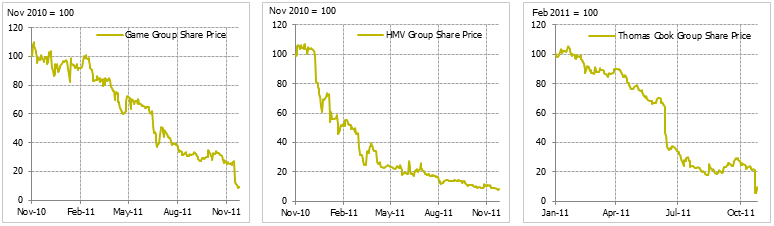
Think of this post as an open letter, then, as I'd love to hear you opinions as I conjure up one possible explanation. Is it the case, in exactly the same way it's foolish to use simply P/E and PBV ratios to value tech and growth companies, that these metrics lose any sort of relevance when companies go past the 'tipping' point in the mind of the market? Is the concept of a 'tipping' point an oversimplification? It seems to me that there is almost a cyclicality of reasoning in companies who are on the way down; equity investors won't invest on the basis of uncertainty in their lending, and I wonder whether lenders are put off by a company which has shed 70% of its value in the last 6 months. Both sides like confirmation from the other that the business is solid.
That said, though, if earnings and assets lose their relevance - as I have basically said above - what do we actually have left with which to value a business? The business is worth the discounted present value of future cash flows, the easiest proxy for which we have is earnings. How can earnings, then, lose their relevance? Maybe, as I posted in the second paragraph, I am simply looking for reasons not to invest in companies I have no idea how to value. I'm not sure that's such a bad thing, but there is always the possibility that I am missing a great deal of value here. It almost feels as if am buying into exactly the premise I so strongly reject - that herd mindset that scares us away from stocks on the way down and sees private investors so often load up on stocks just as a long bull market peaks.
Maybe the answer is staring me in the face - the fact that all three of these companies have huge obvious catalysts for the share price - refinancing arrangements. The capital structure of all three companies, if they survive, is likely to change dramatically, and that's not something I have any experience in. Market thinkers commenting on the scale of equity raises or debt refinancing deals elicit no opinion from me - simply because I acknowledge how little I know about how these things work historically. Is this most obvious explanation the best one? Simply that these stocks have passed through 'the value zone' and into the realm of investors who are able to accurately perceive the outcome of capital rearrangements? I'm sure many of my peers have that skill, but it's certainly one I don't possess, and may explain my ambivalence!
Disclaimer
This is not financial advice. Our content is intended to be used and must be used for information and education purposes only. Please read our disclaimer and terms and conditions to understand our obligations.
1 comment
An interesting article; I'm fascinated by your suggestion of a 'tipping point' and where it might be, but I'm sorry I can't help thinking that you are in some ways being over sophisticated in your fundamental analysis, perhaps thereby overlooking some of the simpler issues.
For example you say:' I wonder whether lenders are put off by a company which has shed 70% of its value in the last 6 months.' You bet they are!
Again, when we look at the companies you are discussing you seem mystified by the fact that their share prices have gone down so steeply, but baring in mind we may be going into another serious recession, look at them again: Game sells expensive computer games from high street outlets. The demand for such products blows in a fickle wind and the retail model is expensive and outdated. HMV is the same issue further down the slippery slope. How the hell did they not realise years ago that music and video selling (and stealing) was moving out of the high street and going online? A rabbit caught in the headlights springs to mind. Finally Thomas Cook, another type of product entirely, but again a big name caught in the expensive high street premises versus online sales quandry. Apparantly all holiday companies have cash flow issues in winter when bills are due and revenues not yet in, but to be out in your calculations by £100 million or so is surely rather more than a cash flow issue.
My point here is that in some complex balance sheet analysis of earnings and assets, there may be no obvious reason why these companies have struggled to attract investors, but if you stand back and take a look at how they actually function in today's market place the reasons become glaringly obvious... the business model has exceeded its 'use buy' date.
I think your theory is absolutely correct, there is a tipping point, but in reality it comes long before the share prices drop, and maybe even before the sales figures drop, it comes when market and consumer perception have moved on to something new. Initially its not in the figures at all, its just floating about in the ether, like a zeitgeist or spirit of the times, and that's why it's so hard to catch!