What's Happening with Extract Resources?

Extract Resources, the ASX & TSX listed Namibian uranium miner (ASX:EXT, TSX:EXT) part owned by Kalahari Minerals (LON:KAH) , released the latest drilling results on its Rossing South project on 21st May. Rossing South is the most significant global uranium discovery in decades and is likely to be amongst the world’s top 3 uranium mines once fully in production. For further analysis on Extract, see this: http://www.stockopedia.com/content/the-extract-complex/30317.
Extract currently has the largest mineral drilling programme in Africa underway, with 19 rigs deployed. Since Extract's last JORC resource statement in July last year, the focus has mainly been on infill drilling on the existing known zones 1 and 2. This is necessary to form the basis of Extract's DFS (definitive feasibility study) which is due in the fourth quarter of 2010. I have analysed the latest results and believe that they reveal some interesting new information.
New Drilling and Current Resources
Figure 1 below shows the locations of the drill holes listed in the latest release. Click on the diagram for a clearer view in a separate window.

Figure 1 - New drilling locations
Figure 1 covers an area of 4.1km East-West x 9.4km North South (it appears stretched east-west due to the underlying spreadsheet used to create the diagram). Each cell represents a 100m x 100m area. Where an annotation appears in a cell, drilling results have been reported for that cell (either in this month's release or previously). Cells coloured yellow represent infill drilling reported this time in previously drilled cells. Cells coloured green are "virgin territory", previously undrilled (i.e. new exploration). We can see that a significant amount of new explo has been reported this month. I have marked the approximate extent of the previously reported zone 1 and 2 resources on the diagram.
Note that the official JORC resources are 145Mlb U3O8e for Zone 1 and 122Mlb for Zone 2. An independent estimate [ref] ShareScene post by "BeerBaron" dated 18 Feb 2010 http://www.sharescene.com/index.php?showtopic=906&st=660 [/ref] of additions to those resources by drilling results released since last July suggests that the next official JORC declaration should include at least 173Mlb for Zone 1 and 164Mlb for Zone 2 - representing an aggregate increase of 70Mlb... but that's before new exploration is taken into account.
Findings of Drilling to Date
The following illustration shows what all the reported drilling to date has uncovered (again, click on the image for a larger view):
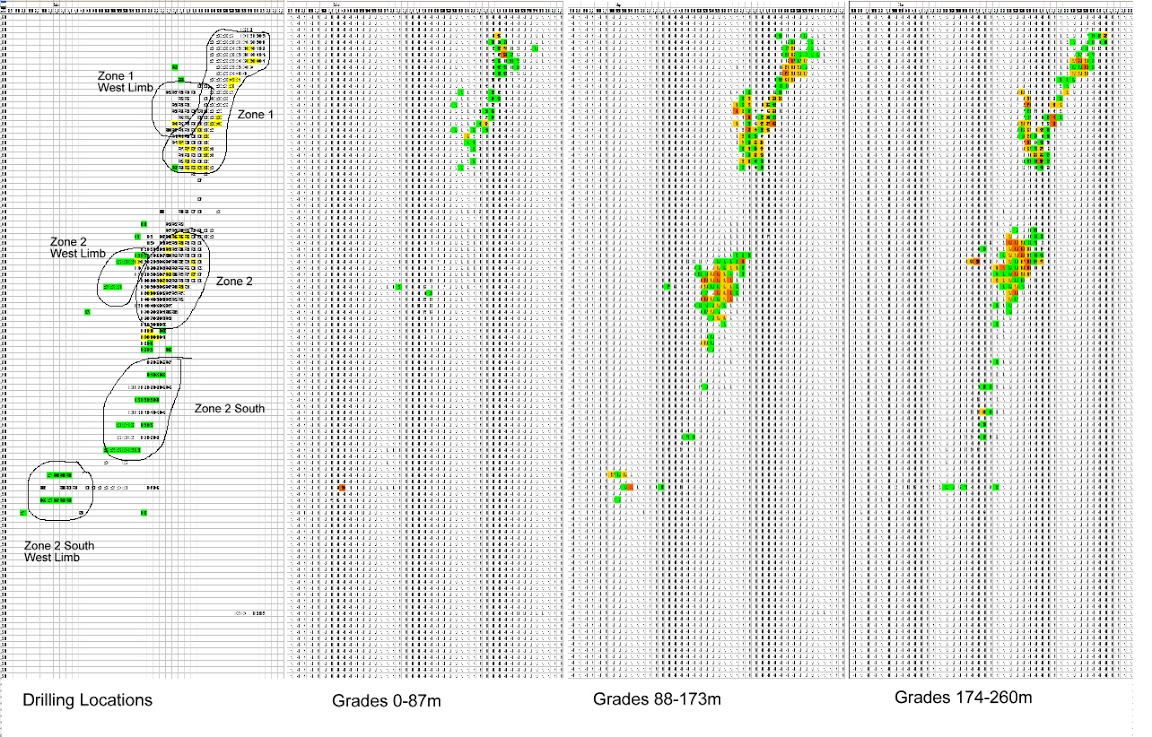
Figure 2 - Composite of drilling results
Figure 2 is a composite of four diagrams. These have each been scaled to be a good approximation of the 9.4km (N-S) x 4.9km (E-W) topology. The leftmost diagram is a repeat of the drilling locations as illustrated in more detailed unscaled form in Figure 1. Each of the subsequent three diagrams represents a slice through the geology with a 100m downhole thickness. Adjusting for the 60o drill angle, the true thickness of each slice is 86.7m. Cells coloured green in each of the slices contain an AVERAGE grade of 50-150 ppm U3O8e; orange cells represent grades of 150-300ppm; and red cells are over 300ppm on average. Any of these averagae grades is very good and likely to be economically minable. Grades averaging above 150ppm over an 80+ m thickness are exceptional for the ore type (Alaskite). The data shows further good intercepts below 300m downhole but I have omitted these to keep the composite manageable.
These results (when combined with previous statements made by Extract) have some interesting implications. Firstly, besides the original zones 1 and 2, four further areas of interest returning good grades can be seen:
- The west limb of the anticline containing the zone 1 alaskite deposits
- A similar west limb for zone 2
- A southerly extension to zone 2
- A west limb to that southerly extension
I have marked these on the "drilling locations" portion of the composite - you can mentally transpose them onto each of the horizontal slices.
None of these new areas of interest have been fully explored yet. Note also that several km of strike to the south of current exploration remains, as yet, totally unexplored - but has returned positive aeromagnetic signatures and Radon-X survey results.
Of these four new areas it appears that the west limb of zone 1 has been most fully explored - however, even this area requires significant further drilling with holes angled correctly for the west limb inclination to determine its extent + infill to establish continuity. In particular, it appears that some further holes may be needed to the east of those that have been currently drilled as there are several high grade intercepts immediately to the east of currently undrilled space.
The west limb of zone 2 has very few assay results returned so far but several of these have return good and exceptional grades at relatively shallow depths. Much more drilling is needed to determine the extent and continuity of ore in this area.
The southern extension of zone 2 mainly yields results at greater depths, including some at depths > 300m downhole. That suggests that there may be significant amounts of good ore there but at depths that mean that that ore is unlikely to be mined in the near future, so exploration of that area may not be a priority for Extract. OTOH, results from the "zone 2 south west limb" are highly promising, with good and exceptional grades being returned from all depths. Few holes have been drilled in this area, so again much more drilling/assaying is required.
What Does This All Mean?
Summing up, several promising new areas have been identified by drilling. Of these, only the zone 1 west limb has been adequately drilled to be able identify a meaningful resource. It is for this reason, I believe, that Extract has decided to delay the release of its next JORC statement to Q3 of 2010 and the DFS to Q4. There is simply so much to explore that time is needed (even with 19 rigs) to do an adequate job. I expect that drilling may now focus on the three west-limb areas, which may yield the most immediately bankable results.
Given these delays and a persisently weak uranium spot market, there has been little market interest in Extract, allowing its SP to drift downwards. That may continue, until the market wakes up with a jolt to the next JORC anouncement - unless one of the several parties that has expressed an interest or taken a stake in the project decides to pounce first.
Disclaimer
This is not financial advice. Our content is intended to be used and must be used for information and education purposes only. Please read our disclaimer and terms and conditions to understand our obligations.
8 comments
Hi All
Latest WH Ireland (07/06/10) Broker Note for Extract.
Regards
Steve
Extract Resources Limited
Buy
Price A$6.65
Target Price A$8.02
3-year Target A$12.37
Evident Scalability still Not Understood by the Investor
-Current 3-year target of A$12.37 ps
-Raised average Resource grade by 25% to 600ppm
-Lowered our LT U3O8 price 8% to US$55/lb
-Raised operating costs by 11% as a result of increased stripping ratios
-Additional US$25m in capex for pre-strip
-50% increase in production would result in a 3-year target of A$17.73 ps
As mentioned in the recent EXT quarterly, approximately 72km of both RC and diamond drilling went towards infill, extensional and sterilisation of Zones 1 & 2. There are now 19 drill rigs on site and we applaud management for its diligence in converting much of its Indicated to Inferred and Measured categories for the Definitive Feasibility Study (DFS), currently scheduled for completion in the 4Q10. However, it has become apparent that, as a result of recent diamond drilling, an over-reliance on the cheaper RC technique under-estimated the insitu grade by at least 23%. RC drilling, by its very nature, breaks up the rock into small rock fragments and dust, which is not considered a statistical issue when drilling a heavy element such as gold. But in an alaskite (the host rock), composed primarily of quartz (20 to 60% by volume), with the difference composed of alkali-feldspar, primary uranium mineralisation as uraninite appears to be highly susceptible to aerosol loss. If confirmed officially, it will be interesting to see how the
company will accommodate this issue in future resource calculations.
We also updated our assumptions. For instance, the arbitrage between the spot price and the long-term U3O8 price has increased by 7% over the past seven months to 42%. Even taking into account the relative liquidity of the market, it is too high given both carrying costs and commodity price spreads. We therefore hypothesise that the long-term price will decline from current levels (US$58/lb), lowering our LT price assumption to US$55/lb U3O8. As flagged in our previous note, we fully incorporated additional costs from the previously announced higher stripping ratios, coupled with slightly higher capex. Although our cost per tonne is no-longer within company guidance (~+11%) as released with the pre-feasibility study (~A$23.9/t), we await the DFS release, due in 4Q10, before we will review our figures.
We understand that the company is evaluating the option of building a 6km conveyor belt from Zone 2 to the existing Rossing mill, coupled with the development of their own processing plant. We believe that a toll-treatment option is clearly a sub-optimal outcome for all EXT's shareholders, with the exception of Rio Tinto, especially when compared with the opportunity of increasing capacity throughput to capture additional economies of scale and possibility of bringing additional cashflows earlier. For example, assuming a 50% increase in capacity, additional capex of US$200m coupled with scalar increases in opex and repayments, etc., the three year price target would increase to A$17.73 per share. If we increased productive capacity by 100%, additional capex of US$350m, the three year target would increase to A$23.25 per share. Although there is a risk that the project could inundate the primary market with supply, it is clear evidence that management should retain full control of this project.
Despite our three year target declining by 11%, we believe that investors have yet to appreciate the significance of the Rossing South Discovery and the ability of it to add to shareholders wealth. Our financial model is currently constrained by pre-feasibility output guidance. However, we believe that future optimisation studies will recommend greater production levels than currently anticipated, coupled with the prospect of mining higher-grade
portions of the ore-body to facilitate faster payback. We think this company to be very good value for a risk tolerant investor with a 5-year time frame.
Full Report
http://www.capmarkets.com/ViewFile.asp?ID1=138173&ID2=420391633&ssid=1&directory=12494&bm=0&filename=EXT_WHI_070610.pdf
Extract has posted a new presentation, given this week at the RBC Metals and Mining conference in Toronto: http://www.extractresources.com/DesktopModules/Bring2mind/DMX/Download.aspx?EntryId=3483&PortalId=13&DownloadMethod=attachment
Gratifying that Extract's official interpretation (slide 10) seems to match mine as shown in Figure 2 from my original article:
Cheers,
Mark
Hi All,
I agree and think the story was a plant, as the battle for ownership of Rossing South hots up. Here is an article that I feel clears the matter up (H/T to "Ugly" on another site): http://www.newera.com.na/article.php?articleid=11355
From that article, this is what Jonathan Leslie had to say:
Even more importantly, here's word from Epangelo, the Namibian govt's new vehicle for mining investment:
LOT's of parties are interested in Rossing South (which is why drilling it, to determine it's true worth, is the top priority for the company). ;0)
Just one final point, talk about "deadlines being missed" and licences being 3 years old is clearly misleading. The explo licence relating to Rossing South, EPL 3138, was renewed in April 2009 for a further 2 years: http://www.extractresources.com/DesktopModules/Bring2mind/DMX/Download.aspx?EntryId=3338&PortalId=13&DownloadMethod=attachment
Cheers,
Mark
APAC have taken their holding of KAH to 9.55% (21,585,392 shares)
This exceeds their committment to buy a minimum of 12.8m shares in the RNS from 4th May. It comfortably exceeds the total number of shares that KAH had to sell them (up to 16m).
Clearly, APAC are buying heavily in the market. I hope this means that KAH are buying EXT, expecially at EXT's current depressed price.
FWIW, I consider the comments in The Australian by Rosatom as being a last ditch attempt prior to some serious corporate action.
Best,
Chris
That was an interesting link on Rosatom - another one here which I hadn't seen before.
http://www.perthnow.com.au/business/russians-threaten-extracts-uranium-site-in-namibia/story-e6frg2r3-1225876458414
Thanks,
I don't think the Russians will get anywhere (but who knows with what's happening with BP in the US)
Kalahari have issued an RNS confirming my hypothesis
Chris
Kalahari have published their 2009 annual results this morning. They include this paragraph:
I believe that this is in line with my views (though I think they mean "western limb of zone 2").
It is also noteworthy that:
According to my records, that impies that Kalahari have bought around 1m Extract shares in the market since last November.
Cheers,
Mark
Thanks Mark,
I see that APAC Resources have taken their holding of KAH to 4.45%.
That's 2.2m shares bought since 10th May.
Chris