Which US Tech Titan is cheaper (and better) than it’s been in years?

Last week I wrote an article on America’s big tech companies in the wake of their second quarter earnings announcements. The conclusion: Apple, Amazon, Alphabet and Microsoft are fabulous businesses (even the latter two which missed their own and brokers’ expectations expectations in their recent numbers) but remain questionable investments with market capitalisations of over $1trn.
The article prompted a thought provoking comment:
So what is a Poor (relatively) Old (absolutely) Investor going to do? Keep his or her Core Portfolio in these highly liquid stocks or in UK small caps with wide spreads, stamp duty, commission friction, dangers of profit warnings, pumping, dumping, and corporate skulduggery?
It’s a tricky question to answer. High quality companies often come with exorbitant valuations and expectations of continued outperformance. If those high expectations are not met, investor disappointment can send the stock into a downward spiral.
The additional fear with the large cap tech stocks is that their bulk has propped up the US market (and in turn the passive investing universe) for so long that any excess selling could initiate a feedback loop which results in passive outflows and further share price misery. And that fear keeps many investors out of these wonderful businesses.
And so, we come back to the question: what is an investor to do?
Ed offered up a solution in the article he wrote last week. Rather than searching for perfect businesses which have excellent fundamentals, are riding the upgrade cycle but are not ridiculously overpriced, he has suggested investors should build a portfolio of stocks which together form an average which ticks all the boxes.
Here are the key statistics from his portfolio of top ranking stocks in the UK diversified across the sectors:

I have generated similar results when applying the same criteria to the US market - the only real disappoint here being the relative lack of yield:

So, in response to investors who worry how to construct a portfolio of wonderful businesses which have genuine momentum and aren’t over priced, the answer is simply to stop trying. Build a well diversified portfolio of decent companies which on average will give you an excellent portfolio.
And yet…
Using simultaneous screening to build a portfolio fails to acknowledge the individual attributes of the underlying businesses. Thus Ed’s article also prompted a very thought provoking comment:
I love the concept but, with a bit of poetic licence, this screen has me raising the Earth’s temperature with hydrocarbons (several times over), deforesting Indonesia, causing lung cancer, flogging used cars, surveilling the population, digging holes on the Russian border and profiting from the opiate epidemic. No wonder they’re all cheap!
It’s an excellent point. The stocks which make up Ed’s perfect portfolio in the UK and my perfect portfolio in the US have many questionable characteristics which may undermine their ability to continue to perform well. This mirrors a common problem with factor investing - it is backwards-looking in nature and fails to acknowledge the trends of the future.
Stocks for the future
So where should we be looking for the companies which can keep delivering in the coming years?
Perhaps the answer does lie in the US tech space.
It’s not hard to make the argument that the four $1trn companies are going to continue to dominate in the future. Even at Alphabet and Apple, where demand for digital marketing and iPhones (respectively) has shown signs of easing in the last few years, both companies are making strong inroads into new ventures.
All four companies have materially upped their spending on research and development (R&D) in recent years, with Amazon investing over £60bn in its last full financial year. That sort of spending reaps rewards for the businesses in the long run.
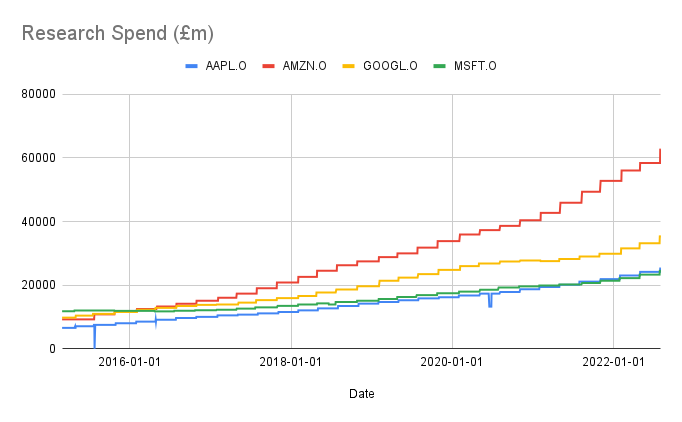
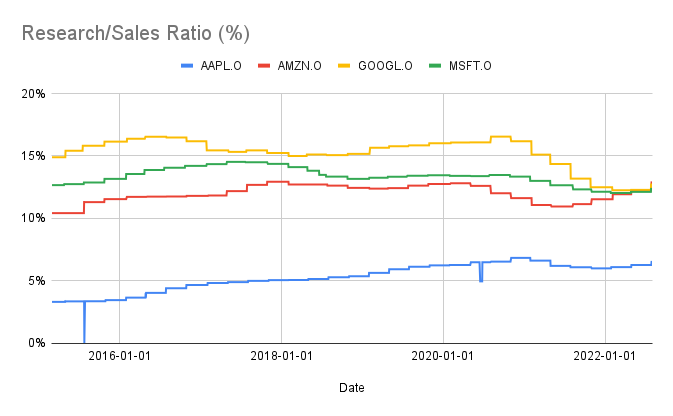
If we look at Alphabet’s expenditure since 2015 we can see that the company has consistently invested more than 15% of its revenue into R&D, with the volume only dropping off in the last couple of years. That drop off in percentage invested is more likely a result of spiking revenues (partly owing to the shift in marketing expenditure and demand during the Covid-19 pandemic) than it is falling expenditure, which - as we can see in the chart above - has increased year-on-year.
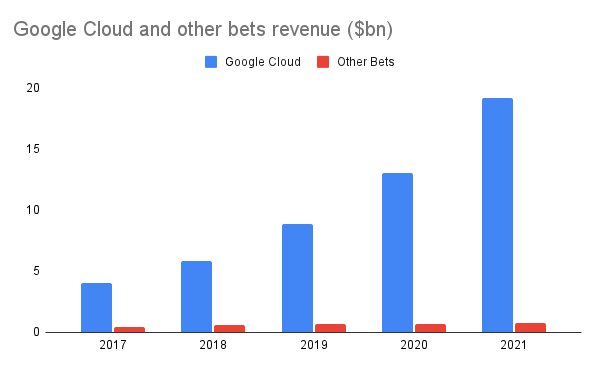
Looking at the revenue mix, we can see where this investment has paid off. Alphabet’s cloud business has grown and now accounts for almost a tenth of the global cloud market. The company is also investing heavily in ‘other bets’ including a couple of healthcare ventures and an AI company.
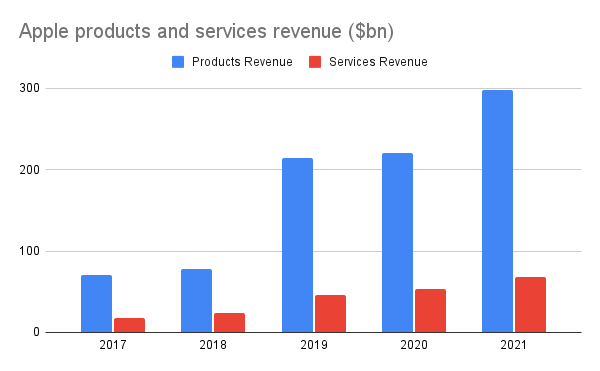
Meanwhile, Apple has invested heavily in its services business which contributed 24% of revenues and 40% of gross profits in the fiscal third quarter to June 2022. This shifting sales mix has had a positive impact on margins. Operating margins have crept back over 30% in the last few years. More significant is the fact that net margins have also crept closer to 30% - far more akin to a software company than a hardware company.
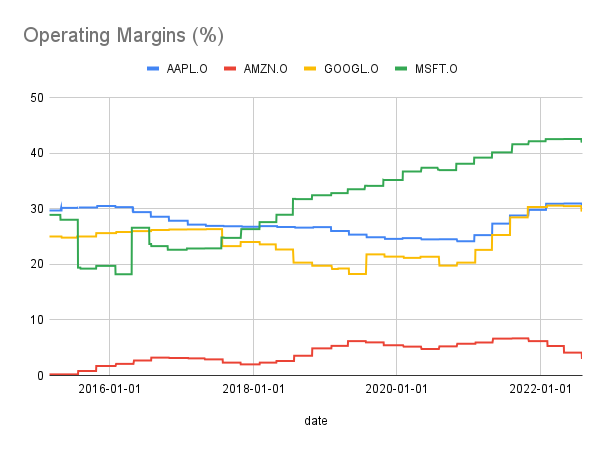
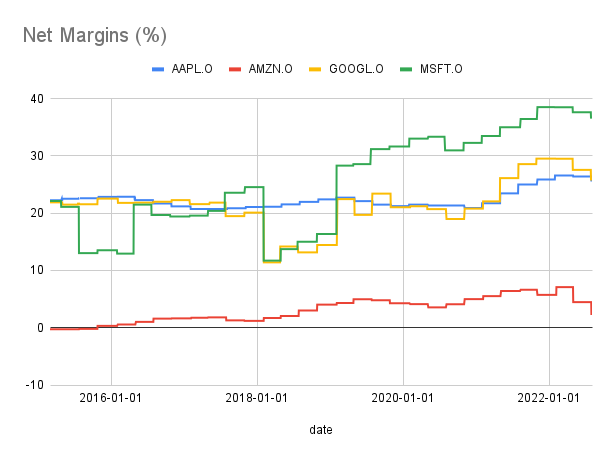
And talking of software companies, it is Microsoft where the most impressive margins in the big US tech sector lie. Net margins are just shy of 40% and Microsoft does a god job at converting its net profits into cash - which are in turn re-invested into the business. This means that Microsoft is also taking big strides in the cloud space and now accounts for 22% of the global cloud market - second only to Amazon’s web services business.
Amazon falls down in the margin comparison chart owing to its high asset turnover. While a rising proportion of revenues are coming from services (curtesy of the cloud business), Amazon remains predominantly a products business. It also has a mantra of reinvestment - profits are sent back into the business for expansion into many new fields.
Better companies than they were before
But we always come back to the valuation. For most of the last decade all four companies have traded on price to earnings multiples that make them seem out of reach for most investors. The exception is Apple which hovered around the 10x mark in 2016 when Warren Buffett added the stock to his portfolio - surely a contender for trade of the century.
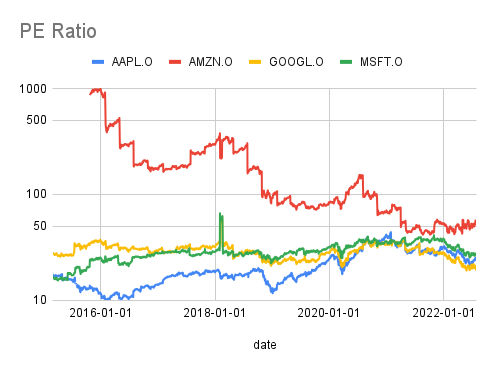
That said, with the exception of Apple, the tech giants’ valuations are not looking any more untenable than they were eight years ago - Alphabet in particular has come down a lot. That is despite the fact that these are all better companies than they were in 2016, operating at higher margins, generating more cash and investing more in their own operations to generate further growth in the future.
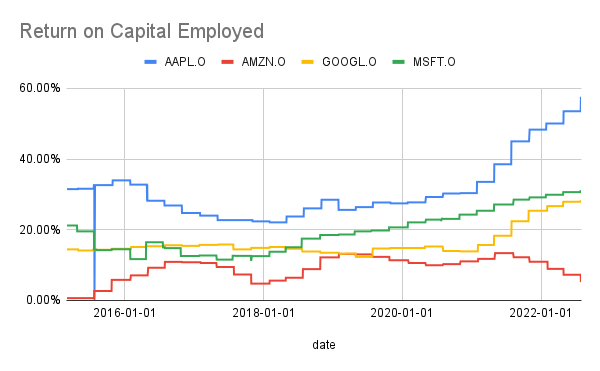
More important for investors is the fact that they are also doing more to generate returns for their shareholders as shown by the uptick in return on capital employed (ROCE).
What is an investor to do?
There is still no obvious answer.
But for investors who are looking for companies which are investing in products and technologies which have an exciting place in the world in the coming decades, the big four US tech giants continue to fit the bill.
And the valuation might be tough to stomach, but you’re getting more for your money than you were a few years ago. Especially at Alphabet which is my pick of the bunch.
Disclaimer
This is not financial advice. Our content is intended to be used and must be used for information and education purposes only. Please read our disclaimer and terms and conditions to understand our obligations.

5 comments
£TMT Interesting article a lot of US Tech Stocks have fallen significantly. One stock that is Uk listed which has a number of US Tech Stocks amongst it has also fallen considerably in the last year as chart will illustrate. Net Asset Value would appear to be very much higher than current price but hard to evaluate. Simon Thompson has written several articles extolling its virtues and values at higher prices than at present. I hold at loss at present, just wondering if anyone else has any views, would appear to be cheap per Stockopedia and qualifies for John Templeton Bargain Screen (Value Investing)
Megan I concur with your choice of Alphabet.
I bought last year partly because I listened to a very enthusiastic endorsement by Josh Brown on CNBC's Half Time Report .
At this stage in the economic cycle I believe value is the most important attribute to consider and Alphabet does show more value than the other Tech Titans. It will take a while before digital advertising reverts to its mean level but I believe that this is beginning to happen.
I understand Alphabet has given China a wide berth so it is unlikely to be too impacted by any future sanctions or continuing lockdowns whereas I think other Tech Titans may be more affected.
The lack of yield does not bother me as it eliminates the need to pay US withholding tax. In these circumstances I would rather funds are reinvested.
The closest competitor appears to be Microsoft but in their case I believe the potential is already reflected in the price.
Megan, I almost responded tartly to your last article when you described Alphabet as expensive. It’s lower priced than its index on an FY23 basis, which, when you consider the possible growth on offer, makes it downright cheap. So I applaud you taking a second, more nuanced look.
As for the quote, you’re welcome ;-)
Fantastic article - I own none and never have but have clearly missed out. Now however, I wonder if the biggest risk they face is regulatory - governments wanting some of the action and to avoid suppression of competitors. I see them mutating into regulated "utilities" somehow, with commensurate stable but not stellar returns (which is why they are all trying to diversify). Politics not economics is their biggest risk.
£Meta is the answer to your question.