Why Softcat will never be Alphabet (and that’s ok)

In 1996, two young men hunched over a big box computer in a messy dorm room somewhere in America. They were building a search engine called Backrub. Thankfully, they decided to rename it - I much prefer to “Google” things rather than “give them a Backrub”.
Since then Alphabet has soared to incredible heights, providing enormous value to the wider world.
Recently I’ve been looking at Softcat (LON:SCT), following on from VAR peer Computacenter (LON:CCC) 's recent bullish trading updates, but I’ve ended up thinking a little more deeply on the nature of competition and long term value creation.
I like both SCT and CCC. I think they are good at what they do. They are cash generative, liquid, and confident in their short and medium term prospects. Over the past five years, both companies have handily outperformed the market.
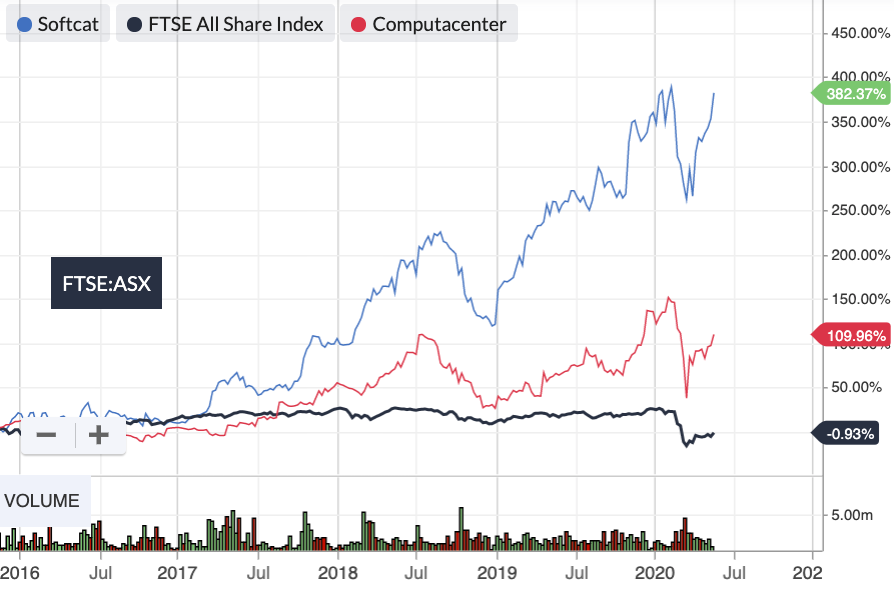
Softcat has a history of double-digit growth and market share gains. That said, here’s why I won’t be investing right now (although I can understand why others might).
Strong growth in a fragmented UK VAR market
According to Channelweb, Softcat is the number two UK VAR (value-added reseller) by revenue, just behind Computacenter - and it is catching up fast.
The group handles a company’s IT infrastructure and frees them up to focus on their core operations. It has won market share over the years with a simple two-pronged strategy:
- increase revenue from existing customers; and
- win business from new customers.
Here's the top 100 UK VARs by revenue in 2019 (CCC is red, SCT is black. Listed peers Redcentric and Adept Technology are orange and yellow respectively):
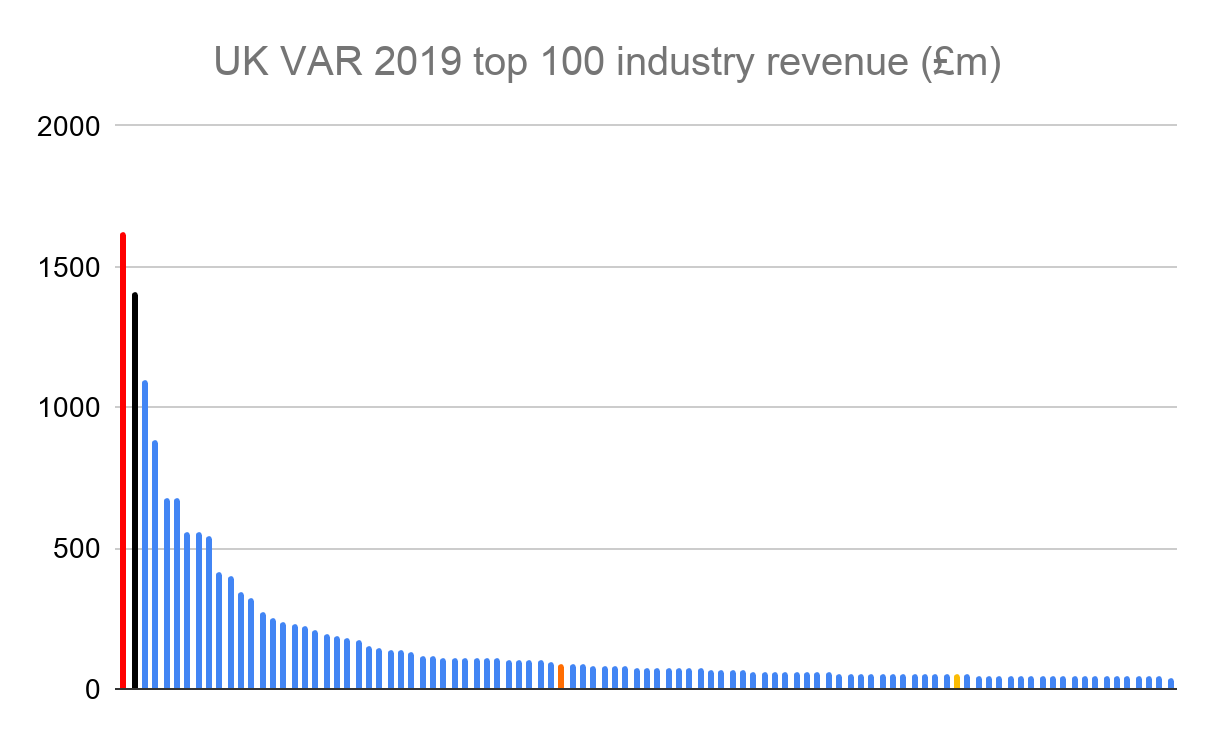
Competition is fierce and evolving all the time, but Softcat has a long history of taking market share and it says it continues to be presented with a “vast” opportunity.
Total revenue across the top 100 VAR firms added up to £17.2bn in 2019. Softcat generated just over 8% of this. I’m not sure this qualifies as a “vast” opportunity but perhaps it could still treble revenue or thereabouts before having to look abroad (as Computacenter has done).
Operating margins at Softcat are high single-digits and growing. Revenue is also growing consistently at double digits. When you get margin expansion and revenue growth at the same time, that can be a potent driver of share price growth - if those trends can be sustained for a decent period.
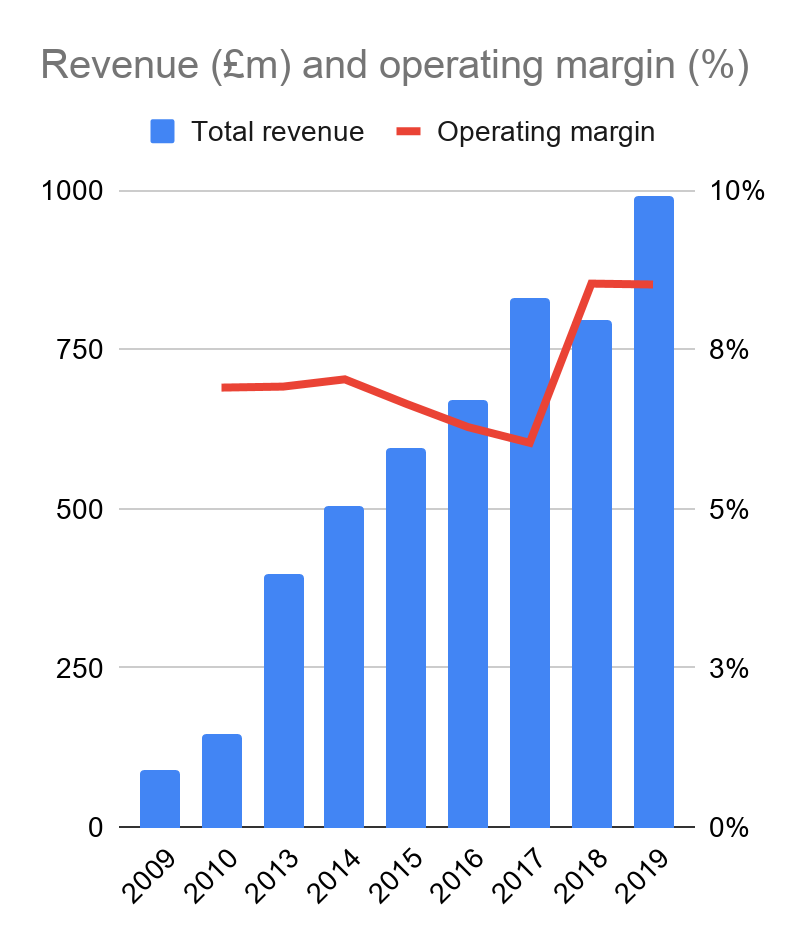
It certainly seems to be a profitable line of work - Softcat generates eye-catching returns on capital:
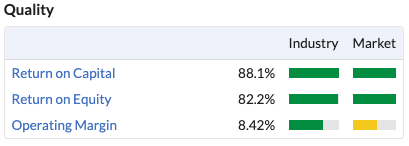
But what’s stopping others from seeing that and doing what Softcat does? Serious competition must be inevitable given these exceptional returns.
That said, Computacenter has managed to maintain stable profit margins for decades. Scale and learning curves are valid barriers to entry - and Computacenter and Softcat are number 1 and 2 IT VARs in the UK by revenue respectively. They generate and reinvest lots of profit every year - that must be hard to compete against, especially when coupled with industry know-how.
There are some differences between these two companies. Softcat is smaller by revenue but is growing faster, has higher margins, and its shares trade on a higher multiple. Computacenter has been around for longer, is growing more slowly, has lower margins, and is cheaper.
It’s notable that SCT is actually the bigger company by market cap when you consider CCC generates around five times as much revenue. Other listed VARs such as Redcentric and Adept Technology are far smaller.
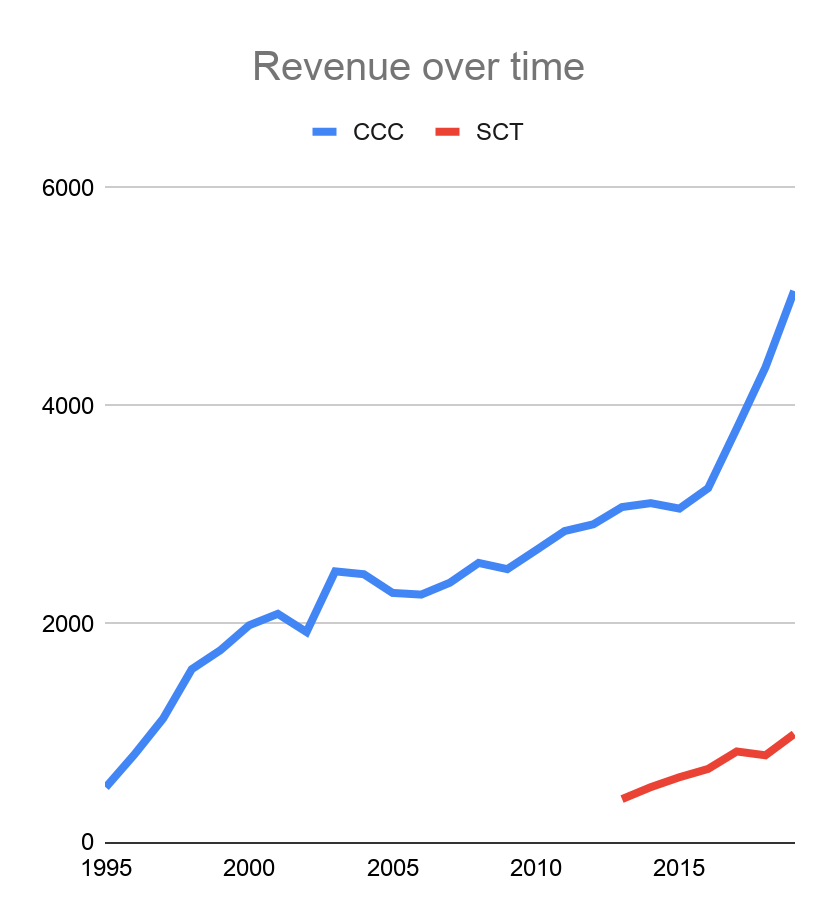
When you compare the above chart on revenue to its equivalent for operating profit, we do see that SCT is significantly more profitable than CCC relative to the revenue it generates. The gap between the two companies reduces dramatically.
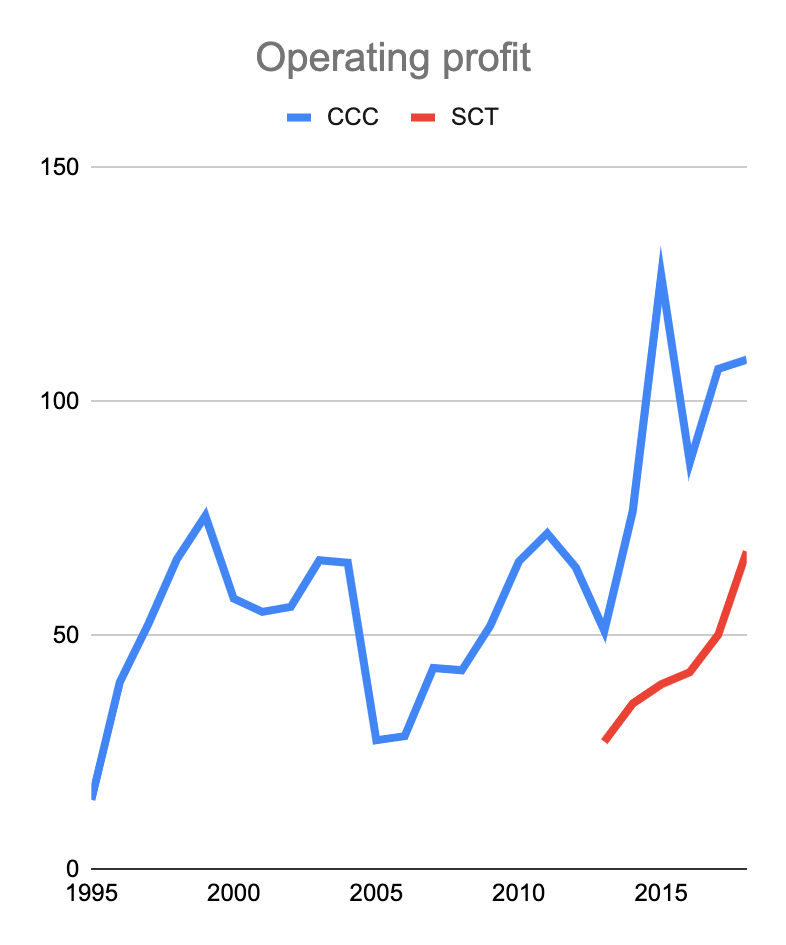
Softcat looks to have more than treble Computacenter’s profit margin - and while the latter’s has been steady for decades, the former’s seems to be increasing. This explains the difference in valuation. I am curious to know how Softcat can be so much more profitable than Computacenter.
Competition and potential margin pressure
The UK IT infrastructure and services market is highly fragmented and continually changing. Customer service is the only real differentiating factor. Competition is intense.
What’s more, new IT products may be easier for customers to set up and maintain themselves - commoditisation. “In the long run, everything is a toaster” after all.
Softcat’s gross profit margins have declined in the past as a result of the increase in revenue from public sector customers. It looks to me as though future growth might come at the cost of margin dilution as it courts lower margin (but larger) public customers.
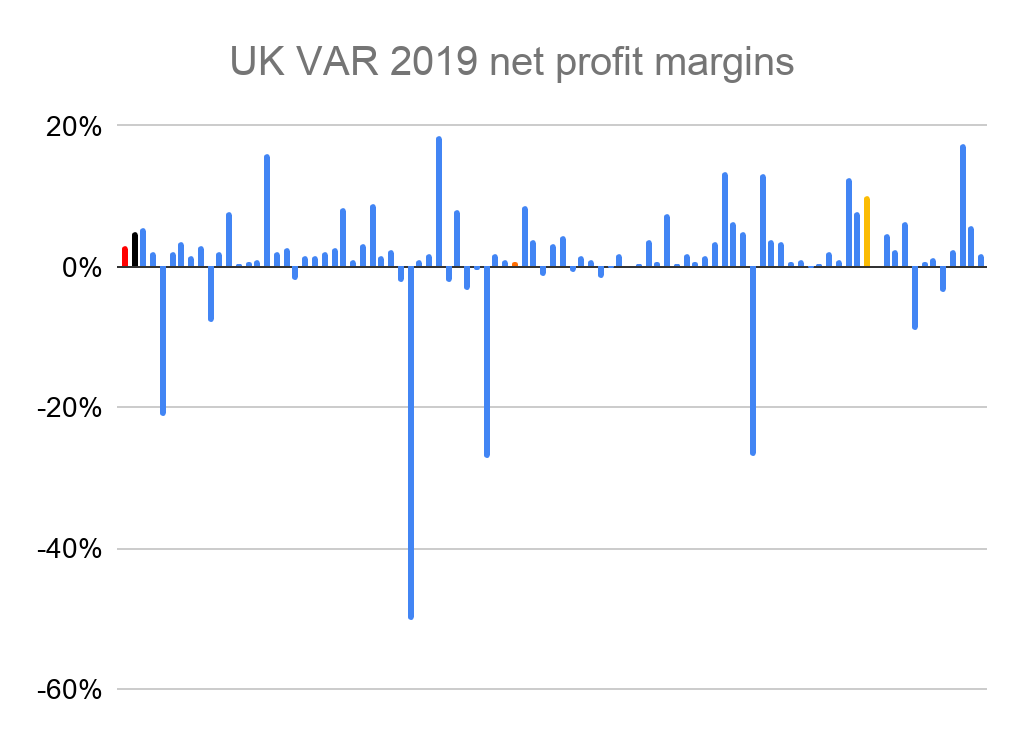
The chart above shows CCC as red and SCT as black. Only 15 or so VARs reported higher margins than SCT, and most of these had much lower group revenue. There could be plenty of growth left in the tank before this becomes an issue for shareholders, though.
Can culture be a moat?
One way to retain above average profit margins is to have some kind of economic moat - a structural competitive advantage.
Softcat makes a lot of its unique workplace culture. On its website, everyone is wearing converse trainers and t-shirts. It looks great but show me a company that doesn’t boast about having a “fun and vibrant” office environment.
I don’t want to dismiss culture out of hand - in Softcat’s case, it really does seem to be something worth shouting about. In 2020, it was ranked 5th on Glassdoor’s 2020 best places to work in the UK.
Still though, can culture be a long term moat? Can you earn high margins forever because you have created a fun working environment? I’m not so sure. Others may disagree with me here - I note that Keith Ashworth Lord holds it in the Buffettology Fund, which typically goes for companies with moats.
Perhaps you can maintain a truly exceptional work culture for long enough to spark a period of sustained above-average growth. But cultures shift and evolve all the time. They are not as permanent as people sometimes think. Every day is a battle between good habits and bad.
A good culture is highly desirable - it is not, however, a structural competitive advantage that can guarantee long term above average margins.
Alphabet and why I want moats
Let’s circle back to Google. Investing in Alphabet is an option, so we need to know why we should invest in CCC or SCT instead.
Which company in the table below would you rather have held since inception?
Company | Founded | Market cap today |
Softcat | 1993 | £2.4bn |
Computacenter | 1981 | £1.8bn |
Alphabet | 1998 | £775.8bn |
Building up a c£1bn company over a couple of decades is clearly an impressive achievement. It just pales in comparison to what can be achieved by that top tier of companies. A disproportionate amount of total wealth and productivity is generated by a thin sliver of people and enterprises. Alphabet clearly belongs in this bracket.
It has been so successful because it is so hard to compete against. Alphabet is a series of tech titans, each with their own economic moats.
These economic moats - durable, structural competitive advantages - are profoundly important to long term investors. They entitle you to a greater slice of the value pie over a longer period of time, greatly enhancing compound returns.
Thinking about moats can get quite abstract. There are a few different conceptual frameworks. A classic categorisation might include:
- Intangible assets such as proprietary technology, intellectual property, trade secrets, or strong brands.
- Switching costs - stickiness through standardization, from a lack of substitutes, through integrations to other apps and data sources, or because you have a valuable workflow.
- Network effects, best described by Metcalf’s law. You have network effects if each additional user of your product accrues more value to every other user. A good example is Facebook.
- Cost advantages. For example, being a lowest-quartile miner as a result of owning and operating superior assets.
- Size advantages, aka economies of scale. The bigger you are the more operating leverage you have which lowers your costs. This can become difficult to compete against.
The above is part of the reason why video games makers are attractive - because, with their own IP and proprietary engines they are well placed to earn a large slice of total industry profit. If you get it right here, I think you can truly win big.
Case in point: Frontier Developments is hitting new all-time highs after releasing a very encouraging update here.
Schumpeter’s creative destruction
Joseph Schumpeter once wrote in his diary that he aspired to be the greatest economist, horseman, and lover in the world. I’d like to focus on the “economist” part of that unholy trinity (for now, at least).
“Creative destruction,” he said, is the driving force of capitalism. The thinking was cold and clear: most businesses fall to competitive innovation. Obsolescence is the norm, but the general prosperity produced by the “capitalist engine” far outweighs the broken companies it leaves behind.
And amid this endless innovative churn, investors seek value.
How much of this value accrues to the innovator depends on how quickly it attracts competition. That’s why economic moats are so attractive - you hold onto excess profit for longer.
Graham wrote this great breakdown of what makes Alphabet so spectacular. In it he relays an exercise to think about competition. I’m sure there are a few variants of this but the one I recall comes from Pat Dorsey’s The Little Book that Builds Wealth.
Discussing eBay, network effects, and economic moats in general, Dorsey recounts:
I once asked a candidate applying for an analyst job at Morningstar what he would do if I played venture capitalist, gave him huge amounts of financial backing, and told him to go beat eBay at its own game in the United States. He thought for a minute and then replied, “I’d return the money.”
Good answer.
To build a sustainable and profitable business, you need strong defensive moats around your company. Softcat operates in an industry which is subject to continuous and fast-paced technological change. Competition will always be an issue in this arena - no matter how good you are.
I don’t think either SCT or CCC have moats - but they do have some structural growth tailwinds and large, fragmented markets to expand into. Prospects look good in the medium term, I think, and some might even say the pair’s leading market positions, scale of operations and reinvestment, and sector know-how are enough to keep them at the top in the long term.
VAR industry prospects
Here’s a rundown of recent VAR comment on market conditions. Given the commentary below, I’ve decided to include forecast PE ratios (for now).
Softcat (LON:SCT)
- Market cap: £2,470m
- Revenue: £1,080m
- F’cast PE: 31.7
- StockRank: 77
The second half has started well and to date we have not seen a material impact from the ongoing Covid-19 outbreak, although this does create uncertainty for the remainder of our financial year. Given the strength of our business model, lack of any bank debt and a strong cash position, we will continue to invest in our business and are confident in our ability to continue to build market share and drive profitable growth over the longer-term.
The group’s financial calendar actually shows the next trading update is on May 26th - so it will be interesting to see what the company says then.
Computacenter (LON:CCC)
- Market cap: £1,830m
- Revenue: £5,053m
- F’cast PE: 18.3
- StockRank: 95
We stated in our trading statement on 23rd April 2020 that current trading was more robust than we had anticipated at the start of the crisis. Since that date business has accelerated further and we have managed to secure some substantial Technology Sourcing contracts due to our ability to scale our operations to meet the demand. These incremental volumes mean that we now believe that the first half of 2020 will be considerably ahead of the same period of last year.
While things are a little clearer, continuing uncertainty in the market is such that the Board believes that it is still unable to provide meaningful guidance at this time concerning the second half of the year due to the COVID-19 crisis.
Redcentric (LON:RCN)
- Market cap: £168m
- Revenue: £208m
- F’cast PE: 15.9
- StockRank: 71
In the second half of March 2020 we saw a material increase in sales opportunities as a result of the COVID-19 pandemic. Demand has been particularly strong for increased bandwidth and, in particular, for our secure remote access product. As a result, the volume of new recurring revenue contracts signed in March was materially above that seen in previous years.
… Looking further forward, we anticipate a reduction in sales to new customers and a slowdown in major change projects from existing customers until such time as the COVID-19 crisis is averted. We also anticipate that some of our customers may come under pressure as a result of the COVID-19 pandemic and this may lead to delayed customer receipts and increased business failures.
Adept Technology (LON:ADT)
- Market cap: £54m
- Revenue: £57m
- F’cast PE: 6.9
- StockRank: 23
The Group has seen another strong year with further geographic expansion into Yorkshire... We doubt that the world of work will return completely to 'as it was before', indeed we anticipate a 'new normal' where remote working is more prevalent - increasing the dependence on effective, unified communication, highly resilient networks and cloud technology...
we expect to be well placed to address the changed demands that arise.
Overall, these comments from various VAR players suggest to me that they are currently experiencing a surge in business (which may fade - or decline if the wider economic situation deteriorates). The body language of key players in this sector is much healthier than in other pockets of the market.
Conclusion
CCC and SCT look like good businesses. Adept Technology is also interesting at first glance, given the strikingly low valuation versus its peer group.
In investing though, you can wait for your pitches and I question whether you need exposure to this part of the market at all. It is cut-throat and there are no obvious moats. That said, the “winners” (such as Softcat and Computacenter) are very cash generative with excellent operating track records of profitable growth. They are the two clear winners in a large, fragmented industry. Softcat has great momentum, and Computacenter's recent updates have been strong.
Given this backdrop, I think both CCC and SCT can continue to grow profitably for years to come - but they will need to continually reinvest profits back into their operations in order to maintain any kind of competitive edge. Scale is a real advantage here - few competitors can offer the range of services to end users that SCT and CCC offer. Perhaps this is enough to ensure longer term profitability.
There is still a lot of growth to come in the medium term from businesses migrating to the cloud and the ever-growing need for enhanced cybersecurity. SCT continues to report broad-based, double-digit growth across all its operating divisions - fantastic operating momentum - and I’m not about to bet against that now. We should be hearing more from the company soon.
That said, I see long term industry profits accruing more to IP-creating software creators rather than to the value-added resellers that pass them on to end users. I would rather look at the actual cybersecurity vendors, for instance, and there are a few of these around.
Disclaimer
This is not financial advice. Our content is intended to be used and must be used for information and education purposes only. Please read our disclaimer and terms and conditions to understand our obligations.

12 comments
My own take on this is through both Computercenter and Softcat as takeover targets post Brexit transition.
Imagine the UK outside of Single Market and with no future arrangement for Services. The UK's own internal market is sub-scale compared with both USA and EU - so margins lower for those UK market participants that have a UK-only domestic footprint.
With GBP now weakening against USD and EUR could both Comptercenter and Softcat become takeover targets for larger USA and EU based companies who want to tap the UK market via a wholly owned UK subsidiary? Then export USA and EU sourced service solutions to their UK subsidiary to gain additional returns. Increasing Value at Scale.
Jack,
Richard Bennard wrote a piece in February where I think he correctly identified the Softcat (LON:SCT) Moat:
Softcat’s biggest asset is its account managers, who help customers decide what to buy and advise them on implementation. Its strategy requires it to recruit and keep hold of good salespeople. The company, which has offices all over the UK and a handful overseas, will only open a new office when it has an employee to promote from within to run it. It only recruits salespeople at entry level, so they know their prospects will not be diminished by high-level appointments from outside the firm. In 2019, Softcat reduced its working week by 2 hours.
Thanks, I'll google around for that article. Always interested to get Richard's take on a company.
An interesting read, Jack... but I would not have said that either AdEPT Technology (LON:ADT) or Alphabet are fair companies to compare against as their product/services are quite different in my mind.
Jack
A very well constructed analysis, enjoyed reading it. My 12 year old daughter always asks about softcat because she likes the name. Probably not a basis for picking shares, but I have held it on and off but keep feeling the valuation gets ahead of itself.
I used your screen that you built and used on software businesses a couple of weeks ago. I applied it to mu US subscription and it came up with lots of interesting companies including Qualys, which I believe Smithson recently purchased for their investment trust.
Keep up the good work it is appreciated and used by me. (PS I always do my own research).
Best wishes
Greyster
Jack, Thank you for this really good piece of writing!
My strategy used to be to buy & hold quality shares for a long time. I used to spend ages analyzing companies and the nature of their moats. But my approach has changed. I don't hold shares for so long now because I sell everything if the Fear & Greed index takes a tumble, so as to protect my capital. So now I don't spend any time at all looking at the nature of the moat. If the ROCE and operating margin are fairly high and improving, or at least being stable, then I take this to mean that the company has some kind of moat, which will probably last for longer than my holding period will be. However, if the ROCE and operating margin are not high enough or falling, then I will not buy, or I will sell. The falling metrics may mean that the moat is being eroded. But, again, I do not spend any time examining the reasons for this, I just conclude that the company is becoming less attractive to own. A useful side effect of this is that I can quickly screen for what I want, rather than spending ages on qualitative analysis.
Agree. On furlough so can spend some time but when I get back to the bill paying day job then just need to churn maybe one a week and max holding of 12 stocks otherwise too many to keep track of - a chartist so spend hours studying 'rice traders' inventions.
Disagree. You do need to try and understand what they do, even and wide reading of everything out there. Thats the fun part. Not just spreadsheet analysis.
Newby so maybe just learning how to lose money. Plus 500 next.
HI Jack
Another very good article.
Keith Ashworth-Lord was quizzed on the Softcat (LON:SCT) moat on the recent PI call and responded by pointing out their high quality metrics. Which to my way of thinking is the wrong way around - a great company will have great ROCE, Op Margin, etc but you can have the same numbers without being a great company due to short term tailwinds.
However, the underlying trend is to move to web services. No start-up these days would even consider owning its own hardware or third-party software. I even know of banks who are trying to move into the cloud - which is a real challenge due to regulatory concerns and incredibly cautious compliance departments.
Both Softcat (LON:SCT) and Computacenter (LON:CCC) offer cloud solutions through Amazon Web Services so a lot of their future revenue will be dependent on their margins on that business and what they can sell around the edges. But the difference in growth rates is remarkable and, as you suggest, hard to explain.
A cybersecurity company review would be interesting. There just isn't much of any quality listed in the UK - Ncc (LON:NCC) and Avast (LON:AVST) are all that come to mind, although there are a fair few smaller operations providing simpler services. Qinetiq (LON:QQ.) , Bt (LON:BT.A) and Bae Systems (LON:BA.) all have substantial cybersecurity groups but none are pure plays. As usual, when it comes to tech, it pays to look West ...
timarr
Looking at what Microsoft are doing with Power Apps: https://powerapps.microsoft.com/ (low code solutions that require minimum knowledge, based in the cloud); i'm wondering how this will impact companies like Softcat (LON:SCT) and £CCC. It could have a negative impact on their services. Intercede (LON:IGP) & Kape Technologies (LON:KAPE) are another two companies dealing with cybersecurity
Thanks Tim,
Really enjoyed the lockdown post you wrote a couple of weeks ago.
I did catch that interview with KAL - they didn't dwell too long on SCT did they, but I remember walking away with the same impression. High ROCE alone is not confirmation of a moat (but is desirable and suggests there might be one if you start digging).
I'll add those cyber names to the list - also thanks Andy Sav for IGP and KAPE.
Any particular part of the market either of you have been looking at recently?
Great article Jack. In my humble opinion, a high ROCE but no moat company will probably not make a good long term investment due to reversion to the mean.
Any particular part of the market either of you have been looking at recently?
Hi Jack
Everything’s of interest :)
Although I don't invest in companies for dividends, it's interesting to see who’s still paying them. In my portfolio since the crash in mid-March the following have paid or declared increased or unchanged divvies: Unilever (LON:ULVR), Treatt (LON:TET), Spirent Communications (LON:SPT), Schroders (LON:SDRC), Rathbone Brothers (LON:RAT), Moneysupermarket.com (LON:MONY), Prudential (LON:PRU), Tp Icap (LON:TCAP), Aj Bell (LON:AJB), Cerillion (LON:CER), Avast (LON:AVST), Domino's Pizza (LON:DOM), Jarvis Securities (LON:JIM), Legal & General (LON:LGEN), M&g (LON:MNG), Pearson (LON:PSON), Reckitt Benckiser (LON:RB.), Relx (LON:REL) and Sage (LON:SGE).
A few companies there supplying consumer essentials and the rest of them have businesses that are primarily internet / mobile based. The latter have attractive economics if they have hard to replicate business models - asset light with low capex, good operating margins and most of them have net cash or very low levels of debt. A lot of financial companies there too – insurance, fund managers and stock brokers were among the first to digitise and have business models unaffected directly by lockdown.
Anything that supports home working, telehealth or home based socialising is of interest but that’s so obvious there’s not much of any value around. But I'm also looking hard at businesses that fulfil the remote operations criteria in sectors that are currently furloughed - for instance: travel agencies (On The Beach (LON:OTB)), estate agencies (Rightmove (LON:RMV), Purplebricks (LON:PURP) ), education (Pearson (LON:PSON)) and car dealerships (Auto Trader (LON:AUTO)). The economics of their real world competitors look seriously damaged as and when normal service is resumed.
The disparity between the valuations of some online companies and their furloughed equivalents now look stretched - Boohoo (LON:BOO) is on a PER of 54 and Next (LON:NXT) is 11. Both of those look wrong. I don’t have a huge amount of confidence in a lot of asset values right now – if companies move to home working at the same time as swathes of the High Street go bust then commercial property values will drop – and, if there’s a switch to residential, a lot of housebuilders will see write downs in their land banks.
However, there’s a price for everything – J Sainsbury (LON:SBRY) on a PE of 9, a P/TBV of 0.6 and P/S of 0.14 looks anomalous when they’re still trading and debt is dirt cheap. Or Aviva (LON:AV.) at 4.4, 0.75 and 0.13. Notwithstanding the headwinds for both businesses there’s a hell of a margin of safety in there.
All crises throw up opportunities, but people tend to anchor to favourite stocks and historical prices. This isn’t just a reset, it’s a major reboot – but from here whatever survives will probably do OK. At the very least we should see a partial rebound in the second half, things could hardly get worse. Could they?
timarr