Zotefoams - A little bit of froth?


(Edit : subsequent to writing this piece CEO David Stirling gave a presentation to MelloLondon in Nov-18 the slide deck gives a really good overview and is well worth a read)
There have been an interesting series of announcements from Zotefoams (LON:ZTF) over the last few weeks and months. When I first researched this stock some while ago, one of my frustrations was that there was seemed to be so little analysis and commentary around. So with this in mind, here is a short writeup on the company which hopefully together with inputs from the wider community may be a useful source for further reference.
Not withstanding the lack of commentary, Zotefoams (LON:ZTF) is quite highly valued on a forward PE of c. 30x and earns the SR Style of “High flyer”
About the Company - History
Hardly a household name, but Zotefoams can trace it’s history back nearly a century to an original incarnation as Onazote {http://www.zotefoams.com/about-us/history/}
More recently the Zotefoams floated on the LSE in 1995 and I would argue that the company in it’s current form really took shape around 2002.
Whichever way you look at it Zotefoams has been around for a long time and therefore is perhaps not the obvious place to look for a dynamic growth opportunity, however there are some reasons to think that is exactly what it is.
About the Company – What it does
Zotefoams plc is a United Kingdom-based cellular material technology company.
Eh?
It manufactures foam products!
Oh you mean cushions?
That doesn’t really describe it to be honest.
Let’s just say that Zotefoams make plastic whoosits used in a wide variety of products in many industries; and some “global megatrends” are driving increased demand for their products.
Personally I think that the difficulty to succinctly characterise what it is that ZTF does and why their products will fly is a reason that ZTF appears “unloved”.
I can absolutely understand this. On the other hand I am very cautious of those situations where one over-researches a company to the extent that one feels capable of judging every new product launch despite being a million miles away from the target demographic.
For those that want to get a better appreciation of the company’s products there is a lot of information on the company website and in reports and presentations, personally though I don’t think it adds much to the investment case to wade through this in detail.
The investment Hypothesis?
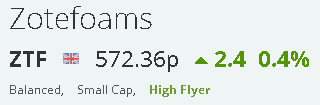

The stocko computers rate this as a ‘high flyer’. That is; good quality, good momentum, but quite expensive. That sums it up quite nicely I think; this is a company with some valuable IP in their foaming process patents operating in a market that is drawing customers to the (arguably) market leader and driving an acceleration in growth. It is however clearly not cheap, after recent dilution (see below) the forward PE is now c. 30x
Looking at the historic & forecast revenue and PBT (adjusted) is quite interesting
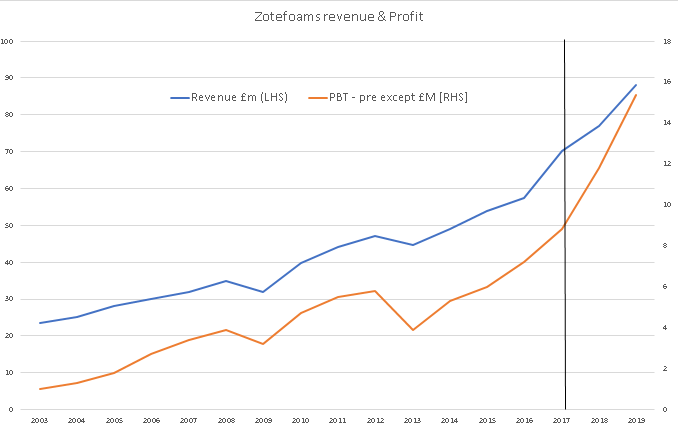
It demonstrates the “hockey stick” formation much beloved of business planners, but rather than the ‘heel’ of the stick being long in the future as is often the case, the heel (i.e. the acceleration of growth) is already established.
Over the period 2003-2013 the company enjoyed respectable revenue CAGR of 7% pa (and 15% PBT), but in the subsequent four years annual growth has increased to 12% (23%) and the forecast for the next two years is 12% (32%).
Recent newsflow suggests to me that these forecasts may be somewhat conservative and I think this is best considered in the context of the three segments in which Zotefoams (LON:ZTF) operates, so I’ll take a brief detour to describe the segments and then cover the recent newsflow within each.
DIVISIONAL BREAKDOWN
At a high level, the company has three business lines : Polyolefin Foams, High Performance Polymers (or Products) and MuCell (Licensing).
Polyolefin Foams
This is what I would refer to as the “basic” volume set. It is relatively ‘mass market’, representing £52.8m (75%) of the 2017 revenues. Annual growth since 2013 has been a respectable 8% pa , although one has to note that 2017 growth was despite (now resolved ) capacity constraints . Operating margins have improved over the period from 11% (2013) to 19% (2017).
I would judge that 19% operating margin is probably the peak, given that 2017 capacity constraints meant that the assets were being properly “sweated” and possibly that the company could cherry pick the more profitable business. However, there are good reasons to expect strong continued growth. Revenues grew by 18% in 2017 (c. 12% at constant currency, reflecting 7% volume growth and 6% price) despite capacity constraints at key times of the year. New capacity in Kentucky came online recently increasing overall capacity by 20% with an additional 20% potential, which is now being provisioned for 2019.
Additionally as announced (15-May-18) the company is investing in a new plant in Poland, due to come on line in 2020 providing a further +20% capacity (and again a further plus 20% potential)- this capacity is also capable of being converted to support the HPP segment.
(This capacity was funded through a placing, causing a roughly 10% dilution in the next 2 years given that it won’t start to deliver until 2020)
HPP
It seems to me that the company defines this segment by principally by Chemistry , but really the definition is about using the “foaming process” to create unique properties that add value (see Nike below).
HPP is a higher margin business – I don’t however think we know quite how much higher margin, Operating margins in 2017 were 24% (cf Olefins 19%) but despite a 32% revenue growth in 2017 I think HPP is still subscale, so the margin differential could ultimately be significantly bigger than is thus far apparent.
This is also absolutely where the excitement and “froth” is in Zotefoam’s valuation.
On 13/14-Dec-17 Zotefoams issued two separate notices relating to HPP; firstly the establishment of a strategic partnership with Nike for research, development and production.( Although not explicitly referenced by ZTF – presumably due to NDAs – at around the same time Nike launched a new premium sports shoe with a performance sole, it is not rocket science to establish that this IS using HPP technology.)
The second announcement was the investment of £12m in additional HPP capacity at the HQ in Croydon. This investment, to come on stream during 2019, will increase HPP production capacity by up to a factor of 6 times. Very significant indeed and the company it certainly putting its money behind the stated view that there is substantial market opportunity for HPP.
MuCell (MEL)
This is essentially a technology licensing business, acquired in 2010. It is also a significant puzzle to me. Technology licencing should be extremely lucrative, but MuCell has been consistently loss making and the losses are widening! In 2017 MEL achieved a £1.4m loss on revenues of £4.3m (30% loss on Turnover!!!)
The business model is to install patented technology into the customer’s production line at a low margin (actually I suspect it to be pretty much breakeven) and then to reap license / royalty payments from each ‘product’ produced.
I am struggling though to understand the numbers here (so if any readers have a better insight please do contribute)
The 2017 revenues and margins break down like this :
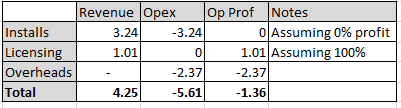
I believe this included c. £0.4m of writedowns.
That seems to me quite bizarre – why are the (apparent) overheads so high?
The company puts this down to development cost etc. and maintains that the MuCell business is well positioned for long term profitable growth.
For me, this is a puzzle and a worry given that MuCell has been in the family for 8 years already. One however has to have a modicum of faith in the management and if they can at least bring MuCell to break-even (or close it) that would improve group profits by c. 10%
Overall
So overall, there is a very impressive potential growth story here and the company is now investing heavily (it should be noted that this is quite a capital intensive business) in the promise that they have talked of extensively in the recent past. On forward PE of 30x, however, you have to pay handsomely for the privilege of being involved.
As someone who still classifies myself as a predominantly a value investor, this is quite a challenge to buy into the “future story”. Zotefoams’ strong financials and track record (albeit not in themselves justifying the valuation) earn the company a Stock Rank style of “high flyer”. This is statistically a successful investing style. I rationalise it in this way ; in common with many “sucker stocks” Zotefoams offers “jam tomorrow” but the difference is, they already have a track record proving the know how to make jam and already make enough to justify perhaps 2/3rds of the current valuation.
I’d be grateful for the views of others here to expand the knowledge base and ‘kick the tyres'.
Disclosure : At the time of writing I hold shares in Zotefoams (LON:ZTF) .
Disclaimer
This is not financial advice. Our content is intended to be used and must be used for information and education purposes only. Please read our disclaimer and terms and conditions to understand our obligations.
9 comments
Thanks for the post Gromley. I attended the Mello show in London yesterday and had a chat with David Stirling, and listened to his presentation. I was quite excited about this company after researching the Stockopedia numbers beforehand, and remain so after hearing more.
I too was interested in the MuCell business as I see this an area that could produce good profit in the future with very little capital investment. MuCell is a process that injects Nitrogen into plastic as it's being formed into the final product creating a kind of "foamed plastic" (David uses plastic shampoo bottles as an example).
Zotefoams install the equipment, which retrofits to the customers existing machinery, and trains the staff how to use it. Once up and running the customer should be able to reduce the amount of plastic used in the product by around 15% (but higher reductions may be possible in some circumstances). This in turn saves the customer money on raw material, and reduces the weight of the product, reducing transport costs. It's also more environmentally friendly, having less plastic in the product.
The business model is geared towards mutual benefits, as Zotefoams seems to "partner" with the customer. The agreement seems to be that Zotefoams does the installation at cost (perhaps even a small loss), the argument being that the customer has costs to bear also (to adapt it's machinery and invest in staff training). Zotefoams then gets paid a royalty based on the amount of raw material saved by the customer. David suggested that Zotefoams gets about 12-15% of the savings made by the customer.
Hence, there's no profit for Zotefoams in each installation, and investment in the MuCell business shows up as a loss in the recent years statements. I guess at this stage there's not much revenue coming from these early installations. The revenue is also highly dependent on the customer's production volume and the savings they make. I think David said that the contracts were quite lengthy (10-12 years I recall, but I may be wrong on that one), so the company and their customers obviously see it a long term investment.
My view is that significant revenue is a few years away, and I guess that will mean more losses short term. Overall though, I'm positive about MuCell as it could produce fantastic profits down the line if it's widely adopted in the industry.
Hi bluecurve, probably no surprise if I tell you I also attended David Stirling’s presentation yesterday.
It is I think the first time that Zotefoams (LON:ZTF) have really reached out to private investors and I thought it was excellent. David hinted that a visit to the Croydon site might be possible, as someone who trained (but never practised) as an Industrial Chemist it would certainly interest me, if anyone else would be interested please let me know and I’ll enquire as to whether it would actually be possible.
For those that are interested, the presentation slide deck is here
The session was also videoed by PIWorld and I will also post a link to that here when it is updated.
David gave a really good run through of the business and the investment case.
Like bluecurve though what most interested me was to find out more about MuCell.
I had some further questions lined up on MuCell, but unfortunately the session timed-out before it got to me.
Anyway I took less positives from the MuCell piece, but before I explain why I should stress that I believe the market (rightly) ascribes negative value to MuCell at this stage so notwithstanding my downbeat view I think there is future upside from MuCell in one way or another.
I formed the impression from what David said that not only do they not make a profit on the initial installation but that in reality they make a loss on the installs. This is then recouped from the royalties over the course of the contract.
David did indeed say that the average contract length is about 12 years but I am unclear how meaningful that is. I’m sure I read somewhere previously that the customer is not formally locked in to the contract, but on the other hand once the kit is installed and saving the customer money on production costs, why would they stop using it at the end of the contract.
One of my questions would have been to understand what the average payback is on an install.
The current contract model is that they charge a low fee for the install – that’s supposed to produce a small margin , but as above I suspect it is actually below fully allocated cost – and then receive c. 15% of the savings the customer makes in use.
David inferred that if they tried to charge more for the initial installs they would not get much business. Somewhat cynically and perhaps unfairly, it crossed my mind that this is a “typical university spinout” (MuCell was spun out of MIT) great technology, bad business.
It is fine to say that MuCell is below critical mass (in terms of the volume of in life business generating royalties effectively at or near 100% margin) but they have owned MuCell for 8 years now during which time it has generated increasing revenues alongside increasing losses. One has to wonder therefore just how much patience they should have with this part of the business.
They are clearly not blind to the issue and are tackling it but if we don’t see some concrete improvements I might be inclined to attend next years AGM and remind David Stirling that he said (paraphrase) that if they closed down MuCell activities it would be instantly profitable with the royalty streams continuing to come in.
I don’t want this to all sound too downbeat; the rest of the company is imho fantastic and the current valuation I believe assumes that MuCell remains a drag on profits. If they were at least to bring it to break even that is c. 20% profit uplift and if they can in fact deliver on the promise there is much more upside potential. Time will tell.
I remain a happy holder and would be prepared to add more on signs of MuCell progress.
Zotefoams (LON:ZTF) arranged an unscheduled tour of the Croydon facility for a few of us who attended the last AGM back in May. It was very informative and I am sure that they would repeat, but I suspect numbers would be limited because it is a very busy and somewhat cramped site. In fact, they are pretty much full to bursting point and the current works to install two large low-pressure autoclaves with associate infrastructure and building work just add to the logistical challenge. They have been at this site since the company began, but I can envisage that they may need to take additional UK space before too long, in addition to the expansion works in Kentucky and the new site in Poland. They are in the nice position of having more demand for their product than they can currently supply, so I understand that they have been prioritising orders from HPP customers at Croydon, which is understandable when you look at the performance of that division - and the superior margins that have been achieved.
Incidentally, for those who have not read them, the presentations on the company's website are very informative. I was sorry not to be able to make the Mello event this week - and David Stirling's presentation in particular.
Here is the full two day programme schedule for MelloLondon includingZotefoams so this is a great opportunity to meet management and ask a few questions...
Http://melloevents.com/wp-content/uploads/2018/11/MT16.11v2.pdf
It is jam packed full of about 75 company presentations, lots of top quality speakers and panel sessions plus workshops to help with investment style and techniques etc.
The pre event fun starts on the Sunday evening with a dinner and investor quiz hosted by John Lee but the main conference begins on Monday 26th November at 9am through to Tuesday 27th in the evening so do come and join us as there are still 97 tickets left...
Http://melloevents.com/mello-london/
See you there.
Interesting question Glorenfeld.
and in their risk management sectionWell worth reading their risk management section in it's entirety actually as it gives a good insight into the business.My understanding is that the technology behind the polyolefins business is somewhat generic but in the HPP area are think there are more protections and a larger potential moat.
The company makes several mentions on the subject in last years AR.
Including
Thanks Gromley, a job for this weekend.
Thanks Gromley.
I am wondering about the barriers to entry (or lack of) on their main business lines (polyolefin foams) and the growing HPP line. The only reference to patents I can find in their reports relate to the MuCell business, which as noted is a tiny part of their revenue. A look on espacenet (https://worldwide.espacenet.com/searchResults?submitted=true&locale=en_EP&DB=EPODOC&ST=advanced&TI=&AB=&PN=&AP=&PR=&PD=&PA=zotefoams&IN=&CPC=&IC=) shows that they only have a handful (2 US and 1 GB) of granted patents although a few others are pending in Europe (for insulation). On a cursory look (not my technological area of expertise), it seems that the patents relate primarily to MuCell so probably aren't a barrier to entry on their main business lines.
Hi Gromley
Very useful write up, many thanks. I held Mar 2018 until Jun 2018 and just re-entered with a small position yesterday.
Recent high trading volumes pricked my attention, as did Zotefoams (LON:ZTF) s trading update (exert below for those interested).
As per your point above with regard to HPP, I was interested to note the ' 97% increase in HPP sales (26% of Group revenue)'
An exert from TU 01/11/18 ......
'In the nine months ended 30 September 2018, the Group has recorded:
· 16% increase in Group revenues against the comparative period, 18% in constant currency
· 7% growth in Polyolefin foams (72% of Group revenue)
o Improved sales mix
o Additional capacity contributing to 5% higher sales volumes;
· 97% increase in HPP sales (26% of Group revenue)
o Increased product adoption by end-users delivered very strong growth in our ZOTEK® PEBA elastomeric foams used in performance footwear;
o Strong recovery in ZOTEK® F fluoropolymer foams mainly from aviation applications;
o Orders for T-FIT® insulation products, down slightly year-to-date, are more strongly weighted in the final quarter this year, with annual growth in this product range dependent upon timing of shipments in the final quarter;
· MuCell Extrusion (2% of Group revenue)
o Year-to-date sales fell by 21%, excluding the one-off equipment sale in 2017;
o Q3 sales were impacted as a result of our internal restructuring, described in our interim results statement, which absorbed resource;
o MuCell Extrusion is being re-focused to develop the full potential of its technology;
· Capacity expansion programmes in the UK and USA are progressing well, with planned commissioning in 2019, while the announced new capacity in Poland is planned to come on stream in 2020.
The trading update is here
https://www.investegate.co.uk/zotefoams-plc--ztf-/rns/trading-update/201811010700029276F/
Regards
Howard
EDIT: I also just noted (12/10/18) 'Zotefoams has announced the appointment of James Bridges to the newly-created role of Director of HPP [High Performance Products] business units. James was formerly global commercial director, life science technologies at Johnson Matthey plc.' https://www.zotefoams.com/zote...
Thx Gromley. A fascinating post.