Small Cap Value Report (19 July 2016) - RCDO, ENTU, STAF, SFE, PEN, IDEA, BRY, GTLY, DPP

Good morning!
Brexit impact
This is probably the most important issue of the moment, determining what shares are worth, so I will continue to focus closely on what is happening. Here is a link to search for companies mentioning "referendum" in their RNSs. It's very useful - take a look.
I'm increasingly coming round to the view that most sectors are gradually getting back to business as usual, post Brexit. That's not to say it won't have some impact, but evidence is mounting that we're not heading for any imminent catastrophe.
An example - one of America's largest banks, Well Fargo, has just agreed to buy an 11-storey London office building for c.£300m. That's surely a good endorsement of their perception of London remaining a major international finance centre. Also, of course the weakness of sterling just made everything a good deal cheaper for American (and other overseas) buyers.
In a similar vein, an update from British Land (LON:BLND) yesterday was reasonably reassuring. There's an article in The Times today, pointing out that BLND has very low leverage now - LTV of only about 30%, its properties are 99% let on longish leases (so fixed rents), and the shares are at a deep discount to NAV. So the market is perhaps pricing-in too much of a downturn? Who knows, time will tell. I'm tempted to dabble though, as the discount to NAV should reduce if confidence returns.
Currencies
Sterling is doing exactly what floating exchange rates are supposed to do - i.e. when a country has some kind of economic shock, then its currency devalues. That makes it more competitive, and attracts inward investment, which enables the economy to recover. Although it also pushes inflation upwards, due to the higher cost of imported goods.
So if the currency devalues too much, then it can trigger a vicious circle of hyper-inflation, and collapse of the currency. So a controlled devaluation is good, whereas a massive & disorderly devaluation is bad. A bit of inflation also helps inflate away Govt & consumer debt of course, which is handy.
We've seen the fall in sterling attracting inward investment this week, not only with the property purchase mentioned above, but also with the arguably opportunistic Japanese takeover bid for ARM Holdings (LON:ARM) - again it's the devaluation of sterling which made it more attractive as a takeover target. So Remain claims that inward investment into the UK would dry up, already seem to be very much wide of the mark. Although I suppose it depends what type of inward investment we're talking about?
Eurozone
The reason I believe the single currency Eurozone is doomed to eventual failure, is because it doesn't have a mechanism whereby countries can devalue in hard times, to stimulate economic recovery. Instead, countries like Greece, Portugal and Italy, are locked into an uncompetitive exchange rate, and permanent economic doldrums. That makes debt impossible to repay of course, so eventual debt default & falling out of the Eurozone looks the only solution, long term.
Meanwhile Germany continues to benefit from an artificially low exchange rate, which stimulates its export-led industry. Yet Germany refuses to make the substantial transfer payments to the South of Europe, which it should be paying out of its bumper profits. The status quo is not going to work long-term. You can't have monetary union without political union, and transfer payments from rich to poor parts of the currency union.
We haven't had a Eurozone crisis for a while, but there's no doubt in my mind that another one is looming. The pattern is depressingly familiar - deals are only struck right at the last minute, when the financial system is teetering on the brink of collapse.
As usual, the above is just my personal view on things. You might see things differently, which is fine, that's what makes a market!
Ricardo (LON:RCDO)
Share price: 760p (up 0.3% today)
No. shares: 52.9m
Market cap: £402.0m
Trading update - this company's description of its activities is as clear as mud, so I don't really understand what it actually does. It appears to be some sort of consultancy & engineering activities mainly serving the automotive sector.
Ricardo is based not far from Brighton, so I wonder if we could entice management to come along to the ShareSoc Brighton meeting in September, to give a presentation?
The shares have looked rather pricey when I've looked at it before, although the excellent track record of growing profits, and fairly good quality scores, are clearly the reason for that. You have to pay up for quality companies, usually.
Note that the company has a 30 June year end, so this is a full year update, and it's in line with expectations;
We expect profit performance for the year to be in line with our expectations and the business is well positioned as we enter the new financial year.
The immediate outlook sounds good, with a strong order book;
Further to the trading update of 19 May 2016, overall customer activity in the last two months has been positive leading to a strong year-end order book and a good pipeline across multiple geographies and different business segments...
Brexit comments are also reassuring, confirming my view that good quality companies with a decent geographic spread of sales are generally shrugging off Brexit worries;
The vote by the United Kingdom to leave the EU has clearly caused some uncertainty within the wider market and we continue to monitor the situation carefully however do not expect it to have any significant impact on our performance.
The diversification and international spread of our customers and operations is helpful and we have had confirmation that the recently awarded EU research funding through the Horizon 2020 framework will remain in place.
Valuation - bear in mind that it does have some debt, and an £18.5m pension deficit.
Taking those into account, I reckon the current valuation is probably about right. That said, this company has often attracted a premium valuation, so there could be further upside on the shares maybe, providing nothing goes wrong?
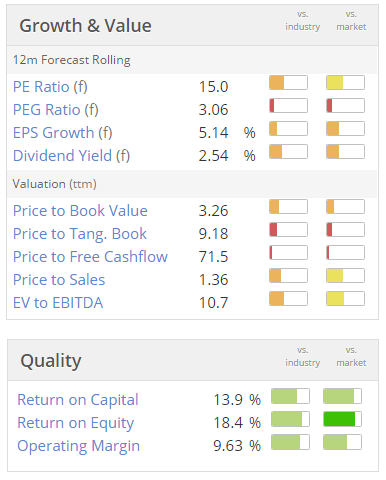
My opinion - overall, I like it. It's tempting to just buy a few, tuck them away, and forget about them for 5 years. The price will probably be a good bit higher then.
However, 5 years is a long time, and things can go wrong even at the best companies. I like a bargain, so am more inclined to put this share on my "buy on a profit warning, or general market sell-off" list.
Entu (UK) (LON:ENTU)
Share price: 39.5p (down 27.5% today)
No. shares: 100.0m
Market cap: £39.5m
(for the avoidance of doubt, I no longer have a long position in this share)
Interim results to 30 Apr 2016 - not good I'm afraid. Personally I ditched my Entu shares, at a loss, a little while ago, because it struck me that big ticket consumer items could possibly be deferred, in a time of economic uncertainty.
This share has always looked great value, but I'm afraid it now appears that it was cheap for a reason. The company's relatively short (since Oct 2014) history as a listed share, has really been one of serial disappointments.
Key points (remember these are only 6 month figures);
Turnover up 11.6% to £51.2m
Profit before tax (on continuing operations) has collapsed by 75% to £1,047k - clearly a very poor result
Discontinued operations (the solar division) is an additional loss of £509k, but here's the strange thing - the company seems to have moved over its overheads (presumably mainly salespeople?) from the solar division to its home improvement division. They say this has had a £2m impact on H1 profit, and will have a £3.5m impact on full year profits.
Although looking at the quote below, it sounds more as if the solar division was absorbing some central overheads, which now have to be absorbed by the other divisions;
Reported gross profit and reported EBITDA are both lower due to a number of non-recurring items and EBITDA is also impacted by £1.4m of central overheads charged formerly to the discontinued operations, but covered by our continuing operations in the first half of 2015/16. As noted in the Chief Executive's Statement, decisive actions have now been taken to remove cost from the business. A reconciliation between underlying and reported results is set out at Note 16.
Therefore, the fall in profits does not look like a temporary factor, it's a real underlying fall in profits.
Cost-cutting is necessary to restore profits, clearly. This action has been taken, as follows;
It's been a challenging year and, whilst we have taken decisive action to reduce the central overheads formerly charged to the discontinued Solar business (£4.0m annualised), the timing of our actions means we will carry approximately £3.5m of this cost in this financial year. As result of this, and despite the momentum we built in the core business in the second quarter, full year outturn will be below market expectations.
Dividends - the interim divi has been slashed from 2.67p last year, to just 0.5p this year.
Balance sheet - there's not much on the balance sheet, other than trade debtors, and trade creditors. It has no cash, but negligible interest-bearing debt, of £891k.
Outlook - there's some hope here;
Home improvements business performed well overall with record order book at the end of H1 and full FCA authorisations secured.
However, it's not enough to salvage 2016 results;
Full year outturn will be below market expectations.
Brexit - doesn't sound as if it's having much, if any impact so far;
We have also refocussed our strategy, restructured our business and reorganised our senior team. There is still work to do, and the long term impact of Brexit is as yet unknown, but focus in the second half will be on improving returns in the core home improvements business and continuing to drive efficiencies to position the business for growth in 2017."
My opinion - I'm not surprised the results are poor, hence why I ditched my shares. Given that this company has messed up before, there was a high likelihood of some more excuses for under-performance.
To be fair though, the Govt's sudden change in policy on solar feed-in tariffs was a bolt from the blue, killing that part of the business stone-dead. What concerns me though, is that the solar division appears to have been flattering overall group results. Now it's gone, the remaining business doesn't look very good.
Cost-cutting should straighten that out, so the outlook for 2017 could be one for recovery. At some point I might revisit this as a possible 2017 turnaround, but overall I feel management credibility is now pretty much gone. So I might just put this one down to experience, and forget about it.
Sorry if my previous bullishness on this share influenced readers, and my apologies if you lost money on this. Whilst I never give recommendations, nor buy/sell advice, I do understand that my posts can influence reader views on things. Over the longer term, I tend to get about 60% right, and 40% wrong, which gives a very satisfactory overall result. So always bear that in mind! There's no substitute for DYOR. Unfortunately, ENTU was part of the 40%. There we go.
Safestyle UK (LON:SFE)
Share price: 245p (up 4% today)
No. shares: 82.8m
Market cap: £202.9m
Half year trading update - in stark contrast to its smaller competitor mentioned above (Entu), Safestyle has reported a sparkling update today. This covers the 6m to 30 Jun 2016;
Since our last trading statement at our AGM on 19 May 2016, the Company has continued to trade in line with our enhanced expectations for the current year. Order intake in the first half was up 19.7% on prior year, which is expected to deliver H1 sales revenue of £83.5 million, an increase of 12.8% (H1 2015: £74.0 million). FENSA statistics show that we have increased our market share year on year to 10.0% from 9.5%.
During the first half of the year our order book increased significantly and we will benefit from a controlled release of some of this increase in the second half.
Profits are turning into cash too;
Cash flow has continued to be strong and we had net cash of £23.6 million at 30 June 2016 (30 June 2015: £14.9 million).
Brexit comments are very encouraging, both for this company, but also as evidence that consumer confidence appears to be holding up well;
We are very pleased with our performance in the first half of this year. Whilst the longer term impact of the referendum decision on the broader economy remains to be seen, there has been no short term detrimental effect on our order intake.
So, another example of it being business as usual, for good quality companies.
Outlook - for the full year is in line, and I like the bit about out-performing the market;
The Company has a proven successful model, with a growth strategy underpinned by a combination of our expanded product range, attractive promotional finance package, continued geographic expansion and financial strength. As a result, the Board remains confident in our ability to continue to outperform the market and achieve full year results in line with management expectations."
Valuation - the valuation, growth, and quality scores all look pretty good here, and there's a nice divi too. Although bear in mind that this type of business is cyclical, and vulnerable to rising interest rates and possibly weakening consumer confidence;
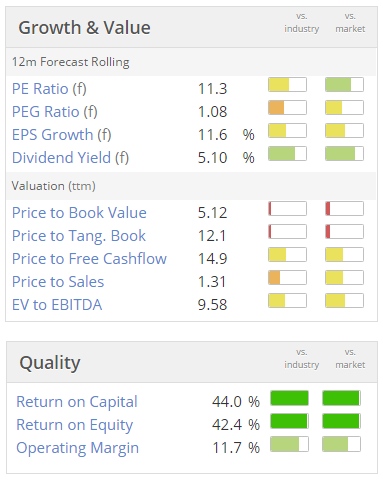
My opinion - Safestyle is clearly doing something right, that Entu is clearly not doing.
However, a lot of the difference might be their business models. Entu gives away some margin to its sister company, Epwin (LON:EPWN) (which manufactures the double glazing for it). A cynic said to me that splitting Epwin & Entu into 2 companies, and floating them both, could have been an exercise in maximising the overall sale price for the vendors!
With affluent baby boomers, and ultra low interest rates likely to persist for some time, and apparently little to no impact from Brexit so far, it seems likely that Safestyle may continue forging ahead for some time to come.
Staffline (LON:STAF)
(at the time of writing, I hold a long position in this share)
Private investor presentation - an excellent initiative here from Staffline - the company is inviting private investors to a results presentation in London, at Buchanan's offices.
I'd really like to see more companies & PR companies arranging results presentations for private investors too. They do numerous results meetings for institutional shareholders, and brokers, so why not tack on an extra meeting for PIs too?
Here are the details if you fancy going along (I'll try to make it, but am on the reserve list at the moment). We get fed too!
The presentation will take place at 1.30pm at the offices of Buchanan, 107 Cheapside, EC2V 6DN and a lunch will be provided.
Admittance is strictly limited to those who register their attendance for the event. To register for the event, please contact Buchanan on 020 7466 5000 or staffline@buchanan.uk.com.
So bravo for this initiative, so let's have more of these from lots more companies please!
I'm running out of time, so a few quick comments before I finish;
Pennant International (LON:PEN) (I hold a long position in this share) - says it's expanding, so has taken on some additional premises. Augurs well. The market likes this, and the shares are up 5% today to 58.5p - recovering nicely from recent setbacks.
Ideagen (LON:IDEA) - good results out today. A few comments;
- 10% organic growth is positive.
- Total revenue growth +52%, due mainly to acquisitions.
- Share based payments look rather high at £936k.
- Adjusted diluted EPS up 26% to 2.66p, so a PER of 20.7 at 55p per share - hardly a bargain.
- Net cash of £6.3m.
- Note that it capitalised £1.6m of development spend onto balance sheet.
- Tax credit boosts EPS.
Outlook comments sound positive;
The market for GRC management solutions remains fragmented and the drivers are long term and highly strategic. Trading since the year end has remained robust. Whilst we remain alert to prevailing economic and political conditions we have a strong presence in a variety of different markets across the globe, which, together with the high levels of recurring revenues and repeat business derived from our 2,200 customer base, provides me with confidence in the future prospects for the Group.
Brady (LON:BRY) - trading update for H1 to 30 Jun 2016.
- In line with expectations
- Revenue up 4%
- Returned to profit due to cost-cutting
- Forex movements are a net overall positive
- Net cash over £6m
- Cenkos forecast 3.2p EPS for 2016, and 3.3p for 2017. So at 68p per share, it's looking expensive on a PER basis
- Shares only attractive if you use some other valuation metric! Or if you think it could out-perform forecasts
- Commodities markets improved somewhat this year, which may help
Gateley Holdings (LON:GTLY) - results for y/e 30 Apr 2016 look good to me.
- EPS a whisker above forecast, at 8.98p
- PER is about 12, at 108p per share
- Good divis - yield is about 6%
- High profit margin - good quality business
- Positive outlook comments
- BUT - very high debtors on balance sheet unnerves me. Probably unavoidable due to sector it operates in - W-in-P builds up, then jobs invoiced when complete.
- Cashflow looks genuine.
- I wonder how variable the cost base is? That's key to maintaining profit in a downturn.
- Seems to have a good spread of activities.
- Looks a proper legal firm, not just ambulance chasers.
- Overall - I quite like it, might be worth a deeper look.
DP Poland (LON:DPP) - market going crazy over its strong LFL sales (up 28%), but ignoring the fact that it will still be heavily loss-making! Market cap is nearly £60m, which is complete insanity. Massively over-valued.
Punters likely to get a rude awakening when next set of results come out, and they realise what a tiny, and still heavily loss-making business it is.
If you want to punt on a retail roll-out, choose a decent one, like Crawshaw (LON:CRAW) or Patisserie Holdings (LON:CAKE) . This one is garbage, in my view, and horrendously over-valued.
Disclaimer
This is not financial advice. Our content is intended to be used and must be used for information and education purposes only. Please read our disclaimer and terms and conditions to understand our obligations.

50 comments
Ricardo is one of the most brilliant engineering companies in the UK. I bought it a few years ago when a long-term deal was announced with Mclaren. I sold it but much too early. You will find that it has a long and distinguished history and apparently a vibrant present and future. How you value companies this good is always a problem but if you could get them to speak in Brighton I would have a go at attending to see if I should get back in. An obvious weak sterling beneficiary but more importantly perhaps a seemingly cracking company.
En tu, Brute? I was lured into this one by some bad error on my part. Luckily only a small position...
Or perhaps even better would be if they could be persuaded to host a meeting with a tour of their facilities? That would get me to drive down from Wokingham at the drop of a hat.
If you read the online FT Alphaville section, it often references a number of 'think' pieces on a number of fronts, and delves sometimes into frankly obscure areas. It has picked up on a few matters to do with Brexit technical matters that may arise that only the nerdy specialists trip across, but may have significant impact
I think in contractual matters this is referred to as the small print.
Let's hope the UK can field some good trade/banking lawyers, because the devil is often in the detail!
Good morning Paul,
As an enthusiastic reader of your blog, would it be possible for your opinion on Angle PLC? The full year results are out on the 28th of this month.
Many thanks
Paul, statement from the Bank of England this morning seems to confirm your view on there being no evidence of a sharp Brexit slowdown:
"Bank of England sees no clear evidence of sharp Brexit slowdown
The Bank of England said on Wednesday it saw "no clear evidence" that a sharp slowdown was underway in Britain's economy after the June 23 vote to leave the European Union, though around a third of firms it spoke to plan to curb hiring and investment.
The central bank's regional agents - who are based at BoE offices around Britain - said business uncertainty "had risen markedly" but there was little evidence that consumers were spending less either.
"A majority of firms spoken with did not expect a near-term impact from the result on their investment or staff hiring plans. But around a third of contacts thought there would be some negative impact on those plans over the next 12 months," the BoE said.
"As yet, there was no clear evidence of a sharp general slowing in activity," it added.
Report from Reuters"
http://www.telegraph.co.uk/business/2016/07/20/ftse-100-smashes-6700-but-pound-flounders-below-131-as-investors/
Re: Ideagen. I like the GRC software space in general. Its driven by regulatory requirements and the cost of non-compliance is typically large versus the cost of the software which makes it quite sticky. Ideagen seems very mispriced however.
You mention it is on 20x PE but this is after adding back large share comp and before capitalisation of development costs. The right way to look at Ideagen and many software cos is on a tax affected (EBITDA - share comp - capitalised development cost) basis. This equates to FCF before working capital moves.
On this basis, Ideagen has a 3yr EPS / CAGR of 8.0% and is trading on 37.3x my earnings. There is no management commentary on the elevated share comp this year. If we were to assume that it was elevated and normalise it, then my 3 yr EPS CAGR is 14.5% and the LTM valuation is 31.4x my earnings. Doesnt strike me as good value or a particularly accretive acquisition strategy (the CAGRs arent much higher than organic growth).
Hi Paul,
You mentioned: you have a "buy on a profit warning, or general market sell-off" list. I recall you shared some lists publicly before e.g. barge-pole. Is this other list one of them? If not, please could it be. Do understand this is only a personal perspective and not advice and we should form our own view, but at least it would help our research. I am also starting to develop such a list as expect some further market volatility in months and years to come.
Thanks - find your daily reports interesting, stimulating and helpful!
Regards,
00mrmark00,
Conviviality (LON:CVR) I hold. I am one of four siblings, as is my wife, so we have a surfeit of nephews/nieces and a couple of our own to boot. A quick pole last year universally suggested that students regard Bargain Booze as the best thing since sliced bread and as a number of them are still under 18 I can only conclude that the soft drinks are also good value. One pointed out we have a shop locally and I had a long chat with the franchisee, who has had the shop under several franchises over the last ten years and, on that basis, I bought in last year. I would point out that I bought on the basis of his views rather than the wines I bought on the visit. I had nearly doubled my money until the latest political events. It then lost a quarter and I was thinking of selling but we have a local "spoons", haunt of 16yr olds for post exam breakfast and I have chatted to a couple of the delivery drivers (Matthew Clark) who are raking in overtime (this is Wales so may just be local) I held on and on the news of results yesterday I.am showing 40% gain over the year. If Paul could get an interview with Diana, who gave up a senior position (and serious pension) in Waitrose Wine, I would be very interested.
Regards,
Seadoc
Thanks Seadoc, agree an interview with the CEO would be great.
I am also a holder since around 2013.
It's the debt that is starting to worry me a little and the enlarged goodwill/intangibles.
What are your thoughts on that?
00mrmark00,
Those that made the most in the housing market were those that ran up huge debt in 1970's (and their children :-) The level of debt in Conviviality (LON:CVR) was chosen by the board, I for one would have joined in the new shares issue if I could but there were more buyers than debt to sell and although, had I got some at the market level, I would have made a good profit I guess the company knew they could easily sell that debt to the few and while we missed out on that potential profit we saved as the funds were raised more cheaply. Overall my holding increased in value. Looking forward interest rates are lower than perhaps could have been anticipated last year and likely to remain so for longer. So if happy last year they should be even happier now (I am). The company statement is opaque (to me) and perhaps Paul can comment but:
"At 1 May 2016 the Group's net debt totalled £86.1m (26 April 2015: net cash of £1.2m) and comprised £76.0m of term loans and £10.7m drawn down under the Group's working capital facilities, less unamortised banking arrangement fees. The bank facilities include a leverage and an interest cover covenant. The leverage covenant requires debt (excluding any amounts drawn down on under Matthew Clark's invoice discounting facility) to be less than 2.5 times the last 12 months adjusted EBITDA. The interest cover covenant requires adjusted EBITDA to be at least four times net finance charges. At the measurement date of 30 April 2016 leverage was 1.96 and interest cover was 12.1."
does not ring any alarm bells for me. I also note that the integration is ahead of schedule. Finally the dividend is well up, could be a Ponzi scheme (think Vislink (LON:VLK) or perhaps the next one, say IQE (LON:IQE) ) where the dividends are increased to push the up share price (often for benefit of directors bonus pay) but ultimately this is just your own shareholder money being returned in anticipation of, and requiring, further capital raising by the board. On this you have to make up your own mind, but I am confident (well, hopeful) it is genuine and appropriate.
Regards,
Seadoc
Paul,
Re: DP Poland (LON:DPP) All wot you says is true and back in 2005 I had a very similar view of Domino's Pizza (LON:DOM), be interested what you think of them now, My view is that Domino's Pizza (LON:DOM) is now a software company that makes the occasional pizza. Certainly there was an RNS last year (or maybe 2014) announcing a few hundred extra jobs, most in IT. In yr to 2015 DPP paid £6433 for software, I suspect there is a much larger charge buried in the accounts which I cannot find but do note that 67% of DP Poland (LON:DPP) pizzas were ordered on line in 2015.
LongbeardRanger,
I have a similar dilemma (the more so as most of mine were bought at 9p). Domino's Pizza (LON:DOM) was my star performer around 2005, similar views re loss or perhaps astronomical p/e (I think it was just making a profit) were expressed at that time and I sold out to the limit of cap gains allowance in 2005 and 2006 and at the time felt well pleased with myself. Bought back in in Sept/Oct 2008 into the ISA at about twice what I had sold for a couple of years earlier. The total return since then has been 586.3% and 30.2% on an annualised basis. I am reluctantly top-slicing DP Poland (LON:DPP) but only minimally on the basis of my experience with Domino's Pizza (LON:DOM). At the moment it is on-line/mobile phone ordering that is driving sales in UK and DP Poland (LON:DPP) has even higher on-line ordering. We are not allowed to mention Br*x*t on here but it may work in our favour as seems to be a roundabout of staff both within my own field (now retired) and that of my daughter who for many years has trained with, worked with, and still visits world-wide her Polish friends, all of whom think that Dominoes is the best.
Regards,
Seadoc
Seadoc,
Thanks, yes I see it similarly, objectively DP Poland (LON:DPP) looks expensive but I am cognisant that Domino's Pizza (LON:DOM) looked expensive for many years, but was in fact terrific value....and I think the core Domino's business is quite a lot better than other roll outs such as Crawshaws and Patisserie Valerie (not that they are bad, it's just Domino's is better).
I too hold Domino's Pizza (LON:DOM) and it has done very well for me, it is expensive but not to a level that would make me top slice or sell......but DP Poland (LON:DPP) is quite a lot more speculative, hence why I am nervous.
Paul, what's your view, if any, on CAP XX?
Paul I do not see why one factor, namely the drop in the value of sterling makes ARM a value takeover. As I explained yesterday that, whereas there has been a drop in the value of sterling against the dollar of 21% since the start of the year, if ARM was bought at either of the two dips in share price then ARM would have been 28% and19% cheaper. Furthermore, the 19% price from just over a month ago would also then benefit from the drop in the pound as the takeover wouldn't have taken place until after the referendum. ARM would only be a cheaper option if it was a company with a stagnant share price or one that was in decline. We have to assume that ARM has been looked at for some time and that just the same criteria apply that are used to buying shares. We don't just look at the share price and the current exchange rates and anyone looking at the charts for ARM would see a company with a continuous upward slope over the last decade. Therefore, the longer one waits to buy the higher the price and the previously mentioned dips in price were the times to buy this year. The only bearing I see on the exchange rate drop is that if ARM were being watched with a view to a takeover, that as the cheaper rate may attract other companies to look at ARM then Softbank may have decided to buy earlier than expected ( they are in the process of offloading other assets).
They had been eyeing ARM Holdings (LON:ARM) up for some time but I think Softbank has a lot of debt problems: http://www.bloomberg.com/news/articles/2016-06-05/softbank-s-son-gets-serious-about-tackling-debt-with-asset-sales
So they probably could not buy ARM Holdings (LON:ARM) before until they sold some assets.
But yes yes its also makes ARM Holdings (LON:ARM) a target for other companies so they probably made their move now.
Hi Paul, you've been busy today...
Don't suppose you managed to take a peek at http://www.stockopedia.com/share-prices/conviviality-LON:CVR/ yesterday did you?
Also, just looking at the Price to Tang. Book for this stock being reported as N/A. Does that mean there are no Tang. Net Assets?
I know I can work it out from the balance sheet, but this is a much quicker way of finding out if that is indeed what it is reporting.
Cheers, Mark
Hi Mark,
I look at pretty much everything, so only write about things that I find interesting!
Conviviality - it's big now, and rapidly acquiring other low margin businesses.
I reckon it will be a massive muddle for years yet. But they reckon they can achieve buying synergies. Good luck to them!
There's a profit warning in there for sure, once they get in a muddle in 1-2 years. Been there, on a smaller scale, rapid growth always leads to chaos. Teams just cannot cope.
Not for me. But I can see the attraction. Good story, shares probably might go up. City boys have no idea - they've never actually done a roll-out!
Regards, Paul.
RCDO, used to be in the business of engine testing when the big boy's test beds got filled up, slowly they have realised that they can act a core consultancy for the big boys and niche engines and so provide, design, testing, R&D into specific areas while offering more trade research as well. Slowly moving into some Hybrid stoff. They are the go to guys when your new engine does not have the umph and fill in where all those second tier engine comp guys used to be experts.
Surely as investors you should be more questionning?
Of course companies will use Brexit in their narrative - whenever results disappoint !!!
It's a freebie there for the taking
Corporate statements on Brexit - no one knew what the economic impact (good, bad or indifferent) would be before Brexit, and no one knows now. (We might know in 10 years time, but probably not because the world is a complicated place and any effects we see could be from any number of events). The referendum turned everyone into economic forecasters, yet we know economists can't predict what's for dinner.
These corporate comments on it are like those trite "risk assessments" in annual reports, such as "our revenue might decline if customers go to competitors" - immensely useful!
Thanks for the update today Paul. Amazingly detailed analysis produced super-quickly. Have you cloned yourself?!
I bought Entu (UK) (LON:ENTU) just after IPO and have been fortunate to top slice at various points including selling two thirds on the day of the Brexit result. I've sold the rest today and luckily only sitting on a miniscule loss for the year but that's only due to a bit of luck so I feel sorry for others who bought in and have made heavier losses. I felt there wasn't enough detail about the change to continuing operation costs especially as to why they hadn't made this alteration previously, and the gigantic slash to the dividend was also a major alarm bell.
The lesson I've learnt from my Entu (UK) (LON:ENTU) investment is to treat poor management as a more major red flag. Yes the solar panel changes were unfortunate but they seem to have repeatedly made errors of some kind or tried to cover up their mistakes. The problem with such managers is that you don't know if they are still hiding other problems from investors. I think I'll be disinclined to invest in Entu (UK) (LON:ENTU) again unless there is a new chief executive.
Hi paraic84 -
"The lesson I've learnt from my Entu (UK) (LON:ENTU) investment is to treat poor management as a more major red flag"
This is a major lesson I learnt last year and since then I studiously avoid any company that is run by a mediocre management or untrustworthy CEO, even if the technical analysis and share commentators give green lights all the way. Why? Because poor management can destroy a company faster than your realisation that things aren't right and it is time to ditch the shares.
I have also followed the converse with some success. There are a few CEOs of UK quoted companies who have a first class reputation. These guys can be trusted to turn a company around when it hits a road bump and the going gets tough. Buy when the share price takes a hit and take a bet on the management and the CEO to fix it.
This may be a stupid question, but could you give some advice please on how you assess whether management are poor or not? Presumably not from the results, as you are saying that even if the figures are good you wouldn't buy shares in a company with poor management, Does it just come down to meeting them and getting a feeling? Thanks in advance.
dgold - There isn't a simple easy way to assess the quality (or lack of) of management. You need to build up a picture from several signals over time. Here are a few.
- a profit warning out of the blue
- followed up by more profit warnings
- CEO who talks up and makes rash promises. Delivery is significantly less than forecast
- CEO's past history
- an opaque set of results with lots of exceptionals, too many adjustments, significant capitalising of operational costs, etc
- read carefully the Chairman's and CEO's commentaries. And read between the lines too.
- take account of Paul Scott's feedback after his interviews; he can smell b*s* at 10 paces
- watch CEO s being interviewed on business broadcast streams such as DirectorTalk, vimeo, youtube, etc
- listen to Paul's audiocasts
You will soon form a picture about the quality and competence of the management in question.
Hope this helps.
Ramridge, thanks, useful advice.
http://www.independent.co.uk/news/business/comment/wells-fargos-300m-purchase-of-a-new-london-hq-should-not-be-seen-as-a-post-brexit-boost-for-london-a7143016.html
So this writer is saying that Wells Fargo would have gone ahead anyway whatever the result of the referendum. Doesn't that rather prove the point about Big Business not having been afraid of Brexit?
As for the argument that "yes, they can always pull out of London down the line", well, sorry, that`s an idiotic statement since that's something that any company can do at any time, anywhere and for whatever reason.
I know that newspaper backed "Remain" and "Remain" lost but it's surely time for them to get over that and just grow up.
Well it's just a different side to this story, I'm not saying it's entirely correct but I think some things are such as the staff are already in London spread around 4 different buildings, its not as though they are suddenly moving to London. Also this has possibly happened because of Brexit due to the fall in £, so for them its now cheaper to buy the building now.
You have either ignored or not understood all the points made.
He says that:
1) banks will lose positions transferred to Europe. It has already started with HSBC moving 1 000 people.
2) banks serve the corporations in London and the foreign ones using the UK as a European base will no longer do that.
From your previous remarks we know your position on Brexit. Do not let it delude you into thinking there will no effect on the City. Short term the uncertainty will.
Long term, if the Euro collapses, London will benefit. IF and when that happens there will be a crisis there which will also affect London and the City at that time. Subsequently it may benefit.
We also know your position on Brexit, from your previous remarks.
I really can't be bothered to reprise all that but neither do I swallow verbatim
the opinions of a journalist from The Independent. That is why I
confined my response strictly to the Wells Fargo transaction.
So you may speculate as much as you wish about the sequel to Brexit.
And we must agree to differ.
Merci d'avoir soulevé mes propres préjugés. Il n'y a pas d'avenir là.
Pas de quoi, bonne soirée.
Paul,
"An example - one of America's largest banks, Well Fargo, has just agreed to buy an 11-storey London office building for c.£300m. That's surely a good endorsement of their perception of London remaining a major international finance centre. Also, of course the weakness of sterling just made everything a good deal cheaper for American (and other overseas) buyers."
It's worth noting that this is for Wells Fargo's new European headquarters.
And this is one of the largest banks in the world and, by market cap, reportedly the largest in the world:
"Wells Fargo & Company is an American international banking and financial services holding company headquartered in San Francisco, California, with "hubquarters" throughout the country.[5] It is the third largest bank in the U.S. by assets and the world's largest bank by market capitalization.[6] In July 2015, Wells Fargo became the world's largest bank by market capitalization, edging past ICBC.[6] Wells Fargo surpassed Citigroup Inc. to become the third-largest U.S. bank by assets at the end of 2015. Wells Fargo is the second largest bank in deposits, home mortgage servicing, and debit cards.
In 2015, Wells Fargo ranked 10th on the Forbes Magazine Global 2000 list of largest public companies in the world [7] and ranked 30th on the Forbes 500 list of largest companies in the United States, according to Fortune 500 (2015).[8] In 2015, the company was ranked the 22nd most admired company in the world, and the 7th most respected company in the world.[7]"
https://en.wikipedia.org/wiki/Wells_Fargo
Actions speak (very) loud!
PS: Note also this one from Derwent London (LON:DLN):
"Derwent London is pleased to announce that it has pre-let 84,600 sq ft in four office transactions at The White Chapel Building E1, representing 46% of Phase 1. This refurbishment totalling 185,000 sq ft has attracted a range of businesses including media, professional services and shipping. The rent is £4.0m pa, 8% above December 2015 ERV with c.70% signed since the EU referendum. All are on ten-year leases, with 59% subject to a five year break and half subject to minimum rental uplifts on first review. The average rent free period is 8 months for the two leases where there are tenant breaks, rising to 17 months if no breaks are exercised."
http://www.investegate.co.uk/derwent-london-plc--d...
The London commercial property market seems to be doing just fine.
Thanks for the cut/paste on Wells Fargo, Jane.
However, as Sherlock Holmes identified in 'The Adventures of Silver Blaze', what DOESN'T happen is sometimes more interesting than what DOES ('the dog that didn't bark').
Regarding Brexit, the long term impact is possibly one of diminished inward investment. So focussing on ongoing commercial property transactions maybe misses the point. There were c120,000 commercial property transactions in the UK last year - good luck with your documenation project if this rate keeps up!
"Cut/paste" and "documentation project", thank you.
How very original and droll you obviously think you are.
Sherlock Holmes as an investment approach?
Well, to each his own.
Good luck with that one!
Ricardo (LON:RCDO) are world class engineers. Most of their work historically is in automotive. They have been going for 100 years. Harry Ricardo designed the first British mass produced engines for our tanks in WW1. They helped design the transmission for the Bugatti Veyron and they produce it. Anyone who knows anything about the challenges involved in that project would take that as sufficient proof of their capabilities. They also produce engines for McLaren and many autosport companies.
They are highly respected around the world and deserve a bit more than "Not sure what this lot do". It's a good idea to invite them to a meeting.
This is useful for understanding where these companies feature. Carclo for example seems to have emerged out of Lucas and others so good old manufacturing Britain just does it with another name not just here but does it worldwide.
Copyright Investors Chronicle
Hi Paul,
Re DP Poland (LON:DPP) , I am a holder (very small position!), as I very much like the Domino's pizza business model. In my view, sales progress (total system sales up 50% in H1) suggests that Domino's has the potential to be a success in Poland - albeit I know you have your doubts based on conversations you've had over there - but some way to go to justify current market cap!
If you look at the UK business, Domino's Pizza (LON:DOM) , it had system sales of £877m last year, on which it made operating profit of £73m (and bear in mind it is at quite a mature stage of its rollout so has benefit of significant operating leverage, years of brand investment, etc) - and it is valued at 23x that operating profit [quite a steep valuation which I would be cautious of applying to the Polish business].
Poland is of course a much smaller market than the UK, so let's say DP Poland (LON:DPP) can ultimately achieve £100m of system sales. (It could do better than this in my opinion but dangerous to assume that...). That would deliver operating profit of, say, £7 - 8m. I think we have to apply a lower valuation to Poland than to the UK, as it's a less well developed market and a smaller total market by both population and GDP, so say 10 - 12x operating profit. That comes out to a market valuation of say £96m. Even if you value that at 23x, you get £184m.
Fine - but, as of today, market cap is around £54m! And assuming sales continue on their current trajectory of the rest of the year, system sales for 2016 will be....around £6m.
Also, we can't rule out the possibility of further (potentially significant) dilution.
So while I am more bullish than you are on the prospects of the business, and think it likely that it will do reasonably well, it seems absolutely clear that it is "priced for perfection".
This is a bit of a conundrum for me - as I said, I've got a small holding, which has done well (up around 70% in short order). Normally I adopt a very very low turnover approach (I've made one sale in the last three years or so!) - I would trim severely but my holding isn't really of economical size to trim - so it seems like the right decision is to sell.
Decisions, decisions!
Sound analysis of the structural problems of the Eurozone Paul.
Hard to believe that senior SNP figures are now advocating Scotland leaving the UK to join the Eurozone. Of course if they do this is probably the quickest way to lose a second Scottish referendum.
/// Sorry, enough politics
"Hard to believe that senior SNP figures are now advocating Scotland leaving the UK to join the Eurozone."
Where and when exactly have senior SNP figures advocated joining the Eurozone? Maybe it's hard to believe because it's not true?
With some international firms putting their money where their mouths are ie SoftBank and Wells Fargo showing that they think the UK is open for business and a good long term option for investments, I think its just a question of time before the markets begin to focus again on Europe. Financial focus ebbs and flows and we all remember in the depths of the Greek crisis how many thoughts the end was nye but the EU couldn't have allowed Greece to fail as that would have been a real final nail in the EU coffin. Im convinced that the world will look at the UK in a few months as a safer ( not completely safe) haven compared to whats going on in Europe. Italian banks, Greece to re-bubble before too long plus moves towards other referenda in Europe make things look really dicey. We have moved quickly here to stabilise the government with no drawn out Tory leadership rubbish and look like we are getting on with it. We've made our bed and we have to lie in it now but I think it could be more comfortable than we expected.
Several years ago, after speaking with and observing successful small cap investors, I decided to start getting to know company management.
At the time I had shares in Entu. I tried and tried to get hold of the CEO and/or FD to discuss the seeming dichotomy of a high yield with an acquisitive nature but was fobbed off with excuse after excuse. I decided on that basis there was something smelly about it and sold out, luckily (pure luck) at a very small profit.
Never underestimate the 'smell' test ! It has saved me from many potentially bad decisions.
good article paul. The euro is a bit like the 'Titanic' and the germans have reserved all the lifeboats !
Thanks Paul :)
Re Brexit, there was never any suggestion that it would lead to an immediate catastrophe but rather the impact would be detrimental to the UK economy in the medium to long term ant that is still the case. We are likely to see a gradual decline over a prolonged period and that is the view held by most economists. There may be trading opportunities in the short term but Long Term investors will still be very vary of the prospects for the UK.
Andyin. Yes I think I agree with what you say. However the future is never a straight line so there is hope of something better than you imply but that would not be my central projection. I rather expect that we will either fail to retain market access to the EU or we will but will have to agree to accept the free movement of labour (in effect). Either way we will not see the current governing party win 2020 because it will be riven with recriminations. I am pretty apolitical and not a natural supporter of the current lot at all but to make brexit work I think we need pretty market focussed policies. I am not convinced that the current set of ego problems can do it but if not them then who ?
However as I said, its not a straight line and most predictions are necessarily wrong - especially about the future !
Very interesting resume which I most agree with. The key question though is that this mostly suits the Germans. Initially it suited France as their big farming' industry' received huge benefits-it is less obvious today. As for the Germans the benefits of operating as a major manufacturer with a 'cheap' currency are massive. Imagine if they had a stand alone currency (like the DM) then it would be so strong as to make their exports less competitive. This also keeps southern Europe poor so I'm sure the Germans will be happy to throw a bit of cash at the likes of Greece now again. We may well be better off out but I think this will only become clear in around five years or so.
Great article as usual Paul.
Would you be able to comment on the results from Entu (UK) (LON:ENTU) this morning?
I know you were holding back in January, but do you still feel this is worth holding now that the dividends have been cut and the EPS have dropped.
The report is not all bad, as they look as though they might have the problem in hand with their cost cutting exercise.
It would be good to hear your thoughts
Marcus.
Excellent, erudite explanation of why the Eurozone is heading for eventual failure.