Bioventix - wide moat, strong growth, high ROCE, excellent cashflow and reasonable valuation

Bioventix (BVXP) 1300p http://www.bioventix.com/index.htm
Mkt Cap £65m Net Cash £5.4m 17.5x FY17 PE DY 3.3% (4.8% incl spec div)
Conclusion
I first read about Bioventix in an interview with Keith Ashwell-Lord on the Stockopedia website. I was really interested as it seemed to be a high returns business with a great moat and reasonable valuation. So I did my own research and along the way met Leon Boros (a great investor) who knows the company very well and owns a lot of it. I think this is a very very high quality company run by CEO Peter Harrison. It produces monoclonal antibodies from sheep gut, used in blood testing by global med tech companies like Beckman Coulter, Siemens and Roche. Revenues have grown at over 20% pa for the last 5 years and I expect further good growth over the next 5 years, although at a slower rate. The next 2 financial years will be bumpy due to the expiry of heart failure antibody NT ProBNP (13% of revenues). This should be offset by the start up of a Troponin test (also used to detect heart failure) by Siemens in Europe and the US and could produce peak sales of over £1.5m. Although there are no patents, the barriers to entry are very high and Bioventix has not yet lost a customer to a competitor. The royalty model means the company is very cash generative and has outstanding financial characteristics: Gross margins over 90%, EBIT margins >75%, ROCE >75%, £5.4m of next cash on the balance sheet and PE 17.5x June 2017 and a dividend yield of 3.3%. Any set back based on the expiry of the NT ProBNP royalty stream would be a buying opportunity to me as I am confident the Group will continue to grow both via its existing antibody library and via the start up of Troponin. I started a holding this summer and added more last week, but have only just got round to writing it up. Apologies.
More detail below:
Business Model
Bioventix was founded 2003, and IPO’d in 2012. Bioventix produces Mono clonal antibodies (MABs) made from Sheep blood cells. Antibodies bind to a particular molecule (antigen). So specific antibodies ONLY bind to specific antigens. Therefore antibodies are used by the manufacturers of blood testing machines like Siemens, Roche and Beckman Coulter in what are known as reagent kits to test for certain characteristics in the blood eg Vitamin D levels, elevated Troponin levels after a heart attack, testosterone levels. The global blood testing market is growing at 5% pa according to CEO Peter Harrison.
BVXP only gets involved when there is a need for an improved antibody. There are only so many niches that appear each year that BVTX can try and develop. It has chosen to work in Sheep MABs because they are more complex than mice MABs, so there is less competition and Sheep MABs have greater utility than mice MABs to their customers eg Sheep MABs are often better when trying to test for a something in the blood that is only present in minute concentrations ie they have better sensitivity and bind better (“affinity”) to the target antigen.
Customers
The majority of Group revenues come from large volume automated testing machines. The Diagnostic machine manufacturers globally: Siemens, Roche, Abbot Labs, Beckman Coulter (part of Danaher), Johnson & Johnson are all customers.
Bioventix has no patents for its antibodies, however the certification process is arduous and long (typically >5 years), so while there is some competition from in-house manufacture of antibodies by the blood testers eg Beckman Coulter, overall there is limited competition and BVXP often works with the blood testers to produce new commercial antibodies.
Royalty Revenue Model
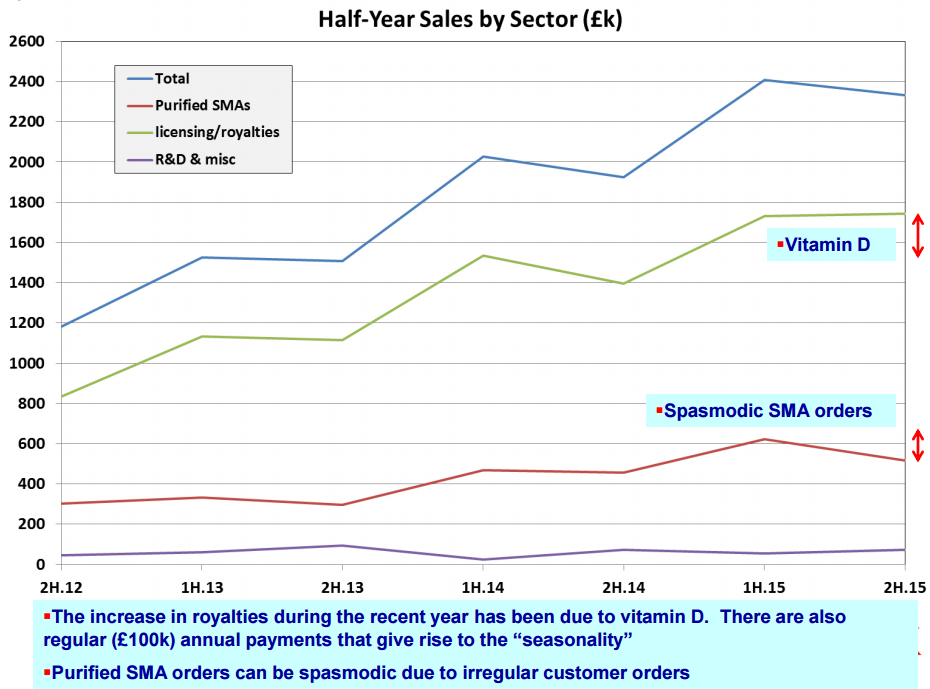
The majority (75%) of revenue comes from royalties, hence the very high margins (GMs >90%, EBIT margin c75%). BVXP enters into a supply agreement with its customers and instead of selling the antibody outright it agrees a royalty model. Typically this is 2% of the value of each blood test conducted using its antibody (although BVXPs Vitamin D test is 5% as it was so hard to develop so BVXP realised they could charge more). So say a test costs Siemens £1, BVXP earns 2p. The royalties are collected by the customer from its global operations and paid half yearly to BVXP, after the period end. Only 6% of sales were derived from the UK in the Financial year to June 2016. The US accounts for over 60% of sales with the rest from EU and RoW. One gripe would be that the company does not break down sales by antibody, so concentration of revenues isn't really known. The remaining 25% of revenue is generated from the outright sale of antibodies to customers (seen as purified SMAs on the graph below and which are "spasmodic" or lumpy) and payments from customers to co-develop antibodies for their exclusive use with BVXPs help (R&D line on the graph below).
source: company
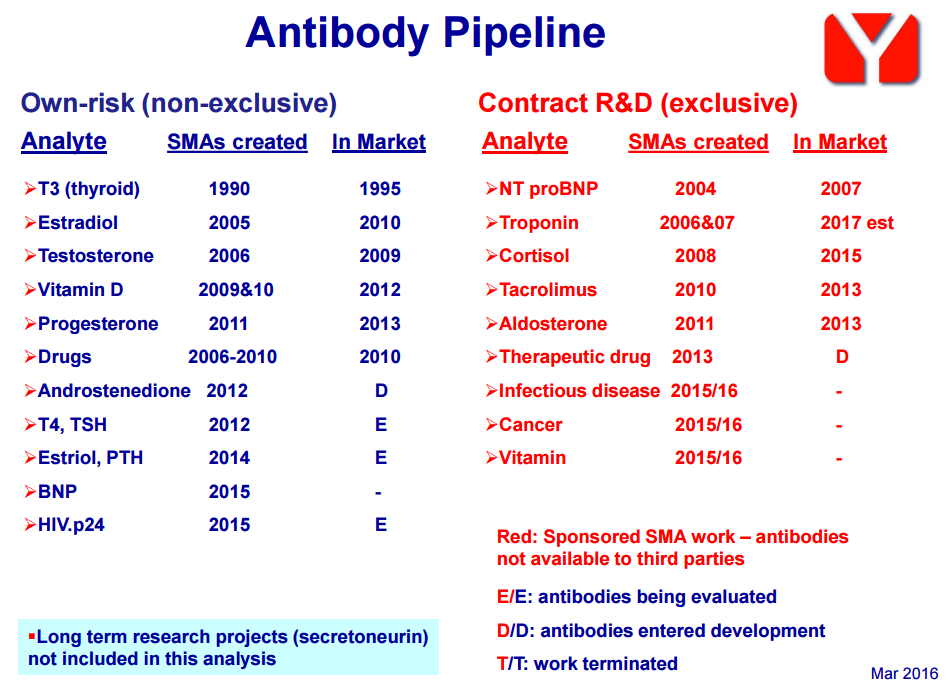
The royalty model applies to most tests for the commercial life of that test. The exceptions to this are NT proBNP (used to detect heart failure) and Troponin (a new antibody used also to detect heart failure).
NT proBNP which accounts for £700k (13% Group) revenue has a royalty agreement which August 2017, then ceases. There is another smaller cliff for another NT proBNP in 2022 (£400k).
Troponin has not yet delivered any royalties. Its development was agreed as an exclusive antibody with Siemens in 2006. It will earn royalties for 15 years from the point of first sales (expected to be 2017)
The reason for these 2 antibodies having a finite life is that when BVXP was a smaller less solvent company it agreed exclusivity periods of 15 years in order to get the deals signed. Now the company is more cash rich and its customers know and are happy with the royalty model, CEO Peter Harrison assured me that he would not do a deals like that again. All the rest of the antibody royalty agreements run for the commercial life of those antibodies.
So when I think of BVXP’s sales, it is made up of millions of individual tests, each earning the company 2p here, 2 US c there, 2 Eur cents there. It has a very diverse revenue stream and should keep growing as blood is tested globally. In the words of Peter Harrison “for next 5 years the revenue growth will just continue as it is already in the can at our customers”.
It is also very high margin due to royalties which are 100% margin, so I am not as concerned by profit margins coming under pressure as people such as Paul Scott have mused. More of a concern is developing new successful antibodies that can be as successful as NT ProBNP or Vitamin D. The royalty model also protects BVXP from minturisation as it gets paid on the value of the test, rather than the quantity of antibody used to perform the test.
Barriers to entry
1. Quality of research in isolating the right antibody. Not anyone can just “science the sh!t out of this” (Matt Damon in The Martian).
2. Time lag to first revenues c5yrs – prevents many start ups entering given they will be cashflow negative for some while.
3. Customers don’t want to recertify a new reagent pack, supplied by a competitor, with regulators because they would have to go through the whole certification process again which would take 5 years. No Bioventix customer has ever dropped an existing antibody
New antibodies.
source: Company
Troponin
Much of the company’s near term fate rests on Troponin. Troponin is a heart muscle protein that is released into the blood stream during a heart attack. A limitation of the earlier generations of blood tests was the time required to detect the troponin release, sometimes requiring up to six hours with less sensitive troponin tests. The mortality rate of heart attacks is highest within hours of onset, so an early diagnosis and initiation of treatment greatly impacts outcome and potentially saves lives. Therefore if patients can be tested quickly and accurately after presenting symptoms of a heart attack those with elevated troponin levels can be retained for treatment, while those with say just a tight chest can be sent home, thus freeing up hospital facilities eg beds and staff. Also there is less likely to be medical malpractice suits for patients erroneously sent home early. So the benefits for hospitals are enormous.
Troponin was developed back in 2006 by BVXP and Siemens. The 15 year royalty rate and manufacturing agreement have been concluded but sales have not yet started. Siemens is now taking the Troponin test through the final stages of regulatory clearance in order to achieve its CE mark. It is expected to launch in Europe in H2 17 and the US from 2018 and will take 3 years to roll out fully. This is a very important antibody with FinnCap assuming global peak sales of £2m, thus more than offsetting the decline of NT ProBNP which goes off royalty in August 2017 and August 2022.
Other areas
The Group has a number of areas under investigation
Alzheimers – collaboration with Pre Diagnostics AS to develop and supply antibodies for a dementia test based on mid domain beta amyloid detection.
Prostate testing – a “huge therapeutic need” according to Peter Harrison.
Cardivascular Risk Asssemet – collaboration with CardiNor to develop a Secretoneurin (SN) IVD test
These are all very early stage but are aimed at being the revenue drivers 5-10 years out from here.
Financials
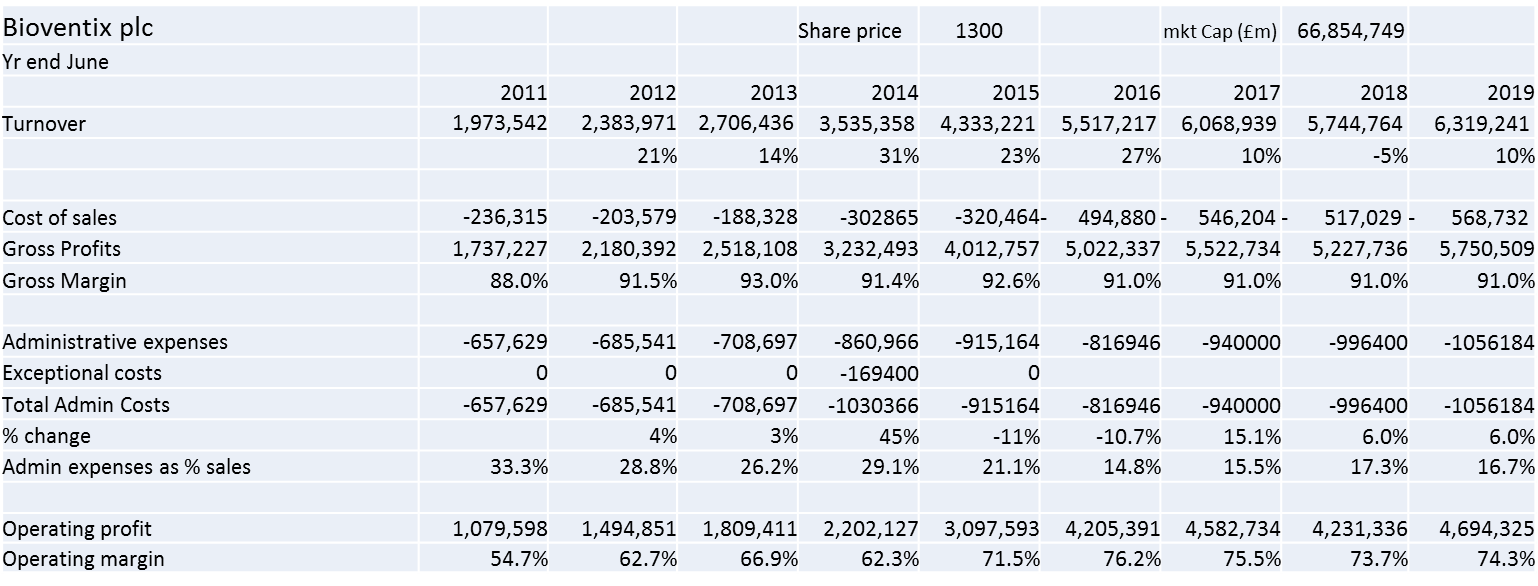
The historic financials are there to see on Stockopedia but the ones that I would highlight are:
Revenues
Source: annual reports / VegPatch
Renivestment needs to grow = low, this is a people based business and doesn’t need huge new turbo genomic splicer-sequencers (I made that up) to grow. Two new graduate reserachers have been recently recruited to increase the search for new antibodies. Capexis small and occasionally lumpy eg when the business needs a new autoclave or freezing machine, but overall capex has been £20k per year, apart from 2015 when it was £100k. This compares to EBIT of £4.5m.
Cash generation: Cashflow post investment, tax and dividends has ramped up from over £500k pa to £1.2m in FY16, that is despite paying £1.9m in dividends. Therefore cash on the Balance sheet stands at £5.4m, just under 10% of the market cap.
ROCE >75%. This is a fantastically high quality company.
Valuation
PE 17.5x June 17, 18x June 18 due to the loss of the NT Pro BNP royalties, although I sense that management thinks if Troponin launches on time this will more than offset the loss of NT ProBNP.
Dividend Yield: the group paid 60% of earnings as its normal dividend in 2016, so paid 42p of dividend, and on top of this paid a 20p special. I get the sense that unless there is a very interesting acquisition then most of the earnings will be repaid as dividends. So I expect further special dividends in the future. At 1300p the Dividend yield is 3.3% on ordinary dividends, 4.8% if specials are added in.
Conclusion
I first read about Bioventix in an interview with Keith Ashwell-Lord on the Stockopedia website. I was really interested as it seemed to be a high returns business with a great moat and reasonable valuation. So I did my own research and along the way met Leon Boros (a great investor) who knows the company very well and owns a lot of it. I think this is a very very high quality company run by CEO Peter Harrison. It produces monoclonal antibodies from sheep gut, used in blood testing by global med tech companies like Beckman Coulter, Siemans and Roche. Revenues have grown at over 20% pa for the last 5 years and I expect further good growth over the next 5 years, although at a slower rate. The next 2 financial years will be bumpy due to the expiry of heart failure antibody NT ProBNP (13% of revenues). This should be offset by the start up of a Troponin test (also used to detect heart failure) by Siemens in Europe and the US and could produce peak sales of over £1.5m. Although there are no patents, the barriers to entry are very high and Bioventix has not yet lost a customer to a competitor. The royalty model means the company is very cash generative and has outstanding financial characteristics: Gross margins over 90%, EBIT margins >75%, ROCE >75%, £5.4m of next cash on the balance sheet and PE 17.5x June 2017 and a dividend yield of 3.3%. Any set back based on the expiry of the NT ProBNP royalty stream would be a buying opportunity to me as I am confident the Group will continue to grow both via its existing antibody library and via the start up of Troponin. I started a holding this summer and added more last week, but have only just got round to writing it up. Apologies.
As usual please DYOR, and this is only my opinion not a solicitation to buy.
VegPatch
(currently looking for a job in fund management industry so if you are interested please send me a private mail)
Disclaimer
This is not financial advice. Our content is intended to be used and must be used for information and education purposes only. Please read our disclaimer and terms and conditions to understand our obligations.
9 comments
Hello,
At the risk of asking a silly question, the stock ranking for Bioventix has been declining over the last 6 months, for a company with a strong moat and I am puzzled by this
The fall in the Bioventix (LON:BVXP) Stockrank is almost wholly due to the momentum rank falling from 90 to 52
This is due both to its share price momentum stalling + a lack of positive earnings revisions
Thanks for refreshing the thread and bringing back into focus Vegpatch's original excellent piece that I didn't see at the time. I bought a small holding in Bioventix (LON:BVXP) earlier this summer prompted by a discussion with a (non investing) medic friend who was talking enthusiastically about Troponin (she doesn't get out much) and subsequent follow up research. Quite a small share float and not very liquid which possibly helps make it quite a volatile share price.
Interesting company although seems to have come off the recent highs and there have been some recent Director sales. P/E now in the high 20's reflected in the low Value ranking but I think the investment case still justifies the rich rating. I agree a primary business risk is the reliance on key individuals although with only 15 employees or so in the company they're presumably all pretty key. I also noted the comment in the recent results release that they deliberately don't hedge their currency exposure (£ expense base vs. Euro and USD royalty stream) so for those interested this is quite a pure currency play.
Not sure if you've seen it, but I picked up a recent interview with Keith Ashwell-Lord (27/10) in which he mentions Bioventix (LON:BVXP) as one of his 3 core holdings (13:20 in). The whole interview is worth a view for anyone interested in his Buffetology approach.
http://www.dailymail.co.uk/money/investingshow/article-5020913/The-Buffettologist-s-guide-finding-winning-shares.html
Gus.
@Gus, you raise an interesting point on lack of liquidity. It looks like average daily volume for this stock is about 1/10th of 1% of the float. The recent large sale was only 1% of the float, and it greatly affected the price. Trading volumes are so low that the price could not quickly recover from that single day of trading. So the implications of that lack of liquidity are that the stock will rise rapidly after good news, but in the face of bad news or any situation where a significant percentage of the float wants out in a few days time, the share price will collapse very rapidly. Everyone is trying to get in and out of the room through a very thin door.
I really liked the Keith Ashworth-Lord interview. Do you know is there any way to get a public record of the trades in his Buffettology fund, even on a time-delayed basis? Or does the UK require any disclosure of positions for funds a few times a year?
Hi pone.
It is pretty easy to get information on UK listed fund holdings on the internet without paying subscription fees. From a few mouse clicks, here is an analysis of the KA-L Buffetology fund mentioned in the article. I've specifically linked the page that shows the fund's top 10 (of 31 - roughly 36% of the total) holdings as of 31/10/17.
http://www.morningstar.co.uk/uk/funds/snapshot/snapshot.aspx?id=F00000M7JJ&tab=3
Pleased to say, I already hold four of these ( Games Workshop (LON:GAW) , Bioventix (LON:BVXP) , Dart (LON:DTG) and Trifast (LON:TRI) ). A case of "great minds think alike" (or more likely "fools seldom differ!").
Gus.
What's your discount rate for the reverse DCF?
@Veg I am using 12% for the discount rate and 10 years at the primary growth rate followed by 10 years at 4%
I guess the other concern here - given how small they are - is do they have an unusually high "key man risk"? Is the CEO the founder and also the brain trust of the R&D? If he dies, does the company effectively go into a runoff?
It is hard to believe that such an interesting company did not gather responses. I really like this company, and it is tremendously unusual to have a company with such small revenues have such predictable increases in their results one reporting period to the next. I guess this is a side effect of using a royalty model as well as having some product diversification.
My biggest concern here is does this tiny company have the ability to scale? Running the current year EPS through a reverse DCF calculator, the current price assumes an 18.5% compound growth rate for 10 years. Based on historical results, don't most of these antibodies max out around 1.5 to 2M UK pounds per year? There are only so many tests they can have in the pipeline given their small size. So isn't a risk here that they grow rapidly to a maximum threshold and then all growth suddenly stops? They then milk whatever revenue level they achieve with high margins, but the growth that is the basis for the extremely high share price would simply disappear, and along with that the share price would collapse dramatically. Asked differently, what is the maximum size this company could achieve in 10 years, given their business model?
I see the 2018 estimate showing a reduction of revenue, but it looks like the Vitamin D product - with its higher royalty rate - is more than compensating for the loss of the antibody that is coming off its royalty period. So I question just how down 2018 would be. A single unexpected down report is likely to collapse the share price significantly, so it is tempting to wait for that.