Bovis Homes - CEO grasping the nettle

Bovis Homes – grasping the nettle 1050p Mkt Cap £1.4bn
Bovis Homes unveiled a new financial plan in its interim results today. The new CEO Greg Fitzgerald, formerly the CEO of Galliford Try, who was appointed in April 2017 has acted decisively and its implementing a new plan. The essence is to shrink the business in terms of its operating units, get more control over processes, invest in training of the work force, weed out inefficiency and increase the quality of the product. The net effect of this is to see improved financial targets out to 2020. I see these as good news for shareholders and expect the share to continue to close the gap on the rest of the peer group in terms of both business performance and business valuation, assuming that the plan is at least partially delivered.
I first wrote about Bovis as a value situation in October 2016 Bovis Homes back at tangible NAV , when the Group was underperforming its own targets and also its competition in terms of sales and margins. The shares had fallen to 1x Tangible net asset value which I felt was usually a place where the downside was limited (see chart below). I used that net asset backing to purchase a position.
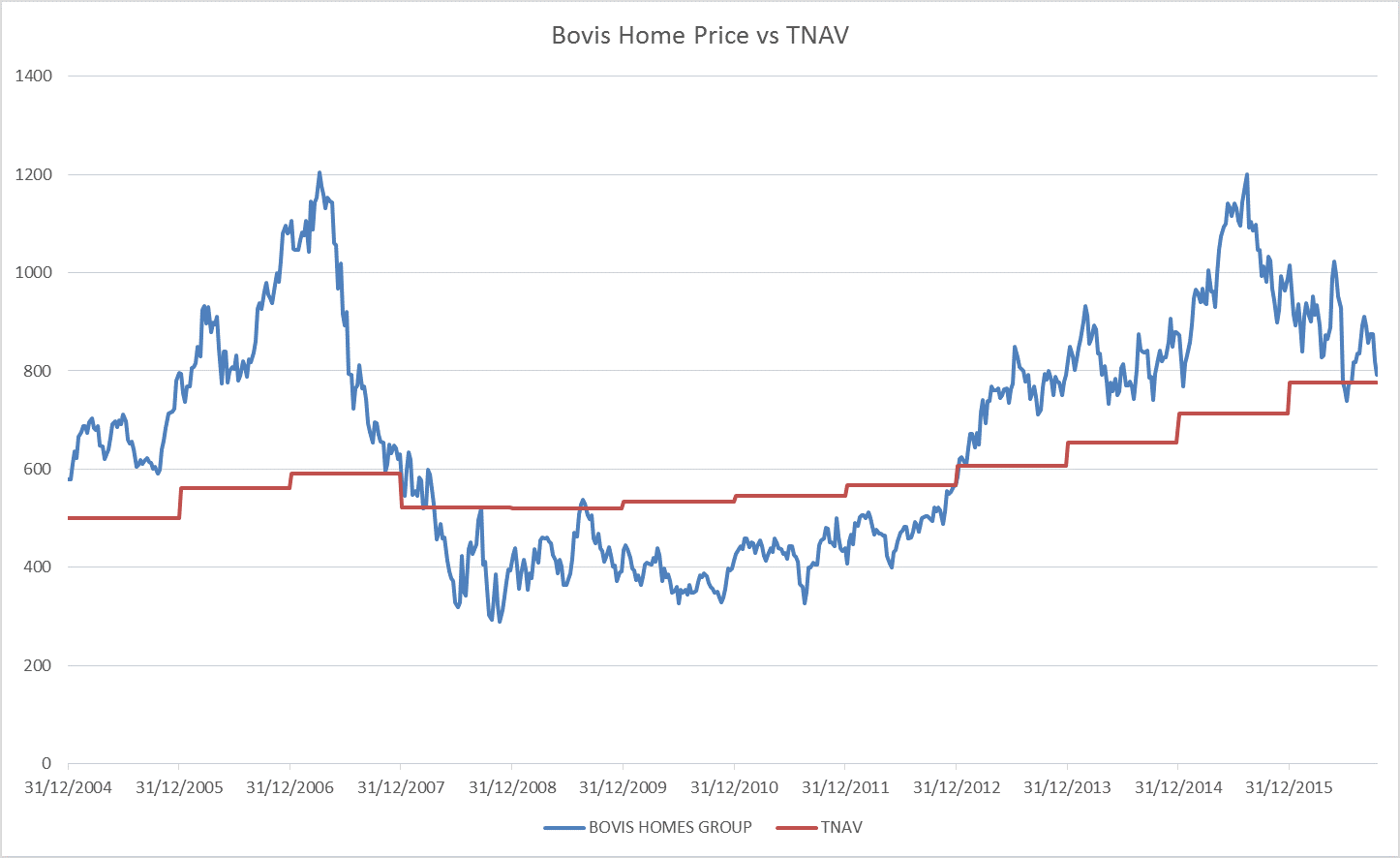
The longstanding CEO David Ritchie was fired earlier this year after another profit warning. The Group then received an approach from Redrow in March 2017, which was rebuffed. However this exemplified in my mind the value the industry saw in Bovis, in way that many institutional shareholders did not.
Focus on efficiency
The new CEO has put forward a sensible plan in my opinion. He wants to reduce some of the bloated capital employed in the business, in this case land held on the balance sheet. Slimming down large sites, selling off other sites which are non core, doing more with housing associations and better managing payment terms for land. The number of operating units will shrink from 8 to 7. According to the financial plan the sales of non core land should liberate cash of c£180m or 134p share by the end of 2020, which will then be handed back to shareholders as a special dividend in FY19 and FY20. The Group is also targeting at ROCE of 25%, inline with what a number of its peers are producing. This is a bold plan and I am pleased that the CEO is grasping the nettle.
The Plan
The net effect is to see completions rise over time to 4,000. If I assume a £280k average selling price = revenues of £1.1bn. Gross margins are expected to rise by 5% to 23% as inefficient land is sold (some of the larger sites) and efficiency measures are implemented. Group admin costs are expected to fall to around 5% of sales. This would leave an EBIT margin of around 18 -19%, but crucially still below peers like Bellway. That would be around £200m of EBIT and after interest (average net debt c £100m ?) and tax I expect EPS of around 110-120p share. The Group will then target dividends of 50% of EPS.
There are clearly 2 massive caveats
1. The housing market remains strong. Hmm I think the housing market is being supported artificially by Help to Buy at the moment. Notice the way that most consumer facing businesses are struggling at the moment, yet housebuilders still claim demand is strong.
2. The plan is delivered as it has been laid out. I am less concerned about this as Bovis has lagged its peers in terms of financial returns for years. There is clearly so much that can be done here.
Conclusion
The plan is bold and based on my "in price" of 766p / share the company could be on a PE of c7x 2020 and yielding 7%. However I do accept that the share price has risen to over 1050p and from here the risk reward is different. I think there is scope for the Group to over achieve on margins relative to the plan. However I am most concerned about a potential phasing out of Help to Buy. This is clearly supporting the housing market and should this be withdrawn I can see real downside on volumes and prices. I have learned to my cost to rely on Governments. They can change their mind on a whim or on a bad opinion poll. Having gone from a buyer only 9 months ago, I feel the risk reward has altered and I will be letting a few go, although I will still retain a holding as I feel the plan, although bold, can be exceeded.
VegPatch
Disclaimer
This is not financial advice. Our content is intended to be used and must be used for information and education purposes only. Please read our disclaimer and terms and conditions to understand our obligations.
2 comments
Regarding house builders, it is my belief that variations in profitability over the cycle are mostly due to an accounting technicality than real.
If I owned a petrol station on small margins and the petrol price rose I wouldn't suddenly report a jump in profits because I was now selling petrol for much more than I paid for when it was delivered at the beginning of the week. And if the petrol price fell I wouldn't report losses. Instead I would report on a replacement cost basis.
However housebuilders buy land, building materials and labour and after a significant lag sell houses. Any downturn affecting the selling prices of houses has an almost immediate effect on all of these input costs (and I suspect that most of their input costs are actually more volatile than built house values). But they will report collapses in profits at best.
On the other hand over the last few years their profits have been exaggerated as both input costs and output values have risen. Unfortunately, unlike on "Property Ladder" there is no Sarah Beeny to tell us how much (if anything) they actually made due to their efforts and how much was simply due to rising property prices.
So the questions are:
a) how much are share prices current irrationally inflated by the rising market resulting in high reported profits (if at-all)? and
b) how much will share prices be irrationally undervalued by a future falling market (again, if at-all)
c) is there a danger of long term (5 years+) falls in house prices rather than the recent cyclical experience.
Following this rationale I made a lot of money buying housebuilders in the last financial crisis, despite most of my buys being far too early and a completely unprecedented and unforeseen drop in mortgage availability and transactions.
For me, the bear case for housebuilders would be if there were long term falls in nominal house prices. It would be very difficult to report profits, pay dividends or indeed operate in those circumstances.
Regarding Help to Buy, see this: https://ftalphaville.ft.com/2017/09/06/2193292/opening-quote-mccarthy-stone-the-odd-builder-out/, but my view is that without the Help to Buy distortion the market would adjust and underlying profitability would be much the same. Of course the worse place to be is having your costs distorted upwards but not your income.
Really strange market in housing related products. Housebuilders saying things are great, SafeStyle, Entu etc who provide rennovation products all saying market is weakening
Housebuilders saying the market is basically fine eg Barratt developments CEO said this earlier this week
However....
Interestingly Berkeley Group, the UK best housebuilder (Tony Pidgeley is an unbelievable genius at buying land) saw Chairman Tony Pidgeley and MD Rob Perrins (his wife actually - lucky her) sell £26m and £17m each of shares yesterday. These are not small director sales like £10k or even £500k but £26m and £17m. That's big Kahuna !
Safestyle, which makes doubled galzed windows and doors https://www.safestyle-windows.... has had a profit warning today stating
Shares are off 30% first thing (a bit of an over reaction IMHO)
So to me the housing market is being propped up by cheap mortgages. Household incomes are under pressure and consumer confidence is waning. Big ticket items struggle usually in that type of environment (see Safestyle for details)
I have small short positions in Persimmon and McCarthy &Stone. Must be careful though as they are Superstocks. Will increase them a lot if trading starts to weaken as most housebuilders are now trading on record premia to price to book values.
Cycle? What cycle ?