Bovis Homes goes for growth

The UK’s four largest listed homebuilders have shareholder capital return programmes in place. As such the competition for new land is not intense which bodes well for homebuilders that are focusing on growth. Bovis Homes invested a record amount in new land in 2014 and is seeing its return on capital improve.
From 2008 to 2013 the UK saw under 125,000 new housing starts a year, which compares to around 175,000 from 2004 to 2007. Current home building levels are estimated to be around 100,000 short of demand.
UK homebuilding falls back

Source: Persimmon investor presentation
The largest UK homebuilders – Persimmon, Barratt Developments, Taylor Wimpey and Berkeley Group – have capital return programmes in place. This means that, despite the market backdrop, they are not prioritising homebuilding expansion.
The competition for new land is therefore not intense with Bovis Homes stating in its May 2015 trading update that:
“The residential land market remains attractive with a good supply of consented land… The average expected return on capital employed on land acquired this year is circa 30%.”
Land is the scarce resource for homebuilders and can be easily bid up in price during strong market conditions. This happened before 2008 and saw many homebuilders subsequently write-down the value of their land banks.
With the memory of this period fresh in the mind of executives a more cautious approach is being taken. As such homebuilders that are focused on growth are well placed to buy land at attractive prices and generate strong returns.
The UK mid-cap homebuilders (in the FTSE 250) are Bellway, Redrow, Bovis Homes, Galliford Try and Crest Nicholson. Bovis Homes has a market value of £1.5bn and is one of, if not the, fastest growing homebuilder in the UK.

Bovis Homes’ profile: Homes for the South
Bovis Homes doesn’t have exposure to London but the South of the UK made up 75% of the land bank at the end of 2014. This bodes well for home price momentum given the strong housing demand in the South.
In 2014 the group saw 73% of legal home completions come from cheaper land bought after the downturn. This will increase over time and will help boost the profit margin on new home completions.
Home sweet Bovis Homes

Source: Bovis Homes investor presentation
Bovis Homes generated a 16.2% return on capital employed in 2014 which compares to 10.6% in 2013 and 3.5% in 2010. The target is for at least a 20% return on capital employed by 2016.
At the end of 2014 the group had net cash of £5.2m which compares to net debt of £18m at the start of the year. The dividend paid in 2014 was 35p a share which was more than twice covered by earnings per share (EPS) at 78.6p.
Bovis Homes invests for growth
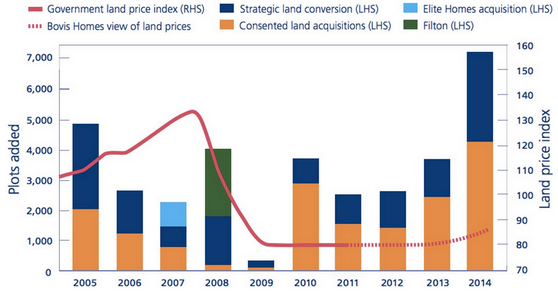
In its 2014 results presentation Bovis Homes stated that it was a: “record year of land investment at the right point in the cycle.” The group added 7,300 new homes to its consented land bank, which was an increase of 95% on 2013.
Bovis Homes invests in land
Source: Bovis Homes investor presentation
Legal home sale completions were 3,635 in 2014 (up 29% on 2013) which is half of the 7,300 plots added to the land bank. At the end of 2014 the consented land bank therefore increased to 18,062 plots versus 14,638 at the start of the year.
The land bank at the end of 2014 gives 5 years of housing supply at the level of completions seen in 2014. This supply profile is likely to increase further given the strong investment in the land made so far in 2015.
Book value comparisons
One way to compare homebuilder valuations is the market capitalisation relative to the tangible book value. The main driver of book value is the acquisition cost of land, which is held as a trading asset on the balance sheet.
At the end of 2014 Bovis Homes had a book value at 655p which was up 8.4% on the start of the year. The ratio of the share price to net assets at the end of 2014 is therefore 1.75X.
The largest listed homebuilder, Persimmon, has a ratio of 2.84X with the net asset per share of 715p at the end of 2014. The largest mid-cap homebuilder, Bellway, has a ratio of 2X with a NAV per share of 1,181p at the end of 2014.
The discount for Bovis Homes appears to reflect a lower return on capital and the group’s emphasis on growth. However, Bovis is set to rapidly improve its returns with land purchased in 2015 expected to generate a return on capital of 30%.
Forecast P/E ratio valuations (closing prices 19th June)
Turning to forecast price to earnings ratios and Bovis Homes stands at a forecast P/E for 2015 at 11.2X. This compares to 13.7X for Persimmon and 11.1X for Bellway with the latter having a financial year-end to June 2015.
The focus on growth means that the forecast P/E ratio of Bovis Homes falls significantly over time. In 2018 the figure is only 7.2X and the forecast dividend yield is 7.5%, with the payout expected to be 1.9X covered by profits.
In the same year the forecast P/E ratio for Persimmon is 11.8X with a dividend yield of 5.8% that is 1.5X covered by profits. For Bellway Homes the forecast P/E for the year to June 2018 is 9X with a yield of 3.8% that is 3X covered.
Summary
The four largest homebuilders in the UK are focusing on capital returns and have been rewarded by investors for doing so. Three of them have joined the FTSE 100 and Berkeley Homes looks set to enter the index in the near-term.
Bovis Homes, by contrast, has an emphasis on growth and appears to have been overlooked. Its market valuation relative to book value is lower than the sector average despite the group’s recent investment in high margin land.
This investment will generate strong year-on-year home growth in home completions in the medium-term. As such Bovis Homes is expected to be valued at a significant P/E ratio discount to its peer group in 2018.
Investors appear to favour “a bird in the hand” in terms of the UK homebuilding sector at present. However, growing homebuilders are likely to come into fashion given the UK housing market supply/demand imbalance.
In the meantime the dividend profile of Bovis Homes offers an attractive and growing income. Record land investment by Bovis Homes is likely, in our view, to translate into a record share price, of over £12, in the medium-term.
This report was produced by Fat Prophets Senior Research Analyst, Andrew Latto
Disclaimer
This is not financial advice. Our content is intended to be used and must be used for information and education purposes only. Please read our disclaimer and terms and conditions to understand our obligations.
5 comments
I'm a holder of Bovis and it seems reasonable to me that while daily we hear about shortages of housing from all sides of politics, likely only to be exacerbated by immigration, house builders ought to be making more house starts soon. In addition, we have a government pushing to ease planning blocks, even of green belt. Oddly, in the last year or so, here appears to have been a very great reluctance of building firms to use the land they hold and there is talk of obliging them to get on with it. Against all this, it is said that there is a lack of building crafts skills in the population. Who can say what the implication of of recent storm damage in Cumbria and elsewhere will have on the building industry, although it may be that companies like Bovis will not be affected, other than by potential issues of material and labour shortages so caused.
Why then, I ask myself, did the value of my Bovis shares fall by 4.1% today? Does a 5% dividend yield, twice covered, and a PE of 8 not satisfy? A peg of about 0.5 and at least 4 years of steadily rising divs? If not, what would? Is it the case that many investors in Bovis really have no idea of the context in which the company makes its money? Were they looking for a company that could pull rabbits from hats or turn water into wine?
Are such a large proportion of the world's investors shallow nincompoops who only take a position to resell as soon as possible at a higher price without necessarily caring what the company actually does to make its profits? It must be so and all I can imagine is that there must be a large number of really scared and unhappy people out there. Meanwhile, whatever happens to the SP, Bovis will continue to build much needed homes, many at the essential starter home level and I will keep sharing in the fruits of their intensely simple process. I'll sell them when the dividends fall below 2.5% or we have a glut of housing in the UK or the population falls not rises, whichever is the sooner.
Yes its strange that it has fallen back when other builders share have gone up, its one reason why I bought some because they looked good value compared to their peers. I may average down but not sure in this market.
Yes they were cautious in their November statement, but then beat the cautions in last weeks
Unfortunately in the interim brokers started to edge their forecast down and led to some weakening, but now they beat their earlier caution maybe forecasts will go back up? -- could mean the recent good news is not being fully reflected...IMO
Regards
Source
Sensible stuff and the value is even better now (especially after Bovis's solid trading statement only last week)...Seems this is all being lost given the wider market wobbles!
Regards,
Source.
Yes quite agree, good statement was ignored due to the market problems. Their previous statement was not very good I seem to remember. All that land bodes well for the future.