Finding the big winners in UK gaming - Frontier Developments and Codemasters

While the rest of the economy is in lockdown, UK gaming is in rude health. The global market is forecast to grow at c9% annually for years into the future, and next gen consoles are set to be released in late 2020. Because of this positive outlook, I’ve been covering the sector in a little more detail recently.
I’ll take a break from UK gaming after this article, but the long term growth trends that underpin this market aren’t going away anytime soon.
So far, I’ve looked at Keywords here, TM17 here, and Sumo here. There are three other companies currently on my list: Frontier Developments, Codemasters, and CD Projekt. I haven’t managed to take a look at CD Projekt yet but it is by far the largest of the set and looks to have a differentiated business model - so definitely worth investigating in future.
Of the remaining two, Frontier Developments says that lockdown-related demand for games is having a positive impact on sales globally, while Codemasters has also reported strong trading. Given the continuing market volatility, strong current trading is a big plus in my view.
The wider UK gaming set continues to outperform the market year-to-date.
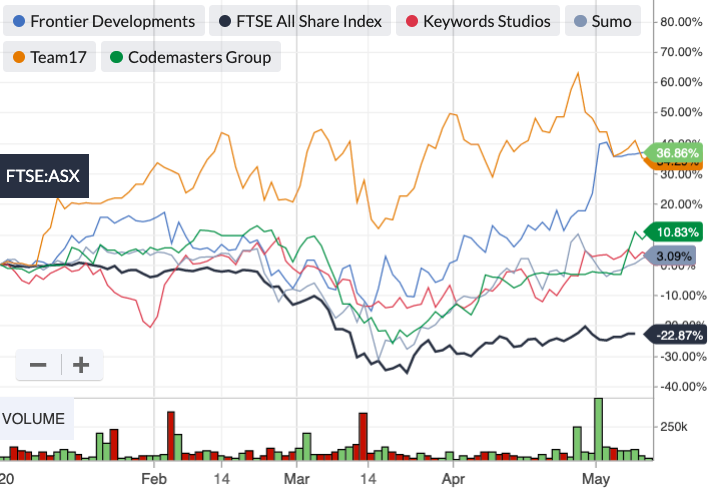
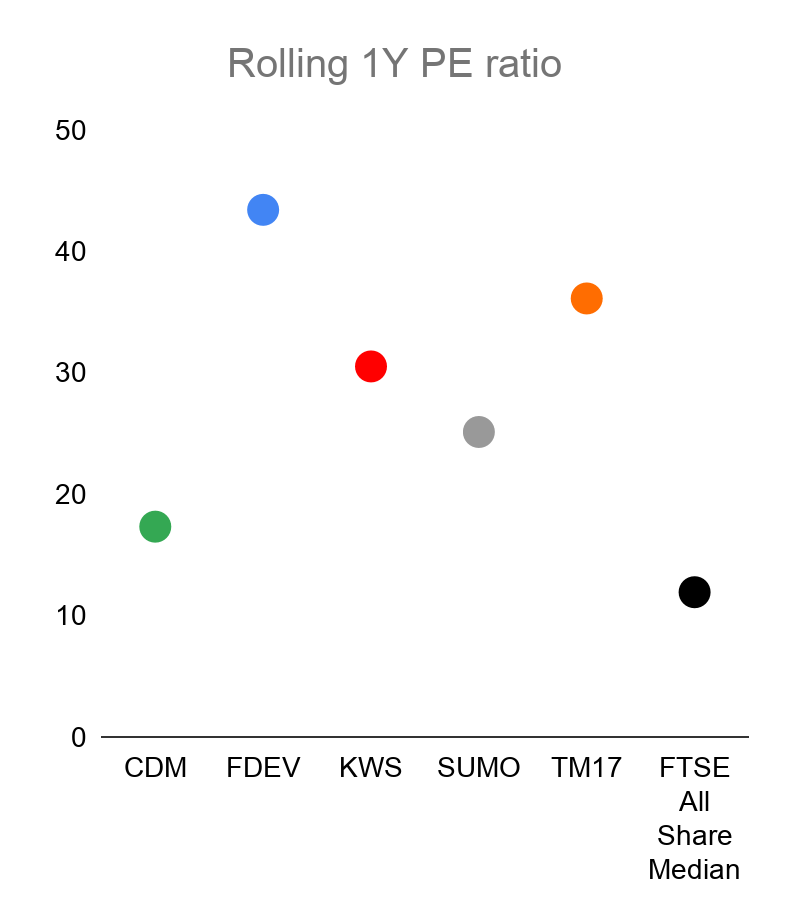
As with all the video games companies I’ve encountered so far, Frontier Developments (LON:FDEV) and Codemasters Group (LON:CDM) are both high QM stocks - ie. “highly profitable and growing, but expensive”. Their market outperformance comes despite decidedly punchy trailing twelve month PE ratios for all involved.
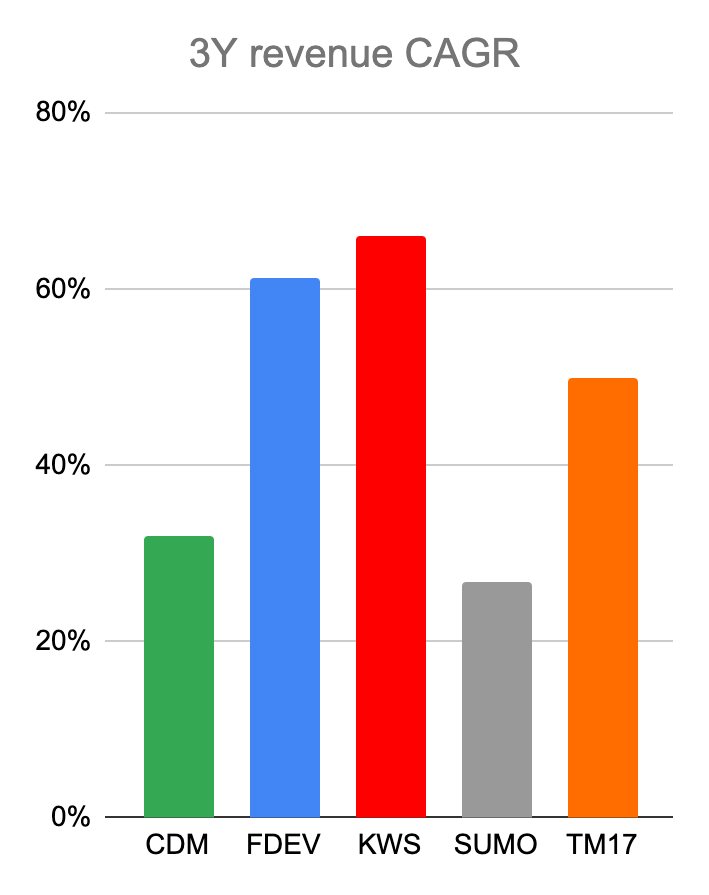
High relative valuations can be justified by strong growth rates and large market opportunities. Here are the 3Y revenue CAGRs for all of the companies:
Strong market growth prospects and government tax breaks
Thematically, as a long term investor, I like the idea of having exposure to UK gaming. This sector alone is worth c£4bn - more than the UK music and TV sectors combined - and it is expanding all the time. I can see a couple of key growth drivers.
Video games’ tax relief (VGTR) was introduced in 2014 and has supported the growth of the sector. The EU commission is committed to this scheme until at least 2023. All five companies in the sector benefit from the policy. It will be a helpful tailwind.
The shift to cloud gaming is perhaps the key trend, though. It completely changes how gamers interact with games. It extends product lifecycles, increases profitability and improves revenue generation. The cloud-based, hardware agnostic approach makes for a far better business model for game makers. Studios can code once without porting across hardware, making them more productive.
Momentum is already building among major gaming companies (Microsoft, Google, Sony etc.) to lay the foundational infrastructure for streaming technology to deliver games on-demand for recurring subscription fees. It is the future.
We are also seeing evolving business models from the likes of Sumo and Frontier Developments. The lines between outsourcing partnerships and own-IP are blurring as the market matures. A dual model allows for companies to capture more value via Own-IP, while retaining greater revenue certainty through high visibility development fees. This is one reason I am leaning towards Sumo Group as a company to keep on my watchlist.
The most immediately obvious trend is rampant M&A - although this to me is also the least sustainable growth driver. Most of the companies I’ve written about are involved in M&A to varying degrees. I am warier of those that rely on it more, however. It sucks up free cash flow, creates integration risk, and obscures the underlying picture. Some specialists - such as Judges Scientific, SDI Group, and Volvere, excel at acquisitions - many others struggle, though.
If I’m paying a high multiple, ideally I would be buying into organic growth at high margins.
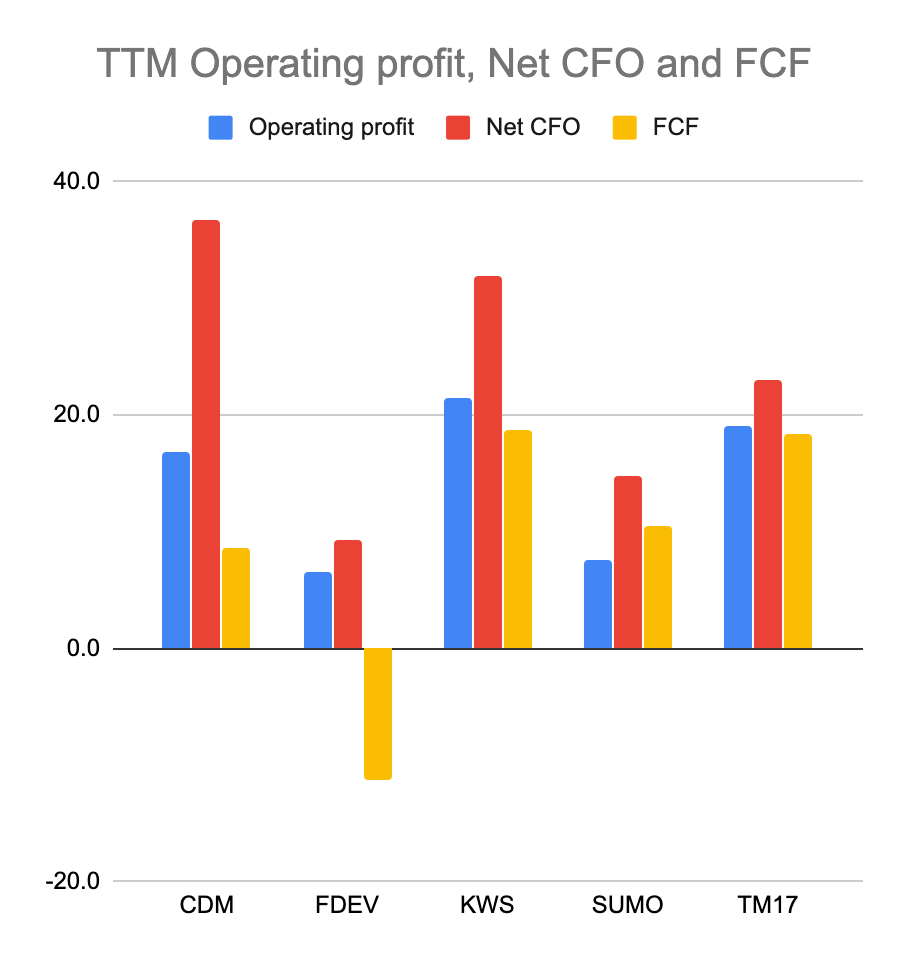
This might explain FDEV’s negative free cash flow over the past twelve months. That doesn’t automatically rule it out though - as we see below, there is plenty for FDEV shareholders to be excited about...
Frontier Developments
Market cap: £646m
QM Rank: 94
1Y relative strength: +94.8%
Forecast PE ratio: 42.7
Frontier Developments was founded in 1994 by David Braben, is based in Cambridge, and uses its proprietary 'COBRA' game development technology. FDEV has a strong games catalogue and has recently made exciting announcements concerning new licenses with Formula 1 and Games Workshop.
This IP license with Games Workshop looks promising. GAW has been threatening to meaningfully monetise its intellectual property for a while and has been quietly scoping out royalty-generating opportunities. The fact that it has opted for FDEV could be a sign of quality.
In fact, Games Workshop’s head of licensing makes an interesting comment:
As Warhammer becomes an ever larger brand and our legions of fans around the world look for exciting ways to experience the splendour of our settings, we are always looking for the highest quality partners to work with. Frontier is just such a company, with an incredible heritage, and an innovative and highly polished development capability clearly demonstrated by their compelling vision for this game. This will be the first RTS set in the epic fantasy world of the Age of Sigmar, which is the kind of game that Warhammer and strategy fans have been clamouring for. We know that the team at Frontier are the perfect people to take on that great responsibility and do it justice.
Questions remain over which party captures the most value in this type of arrangement. Nevertheless, it is an encouraging vote of confidence from Games Workshop.
The group has also signed a multi-year game licence with Formula 1®. The licence provides Frontier with the rights for four F1 seasons (2022 to 2025 inclusive), subject to the achievement of certain financial performance thresholds.
FDEV calls the addition of a multi-year, multi-platform sports management licence “a strategic milestone, which is expected to provide significant annual incremental benefit to Frontier's financial performance from the release of the first game in FY22 onwards.”
All in all, FDEV has a busy pipeline:
- FY21 - two internal developments (Planet Coaster and Elite Dangerous) and two partner developments.
- FY22 - multi-platform release of a game based on an as-yet unrevealed “major global IP” and Frontier's first Formula 1 multi-platform management game.
- FY23 - More internal developments. The release of the 2023 Formula 1 management game and Warhammer game.
Frontier Publishing also continues to win new business.
Concerning COVID, FDEV says: “Like many companies selling mainly online in the digital entertainment industry we have seen increases in demand for our products” - so the assumption that gaming is a rare winner in current conditions appears to be justified.
Based on this increased demand, the board now expects revenue to be towards the top of the previously stated range of £65-73m for the current financial year ending 31 May 2020, with operating profit to fall within the range of £11-13m. This appears to be slightly ahead which, with a forecast PE in the 40s, is probably to be expected.
The business has a strong, debt-free balance sheet with cash of approximately £40m, which leaves it well placed to fund growth. Recent licensing deals are exciting and the future looks bright. That said it generates lower margins than the likes of TM17, SUMO, and CDM - so these might be more attractive investments to consider.
Codemasters
Market cap: £472m
QM Rank: 95
1Y relative strength: +76.9%
Forecast PE ratio: 17.6
(I have a beneficial interest in this stock)
Codemasters is an award-winning British video game developer and publisher that specialises in own-IP and third-party racing games (including DiRT, GRID and an award-winning official F1® series).
CDM qualified for a screen of relatively stable high QM software companies in this post. It’s interesting to note, as well, that the group is noticeably cheaper than its peers according to some metrics. CDM’s major shareholders data also shows its top shareholder (Slater Investments) nearly doubled its stake in the group on the 30th of April.
The racing genre is a gaming staple and its evergreen popularity should give CDM a degree of financial stability. With more than 30 years of experience, management has established a track record for creating high-quality and it is something of a “go-to” racing specialist.
CDM is releasing DIRT 5™ from October 2020 on the next generation of consoles (Xbox Series X and PlayStation®5). Here “players will experience extreme racing in a variety of vehicle classes from buggies, unlimited trucks, rock bouncers to traditional and modern rally cars.”
The first releases on any new console are important for establishing hardware sales momentum and showing off its technological capabilities, so the fact that DIRT 5 is one of the first releases on new consoles is a good sign. The group is also involved in a promising F1 project, set for release on July 10th. I’m unsure if this F1 title is related to the work being done by FDEV. It sounds like they are separate projects. CDM says:
F1® 2020 promises to be our biggest and most innovative title to date. We're bringing new game modes to our core simulation players alongside accessible features that will appeal to the casual racing fan. With sporting events currently on hold around the world, our F1® game is seeing incredible engagement as professional drivers, esports players and celebrities race online in the F1 Esports Virtual Grand Prix series, replicating the original F1® calendar.
CDM last communicated with the market in its Year-end trading update for the year to 31 March 2020. In brief:
- Overall trading in the second half of the year was strong.
- Anticipated FY20 revenues of c£76m (FY19: £71.2m),
- Adjusted EBITDA “comfortably ahead of expectations” at c.£18.1m (FY19: £18.7m), including a loss of c.£0.9m from Slightly Mad Studios ("SMS"), acquired in November 2019.
- No debt and as at 31 March 2020 had gross cash of c.£25.5m (31 March 2019: £18.2m).
I think there is an opportunity here purely on relative valuation grounds. CDM also has a strong market position as a racing specialist. As far as I am aware, there is no clear dominant player in this niche which gives CDM a good opportunity to continue taking share. Formula 1’s increasing focus on the video games market as an additional income stream could be a key catalyst.
Conclusion
One recurring issue I have with these companies is valuation. I haven’t seen a single company in this sector that looks “cheap” in the classical sense. But what looks expensive now can prove to be cheap in hindsight if the market is undervaluing the stock’s growth prospects.
While Frontier Developments has some exciting projects lined up, I prefer to look at the higher margins offered by some of its peers. The ones I'd like to take a closer look at include CDM (cheaper valuation with niche specialisation and a strong portfolio of AAA racing games) and SUMO (smaller and with a growing focus on own-IP development, plus the recent Tencent stake). I’d probably add to that TM17 (strong factor profile and high margins), although as things stand I do struggle with the valuation.
The fact is most of these companies have good long term growth prospects, solid current trading, and net cash positions that make them attractive candidates for further research.
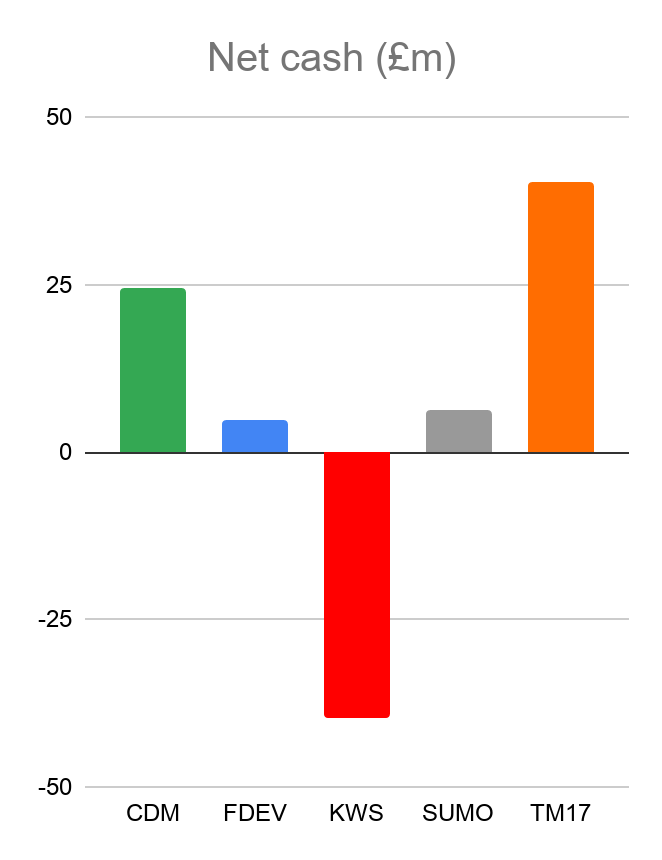
The next step for me might be to dig into the actual content output of these game makers. From there, I might take a firmer view on which outfit is best placed to capitalise on the significant opportunity we all know is out there.
Some investors have mentioned the idea of looking into sector ETFs to gain exposure to the gaming market while reducing company-specific risk. However, while it does diversify away a lot of unsystematic risk, it might also prevent you from fully participating in the upside - so I’m going to keep looking at individual companies in the sector for now. Any views on these companies or the market in general are welcome.
Disclaimer
This is not financial advice. Our content is intended to be used and must be used for information and education purposes only. Please read our disclaimer and terms and conditions to understand our obligations.

13 comments
Hi Jack
Thank you for a great series of articles.
My interest in Frontier Developments (LON:FDEV) became an investment last year when it emerged that Tencent had bought a stake (and I seem to recollect may also have board representation?).
The opportunity to distribute considerable volumes into China via Tencent may well be what is helping them to sign up exciting new IP such as Games Workshop as this will also help Games Workshop (LON:GAW) to build brand awareness in the Chinese market. A virtuous circle in the making. Quite a powerful forward looking strategic opportunity which looking forward 5-6 years I feel should payoff considerably.
All the best
Neil
Excellent article, Jack.
Any thoughts on mainly online gambling companies?
I know from personal experience that there has been a boom in online poker since the start of the lockdown.
Kindred Group PLC (owner of Unibet and 32Red), listed in Sweden, has recovered pretty well in the last 2 months.
Flutter has done even better, despite having a lot of betting shops, but this is probably due to a possible deal with Stars Group.
UK listed companies with (closed) betting shops and casinos etc have not done so well.
the link below is to old news item concerning gaming companies on the sweden market which might interest anyone researching this sector . it
https://europeangaming.eu/portal/latest-news/2018/06/22/22246/swedish-stock-exchange-has-the-largest-number-of-online-gambling-companies/
I own the following companies listed on sweden market and nasdaq,
NetEnt AB (publ) and Evolution Gaming AB also GAN on the nasdq , there is huge growth perdicted in the gaming / casino area for the few years especially in the US.
I've enjoyed reading this series. Having grown up with agmew of the games these brands make I was keen to invest in some of these stocks.
However, I don't agree with assessing Codemasters Group (LON:CDM) based in its niche. In the end, when assessing one company against another in their games' appeal to users, it's worth considering share of time. One game will take time away from another and even with a lockdown, there's only so many we can play in a day. So I would look a game's 'stickiness' if you want to inform your buying decision on their games catalogue.
Hi Jack,
I'd be interested in your view on Codemasters heavy capitalisation of Software Develpment wages and consistently lumpy/poor FCF generation. It actually looks more expensive to Team17 for instance on P/FCF basis
Thanks for the interesting article, Jack. As a gamer, I've often been intrigued about investing in the industry but have always been a tad weary investing in the more niche smaller developers listed in the UK. While focusing on one area for gamers, e.g. strategy/management games for Frontier Developments (LON:FDEV) and racing for Codemasters Group (LON:CDM), to me it has always seemed a bit of a risk (although I take the counterpoint that it allows them to specialize in these genres). Personally, given the lofty ratings and little margin for error (e.g. a game flopping), I'd prefer to invest in a larger diversified publisher e.g. Activision ($ATVI) or Electronic Arts ($EA). They are not on a dissimilar (or lower) forward earning rating and seem safer bets to me. No position in either. Nintendo also offers decent exposure to the industry for obvious reasons and can be bought through a few brokers over here.
Obviously some of the impetus to share prices is a direct impact of having people stuck at home looking for things to do. Some of that is adult related but a lot of teenagers, particularly boys, are relying on gaming to spend time with their friends (well, they are round my way).
As with a lot of the sectors seeing a lockdown boost the question is whether it's temporary or permanent. There'll be no absolute answer to that until after the event but there is at least one of thing that suggests that the economics of the industry will be permanently improved - the current enforced closure of physical retail.
This has two effects. Firstly people who have never bought a game online before are having to do so and have suddenly found they can do easily and with virtually no effort. That's likely to have a beneficial impact on gaming volumes for a considerable time - especially if normal modes of entertainment remain closed for months.
Secondly, online sales provide a margin boost to gaming companies either by completely cutting out the distributor costs or, where the distribution is done by an intermediary like Steam, significantly reducing the incremental costs of producing the display materials (case, inserts, discs, etc). Codemasters Group (LON:CDM) specifically referenced this latter point in its recent update:
The shift to digital delivery has accelerated greatly, which has contributed to higher margins, with traditional retail and box sales impacted, exacerbated by the closure of the majority of game retailers.
The ability of the internet to shrink the distance between producer and consumer and significantly reduce the costs of distribution has been understood for 25 years. The challenge has been that human buying behaviour tends to be sticky. However, once people can be persuaded to try something and find it's easier they'll keep on doing it.
We're seeing similar trends in areas as diverse as online food shopping, home working and the use of contactless cards. The trick is trying to figure out what that means for the world post-virus but none of it looks particularly positive for traditional retail or commercial property.
timarr
Hi Tim,
The ability of the internet to shrink the distance between producer and consumer and significantly reduce the costs of distribution has been understood for 25 years. The challenge has been that human buying behaviour tends to be sticky. However, once people can be persuaded to try something and find it's easier they'll keep on doing it.
- Completely agree w/this. My view is that lockdown will act as a 'nudge' for entrenched trends such as the profound shift to online that is an ongoing dynamic across multiple areas of the economy.
I consider gaming, and particularly the cloud-based, digital-download, games as a service model, as part of this "mega" trend. It should make for higher margins.
My current view is that lockdown conditions will provide a short term boost that might fade (I think more likely it will add to established momentum), but either way the underlying favourable long term trends should endure - in this part of the market at least.
This post has certainly caught my eye. Being a gamer myself it is an area I've been looking at investing for some time, but just haven't done enough homework. I've noticed the rise in streaming content is constantly on the up and the stats on here clearly prove that the gaming sector is booming.
Codemasters looks interesting, but I have just one question........if Frontier have a licensing deal for a Formula 1 game how will this affect Codemasters? Is it an official game or some sort of collaboration with software / development?
This was my first reaction but my understanding is that they are different types of game with no crossover. Codemasters is the racing simulation specialist whereas Frontier specialises in management games. A bit like Fifa or PES versus Championship Manager. So I don't think they affect each other at all.
This is something I was trying to unpick but I couldn't quite pin it down for certain... I'm sure the answer can be pieced together from the various updates.
My understanding is that Codemasters Group (LON:CDM) has a long standing license agreement to produce F1 racing games - something that its EGO engine is uniquely equipped to do.
As Bashley says, Frontier Developments (LON:FDEV) appears to be making a different game with more of a focus on car team management. Perhaps one day these two games could end up merging into one comprehensive package but that is pure speculation on my part.
As I see it both are "official" given the licenses but the games just emphasise different aspects of F1. I wonder if anyone else can confirm this?
I'm no expert but I believe the games are really looking at different things. I found this useful in giving an idea of what the FDEV game might include:
https://www.pcgamesn.com/frontier-f1-management-games
Obvs don't take that as the real functionality, but it shows you the type of game it might be, which seems very different to the CDM game.
Perhaps when the 30% of the workforce currently on furlough (according to the media) go back to work some of the heat might go out of the gaming valuations? At the moment these people are paid c. 85% of their net salary (see my SCVR comment today on the subject) to watch Netflix or play computer games. Hardly an incentive for them to return to work and very frustrating for people still working, many from home, who may see their internet speeds suffering with all the online gaming! However, given the likelihood of mass unemployment perhaps these businesses will grow into their valuations as many people will have nothing better to do. Holding shares in these businesses could be a useful hedge or diversifier alongside Gold and Government bonds as we face economic Armageddon! An added bonus is they may pay a dividend for income unlike Gold & zero interest gilts!