Foxtons and TPFG - real estate recovery candidates

UK real estate is a c£1,600bn market that contributes over £100bn to UK GDP (per BPF).
It’s a huge market (see the listed players here), and it’s also a part of the economy that has bounced back surprisingly well from the lockdown.
In fact, Zoopla research finds that a major decline in house prices is 'unlikely' this year despite the recession. It finds that:
- Property prices are holding firm and are still up 2.5%year-on-year, with 'little sign of slowing',
- Demand from buyers is 34% higher than a year ago,
- Activity is now running at its strongest pace for over five years, with the number of newly agreed sales in August up 76 per cent against the five year average, and
- The time it takes to sell a home has shrunk from 39 days to 27 days since lockdown, compared to the same period a year ago.
Zoopla comments:
This is not just pent-up demand returning to the market. It also reflects the impact of a once in a lifetime reassessment of the nation’s housing needs in the wake of the 50+ day lockdown… Housing market conditions remain unseasonably strong despite the UK moving into recession. While the economy has contracted sharply and unemployment is rising, consumer spending has rebounded and purchasing manager indices are pointing to a wider rebound in the economy.
Can this last? It seems completely counter to other parts of the economy. House prices typically fall during a recession, usually after a period of strong growth.
Pent-up demand, the stamp duty holiday, and furlough extension have all boosted the market in the short term.
But as we head into winter we could see rising unemployment as government support measures are withdrawn, increasing COVID cases as lockdown is withdrawn, and ongoing uncertainty over Brexit. Any and all of these could weigh on sentiment depending on how it all plays out.
In all, I’m wary of this rapid, post-lockdown bounceback in prices - but it’s certainly better than a crash.
Meanwhile a recent Savill’s report confirms these ‘remarkably high levels of activity’ and the ONS notes that rents in the UK increased by an average of 1.5% in the year to June.
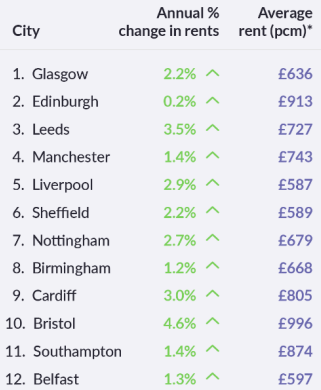
Source: Zoopla June Index 2020
The RICS survey is something of a leading indicator for other indexes. It shows high activity levels for July, with a record 87% of surveyors reporting rising levels of new enquiries, and 80% reporting rising levels of new instructions.
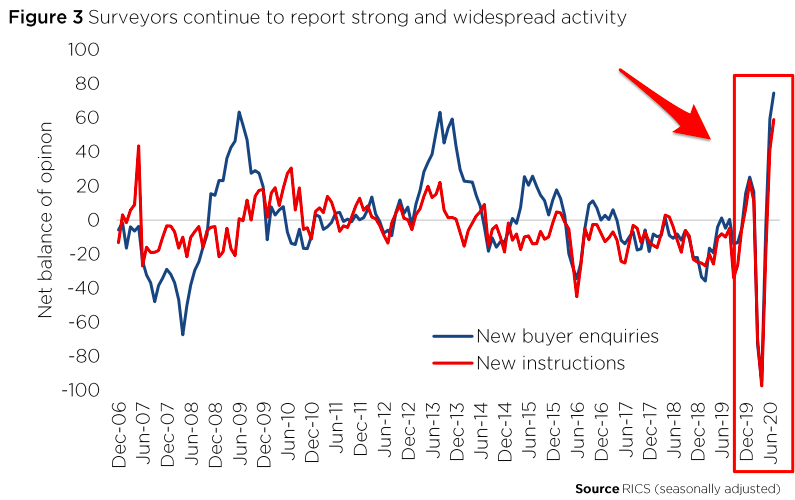
The devil’s in the detail though.
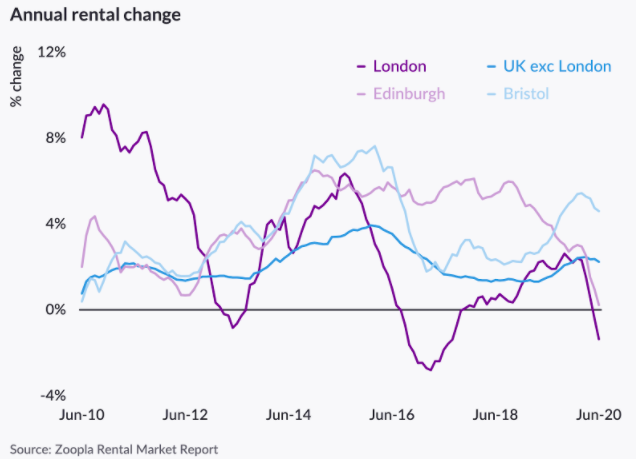
Zoopla notes a ‘two-speed market’: while former favourites like London and Edinburgh suffer from office closures and reduced international travel, other areas are proving more resilient.
All in all, the picture is mixed to positive with some serious near-term downside catalysts to consider in the form of rolled back government support.
Against that backdrop I’ve taken a look at two real estate operations candidates: one long term quality growth play (TPFG) and another higher risk, cheaper recovery candidate (Foxtons).
Since Foxtons is currently loss making, I’m using the ‘price to trailing twelve month free cash flow’ as a valuation metric.
The Property Franchise Group (LON:TPFG)
Share price: 192.5p
Market cap: £49.71m
Price to free cash flow: 11.9
1y RS: +41.5%
(I hold)
Property Franchise (LON:TPFG) is not a world changing healthcare start-up with an exotic name - but it is a fantastic, proven cash generation vehicle for shareholders. This outfit has generated double-digit margins and returns on capital for years, clocking up steady growth the whole while.
I’d class it as a QARP (quality at a reasonable price) play, but with a number of potential share price catalysts.
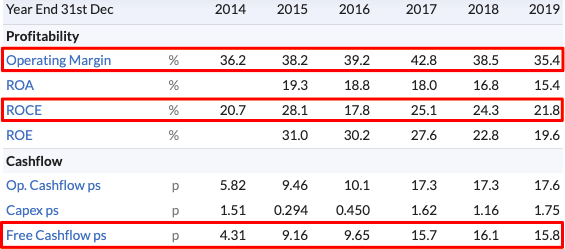
It’s ably steered by steady management with a strong sense of continuity and skin in the game and, with a market cap of just £50m, there’s plenty of scope for long term growth.
It’s really about as good as it gets in terms of financial prudence and steady, controlled expansion over time.
Along with other listed plays Belvoir (recently covered here) and Winkworth, TPFG operates a property franchise approach to real estate operations. Today that franchise network lets c32,000 properties, sells c11,000 properties, and manages c58,000 properties annually.
This is a key strategic business characteristic. The franchise network makes for a more resilient and higher margin business model which has bounced back from lockdown impressively (the same can be said for Belvoir).
There are three distinct operations:
- Its traditional real estate brands, spearheaded by Martin & Co,
- one market-leading hybrid outfit called Ewemove, and
- a nascent Financial Services division that should grow usefully in the short term.
Interim results
TPFG has just updated on trading through lockdown. Here are the financial highlights:
- Revenue steady at £5.4m despite COVID-related closures
- Operating margin constant at 37%
- Profit before tax steady at £2m
- Net cash balance sheet up from £2.8m June 2019 to £6.1m
- Net CFO same at £2.2m
- Earnings per share up from 6.3p to 6.4p
- Tenanted management properties up from 56,000 to 58,000
- Group weighting towards lettings up from 70% to 73%
That’s a strong performance given this period encompasses two months of basically no activity. What’s even better is management commentary around current trading:
- ‘Extremely strong increase in activity in July’ for TPFG’s traditional brands, with total lets up 28% month-on-month and sales agreed up 25% mom
- Ewemove sales listings +36% mom to 728 (record) and sales agreed +28% mom to 519 (record), with website visits double normal rates in July 2020
- The majority of lockdown-related cost-saving measures have now been reversed
It’s a resilient display from a group that saw severe operational disruptions for two of these six months and continued to absorb the tenant fee ban at the same time.
Importantly, this performance gives TPFG confidence ‘to build momentum behind strategic growth initiatives, re-initiate forecasts and set out a number of mid-term strategic objectives’...
Strategic growth opportunities
Running through these mid-term strategic objectives, we have:
- Financial services growth
- TPFG sees a ‘healthy pipeline of potential acquisition opportunities’ here and intends to grow its number of financial services advisers to over 100 across all brands by the end of 2021.
- On 7 January 2020 TPFG purchased a 72.25% share in ‘life assurance buying club’ Auxilium from Mark Graves, who remains in charge of the division. TPFG can buy out Graves’ remaining shares in April 2022.
- Developing residential sales activities in the traditional brands
- Organic growth here could also generate additional Financial Services business.
- EweMove recruitment
- With Purplebricks floundering and other rivals struggling to gain traction, EweMove has a good chance to cement its status as the market leader.
- The medium-term ambition is to double the number of territories in the footprint.
- Purplebricks alone is valued at £250m. Ewemove is just one part of TPFG, which is valued at less than £50m in total.
- Acquisitions
- TPFG will support franchisees in acquiring local competitors’ lettings books and believes ‘there may be increasing numbers of potential opportunities in the current market environment’.
- TPFG is also looking for larger acquisitions of franchise brands.
Conclusion
My view is that TPFG is going to be a long term winner in the real estate market and can grow profitably for years to come.
Any market weakness is a chance to generate long term value via opportunistic acquisitions, both at the franchisee and group level. It’s clear to me that there are some exciting growth opportunities ahead and TPFG has the type of robust business model that can take advantage.
The group now expects results for the full year to be in line with its pre-Covid expectations for the full year. Who would’ve thought that back in April?
Valuation
The group’s reassuring £6.2m net cash position has been bolstered by strong cash generation - if you assume TPFG once again makes 2019’s 15.8p of FCF that puts its shares on 12.4x free cash flow.
Probably a modest to fair valuation for a prudently run, resilient business with recurring cash flows and solid growth opportunities. The group fully intends to hit 10p of dividends in the near future, which would be a 5.1% yield at the current share price.
The only real issues here are a) the liquidity of the stock, and b) a serious economic downturn.
Here’s a quick model. I’ve assumed that:
- FY20 financial figures are the same as FY19 (based on the largely ‘flat’ H1 performance)
- Revenues then grow at their 3y compound annual growth rate (CAGR) of 4%
- Operating margin trends upwards from 35% to management target of 40%
- The ratio of profit margin to operating margin mirrors a long term (9y) average of 79%
It’s a rough take, and I’m hoping the inputs are quite conservative. The above shows TPFG’s PE ratio falling toward 12x over the next couple of years.
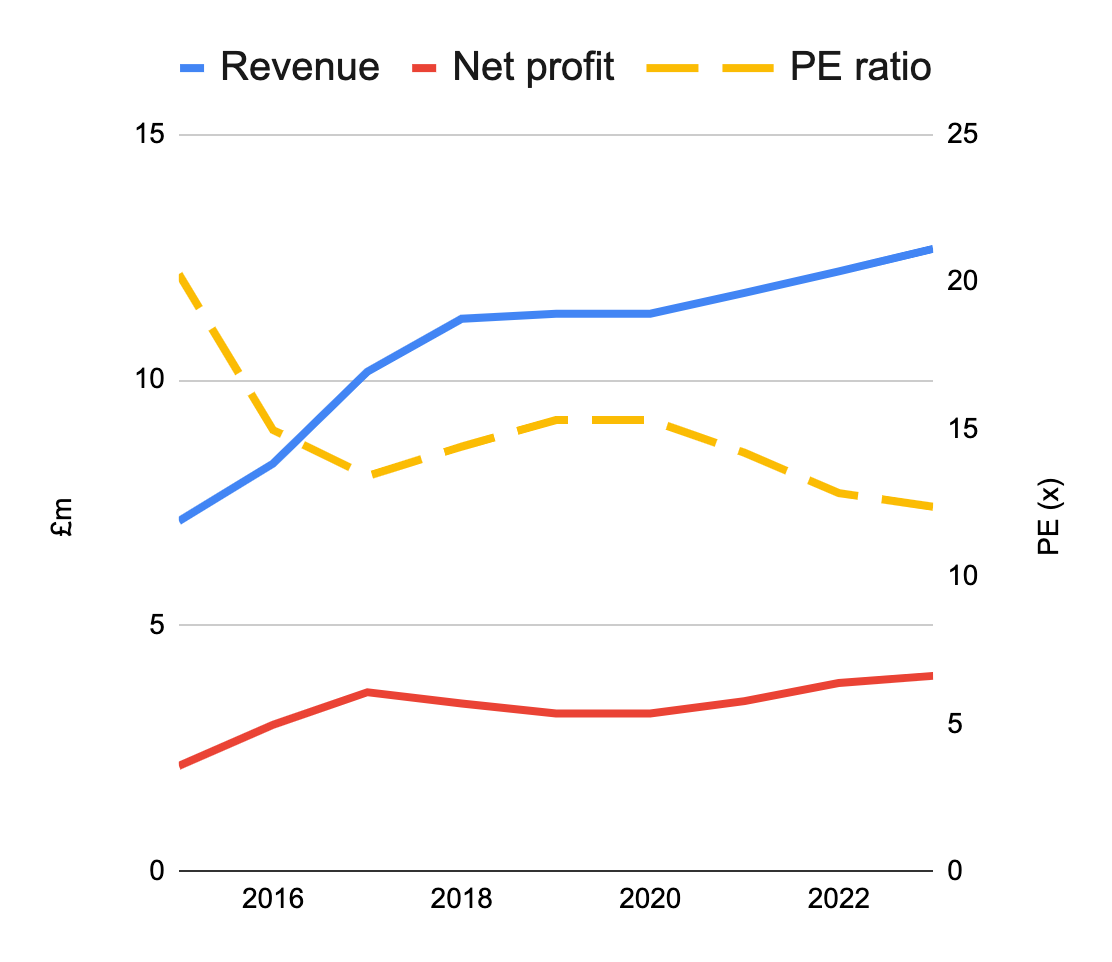
What the graph doesn’t show is the dividend yield also rising to more than 5%.
There is also potential for upside surprises via acquisitions or accelerated growth at either Ewemove or TPFG’s Financial Services division.
However you cut it, I think TPFG is a quality operator with good growth potential in a very large market.
Foxtons (LON:FOXT)
Share price: 40.3p
Market cap: £110.84m
Price to free cash flow: 7.3x
1y RS: -1.17%
And now for something completely different…
Let’s just say it: Foxtons (LON:FOXT) has been an awful investment since listing at c250p back in 2013.
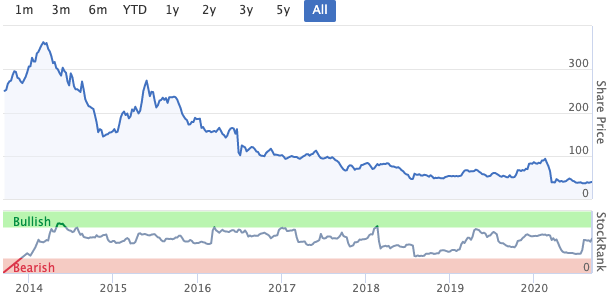
But let’s explore the idea that this might be a high risk/reward contrarian recovery play. Simply recovering to IPO prices would be a c5x return.
The problem is that FOXT focuses specifically on the London market - the one that’s on the wrong side of that two-speed market mentioned above… In fact Foxtons has bemoaned a London downturn for years and would no doubt attribute a lot of its post-IPO performance to this.
There were some signs that this had finally begun to turnaround, with ‘strong growth indicators’ in the first 11 weeks of 2020.
What’s interesting about this potential turnaround is its relatively good financial strength and cash generation:
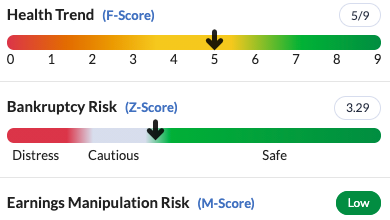
The Lettings side of things accounts for about 63% of revenue and has been pretty resilient. It’s the lumpier Sales division that has been hammered. A recovery here could return Foxton’s to profitability.
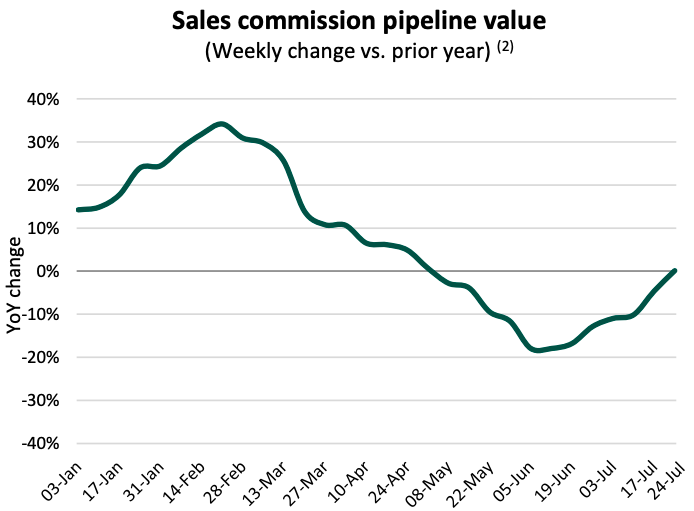
We can see from the group’s interim presentation that both supply/demand dynamics and the group’s sales pipeline were both improving pre-lockdown, after years of deterioration.
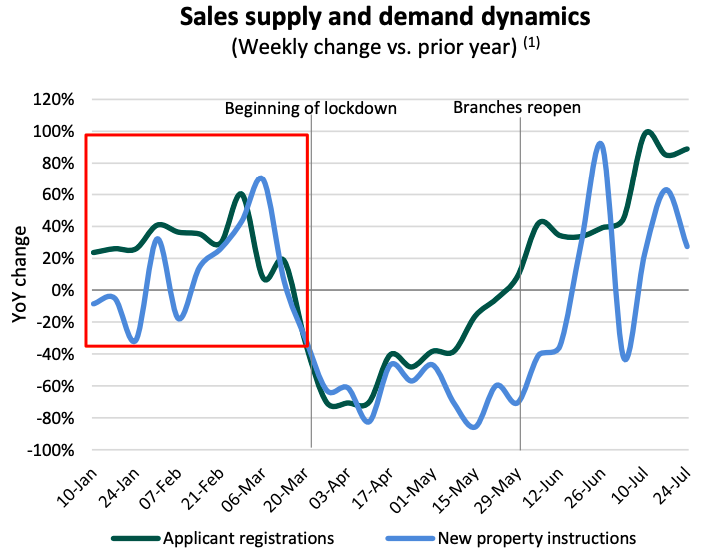
Then, apparently, some pandemic put the brakes on everything. The trajectory of FOXT’s sales commission pipeline also looks quite useful.
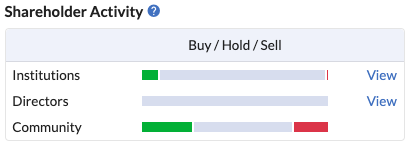
The shareholder activity box suggests others are sniffing around this London-based estate agent - especially after its £22m equity placing in April where directors put in around £155,000 of money at 40p.
Paul covered it in some detail here.
Today you can still buy at roughly the placing price.
Interim 2020 results
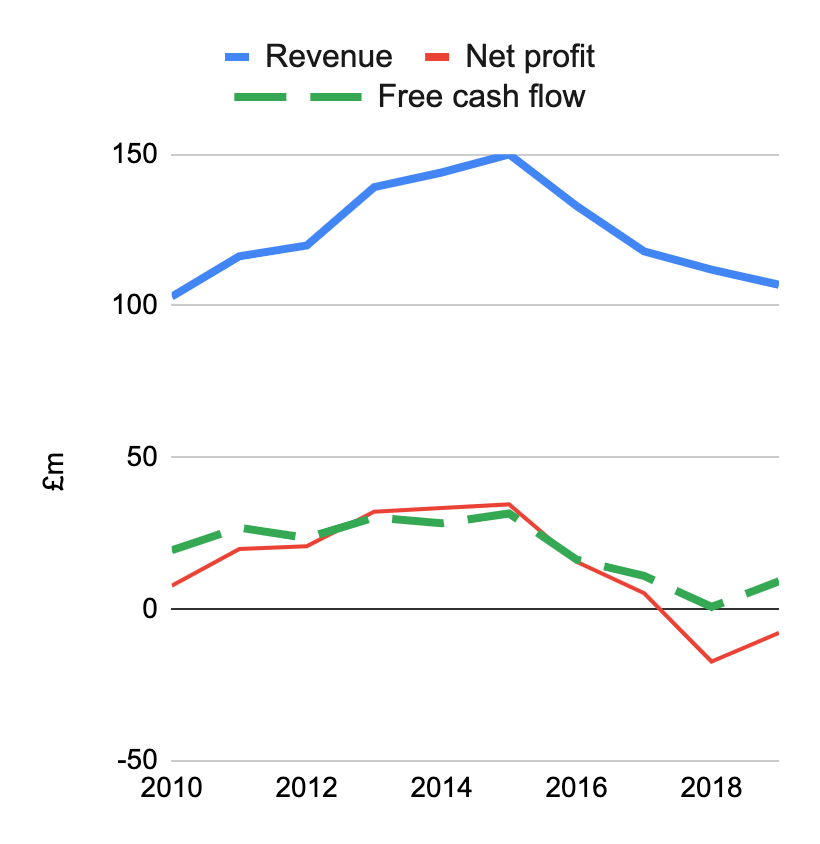
The latest results show FOXT is still very much loss-making, so there’s plenty to do. That recent equity placing has handily strengthened the group’s net cash balance though.
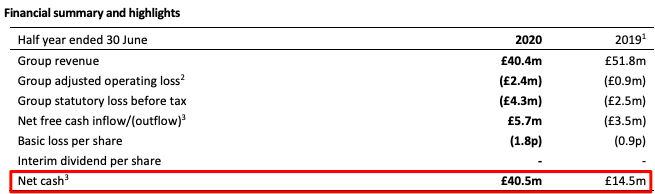
Even during this ongoing London property sales downturn, FOXT has managed to remain largely cash generative, so this actually puts it in quite a strong position should the market recover.
You can see in the chart below that, while FOXT has slipped into losses, it has continued to generate free cash flow.
With around two thirds of revenue now coming from more resilient lettings rather than sales revenue and a clear strategy to acquire high quality independent estate agents and lettings books around South East London, maybe Foxton’s is actually well placed to consolidate in a weak market.
In the first eight weeks since reopening branches, there has been a steady improvement in activity across key areas of the business:
- Lettings commissions over the 4 weeks of June down 12% and over the 4 weeks of July down 3% against the prior year.
- Sales commissions over the 4 weeks of June were down 44% and over the 4 weeks of July were down 32% against the prior year.
Conclusion
Clearly there are risks - namely the ongoing COVID situation and a poor London market. Operational momentum was bad way before the pandemic, although there are early signs of positive change.
With work-from-home now appearing to be quite an entrenched trend, might that weigh on the London market too? Property prices in the capital have long been out of reach for many of its workforce.
Why save up now when you could be working from a less expensive city?
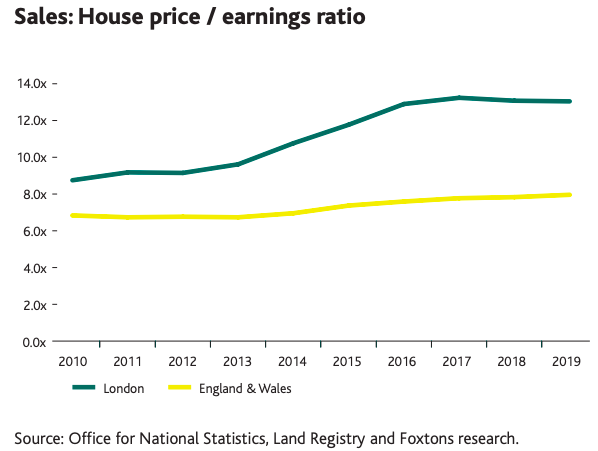
Ultimately, London is still London - a highly desirable property market with a global customer base. Only a few other cities in the world rival it. And there is a good chance that the sales market does recover at some point. Perhaps that is already happening.
Meanwhile I would back the lettings business (which is now the majority of revenue, remember) to prove its resilience.
I’m always wary of turnarounds having found that a lot of them never turn around, while others do so frustratingly slowly. But some really work out with substantial and rapid upside for patient investors. Foxton’s has a refinanced balance sheet and has been cash generative even at its worst points.
It could outlast the market downturn and emerge as a stronger competitor. In all, it’s one of a number of riskier, contrarian turnaround opportunities I am looking at. I'm sure there are some strong views out there on UK real estate prospects right now, happy to hear arguments both for and against looking at this part of the market!
Disclaimer
This is not financial advice. Our content is intended to be used and must be used for information and education purposes only. Please read our disclaimer and terms and conditions to understand our obligations.

4 comments
Hi Jack
Thanks for another great article.
I hold Belvoir (LON:BLV) (and am looking to top up) so I certainly see the attractions of Property Franchise (LON:TPFG)
One point if I may regarding Purplebricks (LON:PURP) , which is very large holding of mine.
I actually see a company with an all important first mover advantage and growing quickly. I certainly haven't seen evidence to suggest that it is struggling in the UK hybrid estate agent market.
For transparency I have not done much research on EweMove, so if there's value there I am unaware of it.
I recently made a comment on Purplebricks (LON:PURP) here, but for ease I am copying and pasting below.
Thanks again
A
"Holding quite a large position in Purplebricks (LON:PURP) I thought it would be worth sharing some of my thoughts from today's results.
As I scanned the results first thing, my initial reaction was actually disappointment , but the more I look into it, the more optimistic I am.
Note that the results published today include the Canada business, which is now sold off, so all the comments below relate to the UK business only.
If there was 1 negative to take away it was the Year-on-Year decrease in H1 (so up to October 2019). This was a relatively long time ago now, and it's not clear what happened here (Brexit-related uncertainty perhaps? - I saw a comment saying UK listings were extremely low in this time period), so the revenue growth at the start of H2 is one to keep an eye on.
VALUATION
It's probably also worth noting that the first 10 months of the year generated EBITDA of £5.7m and the last 2 months of last year generated £1.9m EBITDA. Combine these together gives a pre-covid Last 12 Months EBITDA of £7.6m.
Underlying capital expenditure (including capitalised development costs) have been <£3m for the last 2 years, so an underlying positive cash flow of c £5m.
The current EV of the company is £77m.
Given the operational leverage a company like this will have, this still looks cheap to me."
Thanks Abtan, interesting points.
I haven't been following Purplebricks (LON:PURP) closely and my only reference for now are some remarks made in passing by TPFG management during the recent results presentation. IIRC they mentioned another vehicle backed by Charles Dunstone that was struggling to gain traction and was having to rebrand.
The implication was that it's still all to play for in the hybrid market with other competitors preoccupied with rebrands and turnarounds - but then they would say that wouldn't they!
Either way, I'm more focused on the potential for steady organic growth in its traditional real estate brands and hopefully quicker growth in Financial Services.
If anything happens in hybrid that's great as well but it's not central to the investment case for me & you may well be right re. PURP. I'll take a closer look at it sometime as another potential turnaround candidate.
Good luck!
Another superb article - thank you Jack! I'm currently looking for a medium/long term position in this sector but still haven't decided where that should be - this really helps.
The only related position I've taken at the moment is a short term punt on Simplybiz (LON:SBIZ) in the hope that their comments in the Pre-close trading statement for six months ended 30 June 2020 were overly pessimistic based on the recovery in buying activity since June. At that time they were saying that
"The Group's mortgage valuation business has been significantly impacted by the lockdown restrictions in the second quarter, with volumes moderately increasing in June. Management believes that there will be a suppressed housing market for rest of the year."
If that was premature/pessimistic then I'm hoping we could see an "above expectations" comment in their trading statement next week. Of course, they could have been entirely correct and the business hasn't positioned itself to benefit from the increased activity. We'll see!
Cheers Glorenfeld,
I'm not familiar with Simplybiz (LON:SBIZ) but looks like it's grown at a fair clip these past few years. I'll keep an eye out for next week's statement. Good luck!