How dividend growth can boost a high yield strategy

Last week I did some backtesting to find out whether a high dividend yield strategy could be improved using Stockopedia’s StockRanks. What this discovered was a 25 stock portfolio that notched up 1-year capital growth of 11% and an overall yield return of about 5%. While that 16% return was pleasing, there are other approaches to dividend investing that might help to improve those results. One of them is to look at whether a long, unbroken record of dividend growth has any further impact on the StockRanks + Yield strategy returns.
Philip Fisher, the late American growth stock investor, once said that regularity and dependability are the most important but least discussed aspects of dividends. In his book, Common Stocks and Uncommon Profits, Fisher wrote: “The managements whose dividend policies win the widest approval among discerning investors are those who hold that a dividend should be raised with the greatest caution and only when there is great probability that it can be maintained.”
Fisher’s 1958 book followed the publication of an influential research paper into dividends by Harvard finance professor John Lintner. Lintner's study - and others since - found that many company executives believe the market puts a premium on dividend stability and gradual growth. They particularly fear the ramifications of cutting dividends.
It’s clear from these observations that dividend sustainability is highly prized by income investors. One way of tracking it down is to look at a company’s dividend record - which is exactly what’s done by big name index providers like S&P and Nasdaq OMX. As ex-Fidelity fund manager and investing legend Peter Lynch wrote in his 1994 book Beating the Street: “The dividend is such an important factor in the success of many stocks that you could hardly go wrong by making an entire portfolio of companies that have raised their dividends for 10 to 20 years in a row. Moody’s Handbook of Dividend Achievers – one of my favorite bedside thrillers – lists such companies.”
The Dividend Achievers index is now run by Nasdaq OMX. But at Stockopedia we track a similar strategy that looks for companies with a record of raising dividends - or a dividend growth streak of at least four years. Since December 2011, the quarterly rebalanced portfolio has generated capital growth of 88%.
Combining StockRanks + Yield + Dividend Record
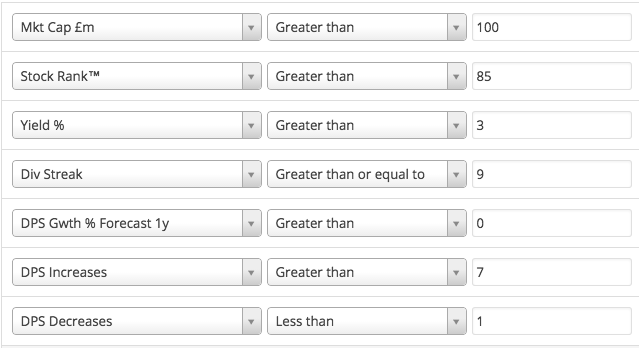
Returning to the backtesting, we revised the existing rules for the dividend strategy to look at dividend consistency and growth. Now the companies that qualify must have:
- A market cap greater than £100m.
- A StockRank greater than 85.
- A yield above 3%.
- A record of paying a dividend for at least the past 9 years.
- A dividend per share that is forecast to grow.
- No dividend decreases in the past 10 years.
- At least 7 DPS increases in the past 10 years.
This time last year there were 33 companies that met the criteria. Over one year, the top 20 stocks based on those with the highest StockRank produced a capital gain of 16.9% and an average yield of 3.1%. By comparison, the FTSE All-Share fell by 2.6% over the same period:
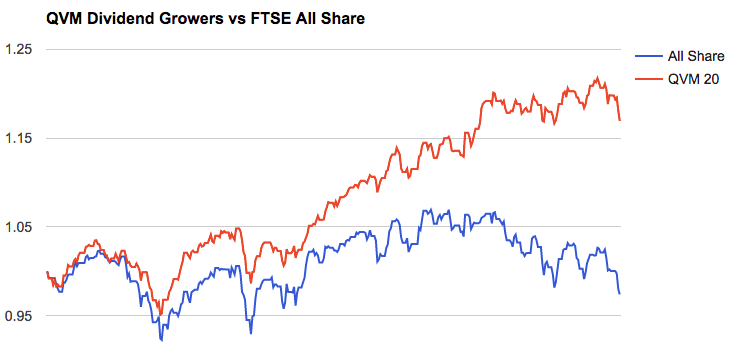
This is a blunt and unscientific test. But a glance into the past reveals some interesting signs. Those shares with a record for paying and growing dividends and the highest StockRanks produced a stronger total return than StockRanks + Yield alone. The total returns from the two strategies were roughly 20% and 16% respectively.
Current qualifiers
Here’s a snapshot of the list of shares that these rules produce right now (subscribers can access the screen here).
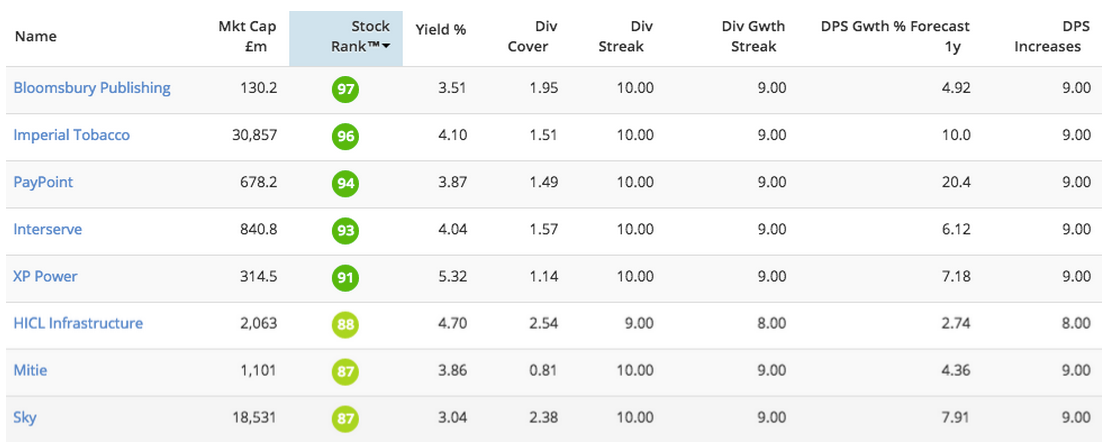
All with the exception of HICL Infrastructure have a record of paying dividends for at least 10 years and a record of dividend increases of at least nine years. Interestingly, the list appears to be market-cap agnostic. At £130m, Bloomsbury Publishing is the smallest company but also has the highest StockRank, at 97. It is followed by the largest company, Imperial Tobacco, with a StockRank of 96. The highest yield on a trailing twelve month basis is XP Power on 5.3%.
Does dividend consistency matter?
Intuitively, a track record of dividend consistency and growth sounds like a sensible way of finding companies with carefully managed dividend policies. If the research is to be believed, a commitment to paying (and a fear of cutting) dividends makes these companies more likely to continue paying them in the future - although nothing is certain. Our leap into the past throws up some evidence that a dividend streak can improve the total return.
In the next article I’ll take a closer look at this Dividend Achievers list because there’s evidence that sorting these stocks according to value, low volatility, yield and StockRanks, has a big impact on the total return.
Disclaimer
This is not financial advice. Our content is intended to be used and must be used for information and education purposes only. Please read our disclaimer and terms and conditions to understand our obligations.
3 comments
Thank you for the post. I remember that James Montier was mentioning a study of CS (Credit Suisse US) in his book "value investing" or in an article. CS found that adding the pay-out ratio as a further selection criterion (the lower the better) to the group of high yielding stocks does improve the result (invers to the negative side of a negative dynamic in dividend cover as mentioned by Mr. Cannon). You might add this criterion (low and positive dynamic in dividend cover) to your research for your next article.
Kindly
Bearbull
Rebalancing the portfolio quarterly sounds expensive. Would you confirm that you allow for touch, tax and brokers's charges when doing your calculations. What percentage of your fund goes in these annually?
Thanks for the interesting post Ben. Your back-testing here shares many traits with the "high-yield portfolio" strategy where a solid history of paying rising dividends plays a leading role. I use the presence of a dividend as a key part of most of my investing decisions as this can indicate many things (such as cash-generating ability, a longer-term perspective for management and recognition that shareholders actually own the business). The only aspect that you may of overlooked, in this testing, is the level of dividend cover with respect to earnings. In some cases management decide to maintain the dividend even in the face of secularly declining profits and this can lead to real problems in the long-term!
Damian