Is picking funds an easy route to outperformance?

Kevfle recently posted an intriguing article called “Can we beat the professionals?’ In this he touched on some interesting questions around the investment industry, which provoked a flurry of responses from our fantastic community here at Stockopedia.
Kevfle seemed to have several questions on his mind, including:
Can we actually ever outperform the pros?
Am I wasting my time?
Is it easier to choose and evaluate a group of funds instead?
Can I achieve similar results leaving it to the pros?
In my previous article, I considered the first two questions regarding a more personalised investment approach. In the second of this two part series, I investigate the alternative option of buying funds and look at some of the difficulties that must be overcome.
Is it easier to choose and evaluate a group of funds?
Purchasing a group of funds (be they active or passive) has many advantages. Investing in a fund is an easy way to gain exposure to a certain market or asset class. They are efficient in gaining access to markets that are more difficult to trade in and and can provide the investor with a more diversified exposure for smaller investment sums.
Buying funds also requires very little time investment and you utilise the combined expertise of the talented members of the fund management team.
I will argue however that it is possibly more difficult to pick and evaluate ‘winners’ in this space.
The usual starting place for determining the level of skill of the fund manager is to look at how they have historically performed. Whilst we are all aware that we ‘cannot buy past performance’ it is still often used as a guide for how talented the fund manager is.
However due to the nature of luck involved in investment returns, past performance is a poor proxy for determining manager skill. Using returns data standalone, you would need a very long time series of return observations to have enough data to deduce a statistically significant outcome about a fund manager’s level of skill.
A popular way to filter the universe of funds is to use the Morningstar star ratings. These ratings are based on past performance and rate each fund between 1 and 5 stars, where 1 is the worst and 5 is the best. Seeing many stars on a fund factsheet may be visually appealing, however in line with above, a 5 star rating has been shown to be a poor indicator of future returns. It’s interesting to compare the three year performance of funds before and after they gain a 5 star rating:
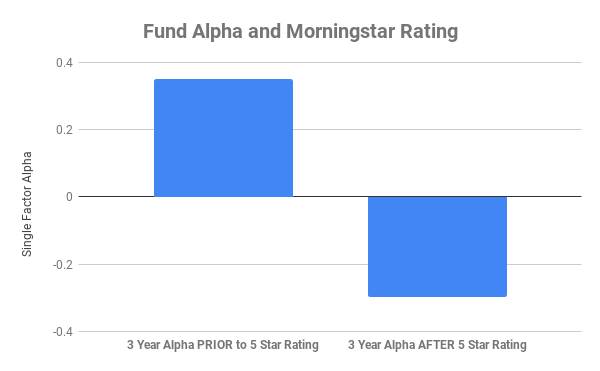
We can see that the successful past performance leads to a higher rating, but the persistency of this performance is shown to trail off. The importance of this is noted by Morningstar themselves, who state:
“There are a couple of problems with using Morningstar's star rating for funds as an indicator of manager skill. For starters, though we've found that the star rating has some predictive abilities, all it really tells you is how well a fund has performed in the past, given the risks it has taken on. Just as past performance and alpha can't indicate future success, neither can star ratings.”
As the popular financial disclaimer notes ‘past performance is no indicator of future results’. When evaluating fund manager performance it is important to not just know how they performed, but also what they did to achieve that performance.
The importance of process
For those of you who have attended Poker nights, the concepts of process and luck can become very apparent. Looking down at your pocket pair of Aces, you are feeling very comfortable looking at a flop of J, 8, 5. After your raise and reraise, only ‘Crazy Eddie’ is left in the hand. The turn is a 2. Another raise from you and a call from Eddie. The final river card is a 7. In the showdown, Eddie shows a 7-2 to take the mountain of chips in the middle, whilst you bemoan to your colleagues about what just happened.
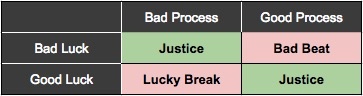
In a fair world, all good processes would be justified with good performance and all bad processes would be punished with poor outcomes. Unfortunately like other pursuits involving chance, investing outcomes are not so neatly distributed, with bad processes occasionally resulting in good outcomes in the short term. Similarly, the past performance of the fund is a poor signal for investment skill as from this alone we do not have any insight into the process used to achieve it.
Take the relative performance of one famous fund manager in the late 90s.

It would have been very difficult for an investor to stomach a c20% underperformance over these two years. Taken alone we may also conclude the fund manager had ‘lost their touch’. However it does not consider the style employed by the manager or the market context. The late 90s was a period dominated by a momentum fueled market with many investors who adopted a value style approach suffering. In the case above, Anthony Bolton’s fund (and other value managers) held a structural underweight to momentum stocks in this period, so when the market environment was against them, this led to significant relative underperformance. When the style in favour changes, this can have a large impact on the outcome of the fund - Anthony Bolton went on to outperform the index for 7 consecutive years.
The importance of process is understood within institutions. When an institutional investor is looking to invest in a fund, they will typically send a ‘Request for Proposal’ (RFP) document to the fund groups in question. These fund groups then proceed to fill out this document, answering queries which touch upon all areas of the business. This document will provide detailed insights into the investment process that the fund adopts, including the manager’s perceived edge, the selling strategy and what market conditions the fund will perform best in. The structure and stability of the business will be considered, including how staff are compensated and incentivised. It will provide details in the size and level of oversight from Operational and Investment Risk teams, software systems that are used and how trading is controlled. The due diligence may be reviewed from investment, risk and operational perspective to determine suitability.
From this document and meeting with the fund manager and risk teams, the institutional investor can develop their expectations for the fund and better understand the conditions when it it is likely to underperform.
Given the importance of process in determining the underlying skill of the fund, the retail investor is (unfortunately) unable to gain the same level of insight into the underlying process of the fund. Descriptions provided in factsheets and investment brochures are typically vague, focusing on the end goal without going into specifics of the process as to how this will be achieved. This lack of information can make it harder to decipher whether the manager performance has been due to style reasons, structural reasons or luck.
Going deeper - further process considerations
Knowing the investment process inside out is still not sufficient to fully understand the environments that the fund is likely to perform well in as there is another element to consider.
Suppose for a moment you invested in a rules based, quant fund prior to 2008. They had explained the years of research, hundreds of backtests and you had a full understanding of the process and how it will behave in different market environments. Then the financial crisis happened. Suddenly the fund has started taking positions that are very different to your expectations.
This is not a unique experience. In an article by Jim O’Shaughnessy, he noted that over 60% of quants overrode their models during the financial crisis. Years of research and development to distill a model, only to be thrown in the bin when put in a stressed environment.
“I know that as a systematic, rules-based quantitative investor, I can negate my entire track record by just once emotionally overriding my investment models, as many sadly did during the financial crisis.” - Jim O’Shaughnessy
Not only do you need to know the fund’s process, but also how the fund manager will behave in the periods when that process will inevitably underperform. Will the portfolio manager stick to their process given the career risk (that term again) or will they override their process to gain a relief from the pressure being applied to them? Choosing a fund is now not only a game of choosing a fund with a good process, but also choosing a manager who will be talented enough to know when to stick to the process (even under high pressure) and when to update the process to the constantly evolving marketplace. Had Anthony Bolton caved under pressure in 1999 to mirror the index, his subsequent performance would have been -5.9%, -13.3% and -22.7% from 2000-2003. His actual performance? +25.8%, +3.8% and -10.7%.
The next challenge
Suppose that you have overcome the previous challenges and have been able to identify a fund with a fantastic process and a manager that will consistently adopt this process. Subsequently the fund has had excellent performance. Financial press starts to celebrate the performance of the fund. The fund manager starts appearing on the covers of investment literature. Suddenly your hidden gem of a fund has become incredibly popular and the assets under management have ballooned from a couple million to billions. The fund now has a new challenge. Previously the manager had built a process around being able to dynamically enter and exit positions but this is now not possible due to the new liquidity challenges (as discussed in a previous article) from the increased fund size.
The negative impacts of increased fund size have been documented in investment literature, with some papers concluding that the larger fund size does result in relative underperformance due to the additional liquidity constraints reducing the size of the investment universe, resulting in diseconomies of scale.- The impact of this effect is likely to be related to the market cap of the stocks that the manager is targeting. A fund that invests in small caps is most likely to be affected by size constraints and as such may lose the nimbleness in their approach.
An insight into investor success
Perhaps one of the insights into how difficult it is to choose and hold funds is demonstrated through the returns that investors have received. One of the most successful funds in the 10 year period from July 1999 to July 2009 was the CGM Focus fund, which earned an annualised 17.8% total return, outperforming the S&P 500 by 640% over the period. The average annualised return of investors that bought this fund over this period? -16.8%.
Re-read that.
That’s right - the average investor who owned this fund actually lost money. Despite investing in a fund that was subsequently described as the ‘fund of the decade’ by the Wall Street Journal, the timing of investor flows meant that the money weighted return was negative.
Investors underperforming their underlying funds is unfortunately a recurring theme in the Dalbar’s Annual Quantitative Analysis of Investor Behavior and in investment literature, with Frieson finding “Investors in both actively managed funds and index funds exhibit poor investment timing”.
Note that this is not limited to retail investors. In the “The Selection and Termination of Investment Management Firms by Plan Sponsors”, Goyal and Wahal noted how on average funds that have been fired by institutions have subsequently gone on to outperform their hired counterparts.
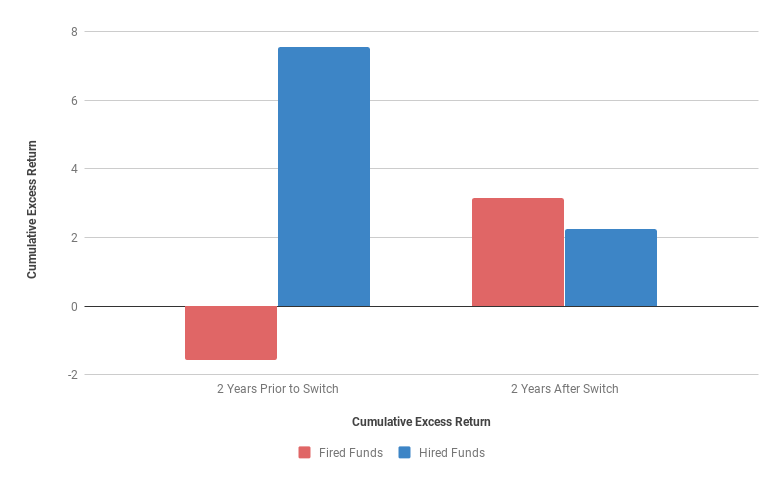
We can understand some of the key elements at play here. Holding an underperforming fund can be hard, no matter whether related to style or luck. There is always a shiny new fund that is shooting the lights out and it is easy to justify the switch to the oversight committee (Yes, those who choose funds suffer career risk also).
As you can see there are several factors at play when choosing funds to invest. With thousands of available alternatives, buying a fund is very easy. Evaluating a fund on an ongoing basis however is considerably more difficult.
So reverting back to where we began. . .
Can I achieve similar results leaving it to the pros?
Without knowing an investors results (or desired results), it is of course impossible to say whether one could achieve similar results in a fund. For an investor performing in line with a passive fund after fees then the obvious answer is yes; if you are outperforming the index the answer is also yes - I just don’t know which fund will match your desired performance in advance.
Irrespective of the fund chosen, an investor should consider the impact of fees. When you invest in a fund, the fee applied is typically a variable fee (for example 1% on AUM). This means that as the size of your portfolio grows you pay more in absolute terms. If however you were to adopt a consistent trading approach of purchasing a fixed number of stocks at the start of the year, then no matter how the size of your portfolio grows, the commission fees are broadly fixed as they are based number of trades, not monetary amount (with exception to share levy of £1 for a £10,000 trade).
To provide a concrete example, assume that both you and the fund have consistent gross (pre-fee) return of 10%. For the fund, fees are based on start of the year value and charged at 1% AUM. For the investor, they have a generous fixed fee of equal to 1% of the starting value; as a result the charges after the first period are the same. (Note that in this simplified example I am ignoring Stamp Duty as it borne both by fund and investor).
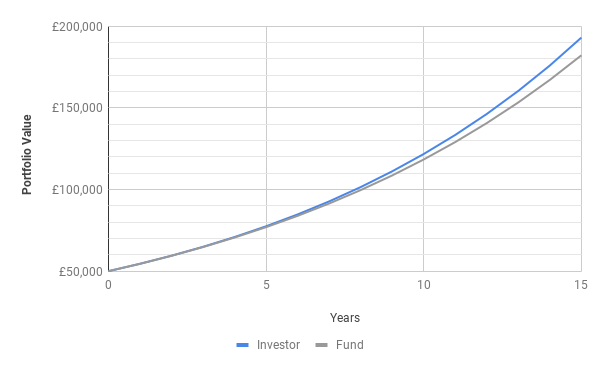
From the chart we can see that we can build a larger portfolio value over time, without generating any additional return in comparison to our fund. This is because as our portfolio grows our relative costs decline, whereas our relative costs are constant for the fund. Cost savings compounding over time offer huge benefits. As John Bogle of Vanguard notes: “Where returns are concerned, time is your friend. But where costs are concerned, time is your enemy.”
Conclusion
With thousands of funds to choose from and an asset management industry managing assets equivalent to 373% of UK’s GDP, investors are spoilt for choice when it comes to available options. The large number of alternatives have enabled investors to gain exposure to any niche they wish, however the sheer volume has possibly made it harder to identify and analyse funds.
Given the large sample there are likely to be winning funds that generate excess performance but we should not be deceived into believing that picking funds is an easy route. Similar to stock selection, capital allocation is a competitive business in itself, with trillions of pension assets seeking the best funds.
If one does choose to allocate investment capital to funds then we should ensure we know why we hold each fund and where it fits in our overall portfolio.
Photo by Raquel Martínez on Unsplash
Disclaimer
This is not financial advice. Our content is intended to be used and must be used for information and education purposes only. Please read our disclaimer and terms and conditions to understand our obligations.
43 comments
Here is the list. The distribution is very uneven, with the largest position being over 5x the size of the smallest.
Some have been consistent stars. Others had a few very good years, followed by several poor years. Some have done nothing for years and have gone very well in the last 3 years. Plus the odd failure, like Black Rock Latin America.
Most of these have been long term holdings. The first 10 or would have been picked based on long term criteria.
Aberdeen Asian Smaller Companies
Aberdeen Asian Income Fund Ltd.
Jupiter European Opportunities Trust PLC
Templeton Emerging Markets Inv Trust plc
Scottish Oriental Smaller Co's Trust PLC
Fidelity China Special Situations PLC
Standard Life UK Small.Co's Tst Plc
Baillie Gifford Japan Trust PLC
JPMorgan European Smaller Cos Trust PLC
Baillie Gifford Shin Nippon PLC
JPMorgan Russian Securities Plc
BlackRock Latin American Inv Tst Plc
VinaCapital Vietnam Opportunity Fund Ltd
Fundsmith Emerging Equities Trust PLC
Schroder Oriental Income Fund Limited (new position, replacing some Scottish Oriental, as my very slow response to a mangement change at the latter)
The management also recently retired at Baillie Gifford Japan I believe.
Hi jonesj, thanks for sharing your investment trust portfolio with us.
Here's another article on whether funds show persistence of performance:
https://www.factorresearch.com/research-chasing-mutual-fund-performance
I have been picking Investment Trusts based on long term manager performance before selection.
Require: Long term outperformance & same manager in charge.
After picking about 9 trusts, the average performance is several percent a year above benchmark etfs, measured from the date when I took the first position (mostly between 2007 & 2015). Prior to that, I didn't have any logical selection method.
One downside is since the manager has often been in place 10~15 years before I buy, they sometimes retire after I have only been holding a few years.
Beware, most of the studies saying you can't pick fund managers have 2 flaws:
1 They look at 3 year performance, or some other short term measure.
2 The studies are mostly based on the US market, which is known to be difficult to outperform.
The current portfolio is a mix of stocks, investment trusts and etfs. So far, my etfs are only for cases where there is no good Investment Trust option, such as buying gold, or investing in a single country like Poland.
I would want to see etfs tested over about 100 years before putting a high proportion of my portfolio into them.
Hi jonesj, Thanks for your post, in which you wrote:
"I have been picking Investment Trusts based on long term manager performance before selection.
Require: Long term outperformance & same manager in charge.
After picking about 9 trusts, the average performance is several percent a year above benchmark etfs, measured from the date when I took the first position (mostly between 2007 & 2015)."
That's interesting. Would you mind telling us which Investment Trusts you have in your portfolio now?
Here's an anecdotal example from John Authers at the FT:
https://www.ft.com/content/3c740106-c273-11e8-95b1-d36dfef1b89a
Unfortunately this is behind a pay wall, but in summary he bought the Capability UK Growth fund
from Capel-Cure Myers in 1992. It had one of the best 10 year records around, and he even had the chance to interview the fund manager. He invested £500, and after 26 years, this had grown in value to £3,160. If the £500 had tracked the performance of the FTSE All Share index it would have been worth £3,297. After tracker fees he thinks it would have been a little less than his fund, but as costs are more predictable than performance he recommends an index tracker.
I don't know that fund and that seems a long time ago. Just been looking at some Vanguard trackers, the FTSE100 one is only up 1.77% over 5 years, that must exclude dividends. The FTSE250 has not been going 5 years but over 3 years it's up 9.7%. I will try to find some figures that inc. dividends and also for some of the better funds to compare.
I was at the office of a friend of mine (another fund manager) recently. A couple of things struck me:
1. A lot of 'fund of funds', 'family offices' and other institutional investors do due diligence on funds before they invest.
2. However based on my own experience (I manage a fund) and what I have observed I think a lot of people fail to ask the right questions or make the right observations.
3. I would humbly suggest the following key points:
A. Observe the fund manager at his desk. He is like a hamster stuck in a small box? Would you want to work in his environment?
B. What is the room density. My friend has an office with four desks regularly occupied (there are actually six desks). In approximately the same space in my office we have 12 - 15 occupied desks.
C. Can the hamster / fund manager influence his environment or is he limited in what he can do. (My friend has posters and fund items throughout the office. In my work environment our walls are bare).
D. How many layers of oversight? I know everyone wants to wrap the world up with oversight but frankly the character, personality and life experience of the fund manager is what you are investing in.
4. I once joined a very large fund management house where all the interviews were conducted in meeting rooms. It was only after I joined that I entered the 'trading floor'. My heart immediately sank. I think I could summarise the whole environment by describing the carpet - '1960s civil service, well worn and well stained'.
5. I appreciate the discussion was about how to select funds etc but let me suggest a hypothesis. Physical environments of where fund managers work change slowly. A good environment often ensures success. A change in performance is often associated with a change in environment.
Let me give an example of the above point. I once worked in a fund house where we were relatively successful. For various reasons we moved our office. Soon after one of the senior partners retired; followed by a couple of others. A new head of strategy was appointed. A number of new appointments were made in rapid succession. Within four years we went from the top of our game to a shadow of our former self.
6. I used to be dismissive of the term 'culture' - however the older I get the clearer it becomes to me that culture is hard to define but easy to ruin.
Rather than trying to pick individual funds, do people seek exposure to factors via ETFs?
e.g. https://www.ishares.com/uk/individual/en/products/270054/ishares-msci-world-quality-factor-ucits-etf
This to me would seem the easiest method of getting close to replicating stockrank factors.
Humour Me wrote:
"Rather than trying to pick individual funds, do people seek exposure to factors via ETFs?
e.g. https://www.ishares.com/uk/individual/en/products/270054/ishares-msci-world-quality-factor-ucits-etf
This to me would seem the easiest method of getting close to replicating stockrank factors."
Prompted by that post, I've looked at the performances of the various iShares Edge MSCI World Factor ETFs. The one that has performed the best over the past 3 years is the momentum one:
https://www.ishares.com/uk/individual/en/products/270051/ishares-msci-world-momentum-factor-ucits-etf#/
Buying that ETF seems a lot easier than buying portfolios of individual shares using Stockopedia's StockRanks and it has given comparable performance to a StockRanks or NAPS portfolio over the past 3 years, although of course the ETF is invested worldwide whereas the StockRank portfolios are likely to be solely UK based.
These factor ETFs have the advantage over active funds that one is not relying on a fund manager's stock-picking skills, which might not persist in the future.
What worries me about buying these ETFs is the fact that they use derivative products, so they have some counter-party risk. That has not been an issue in recent years, during a prolonged bull market, but if there is a major bear market I wonder whether their use of derivatives might cause them problems.
Also prompted by that post :) I've been digging into ETFs as they seem an easy way of getting exposure. As part of this I came across this article which ranks exposure to different factors over time.
https://www.factorresearch.com...
There are several other interesting articles on that website.
ETFs do seem an interesting area to investigate and compare to a NAPS like approach. Good returns with lower volatility would be appealing.
Just touched the surface of this topic area though.
This is true for synthetic ETFs (initially popular in Europe) however there also exist physical ETFs which hold the underlying shares.
"ETFs do seem an interesting area to investigate and compare to a NAPS like approach. Good returns with lower volatility would be appealing."
Low volatility factor ETFs, such as the iShares Edge MSCI World Minimum Volatility UCITS ETF, seem to me to be good candidates for that:
https://www.ishares.com/uk/individual/en/products/251382/ishares-msci-world-minimum-volatility-ucits-etf
and also from the 10-year global performance record on the Factor Olympics website mentioned by HumourMe:
https://www.factorresearch.com/research-factor-olympics-q3-2018
However the iShares ETF uses derivatives, so it has some counter-party risk. Does anyone know of any low volatility factor ETFs that don't use derivatives?
The Vanguard offer implies direct investment.
https://www.etf.com/sections/f...
Personally though, I think a multi-factor approach should also reduce volatility as long as exposure to each factor is balanced. I can't make up my mind though about fund strategy .... whether it is better to select (in Stock terms):
Drivers of momentum are value (with improving fundamentals and/or forecasts) and/or quality (with improving fundamentals and/or forecasts). Momentum is an outcome of the other two, but operates slowly in individual shares due to under-reaction. Low volatility in individual shares is an outcome of 'agreement' = persistent high quality measures or lack of interest. Low volatility in factor based ETFs should be the result of some level of diversification, but too many holdings would to me suggest style drift. So composite or just momentum?
So in summary, at the moment I think I'll look for combinations of multi-factor or momentum, direct investment, regional (developed/ US/Europe), with limited diversification and a low expense ratio. Then wait for a good entry point if I'm satisfied. Or do a NAPS.
A good question, I read an article on Morningstar which said about 80% of ETFs in 2016 were physical, this had changed from 55% in 2011, so there has been a shift away from synthetic ones. Seems synthetics are mostly used for hard to access markets.
Has anyone got anymore up to date information?
What worries me about buying these ETFs is the fact that they use derivative products, so they have some counter-party risk. That has not been an issue in recent years, during a prolonged bull market, but if there is a major bear market I wonder whether their use of derivatives might cause them problems.
Lots of regulators have expressed concerns about synthetic ETFs - often the chains of counterparties are complex and as we saw in 2008 it only takes one link for that to fall apart. There are also concerns about whether the assets they hold are really correlated with the index they purport to follow.
The other problem with ETFs is the unwavering tendency of the fund management industry to leap on the next best thing and pervert it to death. One of the favourite tricks is to create synthetic indexes and then build ETFs to match.
Beyond that, however, there are concerns about the robustness of ETFs in a downturn. It looks like they played a major role in the flash crashes in 2010 and 2015. The SEC did a review into what happened and concluded that some of the pricing during the crashes was decidedly idiosyncratic - basically there's a suspicion that the market makers that are supposed to ensure that they don't trade outside a narrow range around the NAV simply withdrew liquidity.
And finally, of course, there's the hoary old chestnut that ETFs - particularly market cap weighted ones - drive more and more money into the big stocks leading to valuations that are out of synch with their underlying worth. If true that would likely unwind rapidly in a real crash where investors pulled their cash out of the ETFs causing the ETFs to sell the underlying overvalued equities.
Broadly - buy ETFs backed by physical assets and don't get too funky about the indexes they follow. And diversify.
timarr
Hello Oliver and thanks very much for the thought-provoking article and to Kevfle for the earlier article.
If I could perhaps act as devil's adovocate I would suggest that it is irrelevant whether investors choose to invest in funds of directly in shares, the important point is that you (the individual investor) or the fund manager you use, has identified the correct approach to investing, in which case you will get good returns either way.
In common with well informed contributors to this thread, the fund managers I have identified for their excellent long term performance and (just as important) their clearly defined methodology are Terry Smith, Nick Train and Keith Ashworth-Lord.
I have used these fund managers as my mentors for most of my investing activities and have also found that they are willing to answer the occasional questions I pose to them (either directly or through their assistants) which helps me further understand how they invest. I would suggest that it does not matter whether you invest in their funds or directly in the shares (or type of shares) they invest in as you will get good returns either way (but take care if it is an investment trust at a significant premium to nav!). I think I also know why Terry Smith's approach does not work in emerging markets but that is another story.
I use these fund managers to identify which shares to buy both with respect to UK and some overseas companies. Particularly in the case of Terry Smith and Nick Train, I also use their approach to buy shares in smaller companies outside their universe of investing. I tried to persuade Terry Smith to start a fund for smaller companies a couple of years ago as my experience is that his methods also work for smaller companies (glad he has at last taken notice!!).
Of course there is some advantage in buying their funds rather than investing directly in their type of companies because I can not identify what they have bought until some time time after they have announced their purchase and the price may move when they announce the purchase. However, in some cases I can tell fairly quickly what Terry Smith is buying from regulatory filings for his US based fund. For some foreign companies I am also not able to claim back portions of witholding tax which these funds will be able to do for most of their foreign holdings, although I can do this for US and Canadian companies through my broker.
For reasons stated above, you can understand why I hold some of the funds managed by these managers but most of my holdings are directly in companies which they hold or which I have identified using their methods. This way. I avoid their fees for managing the funds. Perhaps I could describe this as a hybrid approach between investing in funds and investing directly in shares and it seems to work for me. However, the disadvantage is the time it has taken me to validate this approach and to execute it and I would agree that most people would not have the interest or background to do this effectively so I would admit that investing in the funds of these managers is probably best for most people.
As an aside, I would admit that if the approach of the fund managers became more popular, the share prices of their holdings could go up so high that the method would no longer work for new investments. Terry Smith has of course discussed this at some length and I would agree with him that this is not currently a problem. It seems to me that most investors still worry about charts, buy and sell limitsand news driven investment decisions so I am confident that the methods used by these fund managers will not become so popular that they will no longer work, but I do monitor this.
I do not think it is any coincidence that contributors to this board (many of whom have also done
I admire Terry Smith, Nick Train and Keith Ashworth-Lord and try to read everything I can by them, but I don’t think investing in all three of their funds is diversification other than in the most limited sense. To jump ahead to my conclusion, it’s likely that if one of those funds does well then all of them will, and if one of them does badly then they all will. And, at some unspecified point in future, they all will.
Diversification can protect you against two forms of risk – systemic and unsystemic. To take an example, if I invest in Rio Tinto (LON:RIO) and BHP Billiton (LON:BLT) I protect myself against the unsystemic risk of Rio’s South American assets being appropriated or BHP’s senior management team being executed by an environmentalist hit team. However, it doesn’t protect me against the systemic risk of a global economic downturn or Donald Trump nuking the Fed or any other event that will cause all commodity stocks to fall in sync.
All three of the aforementioned fund managers take very similar approaches to stock selection such that although the stocks they select tend to be different, their underlying characteristics tend not to be. Given that all three funds have done very well in the last five years it’s tautological to point out that recent market behaviour has favoured the sorts of stocks they like to hold. But perhaps more pertinently, markets have tended to discount the highly cyclical stocks that they shun.
At some point in the future that will change, and the performance of these funds will falter – and when they do, they’ll likely all do so together. Given that they’re all highly rated a net outflow of funds will either lead to a reduction/widening of the premium/discount to net asset value for the quoted funds or the need to sell temporarily discounted shares to fund redemptions for the open ended funds: essentially a double whammy for investors.
You don't have to take my word for it, though. Lindsell Train Investment Trust (LON:LTI) currently trades on a boggling 65% premium to net asset value – some of which can be accounted for by the value of the unquoted LTL management entity – but by no means all. As their Chairman stated in their last Annual Report:
https://www.lindselltrain.com/...
And remember, LTL makes its money from the performance of LT's unquoted funds which invest in similar stocks to Lindsell Train Investment Trust (LON:LTI) so that if the latter fall then so do the former and so does the value of LTL which further impacts the value of Lindsell Train Investment Trust (LON:LTI) ... got that? (Basically, if you want to invest in LT invest in the open ended funds).
None of that detracts from the quality of the managements or their long term success – but it’s a given that a narrowly drawn investment approach like this will suffer setbacks at some point. Investing in all three funds doesn't protect against much unsystemic risk other than the possibility of one of the managers going mad, selling everything and investing in cryptos, and adds some correlated systemic risk at the expense of additional fees.
I vaguely get the idea of diversifying across fund managers when you don’t have much insight into their skills, attitudes or abilities but I don’t get it at all at this level. And this is simply a specific example of the general problem of buying into the fund managers who've done well in the recent past: they tend to be highly rated and highly correlated, and the recent past is only a predictor of the recent future until it isn't.
timarr
Just lost my long reply. Briefly I don't really agree, these funds are generally in different shares, Fundsmith more US large caps, Ashworth-Lord small/medium UK shares, Train larger UK shares. Fundsmith quite defensive, AL more adventurous growth companies, largest holdings are Games Workshop (LON:GAW), Craneware (LON:CRW) and Ab Dynamics (LON:ABDP). Train largest holdings Diageo (LON:DGE) and Unilever (LON:ULVR), so yes it seems Train is similar to Fundsmith but in different markets. You will probably have about 200 different companies. Fundsmith largest holdings are Paypal, Amadeus and Microsoft. All the same, I think they are all looking for quality but Al is a lot different from Train and Fundsmith's in my opinion. In a bear market I thing Train's will do the best and AL's the worst because he holds smaller growth companies. If the problem is just in the UK, ie Brexit then Fundsmith will do better. So I don't see these all performing equally. Worldwide recession then Train's should hold up and to a certain extent Fundsmith.
Hi herbie
That's the wrong way round.
Look at what they don't invest in, as opposed to what they do. None of those funds invests in commodities, many types of consumer cyclical, financials, telecoms, utilities and many types of technology company. We've had booms in IT, financials and oil stocks just this century - is it really believable that none of those things will ever have their day in the sun again?
Sure, wait until the bubbles subside and the quality will float back to the surface, but how many investors are willing to stand against the momentum these days?
timarr
Yes but commodities are unpredictable and may do badly in a recession. Actually Fundsmith does have quite a fair exposure to technology and IT, one reason why I think in a bear market it would not do so well. Fundsmith's 2nd and 3rd largest holdings are as IT companies, Amadeus IT and Microsoft, also it's largest holdings is PayPal which is financial. Train also has financials and IT in it's top 10. I don't know what their smaller holdings are. They will change their portfolios, one reason why I never bought Fundsmith is because a few years ago he had a high proportion of tobacco companies, this has now changed, note those companies have not done very well recently.
"these funds are generally in different shares, Fundsmith more US large caps, Ashworth-Lord small/medium UK shares, Train larger UK shares."
That's true of Train's investment trusts and the Lindsell Train UK Equity Fund, but the Lindsell Train Global Equity Fund invests in international large caps including US ones.
Fair point, I was only looking at the UK fund. I will have look.
The Train Global fund actually is similar to the UK one, the 2 largest holdings are the same as the UK fund. There are some Japanese companies. I see little overlap with Fundsmith, Train has more drinks, entertainment and consumer defensive companies, Fundsmith has more IT, pharmaceuticals/health and financials.
I’m never quite sure why when comparing active vs passive funds the comparison is against the average active fund. We’re trying to find the best managers here, no?
Bestinvest Tilney have their MRI (manager record index), which is a statistical analysis of the manager’s performance and is a starting point. Also, We should select a diverse range of managers for our portfolio (similar to having a diverse portfolio of shares in the NAPS portfolio), not all will outperform but hopefully overall they will.
I also tend to believe that there are a handful of star managers that overall tend to perform well. The likes of Terry Smith, Nick Train, James Anderson, and so on are not too difficult to spot.
Bestinvest Tilney have their MRI (manager record index), which is a statistical analysis of the manager’s performance and is a starting point. Also, We should select a diverse range of managers for our portfolio (similar to having a diverse portfolio of shares in the NAPS portfolio), not all will outperform but hopefully overall they will.
Fund manager performance tends to mean revert - which is what you'd expect if they're adding no real value. There are demonstrable momentum effects in funds which tend to fade along with the momentum in the underlying asset class and the problem the fund manager has of successfully investing new cash attracted by the success.
And there's lots of research about behavioural effects in fund managers. For instance, if your favourite (male) fund manager gets divorced they're likely to start taking a much more risky approach to stock selection. Female fund managers tend to achieve the same performance as male fund managers but to do so with much less volatility. And so on.
As for the obvious handful of star managers - well, I'd guess you'd have included Neil Woodford in there a couple of years ago. Even the star funds will suffer a period of underperformance at some point, the question will then be whether their investors' timeframes match their managers.
timarr
“As for the obvious handful of star managers - well, I'd guess you'd have included Neil Woodford in there a couple of years ago. Even the star funds will suffer a period of underperformance at some point, the question will then be whether their investors' timeframes match their managers.”
That’s why we should pick a portfolio of managers rather than a single star like Woodford. The argument that Woodford’s poor recent performance proves fund managers cannot outperform is like saying a single underperforming high Stockrank share underperforming means Stockrank doesn’t work.
The argument that Woodford’s poor recent performance proves fund managers cannot outperform is like saying a single underperforming high Stockrank share underperforming means Stockrank doesn’t work.
That would be an argument so mindbogglingly dense and unredeemingly stupid that I'd be embarrassed ever to post here again ... but I didn't say that - I was merely pointing out that your observation that the star managers "are not too difficult to spot" is open to debate and giving an example of why that's the case.
But the idea of picking a portfolio of funds - or even of fund managers - is hardly new. If it works the people who've figured out the magic formula aren't telling.
timarr
I never picked Woodford either. You could argue that as I read over 90% of PIs don't beat the market then everyone should just buy trackers?
That study was over 20 years, I think that is too long but anyway the FT100 has only gone up about 27% which is about 1% pa, you would have been better to invest in fixed rate savings. I think most UK tracker are either FT100 and Allshare. I would agree there are a lot of funds that don't perform very well but most of those are fairly easy to avoid. Looking at the funds I had 4 years ago, the best went up 168% and the worst +18%, 6 shares outperformed the best fund and 16 underperformed the worst fund. Overall funds were up 54% compared with overall portfolio of +38%. Now this was before I joined Stockopedia.
Hi herbie
Basically you're saying that you have the skill to pick funds that will outperform the indexes. I can't disagree with you, I don't know you. But if you do have that skill you're in the minority of investors overall most of whom would be better off buying trackers.
Note though that there are hundreds of studies showing that index trackers outperform the active fund averages over all timescales. It's perfectly repeatable, so the fund picker has got to add some skill to the process, even if that skill is the ability to avoid obviously bad funds. Mostly people pick the best performing funds from the last few years - which, as I noted earlier, tend to suffer from mean reversion effects.
One point though - I'm pretty sure that FTSE 100 figure you quoted doesn't include dividends, and certainly doesn't include the compounding effects of reinvesting dividends which would have given you about an 8% p.a return over the last 25 years. Not exactly stunning, you'd think - but it would have turned £1,000 into £6,500 over that period.
That's the baseline for a private investor - with or without using funds.
timarr
But most PIs don't outperform the market so I don't see your arguement. Some reports say 90% of investors lose money, one report says this figure is even higher. No the FT100 figure is just capital growth over 20 years. Fundsmith has fallen back in the last week but still is over 18% pa over 5 years which is a lot better than the FT100 which is still only about 1% pa, ex. dividends. Compounding is all well and good if you do it over a long period.
Since Fundsmith has significant exposure to the USA (currently 60%), it isn't really fair to compare Fundsmith to the FTSE 100. The S&P 500 has had a much better run over the last 5 and 20 years (especially when expressed in pounds due to the decline in GBP). Also, the 4% yield on the FTSE 100 would improve the returns of the FTSE 100 trackers quite a bit (although of course nowhere near to Fundsmith's performance!).
For comparison -
S%P 500 trackers returned 13.51% annualized over the last 5 years.
FTSE 100 trackers returned 6.9% annualized over the last 5 years
Not to take anything away from Fundsmith, the performance of Fundsmith has been extraordinary.
The research shows, time and again, that passive index funds outperform active management, especially when you take fees into account. For instance, Europe:
https://www.fnlondon.com/artic...
Or in the US:
https://www.ft.com/content/e13...
So basically, if you're buying active funds at random you've a very high probability of losing money compared to an index tracker. And if it's not done at random what's the method?
timarr
That is interesting, I had some European ones that did fairly well. I can’t read those links because I’m not a subscriber. But what about the uk? Also more international funds such as Fundsmith which I think makes about 20% pa. If you compare against the FTSE100 I should think quite few outperform it.
Those figures are not for US funds that only invest in the US or European funds that only invest in Europe. They cover all active funds based in those countries - e.g. a US fund that invests in SE Asia, or commodities, or whatever.
As for the UK:
https://www.cass.city.ac.uk/fa...
And:
There are also a number of tricks used by fund managers to hide bad performance, including merging and closing underperforming funds and only letting the successful ones continue - a form of survivorship bias. Vanguard did some research into this a few years ago. The conclusion is that the closure of failing funds leads to a relative boost to the overall active fund performance of the continuing funds - although the remaining funds still can't beat the indexes on average.
https://personal.vanguard.com/...
You've also got to account for active funds which are actually shadow index trackers with a bit of gearing around the edges. In good markets, such as the ones we've been in for a decade, these funds will "outperform" the index without really doing anything worth paying for.
There are other tricks as well to artificially boost performance, but you get the general idea.
timarr
Thanks Oliver - another thoughtful article.
On fees - As many readers will also be aware brokers often levy a management charge which has differential rates for funds versus shares (this latter category includes IT and ETFs). For instance HL charges a % sliding fee directly related to the value of the funds you hold with no cap whilst the fee on shares is capped at £45 per holding.
Therefore for a say £1m portfolio of funds the annual fee is £3k whilst a portfolio of say 20 shares would cost £900. Obviously for smaller portfolios the economics are less differentiated. On the other hand on the face of it funds don't charge a bid offer spread but I personally don't like the lack of price transparency where you don't know how much you will pay per unit until end of day.
I agree that for someone armed with a bit of investment knowledge picking shares is more straightforward than picking funds because the elements of quality, value and momentum are easier to identify in a business.
Yes that is true however ETFs are classed under shares, that's why I tend to buy those, also you instant trading unlike funds which take a day or 2 to buy and sell. Just sold my Vietnamese ETF. Funds can give much more access to shares than just buying individual shares. As for picking funds I would look at the managers record, some have done well over a long period. In some ways it's easier than a companies management which will often chop and change. As I said in the other post about funds, I'm going back more towards them, they are good if you don't have the time to manage a lot of shares. If you are making over 20% a year and have the time then carry with shares.
Good comment as being an HL customer, these broker management fees have put me off from investing in funds!
And it is actually even better - the £45 annual fee for shares is for the entire share portfolio (and includes ETFs). I pay £45 annually for an HL ISA consisting of multiple shares and ETFs.
"For instance HL charges a % sliding fee directly related to the value of the funds you hold with no cap whilst the fee on shares is capped at £45 per holding."
That's why I don't use Hargreaves Lansdowne as a platform to hold funds. I use Alliance Trust Savings instead, which charges a fixed fee per year regardless of the value of the funds held together with a small transaction charge each time a fund or individual share is bought or sold.
Oliver
As I originally posed the question I was very interested to read your two articles, both of which are excellent and very informative.
Like many private investors who subscribe to Stockopedia, I regard the time which I spend on research as a hobby. I am semi-retired so have some spare time which I can devote to this. I enjoy the challenge - except when we have steep sell offs such as last week. I have still not trained my brain to treat this as an opportunity although I am working on it.
However, I started to look at valuing the time which I spend on research and it was that which prompted my question. Based on the size of my portfolio and the research time which I spend, I calculated that I needed to outperform a portfolio of funds (requiring little or no research) by about 300bps a year to recover the value of my time. In other words, if the funds achieved a 5% annual return after costs, I needed to achieve 8%.
I will probably continue this as a hobby in which case the value of my time is irrelevant. However, if you do treat investment as a business, then I think you do have to build in a cost for the value of your time when assessing performance.
Thanks for writing. Vanguard have written a lot of thought leadership on how to pick active funds (they're the biggest buyer of active funds in the world as they buy managers as sub managers for active funds) so have a process for how they assess their managers. Performance is an output not an input
their paper 'Keys to improve the odds of active management success' is an interesting read
Cheers
Oliver, thanks for your excellent article.
What do you think of the following web article, which suggests that using short-term past performance to select funds can lead to out-performance of the relevant stock market indices?
https://quantpedia.com/Screener/Details/85
Thank you for your kind response regarding the article.
I am not aware of that paper, but it sounds very intriguing - you have given me some interesting evening reading material!
Here are some more reading material on the short-term persistence of short-term out-performance of funds:
https://repositorio.ucp.pt/bitstream/10400.14/11863/1/How%20to%20Profit%20From%20Mutual%20Fund%20Performance%20Persistence%20-%20D.Wessling.pdf
https://papers.ssrn.com/sol3/papers.cfm?abstract_id=1462408
https://pdfs.semanticscholar.org/e2d8/c98192110333f1cd451a266ead273e5785a0.pdf
http://www.kowal.com/sites/default/files/00U_short_term_alpha_as_a_predictor_michael_hartmann.pdf
https://www.crai.com/sites/default/files/publications/performance-persistence-in-UK-equity-funds-an-empirical-analysis.pdf
My conclusion from these papers is that there is some evidence for momentum in funds, but the momentum effect in funds seems to be weaker than that in individual stocks. So buying a number of funds that have out-performed over the previous year, holding them for a year, and then selling and repeating the process might lead to a modest out-performance of a few percent on average over the relevant market indices. But this would only be a profitable strategy if one can buy and sell funds relatively cheaply. Having to pay a 5% initial charge to buy a fund (which used to be the norm) would kill this strategy. Fortunately nowadays one can buy and sell funds for a small fixed fee without a percentage initial charge through platforms such as Alliance Trust Savings.
For those seeking to balance time spent against likely return, I would recommend doing what I have done with my Funds based pension. I. E, Scan Investment Week's listings of funds using Morning Star data once a quarter. Under each category there are usually 10 or fewer funds which stand out year after year. The performance of my pension has improved radically since I did this. it's VERY simple. My annual pension return is over 9% despite being in tracker funds for years before switching to this. It doesn't help with sector allocation of course.