Is the party over for UK Consumer Defensives?

If you had invested in consumer defensive giants at the turn of the century there would be reason to celebrate. Reckitt Benckiser's (LON:RB.) shares are up 11.3X since then and British American Tobacco's (LON:BATS) shares are up 11.6X. The question now is whether the good times will continue to roll for UK consumer defensive stocks.
In last week’s article on the consumer defensive sector we assessed five drivers and three disruptive trends. In this article we will evaluate the strengths, opportunities and risks facing the UK’s blue-chip consumer defensive stocks.
The five FTSE 100 groups remain extremely profitable with operating margins as high as 43%. However, revenue growth has slowed down and valuation multiples in the sector (with the exception of tobacco) have increased.
Shares Awards: If you’d like to help support Stockopedia, you can vote for us in ‘Best Investment Software Programme’ (Category 15) and 'Best Customer Service’ (Category 7) at the Shares Awards. Here’s the link.
State of UK consumer defensive giants
Diageo | Reckitt Benckiser | Unilever | Imperial Brands | British American Tobacco | |
5 year annualised Revenue Growth | 1.5% | 3.8% | 0.9% | 1.1% | 5.2% |
Operating profit margin | 30% | 23.6% | 18.6% | 43% | 38% |
Forecast rolling P/E ratio | 22X | 19.6X | 20.2X | 10.9X | 13.4X |
Net gearing inc pension | 90% | 80% | 216% | 268% | 74.5% |
Share price since 2000 | 4.6X | 11.3X | 3.4X | 7X | 11.6X |
Diageo: premium & emerging market opportunity
Diageo (LON:DGE) is one of the world’s largest spirit groups and its brands are well established. The group’s six “Global giants” - Guinness, Johnnie Walker, Smirnoff, Captain Morgan, Baileys and Tanqueray – generate 41% of net revenue.
Increasing premium sales, such as Jonnie Walker Black Label, have been an important profit driver for Diageo. Management has also focused on supporting the performance of three key areas: scotch, US spirits and India.
Jonnie Walker: “one of the first truly global brands”
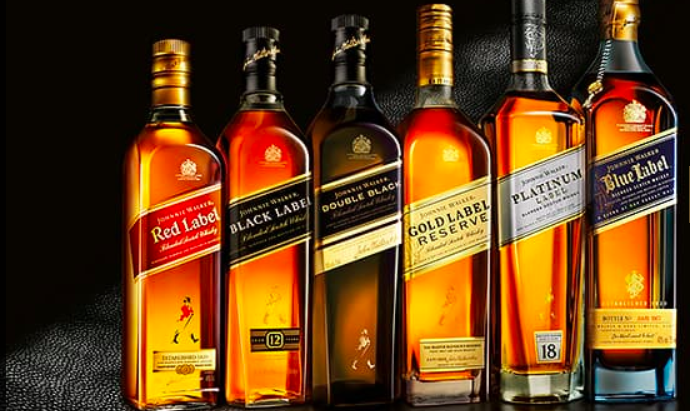
Source: Diageo
The majority of Diageo’s profit is generated in the West and the group therefore has scope to expand in faster growing markets. Diageo’s Asia Pacific sales increased 9% in fiscal 2018 and Latin America & Caribbean sales were 7% higher.
A key risk for Diageo is that disruptive new entrants undermine sales volumes and margins. There has been little evidence of this with net sales higher across all categories in the last couple of years, with the exception of vodka.
Gin has seen an explosion of new competition but Diageo still delivered 16% category revenue growth in FY 2018. Diageo’s most important category, scotch, saw 25% net sales growth in fiscal 2017 and 2% growth in fiscal 2018.
Diageo in the fiscal year to June 2018
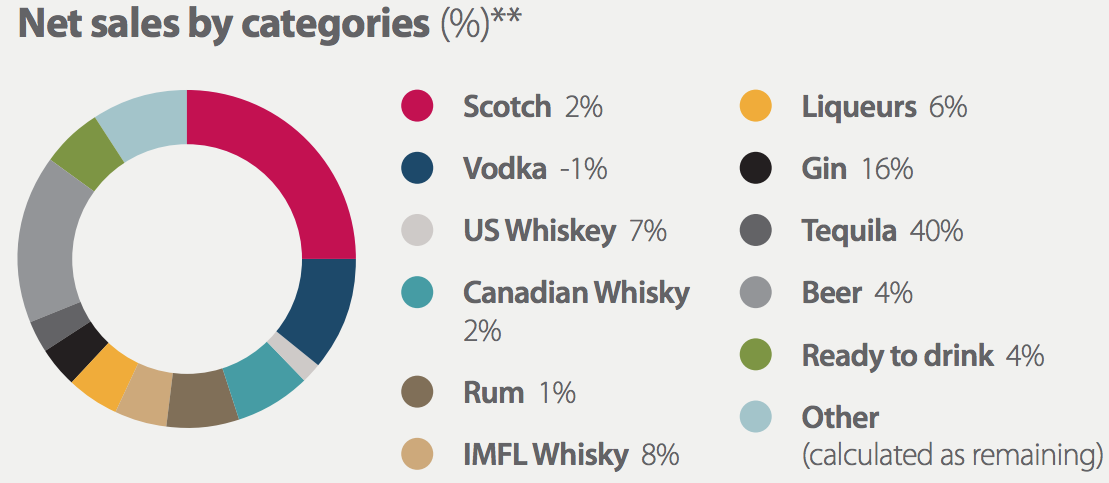
Source: Diageo
Unilever: personal care and emerging markets
Unilever (LON:ULVR) generated 58% of revenue from fast growing emerging markets in the first half of 2018. Developing market revenue rose by 0.2% in the period but emerging market revenue increased by 4.1%.
The group has been reducing the size of its mature food division and completed the sale of the spreads business in July. Acquisitions have focused on building up Unilever's presence in Personal Care & Beauty.
This division generated 38% of revenue in the first half of 2018 and 45% of group operating profit. With an operating profit margin of close to 20%, the Personal Care & Beauty segment is Unilever’s most profitable business.
Unilever’s Personal Care & Beauty division is the key driver

Source: Unilever
Looking ahead and emerging markets and Personal Care & Beauty will both become more significant to the group. This will increase Unilever’s underlying pace of revenue growth and profit margins.
Disruptive competition is a threat with Kylie Jenner’s beauty brand, for example, rapidly taking market share. Unilever’s ice cream division recently lost market share to the upstart low calorie and high protein brand Halo Top.
Emerging markets may become more competitive with consumers less willing to pay a premium for Western brands. The group’s Home Care division is also at risk from supermarket own brands and the shift towards online shopping.
Reckitt Benckiser: focused on Health Powerbrands
Reckitt Benckiser (LON:RB.) has been one of the best performing consumer defensive shares since 2000. The group was formed through the merger of Reckitt & Coleman and Dutch group Benckiser in December 1999.
Bart Becht took control at that time and is credited with improving the group’s financial performance. Key drivers have included consistent revenue growth, ongoing profit margin improvements and a series of large acquisitions.
A major long-term opportunity for RB is to increase its exposure to fast growing developing markets. These only accounted for a third of revenue in 2017 but the group hopes to lift this to 40% by 2020.
The acquisition of baby food group Mead Johnson Nutrition (MJN) has increased RB’s exposure to consumer Health products. If RB can improve the performance of MJN then the financial impact is likely to be significant.
Reckitt Benckiser’s is driven by Health: 62% of revenue
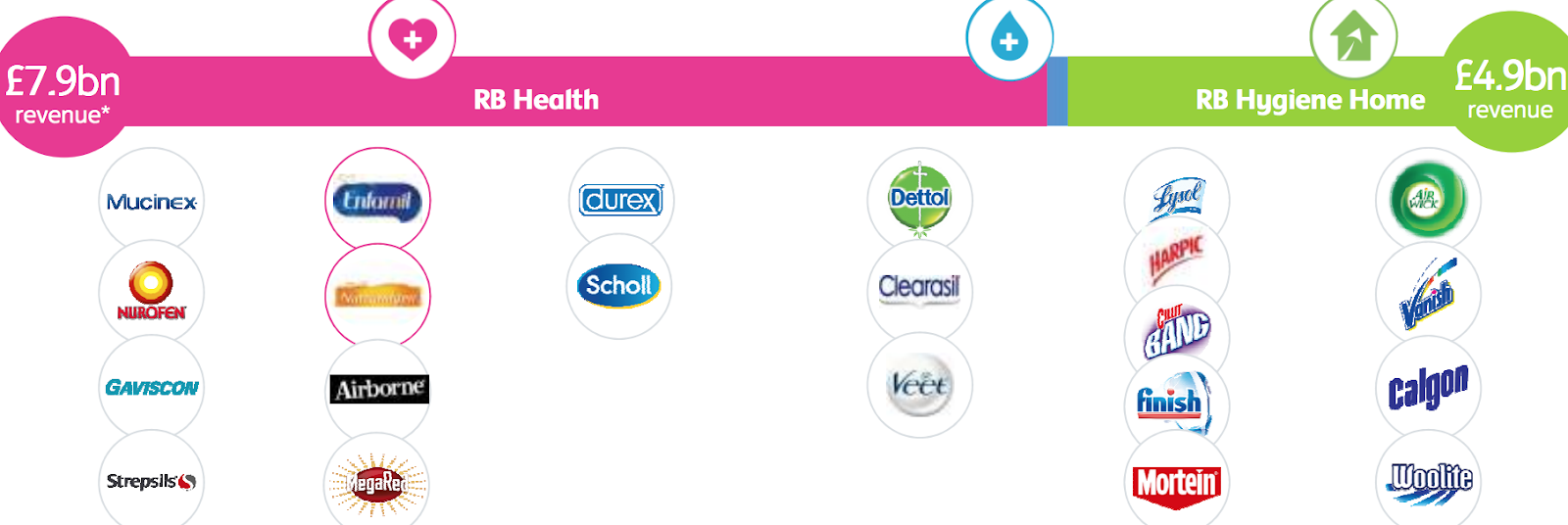
Source: Reckitt Benckiser (2017 revenue including a full year of MJN)
Key risks for RB include own brand competition for its Hygiene and Home brands, and also for some Health brands. Supermarket own brands currently sell at less than half the price of Nurofen, Harpic and Dettol.
The shift towards online shopping, and discount supermarkets, will make this price gap increasingly apparent. An additional risk is that the £14bn Mead Johnson takeover does not work out as planned.
Tesco versus Reckitt: own brands are less than half the price
| Reckitt Brand | Tesco Own Brand | ||
Nurofen | £1.90 | Ibuprofen | £0.35 |
Harpic | £1.75 | Tesco toilet cleaner | £0.75 |
Finish | 17p per tablet | Tesco All in One | 8p per tablet |
Detoll | £1.75 | Antibacterial Spray | 70p |
Source: Tesco online
British American Tobacco (BAT) and Imperial Brands: cash cows
British American Tobacco's (LON:BATS) most important region in terms of profit generation is Asia-Pacific & Middle East (APME). This geographic block delivered a 3.5% increase in volumes in the first half of 2018.
Overall volumes fell by 2.2% in the first half of 2018 but strategic brand volumes improved by 11%. BAT’s premium brands have been taking market share from rivals and this trend is likely to continue.
BAT’s strategic brands global market share in H1 2018
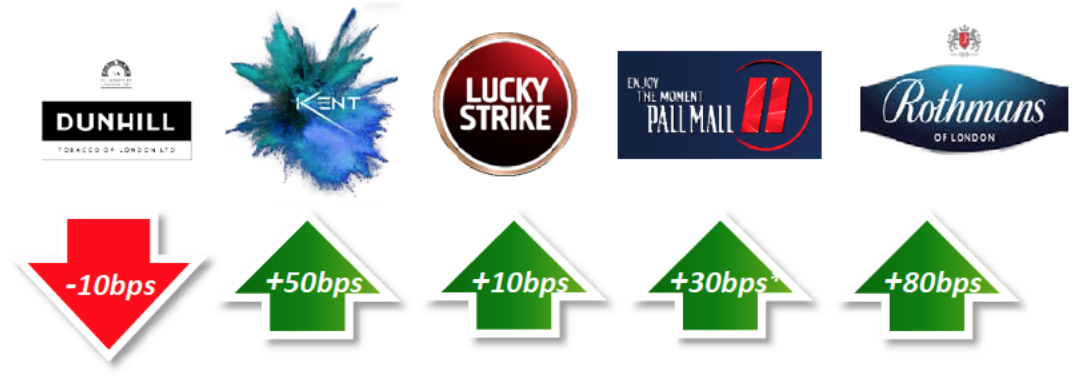
Source: BAT
Growth drivers for BAT include the cost savings related to the takeover of Reynolds American. Next generation Products are also performing well with BAT is on track to generate £1bn in revenue from this area in 2018.
Turning to Imperial Brands (LON:IMB) and tobacco volumes have continued to fall across all of its markets. The group’s Growth Brands saw a 1.6% volume improvement (ex-migrations) but total volumes fell by 2.2%.
A key risk for the tobacco groups is that next generation products prove to be more of a threat than an opportunity. Regulatory changes may also start to impact demand growth in emerging markets.
Summary
Warren Buffett has stated that: “A lot of great fortunes in this world have been made by owning a single wonderful business. If you understand the business, you don’t need to own many of them.”
The question for investors is whether UK blue-chip consumer defensives remain great businesses. Companies in the sector need to maintain current profit margins and also take advantage of the available growth opportunities.
Finding consumer defensives on Stockopedia
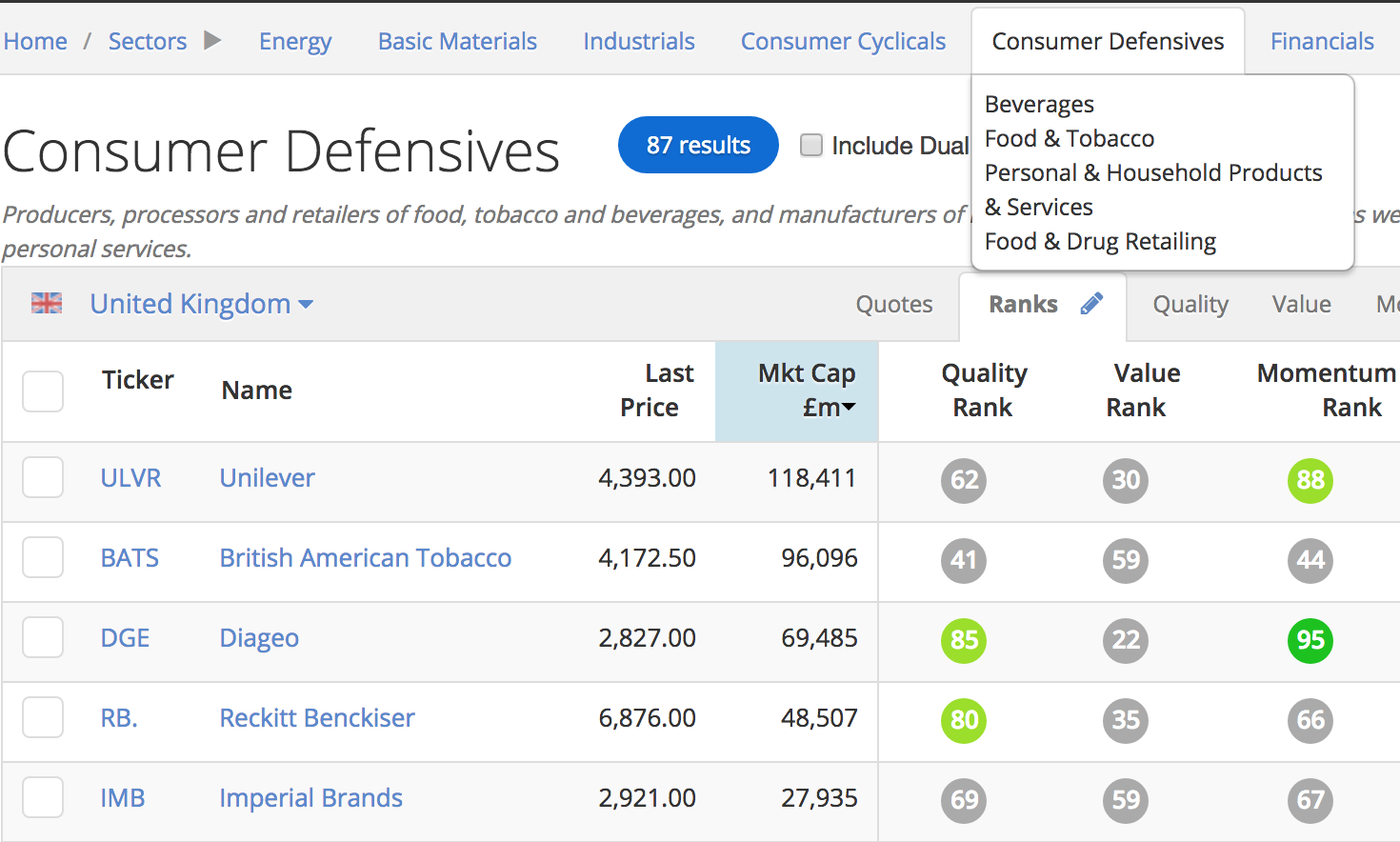
To find consumer defensive stocks on Stockopedia you simply click on the ‘Home’ button and then click on ‘Browse Sectors’. You then select ‘10 Economic Sectors’ and then click on ‘Consumer Defensives’.
Consumer Defensives includes beverages, food & tobacco, and personal & household products & services. I am excluding ‘Food & Drug Retailing’ because it is a service sector and therefore has different dynamics to consumer goods.
Disclaimer
This is not financial advice. Our content is intended to be used and must be used for information and education purposes only. Please read our disclaimer and terms and conditions to understand our obligations.
6 comments
To explain some previous comments in a bit more detail. If you look at the Invest in the Best book on page 31 the table is very helpful. There are three companies producing the same earnings per share over 5 years. However, they each produce different cashflow for investors. This appears at first glance to be a paradox?
We are conditioned to think about earnings per share. If three companies have the same earnings per share surely they are worth the same amount? However, if each of those three companies produce different cashflows for investors then the ones producing the higher cashflow must be worth more.
How do we reconcile this. The two companies producing the higher cashflow have higher returns on capital employed. So they don't need to invest as much to produce earnings per share. They therefore have more excess cashflow.
A company must be valued off the free cashflow it generates for investors. So while the three companies produce the same EPS, the companies producing the higher cashflow are more attractive. This highlights that it is advisable to go for higher ROCE companies. This may even be the case if their ability to invest in growth is less than other companies. They will be producing more more free cashflow.
Another way to think about this is that if three businesses want to grow EPS by 5% a year. A company with a ROCE of 10% is capital intensive and so has to invest a lot to achieve this. A company with an ROCE of 20% is not very capital intensive and so doesn't have to invest as much. A company with an ROCE of say 50% doesn't need to invest very much at all. So the latter two companies can give you much more free cashflow while generating the 5% earnings growth.
This essentially helps make the case for the consumer defensives discussed here. Yes they may not be high growth but with high ROCE's (underlying and so excluding goodwill) they are generating high cashflow. So they can pay out a lot of their earnings as dividends or do share buybacks. They don't need much of the earnings to invest in growth because they fairy high ROCE's.
Hope that makes some sense!!! I personally found Keith's table on page 31 (Invest in the Best) very enlightening. His table on page 20 is also good but takes a bit of thinking about. The point is that growth is worth less for investors when it is capital intensive or driven by acquisitions etc. Think of an industrial company investing in growth versus Facebook adding new users which doesn't cost a lot. Keith has performed very well with his fund and so his book is well worth studying!!!!!
I personally compare earnings per share a company produces to its free cashflow per share in Stockopedia. This is a rough and ready way of seeing if growth (if there is any) is consuming cash. You can then look at other tables such as the cashflow accounts.
Thanks Andrea341 - Great to have positive feedback!!! Interesting point on the conclusion side. There is the old joke about economists: "If all the economists were laid end to end they wouldn't reach a conclusion." So I agree that having no firm conclusion can be frustrating. However, I have mixed views here.
If someone is buying individual stocks it is advisable that they make the final call. In buying a house, you can take advice off estate agents but it is best to make the final call yourself. It is also hard to have a concrete long-term view given that information changes.
I am happy to offer my personal views. Diageo and Unilever appear to be very good companies. Diageo is very profitable, has great brands and can increase its EM (emerging market) exposure. Unilever has great EM exposure and can become more profitable as it mores into personal care.
For RB. I would need to consider in more depth but am slightly worried about it. Some of its products - Nurofen - seem to be vulnerable. If I had to own a tobacco stock it would be BAT due to its EM exposure. But I worry about BAT's US deal and the related debt.
We don't have to buy these companies but can buy into fund managers that buy these kinds of companies. I.e. Nick Train, Terry Smith etc. These are some of the best performing fund managers in the UK. So looking at these companies gives us an insight into why they have done well. Fundsmith AGMs online are well worth watching in case of interest.
I guess it is also useful to think why have these companies done well. We can then see if we find any other companies with similar attributes i.e. the five key drivers: brands, premium products, emerging markets, M&A and buybacks/strong cashflow.
Diageo - Good points about valuation given the modest EPS growth. However, I would distinguish between types of EPS growth. I don't know if you read my Slater Screen article but long-term organic growth (not acquisition driven) is the most valuable type of growth.
A high ROCE with EPS growth is also very valuable. This is because it means much more cashflow. I.e. with a high ROCE you don't have to invest much cash to achieve the growth. So Diageo and Unilever pay out a lot of their earnings as dividends. Businesses with lower ROCE's (capital intensive industries) have to use much more cash to grow.
I also personally think that we should consider quality and risk rather than just valuation versus growth i.e. I am not a fan of the Slater approach by itself. Diageo is an excellent quality company and fairly low risk. A P/E to growth type approach will always miss high quality and low risk companies. It will also miss out on companies with slow but attractive secular growth.
The key is to not necessarily to look at recent growth. It is to look at the long-term growth outlook. Unilever has been seeing good growth in emerging markets. It has exited its slow growth spreads business. As Diageo increases its EM exposure its pace of growth should pick up.
I would very much recommend Keith Ashworth-Lord's book (Invest in the best) where he compares quality and growth. His conclusion is that quality is very important and is usually more important that growth.
Unilever - I also agree on face value it doesn't look great. But again there is that secular growth opportunity in emerging markets. So 50 years of growth at a slow rate can be worth more than 3 years low quality growth at a high rate. I also like Unilever's move into personal care. Slater Zulu screen, by contrast, picks up sudden bursts of growth due to things like acquisitions (i.e. £GOCO). So I quite Unilever.
Diageo/Unilever - While these two stocks may not appear to be "exciting" they offer a potentially attractive core portfolio holding. If you think they will be resilient businesses i.e. the subject debated in the article. Over the long-term quality, growth and risk tend to be more important than the initial P/E multiple. Although this depends on the initial P/E not being excessive.
RB - I think the ROCE is depressed because of acquisitions. The underlying business ROCE excluding goodwill should be pretty good. I just focused on the operating margins to exclude the impact of acquisitions. RB. has good margins but the company's prospects seem more uncertain than Unilever or Diageo in my view.
To explain, ROCE calculated the standard way leaves goodwill on the balance sheet. This means companies that have taken over businesses have a lower ROCE. However, the underlying businesses may be very profitable. One way of assessing this is to calculate ROCE without goodwill.
Tobacco - I kind of agree there as some of their business practices are abhorrent. But it has actually been one of the best sectors over the last few decades. I am personally not a fan of the Western tobacco groups getting emerging market consumers hooked. Some of the videos from Indonesia about children smoking are awful.
Interesting conclusion that you would never buy these companies. Yes if you are in unit trusts they may own them. It can also possibly be good to have companies like these on the watchlist in case there is a stock market crash. But I agree that if your aim is to find higher potential companies you may want to look in mid-cap and small cap stocks.
Over time, though, high quality companies can do well. Someone told me that their mum invested in Unilever in the 1980s or 1990s. She is up 100X since then apparently. Elephants don't gallop but they also don't get trampled on!!!!! Or to put it another way, companies with very strong franchises that have a high probability of doing well can be very valuable over the long-term.
This is definitely, as you say, an interesting area to look at. We buy a lot of the products every day. I am one of the mugs buying the branded toilet cleaner and cleaning products! It is also interesting to me in demonstrating that business resilience is very important to long-term returns. Higher risk companies may appear to have good prospects but they typically fail to pass the test of time. The tortoises tend to win the race in the long-term. Consumer defensives appear to be slow tortoises but slow organic growth does compound over time.
The bottom line for me is that it is fascinating that companies making such basic products have delivered so well over the long-term. Supermarkets and the products appear to be superficially competitive.
However, when we go into a supermarket we can't calculate 1,000 price to quality assessments. So we tend to go for trusted brands. There is also only so much shelf space. At the price point of consumer defensive type products we will not spend a lot of time on the decision. We will spend a lot of time deciding which car to buy.
So while we intuitively may not think that shower gel and face cream will be a great place to invest the reality is that it has been a great place to invest. We are very lucky in the UK to have these great quality companies listed here. Spain doesn't, I think, have any large consumer defensive stocks. A lot of European national markets are stuffed with banks, industrials and insurance companies.
It is perhaps no surprise, then, that a lot of national market indices in Europe are yet to reach new highs. Have a look at Spain's IBEX 35 index, the CAC 40 (France) etc. One very interesting point, then, is that we can potentially look to which sectors are best rather than which companies are best.
You could of picked the UK consumer defensives from 2000 to 2010 and outperformed i.e. rather than looking at economies or bottom up factors. So looking at sector dynamics can really pay off rather than looking at companies or economics. i.e. avoiding banks and buying resilient sectors like consumer defensives.
This is a key takeaway for me from the last couple of write-ups. Consider the sector dynamics of any company you are considering investing in. If the sector is good you have a tailwind. If the sector is weak you have a headwind. We can get obsessed with individual companies and managements. We can also get obsessed with economic trends. However, sector dynamics can be easier to predict and can be much more powerful.
A key thing I like about defensive sectors is that they should hold a lot of their value in an economic downturn. So you don't really have to invest a lot of time thinking about economic downturns or stock market crashes. If you are invested in home builders you do have to think about economic downturns and stock market crashes. But market timing and forecasting economic downturns is generally very hard if not impossible.
So for me companies like Unilever and Diageo are great sleep easily at night stocks. Or alternatively the funds that own them. But this view could be wrong. Consumer defensives make great margins and the new sector threats may undermine their profitability over time.
I guess a final point is that the stock market tortoises always tend to look a bit boring in terms of growth and the valuations always look a bit high. But high quality tortoises have tended to outperform over the long-term. Consumer defensives are globally diversified so need to worry about Brexit, UK economy etc.
I have seen Nick Train present a few times and his way of thinking about Unilever/Diageo makes perfect sense. He referenced Buffett many times and talked about brands and focusing on the the "arrow" rather than the "wheel." In historical terms the arrow is the long-term trend and the wheel are historical cycles. Just look at the long-term chart of scotch demand.
Thanks, Andrew
An interesting in-depth article. I recently cast my eye over some FTSE stocks trying to decide whether any of them deserved investment. Out of the ones you mention, I also (like Trigger14 and you) would on balance go for Diageo (LON:DGE) on the basis of eps growth and momentum, as well as their PEG being the lowest... but I do have a problem in paying such a premium to eps growth especially when revenue growth is almost flat.
On the basis of whose products I use the most, then I should buy Unilever (LON:ULVR) as I use Radox and sometimes their antiperspirants. ROCE is also excellent... but there is little else that excites me about the stats, especially paying a PER of 20 for mid-single digit eps growth.
On the basis of stockranks I guess one should buy Reckitt Benckiser (LON:RB.) although I can't think of any reason to do so. As you highlight, I favour supermarket own-brands in favour of everything that I can think of that they make, their ROCE is the lowest (although 10% is still okay), and again we are being asked to pay through the nose for mid-single-digit eps growth.
The only comment I have on tobacco stocks is that I don't invest on them from a moral perspective.
To conclude, I doubt I'll ever buy any of these companies... although I am sure that the market may well prove me wrong in that over the long term they will all outperform my investments. I expect that some of the unit trusts that I own are invested in some or all of these companies though...
As Trigger14 suggests, I find recent articles that you have written interesting... though I feel that you should add your own conclusions at the end of them rather than just providing a wealth of information.
Anyone want to share their favourite Diageo (LON:DGE) tipple? I personally am not a fan of the Jonnie Walker brand as it seems too mainstream. I also can't say I am a fan of Guinness. However, Diageo has over 200 brands so I think they can survive without my custom. Bombay Sapphire is very nice but they don't own it. Diageo recently did a craft beer type version of Guinness. Hop House 13 Lager. Craft beer uses more hops and is more expensive. From what I have heard the product is popular and tastes good.
I like Unilever (LON:ULVR) 's personal care brands. Having started looking at this sector I now look at who makes the household products and personal care products I use. Some areas, like kitchen towel, I really don't care.
I can't say I like or dislike Reckitt Benckiser (LON:RB.) But their products seem to find their way onto my shelves. Smokers seem to be very brand loyal and can tell the difference between the different brands. Marlboro is apparently one of the leading tobacco brands. Vaping appears to have opened things up to a range of new competitors.
Interesting and well-written article (and your previous one). But what’s your view on which of these have better prospects and which may be near the end of the party?
For me, Diageo seems a much better prospect than the others in terms of certainty and longevity of future returns. I think the household products businesses are much more likely to face the threat of increased competition and the tobacco businesses are more likely to face changing consumer preferences.
Trigger14 - Thanks for the positive feedback! I guess the article just sets out all the arguments. The three risks are 1) Disruptive competition 2) Changing preferences and 3) changing distribution channels. The sector drivers are: brands, premium products, emerging markets, M&A and buybacks/strong cashflow.
From a personal perspective, I tend to agree with you that Diageo seems to be reasonable as it doesn't appear to be exposed to the three major risks. A few years back people were worried that Diageo was losing its market position and focus in the key US market.
However, Diageo appears to have got back on track. An interesting new entrant in the premium tequila segment was Casamigos which George Clooney was behind. The power of celebrity meant that this did extremely well and Diageo ended up buying the brand for what seemed like a very high price.
Changing consumer preferences and distribution channels both don't seem to apply to Diageo. Budget supermarkets have, however, both come out with some own brand equivalents to premium spirits. It is worth remembering though that the market share of own brand supermarkets remains quite low.
So yes I think Diageo doesn't appear to be exposed to a lot of the risks in the consumer defensive sector. I do wonder, though, why it is performing so badly in vodka. Perhaps there is some disruptive competition in this category?
I am not an expert but I think the barriers to entry for brown spirits (scotch etc) are much higher than for white spirits (vodka). This is because brown spirits have to be aged for a long time and are often branded according to where they are made. Vodka (one of the most important white spirits) is made from potatoes and doesn't have to be aged.
In terms of profitability the margins that Diageo generates are very impressive. As someone who doesn't drink much in the way of alcohol it is hard for me to judge Diageo's products!!! But their position in scotch bodes well given increasing global demand for this spirit category.
If you look at the scotch whiskey association website you can see that scotch exports have been growing and growing. Scotch is just whiskey made in Scotland (pointing this out as I didn't realize this some time back).
I also personally like Unilever but this could be because I seem to use their products all the time!!I think their shift into personal care & beauty is a good move. They also tend not to focus on higher end personal care and beauty brands. Popular brands include Dove for example.
Unilever's margins are lower than Diageo's but the group also has a much more meaningful emerging market exposure at 58% of revenue. With Unilever exiting its spreads division in July the mature foods division will be a smaller part of total revenue.
Personal care & beauty brands should have a good degree of user loyalty. I personally use the group's Simple face wash and Sure deodorant. I am not very price sensitive on these products.
Reckitt could be good if we all continue to buy its Powerbrands. Human behaviour isn't rational so this may indeed be the case. However, I am worried that sales growth has been somewhat sluggish of late. It seems to me that Reckitt is at threat from the shift to online shopping but I could be wrong.
A number of investors believe that Reckitt's acquisition of MJN may not work out well. The group may also now be too large for further acquisitions to have a meaningful impact.
Tobacco is hard to call but the valuations have fallen back recently. BAT has the emerging market exposure but recently took over Reynolds American. This increased its debt position and the US may be set to introduce more tobacco restrictions.
Imperial Brands is the cheapest of the bunch but it appears to be exposed principally to Western markets. Some people are also of the view that it is behind the curve with regard to the shift to next generation products.
In terms of fund managers I think Nick Train likes Diageo and Unilever. I think Terry Smith is also in those two but also owns Reckitt. Terry Smith recently sold Imperial. Hope that helps.