Is your stock broker fleecing you when you deal in foreign stocks?

When I got my first iPhone several years ago I quickly decided that I wanted to own shares in Apple, the company that made it. But while it was clear to me that this could be the best company ever, my attempt at buying the shares failed because my broker didn’t deal in them. With the purchase of my next iPhone some years later I had another go at buying shares in Apple, which had tripled in price. While my broker did now deal in the stock, it was charging a staggering £80 to execute the trade.
Buying and selling foreign shares can be expensive, but it doesn’t need to be. UK investors are increasingly looking at foreign markets to diversify their portfolios and grasp new opportunities. Historically, the main barrier to this has been the limited market access and high trading costs offered by many brokers. So choosing the right broker is crucial. However, a lack of comparison tools online makes it incredibly hard.
As a result, this summer at Stockopedia we researched and built a database to investigate and model the costs of all the main execution only and advisory stock brokers in the UK. The results are quite enlightening and we hope are of great use to readers.
Three Key Questions
In summary, deciding which broker is best for you will depend on three questions:
1. Which markets are you looking to access?
 Most of the big brokers offer access to the US and some European exchanges but often that’s where the opportunities end. Big emerging markets like Hong Kong and Singapore as well as well established markets like Australia, Japan and Canada are overlooked by brokers including Hargreaves Lansdown, IG, and Halifax. Other brokers may offer a list as long as your arm but charge outrageous commissions for the privilege. In our research, the highest commission for a single trade was an outrageous £200.
We found that the best coverage of markets was provided by AJ Bell Youinvest, DeGiro, Interactive Brokers and SaxoBank. They were the cheapest services to provide access to the above markets and more. If your broker is not offering you access to these markets, or offering them with minimum fees of £20 plus 1.5% foreign currency commission, then you could broaden your options and save money by switching.
2. What size is your portfolio and how do you trade it?
Brokers charge you for anything and everything: having an account, transferring stocks in and out, trading, not trading, buying currency to trade foreign stocks… the list goes on. Finding the right broker will depend mainly on:
1) What is your average trade size?
2) How frequently do you trade?
Trading and forex fees are the biggest broker expenses, so minimising them is the main priority for choosing a broker. If you’re rebalancing your portfolio quarterly or even six-monthly you could be placing 100 trades per year.
With a fixed rate broker like Halifax, 100 trades would cost you £1250 no matter how big or small they are. Don’t forget that on top of that, with Halifax charging 1.25% to exchange currency, you could end up paying the same amount again in FX charges. By contrast a cheaper, percentage based service like DeGiro or Interactive Brokers with low, or no FX charges could cost considerably less.
3. Are you looking for an ISA, or a SIPP, or both?
Tax-efficient vehicles are a crucial tool for investors to maximise their returns. What many investors do not know is that you can hold foreign shares in ISAs and SIPPs - provided they’re on what HMRC deem “a recognised stock exchange anywhere in the world”. While that definition may seem bit vague, we have found that the major exchanges we are interested in are all eligible.
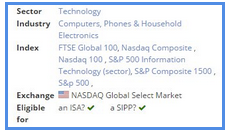 Stockopedia StockReports will tell you whether a company’s shares are ISA and SIPP eligible. The problem we found is that some of the cheapest brokers for trading don’t offer ISAs, SIPPs or either.
In the case of DeGiro, they told us they are “planning” to introduce ISAs and SIPPs but they couldn’t give a date for when. Interactive Brokers do not offer them either. So while these are two of the cheapest brokers per trade with the best market coverage, they may not offer the service you need for tax efficiency.
For ISAs and SIPPs, the brokers who provide the best value service in terms of good choice of markets and reasonable pricing are AJ Bell Youinvest and Saxo Bank.
What does this all mean?
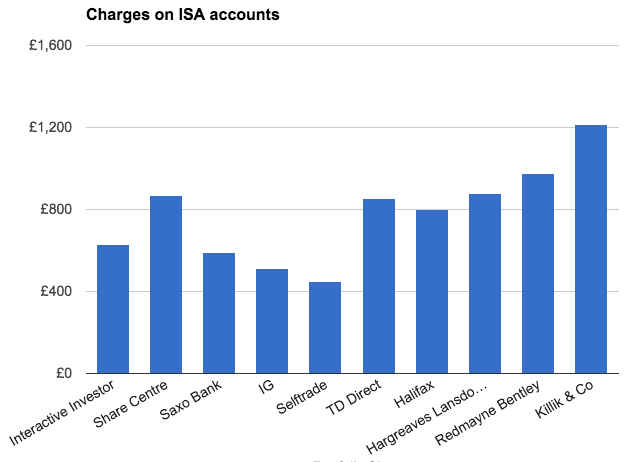
We compared charges based on estimates of a medium sized internationally diversified portfolio (except for ISAs which we based the model on the full, £15,200 allowance). Below are graphs for Ordinary, ISA, and SIPP accounts to show you how the charges compare.
It was surprising to see just how much some brokers charge for their services. Advisory brokers charge premium rates for their services, data and information presumably because they need to cover the costs of their advisory services and research departments. Even some well known execution only services like Hargreaves Lansdown and TD Direct charge a lot for their services. You can save enough by changing broker to cover a Stockopedia subscription many times over!
Here are the results, assuming that investors:
- Trade with a £75,000 stock portfolio;
- Own 25 stocks and trade 3 times per month (average trade value being £1500);
- Allocate 30% of their portfolio to US shares; 15% to European shares and 5% to Asia.
The annual charges consist of trading costs (eg. commissions), forex costs and other charges (eg. custody fees).
- We calculated trading costs assuming that an investor traded 36 times per year and invests 50% of their portfolio overseas (see above). If a broker levies a £70 commission on foreign stocks and £30 on UK shares, this would total £1,800 by the end of the year - ie. 36 x ((£70 x 0.5) + (£30 x 0.5)).
- We calculated the forex fees assuming that the average value of each trade is £1500. If a broker levies a 1.5% exchange fee on 18 overseas trades, forex fees would total £405 by the end of the year.
Standard Accounts
DeGiro is the cheapest of the bunch for trading. There are however a few question marks over them. First, they are Dutch based and regulated which means that adjudication and deposit protection with them could be complicated. Secondly, their service, while neat and user-friendly, is very basic - users have complained that they are not notified when trades are executed so they have to check manually. The company, being new, says it’s addressing problems and improving the service so it’s certainly one to watch if you’re not ready to go with it yet. If you want a no frills, purely execution platform, DeGiro could be an option.
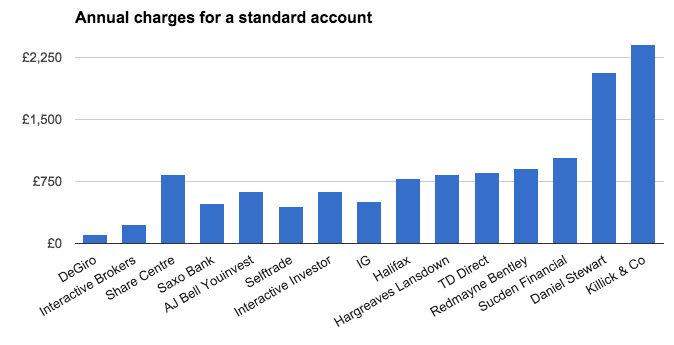
Interactive Brokers comes out as second cheapest from our calculations. They provide a better service than DeGiro and terrific availability of markets. The drawback of IB is that they require a minimum investment of $10,000. Some reviewers have suggested that the platform is not as suitable for ‘basic’ investors, but very good for mid to advanced users. As with DeGiro, IB do not offer ISAs. They can facilitate SIPPs, however you need to separately go through an administrator which can be costly so we have excluded their SIPP from our comparison. If you want a better than basic service with useful tools then IB provides apparently fantastic value. IB’s lack of FX charges make it particularly attractive for trading internationally.
ISAs & SIPPS
We have also modelled the costs for tax efficient accounts (see below). AJ Bell Youinvest and Saxo Bank are the best brokers for ISAs and SIPPs. They both offer very good access to foreign markets, including the US, Europe, Australasia and the Far East, at pretty much the cheapest prices. AJ Bell charge £9.95 per trade. Saxo Bank charge $15 for US shares and €12 for European stocks. They are better value than similarly priced services like Selftrade, Interactive Investor, and Share Centre, which offer fewer markets. Saxo’s platform, like Interactive Brokers, is aimed at a more advanced user but is highly regarded. In addition, Saxo has a minimum investment of £6500 which might not suit some investors. Yes, they’re more expensive than DeGiro and IB, but for ISAs and SIPPs, their offerings are very good.

Conclusions
The cost of brokerage commissions has fallen consistently over time. In the late 1980s the average commission in the States was $45. Thankfully this has fallen to around $10 and we are starting to see brokers (eg. Robin Hood) that can execute for zero percent commission. We hope that these rates will keep falling and the stock market will thereby become further democratised, but in the meantime investors should make every effort to ensure that trading fees don’t eat into their returns. We hope that this article serves as a useful starting point which helps investors hone in on a broker that meets their needs and objectives. If readers have any further insights into ways to minimise trading costs, do please feel free to leave your opinions below.
Disclaimer
This is not financial advice. Our content is intended to be used and must be used for information and education purposes only. Please read our disclaimer and terms and conditions to understand our obligations.
32 comments
Sadly, the article's showing its age!
For example the forigen exchange penalty for non-stering transactions is insufficiently empasised. It is often (carefully) concealed and if the stocks are in an ISA any sales income is instantly converted back to sterling. If, within a few minutes one sells a stock in $US and buys another in the came currency, the charge is incurred twice. Depending on the broker it might be from 0.45 - 1.5% for each trade and is principally a rip-off. Some of the brokers of more recent orogin are at te less costly end of this range and don't levy dealing fees.
Loyalty is not to be admired!
Colin
A big problem with judging costs of trading overseas assets is the two costs associated with FX - the commission and the spread.
My guess is that there are bigger spreads on trades conducted with lower commission providers.
The ISA requirement to always bring cash back to GBP must have been put in at the behest of the providers to generate more income from the increased activity.
One thing I learned recently - if you hold US shares in SIPP, they are not subject to 15% withholding tax on the dividends.
Very useful article. I have noticed that brokers like trading212, etoro or plus 500, are not mentioned. Why is that?
Probably because they were not around or very small in 2016, apart from Plus500 (LON:PLUS) but they are more for spread betting?
I did look into using Trading212 but too many bad reports, I'm not willing to take the risk.
Lorenzo - this is a very old article... that's probably why!
TD Direct increased their forex loading to 1.5%, which for any modest overseas trade dwarfs the trading fee.
e.g. £5000 x 1.5% = £75.
Then another £75 gone when you sell & convert back to sterling.
Just to be really awkward, in some accounts, if you already have a foreign exchange balance, they will only let you spend 90% of it, to protect against perceived risk of forex movements. Even if I have a large net sterling balance & various other positions in the same account.
If I remember correctly, a few years back, all the brokers offered less than 0.5% forex loading, then they figured out increases here could sneak in under the radar. Be aware.
They're probably turning implicit fees included in the FX or trading spread into explicit ones, as per regulatory trends. You'd have to compare full return trip costs before being sure it was cheaper in the good old days.
From what I saw, they turned an explicit forex charge into a higher one.
If I remember correctly, the forex spread went from 0.5% ==>2% ==>1.5% .
When purchasing I would check always check the offer prices via an independent source, so unless the price moved by 1% in 15 minutes, I knew what a competitive offer should be. I saw little difference in that aspect, before & after the forex changes.
More recently, the forex fee has steered me away from individual overseas stocks.
While it is important to keep costs as low as possible from experience of online and telephone dealing via a broker I gain the impression that the extra expense of the latter may well be offset by the broker obtaining better prices. Without knowing what if any comparative advantage there may be may we not find our dealing costs online are larger than they might otherwise be?
I do think think the Interactive Brokers SIPP is well worth considering. Yes, you have to find a third party administrator (but you do also for example with Saxo) with, typically, a £350 annual charge. However depending on your portfolio size and frequency of trading this charge can be well well worth paying given Internative Brokers virtually zero FX costs and the widest portfolio choice. For an ISA Saxo have the widest portfolo choice and their FX charge of 0.5% is reasonable by the standards of most brokers.
I have checked with TD and according to them HMRC rules mean that a stocks and shares ISA has to be pounds so you cannot hold cash in another currency for this type of account.
I have also found out that DiGiro also does not have a stop loss service 'currently'. Although, TD and Iweb do not offer this service for foreign shares in another currency.
(Saxo Banks annual charge of £35 does not look that bad after all!)
Personally I quite like trhe functionality of Hargreaves Lansdown's website. I dont think the others quite compare but it does make me angry when buying foreign shares that they need to charge a 1.5% 'fee' as well as an increased transaction cost.
Having traded Fx for much of the last 30 years for large international banks, I know better than anyone that FX is just one big cartel and all the firms use the excuse of having to charge this margin to cover the risk. Every trade conducted online is then covered online almost imediately afterwards. The banks would have you think they have to carry big sacks of money around the corner to change at the Bureau de Change.... Its one big racket and yet we still allow them to practice this and therefore the stock brokers think its perfectly acceptable to do so too!!!!
Even wprse is that they describe their charges as competitive.. IT makes my blood boil.
Rant over... Sorry all.
This is a really good resource when considering international dealing ...
https://the-international-investor.com/
Great to hear the responses here @all. Thanks so much for the feedback. We've gathered all the data in spreadsheets but we'd like to properly store it and regularly update it in a database. The goals of this are several:
Lord knows when we'll achieve this as we've so much else going on right now, but it's going to be a private project of mine to build a model and see if it can work. Obviously there are lots of nuances but if you think this is a worthy goal go on and give this comment a thumbs up !
"Obviously there are lots of nuances but if you think this is a worthy goal go on and give this comment a thumbs up ! "
There are Ed.
For example in answer to;
if you want to trade Polish stocks... who can help you do it?
You can trade Polish Stocks on deGiro but the list of possibilities are very limited.
Most online brokers may only cover part of 1 index (often the large cap), from a place like Poland.
Also many foreign stocks are listed on more than one exchange in different countries.
You may not be able to trade the stock listed on the index Stockopedia lists.
Where that stock is listedon another index in a different country at your online broker.
I had several non-UK shares, Apple Inc (NSQ:AAPL) being one. I wasn't best pleased with the punitive charges imposed by Hargreaves Lansdown and transferred both my ISA and SIPP to You Invest.
Aside a comical aside, HL told me that the increased charge was to cover the additional costs for their 'research' on US shares!!!
The only non UK share that I now hold is Berkshire Hathaway B in my SIPP, it doesn't pay a dividend, as such I find this keeps things uncomplicated, as I believe investors also suffer FX costs and additional charges on dividend, too - way too murky for my liking.
Regards,
Sully.
Useful article but there are hidden practicalities when actually using individual brokers.
From my experience, TDD allow you to hold different currencies and you can fund them directly in that currency so you can shop around for a favourable exchange rate. Also, they deal directly in the U.S. and Canadian markets so the spreads are generally narrow and open for trade when the underlying exchanges are.
In contrast, AJB Youinvest do not seem to deal directly in the underlying markets and so have wider spreads, a narrower selection of stocks and stop dealing at 4.30pm UK time!
Also worth bearing in mind that you can open a U.S. broker account. I use optionXpress but mainly for options trading although they also trade US stocks for $9.95.
No Barclays Stockbrokers?
Barclays do allow trading in non UK listed stocks, but they make it hard! They don't allow them in an ISA, and you either need an International Trader account, or a Market Master. I no longer have an MM account, and they didn't allow International stocks when I did, so I've never used it. However, it does look as though a Barclays MM account might now offer reasonable value for US or EU stocks - they do forex at 50pips (it's 1% of all others). That's a good rate, though not as good as IB, so probably not really worth it for a non ISA account.
Peter
Another thing to check for if you want to trade on the US exchanges is that will the broker accept an W-8BEN which will give some money back on dividends accepted. (If you are small investors it will make very little difference, a large investor over a long period of time and it will.)
Iweb did not originally handle them but not do. Strangely there is a telephone interview of questions from the New York stock exchange before they will let you trade on the US markets.
For TD direct filling one out is compulsory before you trade and there is no telephone interview as far as I know.
Thanks Oliver this is much needed information.
I think you have followed the money supermarket approach to compare them from the point of view of a typical customer and it just does not consider everything you need to know.
I have experience of IWeb and TD Direct and my experience of international trading is that the brokers make their profit in the currency conversation rate. Which is the best one will vary on a number of factors including the number of trades you make. You can avoid annual NISA administration fees and one of your choices Saxo banks has them. (Beware that brokers can increase or impose extra fees at any time.)
Both Iweb and TD Direct (If you have a certain amount in the account) do not have annual charges for NISA accounts. Iwebs basic dealing cost is just £5 but they increased their currency conversion costs when they introduced this low dealing fee to match other brokers and included a joining fee which has become overtime fairly steep. Iweb not covered by you is similar to Interactive Investor and both were at one time administered by the Halifax. I was not aware that TD Direct allowed you to set up in NISA in a dollar nominated account, and this may only be for non-NISA accounts. It certainly feels as if TD FX charge is much higher than they claim and I suspect there are hidden costs.
You cannot simply compare the brokers by the number of exchanges they cover. Iweb will not deal in certain companies, ETFs, or investment trusts usually on liquidity grounds (but some very illiquid shares are traded.) TD is much better but not perfect and have refused some on grounds they were not ISA eligible when they clearly were. Country choice is not much different between these two brokers for European Trading, with TD direct adding Ireland and one Swiss and Swedish exchange but at three times the cost to deal by telephone only. Inland revenue rules means there is no way to trade on all those minor German Exchanges in a NISA.
Important things like stop losses are another important issue. Iweb charge just to set up a stop loss in a non-Isa account. I have issues with the quality of both services, although Iweb have improved their service recently. Iweb in the past have responded to my complaints and made changes to their service.
The extra research tools provided by brokers that I have seen are little different than what you can get from Yahoo or Goggle for free. (TD Direct's charting service for technical analysis may be a bit better.)
There are heavy charges to transfer between ISAs so make the right choice or you will be stuck.
It is interesting that Barclay’s is not in your table and only Halifax of the high street banks has a service worthy of consideration.
"3. Are you looking for an ISA, or a SIPP, or both?
Tax-efficient vehicles are a crucial tool for investors to maximise their returns. What many investors do not know is that you can hold foreign shares in ISAs and SIPPs - provided they’re on what HMRC deem “a recognised stock exchange anywhere in the world”. While that definition may seem bit vague, we have found that the major exchanges we are interested in are all eligible."
Bit more complicated than that - as I am currently finding out.
It has long been a case of ISA's not being treated the same, from a US tax perspective, as a SIPP - SIPP gets the tax deductions,and ISA seemingly don't.
And it gets even more complex if you deal in "Non Qualified" securities
Eg Pipeline MLPs, or REITS.
It seems that, in the case of an ISA -
Qualified US securities are subject to 15% WHT. At source. Not sure if you can reclaim that.Normally one would expect such tax free as its in an ISA! But from a US perspective they recognise SIPPS as being tax efficient vehicles, so if your qualified investment was in a SIPP, you'd get this WHT 15% refunded.
In terms of Non Qualified stocks, eg Reits and Pipeline MLPS these are taxed at 39.6%! Yes an eye watering 39.6%, whether you have them in a Trading Acct, an ISA, or a SIPP. ie You're paying the equivalent tax threshold of someone earning $460,000 per year!! It is irrelevant which wrapper you hold these in - you pay 39.8% tax.
You can reclaim it apparently, which I am in the process of doing as a 12% yielding stock, taxed at 39.6% is a piss take, especially when it is in a tax wrapper. Apparently US investors purchasing pipeline MLPS in their IRA's/Tax recognised accounts dont pay this 39.6% WHT.
"I recommend you look at trading in your IRA account. I do this and I am not taxed until I take it out at retirement."
I was under the impression that a SIPP was comparable to an IRA for tax purposes but it seems there are exceptions if you're a Non US resident for certain stocks..
So the chunky dividend tax came as a shock!
I use YouInvest for my SIPP and our ISA's and I'm heavily biased to Euro stocks and whilst in theory one can buy trade them at £9.95 online I personally find it hard to get an online trade for mst of the small caps I select. In the end I pay £29.95 for a telephone trade. Add to that 1% forex on all trades and it starts to get expensive. I'm tending to buy in £6000 tranches to minimise the impact of the dealing costs.
I might have to look at TD as it might make more sense to have a Euro denominated account.
I hope that helps
Phil
Your graphs for SIPP and ISA charges are confusing or misleading. Both clearly show Selftrade with the lowest charges, yet you say others offer better value. They may, but how? It would also be good to see figures for the forex charges of the various brokers. It's easy for most people to see and understand what commissions will cost, but forex for UK based brokers on US shares is normally extortionate, and that's the biggest cost for all but small trades, and can catch people out.
Where I do agree is that for anyone wanting to trade US stocks outside a SIPP or ISA, IB offers vastly better value than any of the UK operators. It looks like DeGiro do too, though I have no personal experience.
Peter
Did you look at TD Direct Investing?
I have had a USD denominated account with them for many years. Dealing charges are low, and FX conversion costs non-existent for US stock exchange transactions as everything stays in USD including the dividends received.
He did indeed - it's in there as 'TD Direct' on the various bar charts.
Apologies.
I read the article but did not look at the bar charts closely enough.
Hi Mohammed
As Tom points out TD Direct is featured in the comparisons. Their trading charges were not the worst in our investigation, but they are not the lowest around.
You are correct to point out that TD allowing you to hold foreign currency might eliminate a lot of the FX costs - it is worth noting though that TD are not alone in offering this. However for the purpose of this comparison, considering we are modelling for a portfolio diversified across many different countries and currencies it is difficult to factor in foreign denominated accounts (because not many currencies can be held) but also the benefit is reduced as you hold more currencies because you are likely to need to convert between them.
I hope that helps!
What bothers me about TD is that if you ever want to withdraw your USD's, you will first need to convert them. TD have very expensive conversion charges (at least 1.5% from memory). If you are not using them for ISA, I see no reason to use TD instead of Interactive Brokers. At some point I'd like to investigate if it's possible to transfer the USD's from TD into IB without incurring conversion charges.
I agree, useful info many thanks.
V Useful Thanks