Keith Ashworth-Lord Interview - How to invest in the best

The great US investor Warren Buffett once remarked: “The highest rates of return I've ever achieved were in the 1950s. I killed the Dow. You ought to see the numbers. But I was investing peanuts then. It's a huge structural advantage not to have a lot of money.”
What he was saying is that the more money you have to invest (in his case tens of billions of dollars), the harder it is to make outsized returns. So what would happen if you took the essence of Buffett’s strategy and used it on a smaller scale in the UK? Fund manager Keith Ashworth-Lord is finding out.
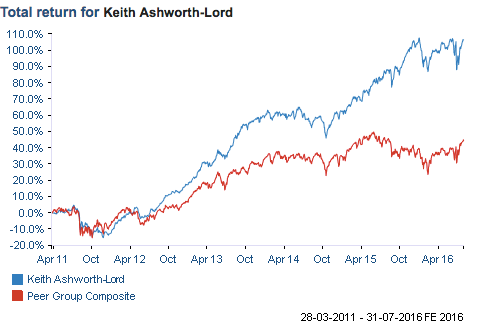
Five years ago Keith set up the Sanford DeLand UK Buffettology Fund. It’s a concentrated fund with a strict methodology that’s just passed £50 million under management and growing fast. In 2015, it made an impressive 27% return in a falling market, propelling it to the top of the IA All Companies sector.
As the fund name suggests, Keith has adopted some of Buffett’s best known investing traits. He takes a Quality + Value approach, looking for ‘moat-like’ characteristics right across the market-cap range. When he likes what he sees - and he can buy it cheap - he takes high conviction positions and holds them long-term.
Keith runs the fund from his home turf in Manchester, where he’s been a fixture in the city’s investment community for 35 years. But he’s just as well known among US ‘Buffettologists’, and close friends with the likes of David Clark and Mary Buffett (from whom the eye-catching ‘Buffettology’ branding is licensed).
He’s also just written his own book - Invest in the Best - where he explores what he calls Business Perspective Investing and the financial clues to finding great quality companies on attractive valuations.
We agreed to meet for steak and chips at Malmaison, a stone’s throw from his office. It’s a lunch menu that Buffett would definitely approve of...
Early on in Invest in the Best, you mention that you wrote much of the book on the lanai of your Florida home. That’s a pretty big hint that you’ve found an investing methodology that works very well for you!
Ha! Well I wasn’t saying it to show off. The point I was making is that had I not been successful with my investments I’d never have had the wherewithal to buy that house. Lesson number one about investing is that it’s nothing more than deferred consumption. You’re laying out cash today to get a whole lot more back in the future. With everything I’ve learnt, it was a very easy book to write. Some people said to me that I was giving away secrets, but my experience in life is that the best place to hide something is in a shop window.
That has echoes of what Warren Buffett was saying in his article on the Superinvestors of Graham-and-Doddsville. He was pointing out that investors generally ignore ‘value’ despite the fact it’s been such a successful strategy for so long.
Exactly. People find value investing boring. But you can spare me the excitement because it works. It’s interesting that you mention the Superinvestors of Graham-and-Doddsville, because that article was what turned me on to what I’m doing now. It was the mid-1990s and I’d been in this business for 15 years. I’d been head of research at Henry Cooke, head of research at Daiwa in London and worked in various corporate finance roles. But it occurred to me after all those years that I’d really learned very little.
I had no anchor-line to my own investments at all and I realised I needed a more robust investment methodology. In all the reading I was doing, the two books that really caught my eye were The Intelligent Investor by Benjamin Graham and Common Stocks and Uncommon Profits by Philip Fisher.
The Superinvestors of Graham-and-Doddsville is Appendix 1 of The Intelligent Investor. In there, Buffett mentions these guys who had been students of Graham who were battering the S&P year-in year-out. Yet when you looked that their portfolios they contained very different companies. What they had in common was Ben Graham, who was the true north on their investment compass.
So I started to look closer at why they had been such successful investors and gradually I focused on Buffett. He’d been the most successful of all of them. In the mid-1990s, myself and a colleague called Jeremy Utton, who had started a publication called Analyst, began going to the Berkshire Hathaway AGMs in Omaha. The first time we went we were fortunate to be mistaken for journalists and managed to get a private meeting with Warren and Charlie Munger, which was great because not many people manage that.
We also got to know all these Buffettologists, people like Roger Lowenstein, Andy Kilpatrick, Larry Cunningham, Janet Lowe, David Clark and Mary Buffett. On Boxing Day 2009, David Clark called me and explained that he and Mary would like to see a fund launched in Europe using the Buffettology methodology, and they wanted me to run it. The call couldn’t have been more timely because I’d been running my own money for 10 years using those same principles and it was doing very well. So we cut the deal, launched the fund and away we went.
Keith Ashworth-Lord’s ‘quality’ checklist:
- Comprehensible business model;
- Transparent financial statements;
- Enduring franchise with pricing power;
- Consistent operational performance with relatively predictable earnings;
- High returns on capital employed;
- Strong free cash flow;
- Strong balance sheet;
- Management focused on delivering shareholder value; and
- No undue reliance on acquisition-led growth.
You’ve just passed the all important five year marker and the performance of the fund has been accelerating. How have things gone during the recent market turmoil?
From the General Election through to the end of last year, the performance was fantastic. That’s why we were number one fund in the IA All Companies Sector last year. We were up 27%. We exited 2015 with about £25m and we’ve since gone beyond £50 million.
I don’t have any mining or oil companies in there. I have a few domestic financial companies such as Hargreaves Lansdown, Mattioli Woods, Liontrust Asset Management and Provident Financial. All of them have had a bit of a bumpy ride this year. I’ve also got some domestics in there like Dart Group, Restaurant Group, which was this year’s purchase after all those profit warnings, and Domino’s Pizza.
As a value investor, I’m guessing that you see market volatility as an opportunity more than a threat, so have you been active in the market recently?
Absolutely, I was doing cartwheels on the 24th June, partly because I think we can do very well outside the EU. Two weeks before the referendum there had been a clutch of polls that Leave would win and the market had dipped as a result. At that stage I topped up some of the bigger stuff in the fund, like Diageo and GlaxoSmithKline.
After the vote I waited to see where the market would settle, and within a few days it looked like we’d seen the worst. By that time the larger companies had shot up but others that I really liked had fallen. Even Domino’s Pizza got hammered.
I tend to be a manager who runs with quite a bit of cash so I do like it when markets collapse. Several times with this fund we’ve seen 10% corrections in the market that have come back very quickly, and I took advantage each time. When I sense that I can buy things 5% or 10% cheaper than I could yesterday, that to me is what investing is about.
Source: Trustnet
Can you tell me about your investing strategy and how you analyse companies?
There are two sides of my character that make me the investor that I am. The first is discipline and having what I think is a robust methodology and sticking to it religiously. People sometimes say that value investing is out of fashion, but it has never been out of fashion. The second thing is to have patience. That means when you have found something that you really like but you can’t buy it at a price that makes sense - there’s not enough margin of safety - you need the patience to say ‘hold off and wait’.
We’ve put one new business in the portfolio this year and that’s Restaurant Group. It has been on the watchlist since day one. Previously it had a fantastic reputation and had done well for many years but it was always selling on a P/E of between 20x and 25x. There was nothing there that suggested value to me but it was always on the watchlist.
We know that Frankie & Benny’s is a tired offering and it needs attending to, and that represents more than half the business. So we had the first profit warning last November, and then again in January and April. Broker earning forecasts had been cut by a third by the time of the third profit warning and the de-rating had taken it down to a 10x multiple. That’s when I get interested. I didn’t rate the management particularly highly but I felt that if they didn’t get it right then someone would get it right for them.
I revisited all my forecasts and all my spreadsheets, taking into consideration no growth or perhaps low growth and what private equity might be prepared to pay for it. I was coming up with fair value of between £4-5 per share. The shares had come down from over 700p to 280p, and I felt that was all the margin of safety that I needed. It wasn’t going to go bust and that’s just the sort of value investment proposition I like.
As Buffett says, wonderful opportunities arise when unusual circumstances surround good businesses. That’s how I saw this. I’m not saying it’s going to be easy to sort out, but a good manager should be able to sort it out.
The whole idea of using Business Perspective Investing is that you use the methodology to find the company. Only then do you go on to valuation and ask whether you can buy it at a price that makes sense. To me, it’s two completely different mental processes - identifying and then buying.
You’re an advocate of the Graham and Dodd principle of having a margin of safety. Are there companies out there that you’ve never actually been able to buy because of that?
As it stands, the portfolio contains five companies in the FTSE 100, nine in the FTSE 250, five that are small-cap or fledgling and there are nine on AIM. So it’s really an all cap portfolio at the moment. What I have found is that valuation anomalies are easier to find at the smaller and poorly-researched end of the market.
The smaller companies that I’ve liked I’ve been able to buy much easier at a price that made sense. A lot of the better researched companies have had to go on a watchlist, because they are all fully priced or worse. Take Unilever and Reckitt Benckiser - I would like to own those businesses but I’m not paying anything like the current prices for them. In my judgement they are overvalued. So there are 28 companies in the portfolio and about another 20 on the watchlist.
You talk about having a circle of competence that’s a foot wide and a mile deep. For that reason you run quite a concentrated portfolio. What are your views on the need for diversification and the risks of too much correlation?
I have always said that I would never take this portfolio to more than 35 companies because after that it becomes a zoo. The key thing is that I want to feel that I know as much, or more, about the companies I own as anyone else does. For that reason, I’m never going to have a massive portfolio of holdings.
I think 30 companies in a portfolio is more than adequate diversification. Obviously you then get questions about correlation. But look at my financial companies - how are Hargreaves Lansdown, which is business-to-consumer, and Mattioli Woods, which is business-to-business, or Liontrust or Provident Financial, correlated? They are totally different businesses.
The same goes for Restaurant Group and Domino’s Pizza. Are they correlated? No, they’re uncorrelated. In times when eating out is off the menu, ordering from Domino’s is on the menu, and vice versa.
My support services groups have got nothing in common with each other, either. You’ve got RWS, which does patent translation, Lavendon, which does plant hire, and Driver Group, which does consultancy. They are completely different businesses with completely different dynamics and revenue models.
You have a very strong focus on good quality, strong cash flows and sustainable growth, whether it’s in a mega-caps or a micro-cap. They range from the likes of AB Dynamics and Bioventix to Diageo. What do you see in those smaller companies?
I met the team at AB Dynamics 14 months before I invested in it. I’d done a lot of work on it in the intervening period and really kicked the tyres. Right from the off it reminded me of a company from the past called First Technology. Often I’ll see things that remind me of something else, which is what happens when you’ve been around donkey’s years!
First Technology made crash-test-dummies and it was doing wonderfully well before it bought another company that eventually dragged the whole thing down. Before that, the core business had the same strong relationship with automotive manufacturers that AB Dynamics has. When I first bought into it, AB Dynamics was sub-£50m, and it’s gone on to be a wonderful kicker for our performance.
But in the case of Bioventix, I’d never even heard of it because it had come to AIM from ISDX. I met them at an investor conference and it sounded a lot like Abcam in the early days, which is a fantastic business. I started to get really interested in it and I spoke to Leon Boros, who had quite a large holding in it, and he really saw it as a hidden gem.
I did the financials and was coming away with a return on equity of 46%, the entirety of profits converting to free cash and absolutely no need for capital at all. So it was a 90% gross margin business and revenues nailed on for the next five years and cash on its balance sheet. I couldn’t believe it, so within the space of six weeks of knowing they existed, I’d invested in it.
So there are businesses out there with barriers, or moats. There are around 3,000 companies listed across the FTSE and AIM and I see most of them as uninvestable. At any one time, there might only be 50 or 60 that I think are worth investing in. It’s just a case of drilling down and finding things. And it does mean doing a lot of work that never sees the light of day.
I’ve never regretted doing the work on a company and then turning the page on it. But there have been moments when I’ve regretted not having the time to follow up a suggestion that has turned out right.
With a concentrated portfolio and a fund that is growing fast, it’s likely that you’ll have quite high stakes in some of the smaller stocks. Is that a concern?
I don’t tend to worry too much about what percentage of a company I own, I’m more concerned about the exposure of the fund to it, particularly if it’s a problem situation. The smallest company in the portfolio is Driver Group, which is only capped at £10m and we’ve got 8% of it. It’s not a massive position in the portfolio but it appears to be a big position in terms of the company’s equity capital. We’ve also got decent slugs of Bioventix and AB Dynamics, which are micro-cap stocks where we’ve built a meaningful holding.
Warren Buffett is famously sceptical of investing in airlines, but one of your strongest performers has been Dart Group, which of course runs an airline. How did that company fit into your methodology?
Dart is the third best performer in the fund. It’s an interesting one and it’s very un-Buffett-like. It’s very heavy on fixed capital. It leases some aircraft but also owns some, and it has warehousing facilities and trucks on the freight side. So it’s a very asset heavy model and I don’t like those usually. But it’s a business that I knew very well and I knew it was prone to the market having a downer on it from time to time.
In the early days of the fund, Dart was just bringing on the Jet2 Holidays division, which I could see was growing fast from a standing start. It was putting ‘bums on seats’ on the aircraft so it was going to have a favourable influence on load factors. I looked at some numbers and felt the brokers had got their forecasts wrong, I thought they were as much as 30% too low. I felt that the undertow was in the right direction, so I bought some at 80p. They were 680p a few weeks ago but they’ve come off a bit since and I’ve topped up that holding as a result.
You’re looking for instances of mispricing in the market, but everyone makes mistakes. How do you deal with the disappointments?
I don’t have regrets because if you get something wrong you have to try and learn from it. There are two sorts of things that go wrong. The first is that the story changes - something happens to the management or the industry or some sort of disruptive technology comes along. Suddenly, it’s not what you thought it was and it’s time to say goodbye. I’ve seen instances where the story has changed, and it has happened with companies like Homeserve, and a small company of consultants called Sweett Group, which is currently the subject of a bid.
Then there have been episodes that were all my fault. The first was Tesco, which I invested in the summer of 2013. Three months later, the very first trading statement said they were going to reinvest extra returns back into margins. In other words they were having to cut their prices to compete with Aldi and Lidl. The whole investment thesis was blown to smithereens, so that had to go.
What I learnt from that was to never try and anticipate a turnaround, always wait for it to start. The key in circumstance where you’ve got it wrong is to admit it, rectify it and then try and learn from it.
In situations where problems emerge at a company, do you tend to get involved with the management?
I only tend to get involved when there’s a problem. As long as the company is doing alright in terms of operating performance, I’m happy not to pester management. Conversely, if there is a problem in the portfolio, it wouldn’t be unusual for me to be chasing management on a monthly basis.
Clearly you very much take a buy-and-hold approach with your fund. But under what conditions do you consider selling selling positions?
Of the first 20 businesses that we put into the portfolio, 16 are still in there. We’ve never made a sale from the fund on valuation grounds because I prefer to stick with things. There are so few great companies that when I’ve got one I prefer to stay with it.
Apart from when the story changes, the other time where we’ve chosen to sell was a switch situation. I’m very wary of switch situations because if you’ve owned a company for a long time you almost get a sixth sense about it. The risk is that you end up selling old gold for gilded plastic.
Right from the start of the fund I wanted to own Dechra Pharmaceuticals because I’ve known that business since the turn of the millennium. Bear in mind that animal pharma is nothing like R&D, it’s more like ‘D’ because it’s often taking drugs that are already proven in humans. So it’s not blue-sky.
The first opportunity I got was in the middle of 2012 but the fund was fully invested, so I took the decision to sell AstraZeneca. The fact that they were both pharma companies was just happenstance. I took the decision because we’d had some great performance out of AstraZeneca but I felt its pipeline was a bit weak. So I sold one to buy the other, and it has turned out to be a good decision.
The worst possible reason to sell a position is to crystallise a profit. By all means sell it if you got it wrong or something has changed. But if something is winning for you, stick with it. My experience has always been that the winners produce the nice surprises and carry on winning. But with losers you seldom gain back what you lost.
Finally, you’re showing that this blend of quality and value is a very effective strategy. As your fund continues to grow, what are your ambitions for it?
At the moment I’m quite happy with the way we are gathering assets because we’re doing it at a pace at which I can deploy the money sensibly. I think we’ll get to £100m and beyond over the next 12 months and as far as the methodology goes, we’ll still be able to do what we do - and still never go over 35 holdings. Perhaps then we should look to launch a global equity fund!
Keith, thank you for your time.
Disclaimer
This is not financial advice. Our content is intended to be used and must be used for information and education purposes only. Please read our disclaimer and terms and conditions to understand our obligations.
29 comments
Hi iwright,
Obviously a portfolio containing 10 stocks over a period as short as 9 months is far too small a sample from which to draw any statistically valid conclusions, as luck plays a big part in its performance, and a portfolio with just 10 stocks is quite risky. I set up my fantasy fund for a bit of fun, but the results so far are encouraging.
I still think my idea of setting up a portfolio with 20 to 30 stocks, made up from the top 10 stocks of funds that are run with a Buffett-type approach and whose managers one respects, such as the funds of Keith Ashworth-Lord, Nick Train and Terry Smith, would probably work well over the long term, if one wants to avoid paying the management fees of those funds. Of course, simply buying and holding those funds is much less work, but I guess most people who subscribe to Stockopedia would prefer to buy individual stocks rather than funds.
pka,
In Keith's latest video interview (part 2) he estimates his success to be 5% "luck" and 95% hard work, although he also admits to getting some selections seriously wrong.
What part does luck play in investing? – 22:20 mins in ... https://www.youtube.com/watch?v=xklrPJCxVi8
The Buffettology fund holds about 30 companies and your BT Fantasy fund concentrated on its 10 largest holdings, so you could argue that because these are his biggest holdings, that they are also his best investing ideas and momentum gain outcomes. Your top cut selection/replacement methodology may be a way to outperform Buffettology, although the timescale is too short to draw a firm conclusion. Interesting result though that merits backtesting?
As people are discussing the top ten holdings, I would like to mention that I had set up a fantasy fund called BT10 on Stockopedia on 20/8/2018, in which I invested a notional £100,000 in each of the top ten holdings of the Buffettology fund, making a total notional investment of £1,000,000. The purpose was to see how buying the Buffettology fund's top ten holdings directly would perform relative to the fund's income units, which had a value of 307p on 20/8/18. Every few months, I sold any of the stocks in my fantasy fund that had fallen out of the Buffettology fund's top ten holdings and reinvested the proceeds in the stocks that had replaced them in the top ten. I haven't rebalanced my fantasy fund since I set it up, so the largest holding is now worth about £220k and the smallest is now worth about £62k.
My fantasy fund is today (3/8/2019) worth £1,161,073, so it has increased in value by 16% (ignoring dividends and the costs of buying and selling). The Buffettology fund's income units are today at 321.81p, so they have increased in value by 5%, while the FT All Share Index has today lost 3% of its value since 20/8/18, again both ignoring dividends.
I'm not sure what to make of my fantasy fund's outperformance of the Buffettology fund's income units by about 10% over the past 9 and a half months. It's possible that it's due to the harvesting of momentum by my buying and selling rules, but my guess is it's just due to undeserved good luck.
Its 2 years since Ben wrote this article and the Buffettology fund has grown from <£100M to a whopping >£1100M . The fund's cumulative return (since 2011) is some 230%; no mean achievement.
Looking at the Buffettology current Top 10 holdings the QM scoring pattern is similar to a year ago with 9 out of the Top 10 holdings having a QM score of 80+, (see Top 10 Quality vs. Momentum graphic above).
The Top 10 don't score so well for StockRank (table on right side) , because they tend to be the more expensive Quality stocks with a low Value score. Increases my resolve to avoid "Cigar Butts". As ever please DYOR.
I started subscribing to Stocko about a year ago and my bias has always been to QM investing, so I am interested that Keith’s shares fall into this category (should also add that I hold his fund). One of the first things I did on Stocko was set up two dummy PFs based on the top ranking QM shares. I can’t remember the precise rules, but I am guessing that I was looking for Q and M both above 80. Then I set up two PFs, the first of the top 10 Momentum scores from that subset and the second of the top 10 Quality scores. Over 12 months, the momentum PF is down 3% and the Quality one up 9.5%. Too small a sample to prove anything, but interesting nonetheless.
Donald - Interesting that High Q is beating High M. My portfolio are mainly High Q/QM shares and I calculate its 12 month MAT at the end of each month. At the end of September my Q/QM style portfolio was up +14.5%/annum which I was a bit disappointed with, but given the uncertainty in the market is maybe not too shabby.
Keith is definitely Quality orientated and doesn't seem to give a fig about current Momentum. But one factor does tend to follow the other. I recall Keith once saying: "I do believe that long-term, there is a 100% correlation between the operating performance of a company and its share price movement". I am convinced that he is right and his Buffettology fund results bear this out. Ian
P.S. I see that one company I hold Ferguson (LON:FERG) with a current 90Q/94QM and 80M has reported YE results this morning with its EPS up over 20% - Maybe a case in point?
If you think of buying the 10 largest holdings you do not know at what stage they are - whether still with potential or bought some time ago and now fully priced. Keith Ashworth-Lord makes an interesting point in his latest letter about his '3 baskets'. See:
http://www.castlefield.com/media/2362/cfp-sdl-uk-buffettology-september-2018.pdf
It is worth looking out for this sheet each month - in this one he gives reasons for completely selling out of Domino's Pizza (LON:DOM)
John,
Yes I agree about the contribution of the smaller Buffetology holdings, although the Top 10 are largely Quality companies with appreciating share prices.
I have modeled Keith's portfolio using web data starting in October last year using equal weighted holdings, to analyse the reasons for its success. The strongest clue comes from a Stocko Quality Rank vs. Momentum Rank comparison which produces a High QM type grouping.
Keith says that he uses his own proprietary selection criteria and I am sure he does, but the above graphic gives a good indication of his profitability criteria and the resultant outcome.
Ian,
I don't think one could necessarily match the Buffetology fund performance by buying and holding its notifiable Top 10 holdings. But I agree with you when you wrote previously that:
"Nevertheless all the funds you mention have a Buffet type approach so you could do a lot worse than pick the Top 10 holdings from all 3 and hold them unless something goes seriously amiss. Understanding why these type of companies have been picked and whether to back them or not, would be my personal preference, because then you have your own Buffet approach."
At a quick look at Buffetology, Finsbury Growth and Income, and Fundsmith I don't see any common holdings in their top tens.
So in the cost comparison you would have to allow for dealing costs to buy 30 shares to start and periodic rebalancing costs thereafter.
But isn't the bigger risk if much of the growth comes from the smaller holdings that do well, and by the time they hit the top ten their growth spurt may be running out of steam?
Ian,
I agree that +214% over 7 years compared with +83% for all companies is fantastic. However, if there had been no ongoing chages of 1.28% per annum and everything else had remained unchanged, then the fund would have grown by +239% rather than by +214%, which represents an increase in the amount grown of 11% and would have been even more fantastic. So high fees take their toll even when fund managers do much better than the market average.
To understand this result, which may seem surprising, the calculation is as follows:
Each £100 invested in the fund just over 7 years ago has grown to £314, based on the growth of +214%. If we assume the fund has been in existence for exactly 7 years, that represents a compound annual growth rate of 17.76% (because 1.1776**7 = 3.14). That would have been 19.04% in the absence of the 1.28% ongoing annual charge. £100 invested at 19.04% for 7 years would have grown to £339 (because 1.1904**7 = 3.39).
PKa
I admire your tenacity, but you are assuming that you can match the Buffetology fund performance by buying and holding its notifiable Top 10 holdings and thereby save the management fees. Whilst I think the Top 10 will do well, there are approx another 20 companies making up more than 60% of the rest of the funds portfolio. Nevertheless your idea has merit for the time poor. Ian
Pka,
Yes, but my point is that +214% (vs. +83% for all companies) is fantastic and if the total fund drops by -8.6% over that period it's still a fantastic result, because the %gain is so high. High fees take a real toll when fund managers match the market average or worse, but not in this particular case, which has beaten the market by 2.5x.
Ian,
Thanks for your latest post. I agree with what you wrote, except that I think you underestimate the cumulative compounding effect of management fees. 1.28% per annum doesn't sound much, but over the 7 years since April 2011, it compounds to an 8.6% reduction in the assets under management that are owned by the fund's investors.
Pka,
If you look at the graph the Buffettology fund has grown 214% since April 2011, so the 1.2%/annum management fee is small beer in the scheme of things. Keith holds about 30 companies, most of which you can determine if you read his book and search the web. In addition the fund buys more if Keith thinks they are underpriced - It is the evaluation process and his judgement you are paying his management fees for.
Nevertheless all the funds you mention have a Buffet type approach so you could do a lot worse than pick the Top 10 holdings from all 3 and hold them unless something goes seriously amiss. Understanding why these type of companies have been picked and whether to back them or not, would be my personal preference, because then you have your own Buffet approach. Ian
As the Buffettology fund tends to hold its stocks for many years, I wonder whether one could get much of its excellent performance by buying its top 10 holdings oneself as directly held stocks. If one doesn't consider 10 stocks to be enough for a well-diversified portfolio, one could complement them by buying those stocks in the top 10 of Nick Train's and Terry Smith's funds that aren't in the Buffettology fund, because they both have similar Buffett-inspired investment philosophies to Keith Ashworth-Lord and they also tend to hold stocks in their portfolios for many years. One could check the funds' holdings once a month and mimic any changes in the top 10 holdings in one's own portfolios. This is freeloading, I know, but the savings in not paying the funds' annual ongoing charges could be very significant over the long term. For example, the annual 1.28% ongoing charge of the Buffettogy Fund means that when they're compounded over 10 years they reduce the total return of the fund by 12% from what they would have been without those charges.
Information about the top ten holdings of Keith Ashworth-Lord's, Nick Train's and Terry Smith's funds can be found on the Hargreaves Lansdowne website:
https://www.hl.co.uk/funds/fund-discounts,-prices--and--factsheets/search-results/c/cfp-sdl-uk-buffettology-income-inclusive/fund-analysis
https://www.hl.co.uk/funds/fund-discounts,-prices--and--factsheets/search-results/l/lf-lindsell-train-uk-equity-class-d-accumulation/fund-analysis
https://www.hl.co.uk/shares/shares-search-results/f/finsbury-growth-and-inc-trust-ord-25p-share/share-research
https://www.hl.co.uk/funds/fund-discounts,-prices--and--factsheets/search-results/l/lindsell-train-global-equity-class-a-income-inclusive/fund-analysis
https://www.hl.co.uk/funds/fund-discounts,-prices--and--factsheets/search-results/f/fundsmith-equity-class-i-accumulation/fund-analysis
I had a similar thought to this...but when I looked at some of the top 10 companies, they had grown a lot. So I concluded that these might have had great metrics previously (when he bought them) but may not have at the moment. As that's how they made it into the top 10. So I decided not to follow this approach.
The Buffetology fund results are super-impressive, but this has not been achieved using cheap stocks and the majority of the selected companies are a 5 year plus hold. Whilst their selection follows Buffet's principles, Keith has particular nuances that he adopts. If ever there was a case for developing a successful share picking process and sticking to it, this is it.
I have read every Keith interview/book/podcast I can and it has improved my investing outcome tremendously. For others with less time/interest I suggest you buy onto his fund.
As an introduction it's well worth listening to this podcast https://money-makers.co/pickin...
Thanks for this interesting article.
I was curious on how Stockopedia's ranking algorithms assess the top 10 holdings in this fund, as listed on its latest factsheet:
http://www.castlefield.com/media/2269/cfp-sdl-uk-buffettology-august-2018.pdf
I've put some links to Stockopedia's pages on those stocks here:
https://www.stockopedia.com/share-prices/games-workshop-LON:GAW/
https://www.stockopedia.com/share-prices/bioventix-LON:BVXP/
https://www.stockopedia.com/share-prices/ab-dynamics-LON:ABDP/
https://www.stockopedia.com/share-prices/dart-LON:DTG/
https://www.stockopedia.com/share-prices/liontrust-asset-management-LON:LIO/
https://www.stockopedia.com/share-prices/dechra-pharmaceuticals-LON:DPH/
https://www.stockopedia.com/share-prices/victrex-LON:VCT/
https://www.stockopedia.com/share-prices/craneware-LON:CRW/
https://www.stockopedia.com/share-prices/rws-holdings-LON:RWS/
https://www.stockopedia.com/share-prices/hargreaves-lansdown-LON:HL./
Interestingly, at the time of writing, all these 10 holdings have above average values (i.e. over 50) of Stockopedia's Quality and Momentum Ranks, but they all have below average Value Ranks. In terms of Stockopedia's QVM StockRank, 8 have well above average values, one (AB Dynamics) has a value of 50, and one (RWS Holdings) has a value of 43.
Hi There
Could you please advise how can I invest in this fund?
It's not exchange traded so you need to go direct, or more commonly via a funds platform. I hold it via Hargreaves Lansdown.
If you look at the end of the latest factsheet there is a list of the platforms that you can invest through.
http://www.castlefield.com/media/2269/cfp-sdl-uk-buffettology-august-2018.pdf
Cannot see where this fund trades, anyone advise ?
Really enjoyed this interview. Thanks Ben.
Hi Warranstar
In short, the answer to your question is that, in general, I don't invest in them....and it's causing me to miss out on good investments. I think that part of the problem is that, for companies like these, they (almost) never look fairly priced on conventional metrics, never mind cheap.
I'll have a think about this (I'm thinking about it more widely in general) and will try to post a fuller answer later, though.
Rgds
Phil
Ben,
Thanks. This is an excellent interview.
Keith is one of the fund managers I follow closely (and not just because, like me, he is a Mancunian!) and he is admirably consistent in his approach, an approach which makes a lot of sense.
I would be interested in hearing a bit more from Keith on valuation. For this kind of investment strategy (i.e. focus on companies with very high returns on invested capital and opportunities to reinvest at least some of their cashflows at those high rates), Terry Smith has shown mathematically that valuation is less important - you can afford to pay a big premium and still do well. Obviously it is critical that your assessment of the business's ability to reinvest is correct! In this era of low interest rates, I'd be interested to see the overall weighted valuation of Keith's fund and what he views as a sensible upper limit of what to pay for companies that can reinvest at 15-20% rates and above (I think Terry Smith's fund is on a free cash flow yield of around 4%, for example).
I try to follow a "quality" approach similar to Keith's but start to worry once my free cash flow yield on purchase gets below 5% and I would be interested in Keith's take.
I'd also be interested to know whether he would consider investing in internet aggregators / marketplaces such as Rightmove (LON:RMV) , Just Eat (LON:JE.) , Auto Trader (LON:AUTO) (a great Manchester business, incidentally...), Zoopla Property (LON:ZPLA) , etc. Superficially they would seem to have the characteristics he likes.
Regards
Phil
Hi LongBeardRanger
I too like to invest in quality growth companies. I would like them to be truly disruptive such as Rightmove & Autotrader, but I haven't bought these two because I consider them to be too expensive & priced to expect very high growth rates for the foreseeable future. My investment approach is to come up with a Graham Formula margin of safety for them. If It's too low then I don't buy. This means that I have to estimate the average EPS compound average growth rate for the next six years. This is obviously very difficult to do and involves me in lots of detail such as analysis of how disruptive they really are, how wide is their moat, and a detailed analysis of the companies Strengths, Weaknesses, Opportunities & Threats.
Would you or others like to share with us a bit more about how you decide whether or not to invest in expensive growth companies?
Here's an article I've done on the subject - "High Flyers - how to beat the market in expensive and overpriced shares". It essentially comes down to sticking to the highest quality, highest momentum set of stocks and being ruthless when cutting laggards - but that article will answer a lot of questions. I've been studying the subject for a long time - some of my favourite authors/practitioners have made a great success of focusing utterly on high flyers - e.g. Bill O'Neil, Richard Driehaus, Mark Minervini.
I did a panel last year with Keith up in Birmingham - he's quite a character, and impressed me with his dedication to his process. Great piece Ben !
Thanks Ed
I've read the article (that you suggest above) before & have just read it again.
I highly recommend it to other readers.
I'd also be interested to know whether he would consider investing in internet aggregators / marketplaces such as Rightmove (LON:RMV) , Just Eat (LON:JE.) , Auto Trader (LON:AUTO) (a great Manchester business, incidentally...), Zoopla Property (LON:ZPLA) , etc. Superficially they would seem to have the characteristics he likes.
Not wanting to put words into Keith's mouth but I suspect that the answer would be yes but:
a)At the right price. Although he doesn't sell on valuation reading is comments on Restaurant (LON:RTN) he certainly buys on it. If those sort of companies were available on a 10% Earnings Yield then I'm sure it would interest him.
b) If the company has a genuine wide and deep moat. That is very different to saying that they are growing quickly and people often conflate these. In my opinion Auto Trader (LON:AUTO) and Rightmove (LON:RMV) probably do and Just Eat (LON:JE.) & Zoopla Property (LON:ZPLA) probably don't
With earnings growth hard to come by I reckon that many large cap growth shares are now over-valued. The return spread between 'growth' and 'value' is very wide and many well known value investors have struggled in 2015/16. Buying something because it seemed expensive but kept going up and you are worried about missing out has rarely ended well!