Majestic Wine: Is it too late to join the party?

Introduction
As a middle-class wine drinker I'm only too familiar with Majestic Wine and their appeal to a specific UK demographic. Whether it's through my wife returning home with a case or two for entertainment purposes, or their free glass loan for parties, the brand feels ever-present in this neck of the woods.
Since opening its doors in 1980 the company has grown to over 200 stores in an impressively consistent expansion (although with a few hiccups along the way). Fundamental to this success is a decision not to compete head-to-head with the large supermarkets (a leading cause of off-license mortality) and focus instead on higher-end but still affordable plonk.
What has happened this century?
Since the millenium Majestic Wine has doubled its store estate, turnover has more than tripled and profits have leapt almost six-fold. By any measure this enterprise is a success story and since listing on AIM, back in 1996, it has been one of the brightest stars on the alternative market. If you'd had the good sense to invest in 2001, at around 55p, then about this time last year you might have cracked open the bubbly as your investment became a 10-bagger!
Unfortunately the party came to an abrupt halt almost exactly a year ago when the share price hit 590p and began an inexorable decline; this seems remarkably prescient given that details of challenging trading conditions didn't emerge until six months later. Either way it's been a tough year for the firm and they've been motivated (forced?) to invest in infrastructure, technology and consumer insights to support future growth.
From an investment perspective this leaves us in an interesting position: if the outlay pays off then Majestic Wine will look cheap in the rear-view mirror but if it doesn't then organic growth will remain hard to come by. To my mind the key questions are whether the business is at least holding its own in the market, at present, and whether there are any green shoots visible due to this investment?
My first area of concern is over the high level of growth that management think is possible: 100 to 200 stores took 12 years but the plan is to ramp up to 330 sites in total. At the current rate of expansion (circa 12 new warehouses per annum) this will take at least a decade to achieve. There's a real chance that margins will get diluted in the process but looking at the last six years (since the current CEO took over) margins have actually improved year-on-year:
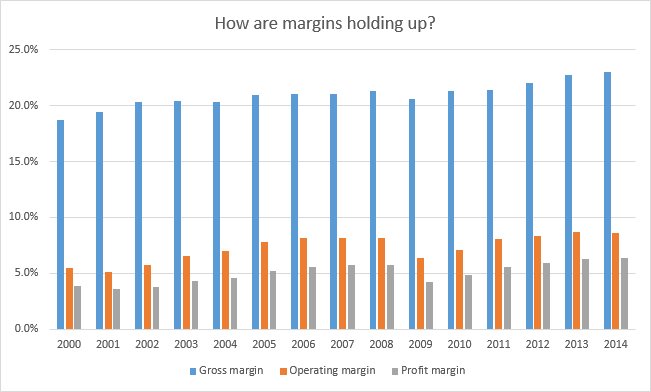
That's certainly reassuring and testament to the stability of the business model in uncertain economic times. Of course profits can be manipulated and I'm equally interested in just how much of this profit converts to cash. In the past Majestic Wine has tried to fund all expansion out of cash generated (only resorting to debt in order to fund infrequent acquisitions) and that history is fully backed-up by the numbers:
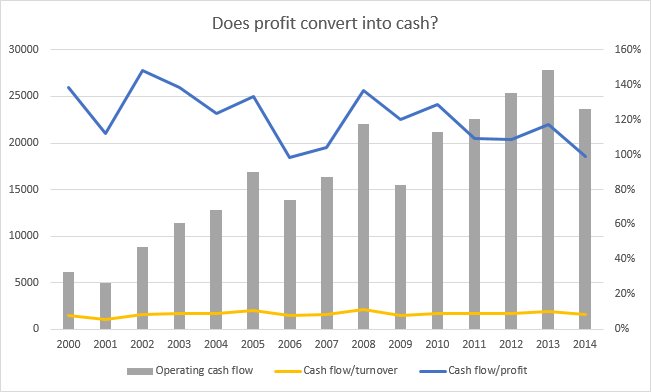
In an ideal world pretty much all profit should turn into cash (i.e. 100%) and if anything Majestic Wine looks to have been a bit conservative in the past (with a conversion rate of 120-140%) and could possibly have reported higher profits. So there's no doubt that the company can support organic expansion out of internal resources but I'm also curious as to where any other free cash goes. As it turns out anything that's left is pretty much all returned to shareholders (at least in recent years):
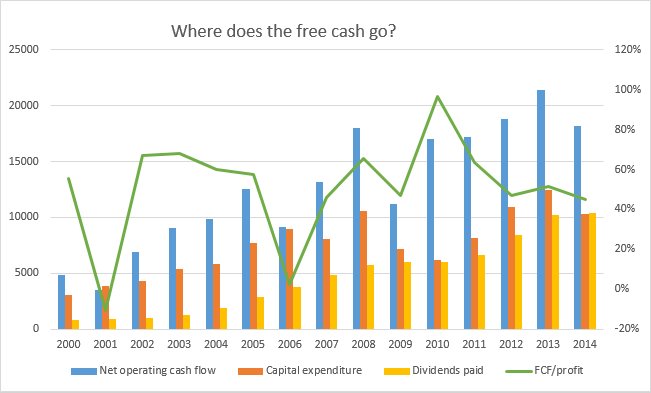
What's notable about this graph is that capital expenditure has always consumed a high proportion of cash flow while dividends have only come to the fore in recent years. These are a welcome source of return but Majestic Wine is now at a juncture where capex and dividends take all of the cash flow and perhaps slightly more. The obvious conclusion is that future dividend growth will remain constrained while management keep opening new stores.
Another good way to test whether capital is being spent wisely is to take a look at ROCE (Return on Capital Employed) and particularly its historical trend. With this metric higher is always better and here we have both a high average, of around 30%, and impressive stability over the years:
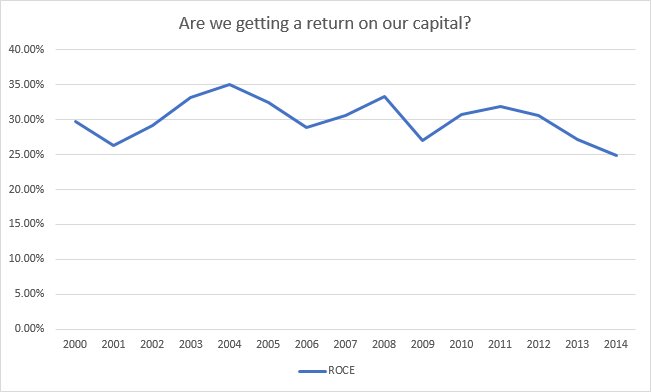
So from a historical perspective the management team seem to run a pretty tight ship. I wonder if this translates to staff and store costs since these are really the largest cash drains for a simple retailer?. In the low wage growth environment that we're living through it's reassuring to see that salary growth has been kept under control (after a bit of jump five years ago) and that staffing levels remain at amazingly low levels:
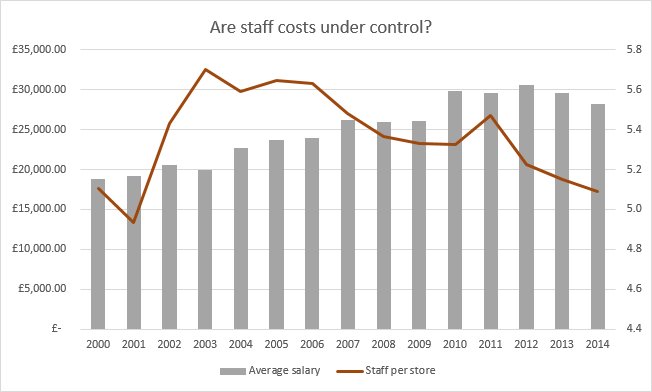
To be honest I'm quite surprised to find that stores can function with less than 5 members of staff (since administration personnel are included in this average) and looking at the company reviews on Glassdoor it's clear that this is a bone of contention. A similar picture emerges when you consider store efficiency both in terms of how much profit they generate and how much capital is required to get them off the ground:
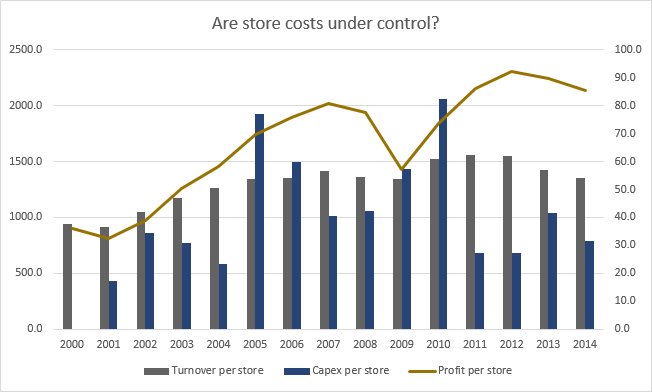
It's clear that Majestic Wine received a much needed boost when Steve Lewis became CEO in 2009 - not least with the switch to a 6-bottle minimum purchase (the 12-bottle limit was a consequence of licensing requirements in the good old days!). There's been a real push for growth and a squeezing out of efficiency gains from the estate; the company has benefited by sticking to its core competancy, as supermarkets have suffered, and the reported margins and cash flow support this approach.
One thing that does bother me is that while the board is very stable they don't actually have much skin in the game. Only Justin Apthorp has a significant holding (over £1m) while the rest hold far more in the way of options and tend to sell them entirely as soon as they vest. Curiously enough the staff appear to have a greater appetite for company shares and injected several million pounds a year into the business in 2011-2013 although this inflow has fallen through the floor recently along with the share price; so that's a useful bit of cash that the company will have to do without.
Recent results for 2014
As mentioned earlier it's been a tough 12 months for Majestic Wine what with that profit warning and all. Trading over the 2013/14 period was essentially flat (like-for-like sales of -0.1%) although things picked up in the second half of the year (in the first six months like-for-like came in at -0.4%).
This subdued market remains centre-stage in the recently released interim results. In fact I can't really put it better than the chairman Phil Wrigley: The cost of these investments, coupled with difficult trading at Lay & Wheeler around the weak Bordeaux 2013 vintage, has seen the Group's profit before tax for the six month period ended 29 September 2014 decline to £8.5m against £9.5m for the first half of the previous financial year.
So merchandising? has been problematic, heavy investment is taking place, margins are under pressure and cash flow has only remained strong as a result of favourable working-capital movements. Seems pretty bleak doesn't it? Perhaps but this is also a business that has increased market share by 0.1% to 4.3% (a record level) and achieved like-for-like growth of 2.8%. Maybe the underlying business is healthy enough after all?
This seems to make sense to me given that all of the metrics that Majestic Wineexpose are heading in the right direction. Active customer numbers are up by 1.9% to 643,000 and each customer is spending more per visit (up £3 to £130) on wine that costs more (up to an average of £8.02 compared to £7.71 in 2013). Online sales are also up by 12.3% while business-to-business sales have firmed by 4.9%.
Conclusion
It's something of a surprise but I feel really quite positive about Majestic Wine. There remain economic challenges but they've coped with them over the last five years well enough, they're not competing directly with supermarkets and the current management appear committed to maximising the potential of the business.
There are always concerns of course (are they expanding too fast, have they lost their touch, is the dividend safe) but to some degree the Christmas trading statement (due around 8 Jan 2015) will answer these questions. If you believe that the underlying business is in decent shape then a more relevant question is whether now is a good time to invest?
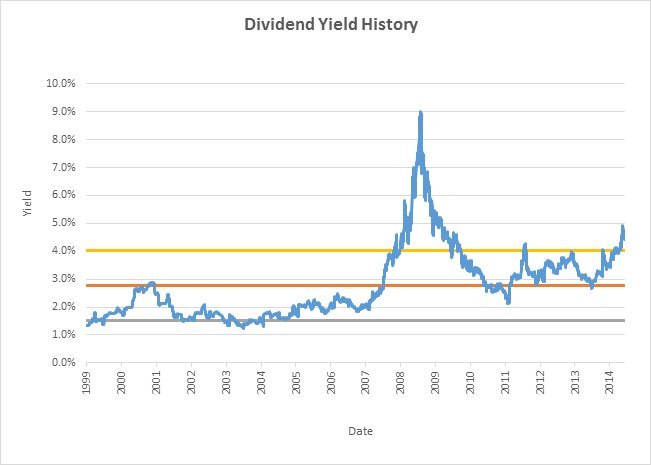
The share price chart suggests not with its relentless, unbroken downward trend but I'm more interested in testing whether the company looks good value compared to its own history. For example Majestic Wine has never been much of a high-yielding share (apart from during the Great Crash) but right now the yield is temptingly above 4%:
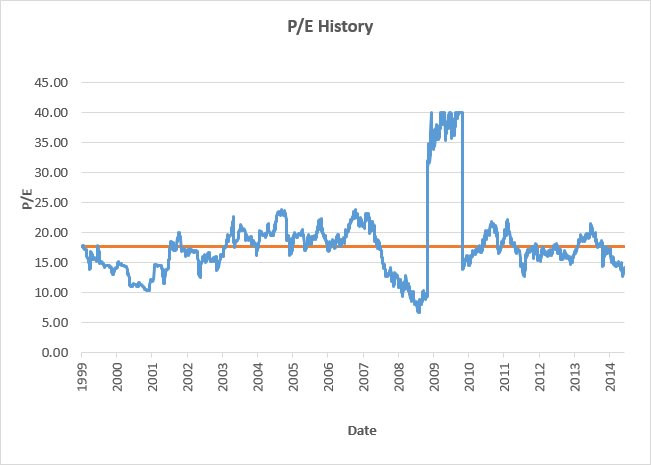
In a similar vein the P/E is also pretty low (less than 14) although it's not outstandingly low compared to supermarkets and the like. This supports my assertion that the company is paying out slightly too high a dividend, given the amount of cash that is being diverted into capex, and that other metrics don't make it look quite as cheap:
Considered in the round I believe that Majestic Wine successfully occupies a mid-market niche in the UK and that their brand has value. Recent board changes have enabled them to refresh their approach, and desire to grow, without distracting from core trading. There are continuing threats to the business model but management appear up to the challenge while keeping a close eye on costs and cash generation.
So right now I see no reason to cut my losses and sell although conversely I'm in no rush to increase my holding either; in the absence of news the share price may well continue its death spiral and I'd like to see some sort of base forming before jumping in. The catalyst for change should be the Christmas trading statement: if it's positive (in terms of like-for-like sales) then I'll probably increase my position; alternatively if it's negative then all bets are off!
Disclosure: The author holds shares in Majestic Wine.
Disclaimer
This is not financial advice. Our content is intended to be used and must be used for information and education purposes only. Please read our disclaimer and terms and conditions to understand our obligations.
21 comments
Buying beer there is a waste of time as its cheaper in the supermarkets. I was buying old speckled hen at around £1.65p per bottle and found you could buy it down the road at Tesco for £1.25p.
I like the tasting facility though-and most staff are decent enough. There are always exceptions-a few are bone idle and know nothing.
Interesting set of results from Majestic today: http://www.investegate.co.uk/majestic-wine-plc/mjw/interim-results/201511160700077592F/
Obviously the numbers are shocking, debt is high and there's no prospect of a dividend for many years to come. On the face of it pretty rubbish from an investment perspective. I'm glad that they're massively slashing the ridiculous store expansion target, simplifying pricing policy and focusing on driving customer growth but they've got a long road ahead.
On the flip-side there does appear to be a much stronger executive team in place now and the board have, as they say, acted decisively (although this doesn't imply successfully!). Time will tell I guess and I'll almost certainly pick up a few bottles from my local store this Xmas to see if the place feels different.
Damian
I'm surprised it is only off 2.7% on that. Not too late to sell I would say although I don't hold it personally and with 0 yield it won't be troubling my scores any time soon!
As a NW "angel" I have to say I was somewhat surprised to receive the email from them advising me of the deal. Unlike Andrew, Im very much still a happy member - its just nice to support new growers and Ive never had a bad bottle yet - just different wines than you normally find.
That aside, I do really struggle to understand what the deal brings to MJW other than Rowan who is clearly skilled in the business. The non combination of the two businesses seems odd though and surely he must have more in mind than just "Click and Collect"!
Ive been watching MJW for some time but never quite pressed the buy button. With the takeover (and very handsome price paid for NW) as well as no dividend, it is yet another share that I'll leave on the watch list. It wil be interesting to see what happens.
(apologies to those who are/were clients of nw and any corrections gratefully received)
The NW buisness is you give then £20pm, they buy wines from small and medium sized producers on a sort of fairtrade basis and you buy from that list.
I think nw is having growth issues.
They have had a waiting list (!) of 1-10k people over the last 12-18m.
The problem (i think) was that they wanted to support small growers by buying up most of their harvest - say 1000 cases and once membership rose above a certain level that sold out too quickly.
They had 'special' small producer sales of 4-600 6 bottle cases that went on sale at 8pm and were frequently sold out by 10pm.
Their model does not scale in that respect.
There was also a fairly active discussion site where the producers and drinkers could discuss the wines. They promoted a genuine sense of community.
They were also very good on customer service and general interaction - if you didnt like the wine (for any reason), they would take it away and give you your money back and a freebie. It gave you confidence to try unknowns more often.
Their model does scale here.
I am not sure why nw are lossmaking. they priced competetively for reasonable quality wine, but not outstandingly so
Whilst i was a member they also issued a corporate bond to customers and started offering more upmarket wines - and almost bombarded you with emails etc. I was also on the mjw email list and got something in the surface post, once.
So now they are heading into the scale of operations that mjw etc work in, and while i was a member (until a year ago) their list did contain some wines from makers that produced in volume.
mjw probably sees a business where there is a queue of people waiting to pay £20 per month up front so they can buy sone nice wine from a small producer later on who are doing interesting and innovative things, and wants some of that.
the market of people who pay 8-15 for a bottle of wine is not growing rapidly, is well served by laithwaites and the wine society (disclosure- it have a share :) and waitrose (who are in with lay & wheeler?), the resistance to buying by post or via the internet is dying off.
mjw need to provide people with a reason to go (drive) to their shops. having staff who are trained helps, but is probably not enough.
(disclosure - I am long mjw in a small way)
If they start to
- place some of the mjw list in the nw site so that there is a core offering that does not run out
- allow 'click and collect' for nw in mjw shops
- introduce some of the nw range into mjw (carefully though - like m&s autograph/ tescos finest/ waitrose inner cellar - easy to get wrong)
- do something that gives you a reason to go to the mjw shop
ie become more like nw than mjw - then it may all come good.
Thanks andrewdb; it's very useful to see this merger from the naked wines perspective and to hear how they've been suffering from growing pains. It makes sense to me that their model doesn't scale terribly well given the focus on funding small, artisan growers and that this restriction is integral to their offering. Given this I do wonder why they've been expanding into Australia and America - especially with the UK business operating on a break-even basis in its own right.
The more I read and think about this merger the more I feel that Phil Wrigley and Rowan Gormley don't have a compelling reason for pushing the deal forward beyond a gut feel that both businesses need to do something special; NW needs to scale into profit and MJW needs to convincingly break out of its warehouse niche. The synergy arguments put forward in the RNS don't sound particularly special to me (click and collect - really?) and the non-merger of the actual businesses is a bit odd.
However I can see that once Rowan Gormley has his hands on the controls that this could all change; as you say a limited range of NW wines could appear in the MJW stores and, equally, some of the lower-volume MJW wines might work with the NW clients. But, as ratioinvestor points out, there's a lot of execution risk here and MJW are taking on debt like never before to make this deal work - although their solid cash-flow should allow this to be reduced relatively quickly.
Ultimately, I think, that future success rests very firmly on Rowan Gormley's shoulders. If he can come up with some solid, profitable strategy decisions which gain traction with the wine drinking public then we'll all be laughing - and with most of his 20M pounds coming in deferred MJW shares then he has every reason to make this happen. But so much is out of his control with regards to the market and competition from supermarkets.
On the whole I think that I'll wait until the results in June to see what shape his approach is going to be; I can't see a major catalyst for share price growth (or decline) before then with the FY result being flagged up already and uncertainty from the merger unavoidable.
Damian
Just FYI, you can check NW's accounts at Companies House (or duedil). They weren't loss making in 2013, they actually made a £1.1m pre-tax profit so we can assume they invested pretty heavily in growing through 2014. You can draw your own conclusions from this but the information is out there.
Interesting summary. On face value I just don't "get it". Paying a huge amount for a loss making business which just appears to be a wine buying club marketed as some kind of a crowdfunding early stage investing business. Reviews of Naked Wines online are decidedly mixed which makes sense as they are funding small scale and very mixed operations. May be romantic stories but not sure on the quality the wines a small Mom & Pop business makes.
It seems to me that Majestic has made a big financial gamble on something which may not come off. Maybe the new CEO will be a genius but who knows. Just smacks of business failure on Majestic's part to me. Like Tesco buying all these brands that consumers actually liked - Giraffe, Euphorium, Hariss & Hoole etc..
No guarantee this will all come off few years down the line... a better strategy might have been to develop a better online presence (not strong app yet), get a new CEO, stall the store expansion and maybe boost shareholder returns... gambling it all on Naked Wines seems like a dumb bet to me... but we shall see....the whole transaction appears to be Majestic admitting failure... a very poor use of capital.... how could they pay so much for a loss making business?
Bit of a surprise from Majestic today: http://www.investegate.co.uk/majestic-wine-plc/mjw/acquisition--ceo-appointment-and-trading-update/201504100700218273J/
In one sweeping move they're buying Naked Wines for 70M and installing the founder of NW as the new CEO for the group. I certainly didn't see this coming but Majestic needed to do something to shake up the business and this bold acquisition certainly fits the bill.
In the same statement they mention that pre-tax earnings for the year will come in at around 21M. This is a bit of a profit warning as this is around 10% down on last year's figure of 23.8M and hidden within this is some further bad news; last year the H2 earnings came in at 14.2M while this year the guidance is now for 12.4M in H2 (which includes Xmas). So there's a second-half drop of 13% which is an acceleration from the reported H1 drop (although there will be interest paid here from the net debt position).
At the same time sales are actually up ("Since Majestic's Christmas trading update on 7 January 2015, total store sales have grown 4.1%, up 1.5% on a LFL basis.") which means that margins are down - either as a result of promotional pricing or increased costs. A somewhat worrying statement is that March was poor ("January and February were in line with expectations but March was weaker with adverse foreign exchange movements in March") and that FX movements played a part in this. I wonder if these will reverse and what the size of the loss is here.
The other bad news is that the final dividend for 2015 is being axed along with the interim dividend for 2016 - with the only guidance on future dividends being that they will be incrementally re-instated out to 2018. Another surprise given that one of the attractions of Majestic Wine (LON:MJW) is its yield and there's no guarantee of it becoming a high-yielder again.
So I think that this statement is a bit of a curate's egg...
Pros:
- New CEO looks very dynamic and has a proven track-record in the wine business
- Naked has a real focus on customer service and this seems to come from the top (see http://www.nakedwines.com/rowan)
- Majestic needed to stop its expansion plans and come up with something new to refresh the business
- Group may start to attract attention in the market and may get re-rated in time
- Majestic business is very cash-generative and should be able to repay debt fairly quickly with much reduced capex and dividend payouts
Cons:
- New CEO is likely to kitchen-sink whatever he can in the Majestic accounts and this could be messy
- No dividends for a year and no real guarantee of a good yield in the future
- I'm unconvinced by the synergies in that Majestic already has an online presence and Naked has a very good delivery setup of its own (and Naked wines aren't going to appear in Majestic stores)
- Management teams are being retained on both sides so there's no stripping out of duplicated costs
- The businesses will be operated separately so they'll both bear their current advertising and acquisition costs
- A hefty amount of debt is being taken on and interest payments may amount to around 10% of pre-tax earnings
- Naked is currently loss-making and will thus act as another drag on earnings in the short-term
- Exposure to US and Australia isn't obviously beneficial for Majestic stores
- Some Naked investors/customers will leave as see this as a takeover by a nasty corporate giant
Overall I do view this as a transformational deal for Majestic but I'm not sure that the reasons given for the merger are all that compelling (compared to Shell taking over BG for example). There's a heap of execution risk here with one struggling business taking over a loss-making one but if they can carve out an improved market niche then things could turn out well. Rowan Gormley has it all to play for and his efforts will certainly be closely watched!
Great summary, I think potentially this is a good strategic move but I'm guessing there'll be missteps aplenty along the way and with no dividend I cannot see a clear case for holding the equity until some clarity as to what they are to become emerges from Mr Gormley.
I'll watch from the sidelines
Cheers!
Thanks rhomboid1. I tend agree that there's very little tangible detail in the statement today on what Rowan Gormley plans and that's fair enough given the apparent speed of the deal. Hopefully by the time the results come out in June he'll have had a chance to review the Majestic business and decide that the strategy is going to be. After all it's a simple business model and so two months should be enough time to get to grips with it.
Not sure you can describe MJW premises as high street. Where I live there are three within 12 miles. One is a converted garage showroom on it's own in a residential area. Another is on a busy main road near an industrial estate close to local housing and the third is on a small retail park of perhaps 6 or 7 units. They're all close to local housing but hardly part of what I would regard as the high street. All have parking on the forecourt which suggests they cater for drive in custom rather than on foot which makes sense.
For me, the key difference between MJW and the supermarkets is knowledgable staff and well described wines on the web site. The review system also helps to pick wines you've not tried before but might enjoy. Most supermarkets seem to rely heaviliy on branding and offers. It sells wine obviously but I think we are talking about two different types of customer. Is that enough to thrive? I think it is but MJW have to be more focussed on their strengths and not try to compete only on price as the big boys will always win that game.
Ha ha - yeah I know they're not on the high street but I couldn't think of a good word to describe their store locations! Maybe "off the high street in dead-end retail premises that no one else wants but with rents to match"?
Anyway I do think that the niche is big enough for them to survive but also agree that they totally need to focus on their strengths - which maybe they've lost sight of? Of course we'd like them to prosper, rather than just exist, and that's a different question; where is the like for like growth to come from?
I am not sure the supermarkets are in quite the same place as Majestic,
but Naked Wines / Laithwaites are and NW seem to be doing rather well.
Interesting article. I think that it may be a mistake to say that Majestic Wine doesn't compete with the supermarkets as it serves its own niche. In my view, Majestic Wine competes with any alternative way of buying wine. If the supermarkets cut prices and up their game on wine quality then Majestic will suffer.
The rise of online delivery (Ocado etc) and the convenience stores makes the retail environment more competitive for Majestic. Waitrose has also been investing in its wine offering and online delivery and many of Majestic's well heeled customers will shop there.
The crux is how many people need Majestic Wine? Has the alternative become more compelling? My local relatively small Waitrose has a good selection of wine along with a small Sainsbury's convenience store. Do I need to make a specific trip to Majestic Wine for a slightly broader offering? I think for a lot of people the hassle of making a separate purchase may not be worth it. In reality I think only a small proportion of the UK population are fussy wine drinkers.
Majestic is at a historically low P/E and offers a high dividend yield of over 5%. However, retail operations are very geared to like-for-like sales in terms of profits. It is not clear whether Majestic's business model is now in relative decline or not.
Thanks ratioinvestor. It's certainly looking pretty gloomy for Majestic Wine (LON:MJW) at the moment with the share price as low as it's been in the last 5 years. However I remain of the view that supermarkets aren't the main competitor for the company - although obviously they account for a huge chunk of the market and can afford loss-leading price cuts - because they're not niche experts and they sell wines that are created to meet a price point (rather than a more subjective measure of quality).
Which is not to say that Majestic Wine (LON:MJW) aren't suffering and I do wonder how valuable it is to have a high-street presence these days (given how well Laithwaites et al are doing as andewdb mentions).
So I'm not certain that their model is broken but equally it's clearly not firing on all cylinders - although putting a stop to the expansion plans will help.
Cheers, Damian
Well the "market" seems to like the news FWIW with the share price up almost 5% so far. I wonder if this is a precursor to some sort of corporate announcement that Steve Lewis didn't agree with? Still it all feels a bit rushed.
Hi all,
I follow the Majestic story as a drinker, rather than as a shareholder ;->
At Mello14, one of the presenters made an interesting comment to the effect that quite a few AIM companies' s/price was underpinned by an IHT-motivated customer base - Majestic being a named case in point.
FWIW
ATB
Agreed. I knew Lewis a bit, and his predecessor, and I can't imagine he would have planned to go in this disorderly way.
OK that's a bit of a surprise and not in a nice way: the Chief Executive, Steve Lewis, is stepping down and retiring with immediate effect. The FD is stepping into the breach as an interim measure but I'd love to know what the back story is here? Some sort of board conflict over strategy?
There is, of course, plenty of mutual back-slapping in the RNS but I can't really see this announcement in a positive light: http://www.investegate.co.uk/majestic-wine-plc/mjw/directorate-change/201502190700202946F/
Christmas trading statement just out: http://www.investegate.co.uk/majestic-wine-plc--mjw-/rns/christmas-trading-statement/201501070700124710B/
There's no doubt that it lacks a certain cheer but I'm surprised by the size of the reaction although the market is rather jumpy at the moment! Anyway I think that achieving like-for-like growth with a small margin hit (0.5% feels reasonably well managed) sounds about as good as it could get - what with the supermarkets engaged in a death spiral of price cuts.
OTOH I think that the negative tone being set for the rest of the year must have got people worried even if it is the truth. On the flip-side this should lead to a slow-down in store expansion plans and that can only be a good thing! Hopefully this will turn out to be a year of consolidation with a limiting of capex?