Market Musings 20/11/20: Good Things Come in Small Packages

Good Things Come in Small Packages
Summary:
- Market breadth suggests this equity market rally could go on for at least two more years;
- Mid- and Small-caps have started to outperform large-caps, and should benefit more from continued economic recovery in 2021;
- Commodities are at generational lows, and represent excellent diversification from standard asset allocation in shares, bonds and real estate;
- If you (like me) favour gold as a portfolio diversifier, you should perhaps like Silver and Platinum even more.
COVID progression v pent-up consumer demand
The 24-hour news channels are full of the ongoing grim reality of the spread of COVID across Europe, and the increasingly stringent lockdown measures put back into place to curb the growth in the infection rate.
However, this may mask the fact that:
(a) infection rates are actually now falling from peak in most European countries, including Spain, France, and the UK; and
(b) that promising vaccines in phase III trials from Pfizer/BioNTech and Moderna have shown surprisingly high deadline efficacy rates, and are likely to be rushed through the necessary approvals and into production in the very near future.
All the while, however, household savings rates have shot up due to the inability to spend on many services, including of course holidays. In the UK, the latest household savings ratio has now touched 30%, a massive level by historic standards (average is more like 10%)..
UK household ratio hits a record high of 30%
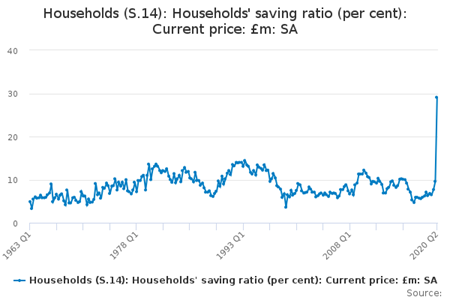
Source: ONS
This strongly suggests to me that, once current lockdown measures are eased all across Europe, which I would expect to happen some time before Christmas to avoid civil unrest, that we could see a huge wave of pent-up consumer demand being unleashed into 2021.
Economists are understandably having trouble estimating how big a boost this extra consumption could mean to the economy, but I think that it could have a surprisingly large effect in early 2021.
Of course, some of this has already been factored into the share prices of sectors and stocks in cyclical consumer services in the last week or so following the Pfizer and Moderna announcements. But this rotation back into cyclical consumer names may still have quite some way to go, if my theory about the release of pent-0up consumer demand proves correct.
Market Breadth as a Lead Indicator for Stock Market Direction
I had to point out the following chart which appeared in my Twitter feed this week, courtesy of JC Parets. This shows in blue the percentage of stocks in the US S&P 500 index that are currently sitting above their own 200-day moving average (a simple measure of whether the stock is in a bullish or bearish trend). The higher this percentage, the stronger the market breadth, which is itself generally a positive sign for the stock market.
The current reading for this market breadth indicator is very high by historical standards at 80%, one bullish sign for stocks.
Market Breadth usually peaks 2 years ahead of the stock market peak

Source: JC Parets (Twitter)
Note in the chart above that this market breadth indicator in blue last peaked at similar readings back in early 2013 and again in late 2016. On each occasion, the S&P 500 index itself did not peak for a further two years.
It still hasn’t peaked yet, as you can see from the chart. Which then suggests that the peak in the S&P 500 index may still be 2+ years away…
Caution: two examples is hardly robust from a statistical viewpoint, but it remains a very interesting observation, nonetheless.
Note that I have looked further back at the history of this particular market breadth indicator back to 2002. So we can add two more major peaks in this market breadth indicator:
- January 2004 - the S&P 500 subsequently peaked 3.5 years later, in July 2007;
- October 2009 - the S&P 500 subsequently peaked in April 2010, 6 months later.
In each of these 4 cases over the last 20 years, this particular market breadth indicator has acted as a lead indicator for a subsequent peak in stock markets.
So (a) it suggests that the bull market is alive and well for now, and (b) we should keep a close watch on any downturn in this indicator.
Rotation into mid- and small-caps
With signs that the global economy will post robust growth in 2021 after a turbulent 2020, we can see that more domestically-sensitive mid- and small-cap stocks are now leading the way in US, Continental European and UK stock markets. In theory, they should have higher exposure to improvement in growth in their respective domestic economies.
In the US, the S&P small-cap 600 ETF (IJR) has outperformed the large-cap S&P 500 since July of this year, after a long period of under-performance (as US index performance has been driven by strength in the mega-cap technology names like Microsoft and Apple)..
US small-caps have been beating the S&P 500 since July

Note: the line above shows the relative performance of US small-caps v S&P 500
In Continental Europe and the UK, the small-cap outperformance trend has been in place for quite some time already:
The small-cap outperformance trend is more entrenched in Europe and UK


Note: the lines above show the relative performance of Euro small-caps v large-cap MSCI Europe ex UK; and UK small-caps v large-cap FTSE 100
Investors who want to buy diversified exposure in these latter two areas could look at Jpmorgan European Smaller Companies Trust (LON:JESC) and Blackrock Throgmorton Trust (LON:THRG) , both investment trusts with strong records of past performance.
Commodities are at generational lows
Commodities have been a largely unhappy hunting ground for investors since 2009. The chart below shows the relative performance of a diversified commodities basket (DBC, in ETN form) versus global stocks (in blue) and against US Treasury bonds (in red).
Clearly, over the last 11 years, investors would have been better off just forgetting about commodity exposure in their portfolios…
Commodities have dramatically underperformed stocks and bonds since 2008-09

I think that this is in the process of changing now, however, for two main reasons.
Firstly, the dramatic fall in commodity prices over the last decade has led to an enormous cut in the amount of investment in new oil drilling, mining for metals and even reduced investment in agriculture.
Secondly, after having seen a huge cut in commodity demand (eg. for oil) because of the COVID-induced economic slump this year, 2021 economic recovery should drive a big rebound in the demand for these very commodities.
Thirdly, certain commodities like copper and nickel (not to mention cobalt and lithium) will also be driven by structural growth in demand for renewable energy and electric cars, given the needs for these raw materials for the wiring and batteries required.
So firstly, I remain a bull of copper and nickel, and thus of copper and nickel miners for the next few years.
Secondly, I remain bullish (as I have mentioned several times before) on the precious metals complex. Gold is experiencing huge investment demand - but opinions are divided as to whether or not this investment demand growth will persist into 2021. I believe that it will.
But within the precious metals complex, the time may now be right to buy into those metals which also have a defined industrial purpose, i.e. silver, platinum and palladium.
Silver is a key ingredient in electronic circuits and connectors (e.g. mobile phones, computers, anything with semiconductor chips and circuit boards) and also in solar panels.
Platinum and palladium are key ingredients in catalytic convertors for petrol-engined vehicles; and yes, car sales are recovering fast!
Looking below at the charts for the gold/silver and gold/platinum price ratios suggests to me that in each case, the long-term trend has now turned against gold and in favour of silver and platinum, which would be consistent with the recovery in industrial demand for these metals.
Gold/Silver and Gold/Platinum ratios look to be turning in favour of silver and platinum


I personally remain convinced of the merits of investments in the precious metals complex within commodities in particular, and i thus like precious metals miner exposure (eg. via the SPGP iShares Gold Producers ETF , the GJGB Junior Gold Miners ETF, and the SILJ US-listed Junior Silver Miners ETF).
Have a great week ahead,
Edmund
Disclaimer
This is not financial advice. Our content is intended to be used and must be used for information and education purposes only. Please read our disclaimer and terms and conditions to understand our obligations.
19 comments
Hi Edmund,
Very interesting as always. I am with you on commodities. I use £XSPR for mining exposure, it was the only etf i could fund at the time but it uses swaps/relocation rather than direct holding.
I avoided blackrock as a few years ago they had a disaster and, possibly unfairly, i avoided. Who do you use for commodities/mining exposure?
I am also with you on precious metals but for slightly different reasons. Currency debasement is accelerating. But there are two other main reasons:
US Election:
Read the MSM and Trump lost, dig deeper on a site such as gatewaypundit.com it is pro trump but the site describes the election fraud. It is enormous & is going through the courts. The key point is the election fraud, as opposed to voter fraud. This is a constitutional crime & falls under military law & the laws of Treason. It is a big deal & markets are not pricing this in. Fear and greed index at 93! The reason for the fraud is placed on china/iran/domestic & the Great Reset agenda.
Great Reset:
This is a reset of the financial system. If you google it the WEF/DAVOS official sites describe the beautiful future, the unofficial sites describe a far more sinister alternative. The heart of the plan is debt & debt forgiveness with a new global currency, basing this around the green narrative.(most noticed the same narrative from johnson/sanchez/merkel/macron etc - new normal & green agenda & ever increasing national debt)
All of this leads to potentially enormous disruption, and the case for either precious metals and/or commodities/and or cryto.
Some may be aware of the above but the MSM doesn't report anything on US elections or the great reset. If this is all new and sounds very conspiracy like, start digging. Google sidney powell for election fraud or james delingpole (spectator editor) for Great Reset.
Why raise this, because its all coming to a head in the next 6 weeks. Its either fake news or there is massive disruption coming to the markets. As investors tend to have more open/analytical minds its worth looking into.
With some markets at ATH and f&g index at max markets are vulnerable. US could easily blow then up.
When you start digging it starts to become a fascinating story, either biggest hoax or biggest story ever- either way as it investors and traders its worth understanding because the US is where to focus for the next two months. imo of course :)
Thank you
John
Great article, enjoyed reading it.
Really enjoyable read
Great article thank you! Would be interested to know your thoughts (if any) on the Buffett Indicator (ratio of Mkt Cap over GDP). In the US that's as high as its ever been which would indicate it could be significantly overvalued, though in the UK its a little different?
Yes it’s important to remember that despite all of the green and EV propaganda, that both oil and gas use grew in 2019, and that together their contribution to World energy was over 57%...with an additional 27% from coal. I think I’ll go and have a look again at some oil and gas producers....though I think the last time I looked it was the debt that put me off. (I hold Sylvania Platinum (LON:SLP) which has loads of cash on the books!)
Hi Edmund, a very interesting read. Gold miners seem to be drifting down for the time being. However, once inflation starts to rise (some predict in the next two years) then I believe gold miners will reverse their decline and start to rise once again.
I notice that Sylvania Platinum (LON:SLP) (I Hold) just keeps rising and rising because of the industrial purposes for the minerals which it mines. I believe Sylvania Platinum will keep multi bagging for a long time to come.
Hi David, I am very biased on Sylvania Platinum (LON:SLP) (I hold) so cannot but agree! But as jack Brumby has pointed out, there are specific risks associated with this stock, of course.
I am also fond of silver miners, given what I said above (again, I hold). Lastly, there are also other platinum producers that are interesting including Jubilee Metals (LON:JLP) (again, I hold). Edmund
I sold out of Jubilee Metals (LON:JLP) when I realised the history of egregious share dilution and past shifty behaviour of management. Switched into Sylvania Platinum (LON:SLP) and will hold as long as the rhodium price holds up. Sylvania Platinum (LON:SLP) is great IMO as it offers exposure to increasing use of hydrogen fuel cells (platinum) as well the materials for diesel, hybrid and conventional exhaust catalysts. I would also buy some platinum bars were it not for the 20% VAT.
Sylvania Platinum (LON:SLP) great choice! Good luck with it. I'd overlooked the hydrogen fuel cells aspect, thanks for pointing that out - but it's still a solid punt even without the hydrogen.
Hi Edmund
An excellent article as always.
I generally avoid investing in individual commodity stocks, which as a general observation tend to be very volatile and to my mind carry excess risk... geological, geo-political etc. I have no experience of using EFTs and feel more comfortable using traditional Investment Trusts.
My intention therefore is to obtain exposure to commodities via the Blackrock World Mining Trust £BRWM. It has an experienced manager in Evy Hambro and traditionally trades at a discount to NAV and pays a handsome dividend, although in fairness the discount and yield have both reduced somewhat of late. I am happy to avoid investing in oil given the prevailing sentiment.
All the best
Very sensible choice Jonno, I like it! Edmund
There probably isn't much to choose between ETFs and Investment Trusts. The advantage of ETFs is that they usually have smaller spreads and lower annual running costs. Also, in the UK, they are free of stamp duty. Investment Trusts can have quite high spreads and relatively high annual running costs, and stamp duty is payable on purchase. The advantage of Investment Trusts ( e.g. Scottish Mortgage Investment Trust (LON:SMT) and Polar Capital Technology Trust (LON:PCT)) is that they can provide spectacular returns well above the market.
Enjoyable and insightful read. Learn something new with each article. Certainly food for thought.
Edmund very helpful insights. I thought last weeks article was really excellent. Looking forward to a regular Saturday evening/ Sunday morning good read.
Thank you all, high praise indeed!
Yes Wilkonz, I will perhaps take a look at China next week. In general, I am a fan of China Tech including BABA, although less keen on BABA specifically as the structure of the US ADR is a little strange and a little too favourable to Jack Ma... Cleverly splitting off much of Ant Financial from the listed Alibaba was a great coup for Mr. Ma, not so good for the other shareholders... I am a fan of the EMQQ ETF, which yoiu can buuy in GBP as EMQP... Edmund
Thanks Edmund. Your weekly input is superior to Investors Chronicle, IMHO and takes less time to read. My plan for the week is to invest in a Russell 2000 ETF (probably IWM). Do you have any thoughts about China and BABA? Maybe for next week if you have time...
Brilliant article, great Sunday morning read, thanks Edmund
Amazing analysis ... thank you for such an insightful article.
An interesting read - thanks Edmund. Keep them coming.