Market Musings 25/09/21: The UK: Contrarian trade of the decade?

Market Musings 25/09/21:
The UK: Contrarian trade of the decade?
Recent podcasts you may care to listen to:
Every Dog has its Day - Eventually

UK stocks have lagged global stock markets since 2008
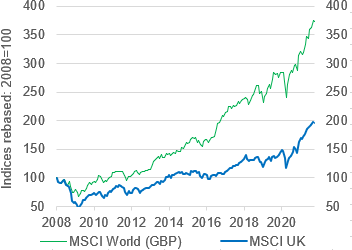
Source: MSCI, Bloomberg
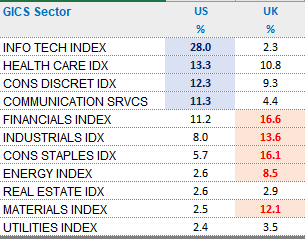
Latterly, the relatively poor performance of UK large-cap stocks in the form of the FTSE 100 index has been put down to a lack of growth stocks in the UK stock market, for instance in the technology sector. This is objectively difficult to argue with, given the massive difference in sector weightings between the two markets.
US stock market heavy in Tech/Communications, Consumer, while UK weighted to Financials, Industrials, Staples, Energy, Materials
Source: Bloomberg
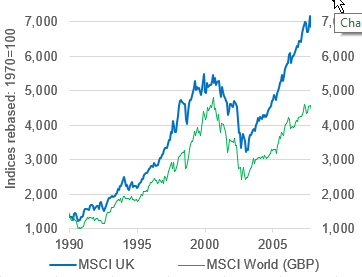
Bear in mind though, that this UK stock market underperformance has not always been the case. It has certainly been the case since 2008, but look at the period between 1990 and 2008! Coming out of the early 1990s recession, UK stocks had two strong runs. - firstly between 1991 and 2000, and then again from 2003 post the TMT bubble and burst up to late 2007.
UK stocks led the World from 1990 to the GFC
Source: MSCI, Bloomberg
Lower commodity prices and interest rates a headwind for the UK
But that does not mean that there is no growth for the stock market investor in the UK. Rather, the nature of this potential growth is simply far more cyclical in nature, depending typically on two key drivers - interest rates and commodity & energy prices.
Financials (Banks and Insurance companies) are sensitive in particular to interest rates and economic growth - the higher economic growth and long-term bond yields are, generally the better for them.
Energy and Materials sectors are evidently sensitive to metals and oil & gas prices, as those prices determine their selling prices and thus their profitability.
Both of these drivers have been trending lower the years since the Great Financial Crisis, as can be seen in the chart below.
Both commodity prices and interest rates have trended lower since 2008

Source: Bloomberg
In the US, the last few years have been marked by increasing penetration of our daily personal and professional lives by Technology, in the form of social media, online shopping, enterprise software and Software As A Service. This trend has only intensified since 2020 with the advent of the COVID-19 pandemic.
Forget Jingoism, There Are Solid Reasons to Invest in the UK
But this trend is now inflecting at last. Re-opening is upon us, and I believe that post vaccinations, the threshold for imposing further lockdowns in the US and Europe is now incredibly high - everyone yearns for some form of return to “normal”, whatever that means.
The emphasis should slowly shift away from technology (at least in relative terms) back towards industries that benefit from a pickup in cyclical demand.
In fact, this has clearly been happening over the last few months, as is evident to anyone who has ventured back into a pub, restaurant or football stadium of late. Indeed, the contrast between lockdown and reopening has been so exaggerated that many industries such as semiconductors, timber, car rental and shipping are suffering widespread supply chain disruptions and shortages, driving up prices in the short term.
That is a general economic argument. But then there are of course the obvious issues particular to the UK, namely Brexit. Let’s avoid the polemic on both sides of the Brexit argument: ultimately, it has happened, the UK has left the European Union, and now the UK is in the process of adjusting to its new status.
I think it is clear that this huge upheaval is having a wide range of disruptive effects on the UK economy and companies in the short term. However, we should also realise that the economy and companies will adapt to this new way of life with the UK’s European neighbours over time, and so the effect of these disruptions will naturally fade from view. Thus over time, the UK’s long-term growth rate will recover from the Brexit disruption, but this is not, in my view, yet priced into UK stocks.
I particularly like the view espoused by Rob Arnott of Research Affiliates, a US fund manager advisor, when he outlines his reasons for naming UK equities as his favourite contrarian long-term “trade of the decade”. For those interested in his detailed views, have a read of this February 2021 RA research paper. These are the key points from this paper:
- Around the globe, value is trading at extremely deep discounts relative to growth. The discounts are wide no matter how we measure valuation.
- While we still like our last named trade of the decade, emerging markets value stocks, the UK equity market, and UK value stocks in particular, are now even cheaper.
- With the final Brexit deal done and the rapid COVID vaccination rate in the United Kingdom, the outlook for UK value is extremely promising, enough for a “trade of the decade.”
If you are too lazy to read the paper, then instead listen to this recent Moneyweek podcast featuring Rob Arnott where he summarises his bullish UK views:
Rob Arnott: COVID’s Hidden Investment Opportunities
Valuation Voodoo: Why It Matters In the Long Term
I will repeat here what I often say to remind people: yes stock market valuation matters (of course), but only really in the long term (i.e. over 5 or 10 years). It tells us relatively little of the direction of a stock market in the next 6 or 12 months.
After all, the US stock market has been expensive for quite some time now, with a forecast P/E well over 20x in spite of strong tech sector earnings growth. And yet, the US remains the star equity market of the last 10+ years in terms of performance.
US S&P 500 forward P/E = 20.8, the high end of the historical range

Source: Factset
Another way to look at this is to use Professor Robert Shiller’s Cyclically Adjusted Price/Earnings ratio (CAPE) to compare markets.
This CAPE ratio has a good correlation with future 10-year stock market returns: the lower/higher the initial CAPE ratio, the higher/lower are subsequent 10-year stock market returns. The table below underlines that the UK’s CAPE ratio, at 15x, is the lowest in the list below apart from Hong Kong (15x) and Russia (11x). All three stock markets are clearly unloved for different reasons, at present.
US CAPE ratio = 37.7x; while the UK = only 15x

Source: sibilisresearch.com
If we then translate these CAPE ratios (and other valuation ratios, for that matter) into long-term expected returns from various markets, we get the following chart from Research Affiliates:
UK equity: 7.9% 10-year expected return (£) v US large-cap 1.7%

Source: Research Affiliates
According to this RA model, only Emerging market equities are projected to deliver higher long-term nominal returns (8.2%), but at the cost of far greater volatility.
Macro Drivers for the UK: Commodity prices, Domestic Growth, Interest rates
Industrial Metals and Energy prices head towards 2011 highs

Source: Bloomberg
UK economic growth is forecast to be not only huge this year, as one might expect in a rebound from the huge COVID-driven recession of 2020, but also next year (5.4%) as well.
2022e forecast to be a huge year for UK Consumption, Investment


Source: Bloomberg
This growth is forecast to come largely from a combination of rampant household consumption (as we earn higher wages and spend some of our excess savings built up over lockdowns) and also investment (as companies and Government need to invest to deal with Brexit and new ways of working post-COVID).
Thirdly, UK interest rates are on the move. The Bank of England recently signalled that it may well raise its base rate as soon as November, in response to the sharp rise in inflation, which is likely to rise further due to soaring electricity and natural gas prices.
In the bond market, the spread between short-term (1-year) and long-term (10-year) gilt yields is also rising (“a steeper yield curve”), a positive sign for both banks and life insurance companies who can generally make more profits when this yield curve is steeper.
UK long-term interest rates are rising

Source: Bloomberg
My Favourite Places to Look for Long-Term UK Value
There are a number of investment opportunities that I spy in the UK today.
1. UK Mid- and Small-Caps
Mid- and small-caps in the UK have better exposure to domestic growth in my opinion, have a greater chance of being taken over either by foreign peers or by private equity companies, and often occupy attractive industrial niches where they can generate generous profit margins. Their historic performance since 2003 has been impressive (note that the MSCI UK SmallCap index is in fact composed of what we would classify as mid-cap stocks).
UK Mid- and Small-Caps have massively outperformed since 2003

Source: Bloomberg
2. Mining and Metals companies
UK-listed mining and metals companies are not really UK in nature, but much more global in terms of production footprint and ultimate customer.
Today, these mining companies are benefiting from industrial metals prices (copper, zinc, nickel, tin, aluminium, iron ore etc.) that are the highest that they have been in over 10 years.
Global Miners (black line) follow the rise in industrial metals prices (blue)

Source: Bloomberg
Unsurprisingly, given the heavy consolidation in the global mining sector over the last couple of decades, the mega-mining companies are today reaping the rewards of their oligopoly positions in the form of record-high profitability, and are certainly not rushing to invest heavily in developing new mines, as they would have done in at the peak in past metal price cycles.
The opportunity for investors today is that current low mining company valuations certainly do not integrate future long-term metals prices anywhere near current levels - but if that were to arise, then they would potentially see a huge rerating.
But that would just be the cherry on the cake - right now, investors can enjoy well-financed dividend yields from the likes of Rio Tinto and Vale of over 10%, in a world starved of yield.
Global Miners (black line) follow the rise in industrial metals prices (blue)

Source: Bloomberg
3. UK-Listed Private Equity Companies
If you are searching for long-term growth rather than income, then perhaps consider one of the many UK-listed private equity companies. These companies offer investors a way to participate in early-stage, high-growth unlisted companies in emerging sectors like technology, e-commerce and healthcare innovation.
A handy way to do some initial research on these listed private equity funds is to look at the screener tool on the AIC’s (Association of Investment Companies) website.
AIC-listed Private equity Funds, listed by 5-year NAV returns

Source: theaic.co.uk
Long-term returns from this universe of listed Private Equity funds have been impressive, generating a compound annual growth rate of 12%+ since 2000, far outstripping public listed equity markets.
AIC-listed Private equity Funds, listed by 5-year NAV returns

Source: BNP Paribas, Bloomberg
Have a great week ahead,
Edmund
Disclaimer
This is not financial advice. Our content is intended to be used and must be used for information and education purposes only. Please read our disclaimer and terms and conditions to understand our obligations.
23 comments
One thing that has intrigued me is that why do investors invest in large companies that don't pay dividends? I don't understand reasoning and I am sure there is one. I am old fashion in that I like metaphorical cash in my pocket. It is probably why I missed out on the tech boom and chose instead in buying dividend payers with high FCF - mainly Footsie companies. These companies are not going to double overnight they require patience.
However, I am kicking myself for not investing in Apple and Netflix 10 years ago when I was procrastinating kind of ironic as I work in tech sector :).
I heard somewhere recently that we could be heading for stagflation in UK. Our issue in this country has been low, persistent productivity and now coupled with higher inflation we could be heading for "interesting" times. It could be the right time to buy those high divi companies.
Value investing could become en vogue
Why pay out profits to shareholders, when it can be invested in the business?
I think it is a fundamental problem with some large UK companies and part of the reason they don't grow. These companies tend to have high debts which maybe ok when interest rates are low but could be a problem when interest rates rise.
I have held some companies because of dividends but then they cut them last year. Shares have not gone up in 20 years, would have been better off buying Apple and the dividend would be higher as well now.
Value investing typically relies on cyclical growth which is the last thing you experience in periods of stagnation. You need the most secure profit growers. Appropriately to your first point, these tend to be large companies with big moats which, instead of focusing on pay-outs to shareholders, concentrate on compounding profits by re-investing for further growth, which is why their share prices rise consistently over time and returns far exceed the dividends that they elect not to pay out. Such companies are actually rare in the UK mid-large cap space, which accounts for the enormous premia placed on the likes of Halma and Spirax Sarco. The US market is loaded with them, starting with the FAANGMs and embracing many software providers but also heavyweights like Mastercard, Thermo Fisher or Illumina.
In stagflation you'd want to be Index Linked Gilts. As the BOE attempts to keep Base Rates low due to low economic growth and not wanting to shock a heavily indebted system, ILGs will rise in price as their extra real yields (due to inflation) over fixed Gilts make them more attractive?
At least that's how I see them; but I'm no bond expert; so would welcome any counter-views if I am completely wrong here!
Edmund. Thanks enormously for the wise words as ever. My only question would be over timing. In effect, your article has been right for the last 10 years+ and the US exuberence wrong for a similar period. So, is it wiser to wait until 3-6 months of the UK outperforming is observed and miss the bottom but also miss the risk of being early(again) to the longest delayed party ever?
Buying cheap UK stocks is a theme which has come up a few times now, including Bloomberg and others. The various valuation ratios look appealing. Thinking about this from my own perspective, I like to break it down as follows.
Firstly, the FTSE100, specifically the miners, financials and oil.
The miners I follow RIO and AAL. The good thing about these two is all their earnings come from abroad, so it’s a nice hedge against UK travails. Their respective PER and dividend yield estimates (from Stocko) for 2022 are 6.37 11.7% and 6.25 6.88%. Seems great, but we are coming off a high point in the metals cycle. Prices, after a good run up are now fading, especially iron ore. It’s all a China story of course, as they are the big swing consumer. The ruptures with Evergrande are pointing to a possible slowdown in property construction along with Xi’s efforts to rebalance the economy and deflate debt. The last time China sneezed was back in 2016, RIO’s share price fell over 60% from 58 to 22 pounds. This time RIO has recently fallen about 32% from 95 to 65. I’m waiting to see if a further shake out happens.
On financials, LLOY is interesting for me. Fits the ‘cheap’ sticker with 2022 PER of 7.88 and yield of 5.57% and a discount on book. The potential here is rising interest rates, which would help banks by providing a wider spread on their lending. At the moment, much of UK consumer lending is dire, particularly mortgages, as vast levels of deposits have led to a price war with margin compression. HSBC being the worst in my mind, after the regulator stopped them from upstreaming surplus deposits to HK, they dumped them into UK lending (purely in my view, no evidence for this). LLOY at least has a decent consumer loan and card book, so there’s good margin there still. But, with UK growth looking a bit shaky, underlying revenues likely static, no growth. The other big financial I looked into was LGEN with a forward PER of 8.28 and yield 6.88%. Again, tasty valuations, but I became a bit stuck in the mire of detail with LGEN as they have recently been pushing buying private pension liabilities and earning tidy fees. But, have they correctly matched long term assets with liabilities? And even can they with Gilts at 0.99%? I couldn’t put capital at risk here unless I figured that out, which is difficult.
A brighter spot for investors has been RDSA which is rating upwards on the back of a rising oil price. Has the overhang of potential stranded assets, also is not the lowest cost provider by far, that’s Saudi and the likes of Russia. But, I’ve read analysis which argued that oil will stay expensive for a while yet, because while EVs and carbon taxes are on the way, this is offset by increasing Asian demand for oil and a lack of capital investment in new supply, holding price up for some years to come, until its eventual demise.
Even though FTSE100 is cheap, there are issues you need to look through, by sector.
On small caps, yes many do look cheap compared to overseas markets. I’ve been holding a small cap fund THRG, which has done well this year. Also, there has been a burst of foreign firms buying up cheap UK firms. I’ve found it a lot simpler to hold a fund here than pick through companies, given it’s an investment theme. I suspect a downrating might wash through now with this cocktail of woes - covid, Brexit, inflation, USA tapering, China slowdown. Looking at the chart suggests a lower price might come.
UK plc is cheap. Small caps were my favourite so far, I’m waiting on the large caps until these macro issues develop further, especially China and tapering.
You make a good point with Lloyds, but with your statement "UK growth looking a bit shaky" I don't think that can be used against buying Lloyds. If you believe that statement then you'd eliminate vast swaths of FTSE shares, and only go for those with huge overseas revenues or defensive in nature.
I take the opposite view - with Lloyds Banking (LON:LLOY) very exposed to consumer lending, the key criteria is wages and employment. Both of which are trending well; wage growth is ticking up, and unemployment is low and getting lower due to the shortage of labour in many sectors. It will take, an economic shock, for either of these two factors to reverse completely and then impact loan impairments for Lloyds in the consumer credit sector. Meanwhile, if rates and gilts rise, their net lending margins will increase as you say.
For the brave, Metro Bank (LON:MTRO) is the distressed play in banking. If NIM soars, they will be rescued from perpetual losses to at least breakeven, and you can see their share price doubling or tripling as P/B they are trading at a meagre sub-0.2 at the moment.
Then there are other finance plays in the market; for example I have a small exposure to Time Finance (LON:TIME) who lend to SMEs for capex investment. Which I think will see huge demand in the next few months as SMEs that can't source labour try to invest in automation to fill the gaps. They will also benefit from NIM expansion, as they are using own-book funds as well as a secure long term funding source at good rates.
(I hold Time Finance (LON:TIME) )
Here in the UK, why do we have a conservative government trying to govern by socialist principles.? Answer: Because of its populist outlook. Faced with a socialist media every problem is framed as one for the government to solve. This leads to the rather ridiculous situation where free marketeers are running around privatising railways and pumping billions into the NHS. The economy needs time to adjust to post-Brexit realities. Why did haulage firms not begin training more drivers 3 years ago? Surely the new emigration rules meant the reduction in cheap foreign labour was inevitable, This is, after all, what the people voted for. Given time, we will find a new equilibrium and in all but the most extreme cases, the government should steer clear, ignore the clamour from the pro-EU media and let the market sort itself out.
Lot of points, but to answer this one:
Why did haulage firms not begin training more drivers 3 years ago
Because three years ago they had no idea what the rules were going to be. Most logistics companies work on margins of between 1% and 2% - where were they supposed to find the money from to start training drivers they might not have needed?
The free market adjusts, given time. But the consequences in the meantime can be quite painful, especially if you're a populist government thinking about calling an early election.
timarr
Yes the world was a different place 3 years ago. Who foresaw Covid then? If margins are so tight then how will the haulage firms afford the wage rises that drivers are getting.
Also with Brexit/Covid, many European drivers went back home and have not been able to return. But there is large shortage in Europe as well, it is not just a UK problem.
Also with Covid, training and testing has largely been suspended. Also many drivers have retired or found other jobs.
It's not just a training issue, you need to find people who are willing to do that type of work, it is the same working on the land, most British it seems don't want that type of work.
If margins are so tight then how will the haulage firms afford the wage rises that drivers are getting.
They can't. Either hauliers will go bust or they'll have to renegotiate contracts. Which will increase costs to retailers and ultimately to consumers.
It's certainly true that the pandemic has triggered many of these problems and the EU has HGV driver shortages as well. However, the EU isn't seeing the same distribution issues as the UK - they have a bigger pool of drivers to choose from and rail freight is able to pick up some of the slack.
In the UK we've got a reduction in the number of drivers available due to the new immigation rules, a shortfall of new drivers due to testing being suspended for most of 2020, problems at the DVLC who are seemingly unable to issue newly qualified drivers with licences and changes to tax rules making HGV driving less financially attractive. All of those are things that the government could have done something about, if they had chosen to do so.
timarr
Why did haulage firms not begin training more drivers 3 years ago?
The Public sector in general is great at telegraphing the general thrust of its intentions but rubbish at providing actionable certainties which can be used as the basis for planning. Sometimes this is for good reason, in this case because noone knew how Brexit would look.
Firms certainly did not have 5 years actionable warning.
Hi guys
Any tip on the best nuclear growth company to invest in?
thanks
Abbas
Rolls Royce?
Surprised that energy costs have not been mentioned unless I missed it. Gas price is up around 250% this year. This will hit consumers hard, the public will have less spending money but also companies will have higher costs which will lead to higher prices. Some companies have already shut down production which has had knock-on effects, such as CO2 shortage as it's a by product from fertilizer production. If the Govt. did not step in and pay a US company millions of £s we would have even more problems.
I'm feeling very bearish on the UK economy.
What with Health & Safety (mandatory risk assessments), the Human Rights Act, and ESG (have I got that right Edmund?) the UK is a lame duck in the productivity stakes. All these together with a tendency to rest on our laurels it's no great surprise to find the tide going against us. I do find your optimism inspiring though and will keep on investing rather than spending as I earn.
Silver
All these together with a tendency to rest on our laurels it's no great surprise to find the tide going against us.
Rising wages with no increase in productivity and a reduction in the pool of cheap labour is more likely to be the underlying problem. Everything else is just noise. In general raising standards - such as with H&S - and improvements to the rule of law - such as the Human Rights Act - make the UK more attractive to capital, rather than less.
Edmund is right, of course, the UK market as a whole has underperformed since 2015, but that's largely due to the dominance of the multi-nationals in the FTSE 100 where the miners, in particular, look cheap. Lower down the indices stand up quite well to global comparisons.
We're likely to have a fraught winter as the twin discontinuities of the pandemic and Brexit play out, with consequent inflation in wages and goods but but in the longer term the undervaluation of many of the UK's companies, both small and large, will continue to attract overseas interest.
In the short term smaller companies are likely to have quite a difficult time. Rising import costs and the increasing cost of labour will leave a lot of them under considerable financial strain. We're beginning to see logistics companies failing because they can't get drivers at wages their contracts allow for. Such is the nature of discontinuities - long term contracts, short term market fluctuations.
Personally, while I agree with Edmund that the UK is cheap, I think a lot of care is needed in the short-term. We're going to see some surprises ahead, and a lot of them aren't going to be nice.
timarr
Timarr,
totally agree. I've been fascinated for a long time by the UK's poor productivity growth. Together with the apparent inabiliy of private sector, public sector and government to address it and invest sufficiently. Whether through poor judgement, neglect, delayism, austerity. It'a a long list of excuses. You choose.
It's seemed to me that there is no easy solution to our addiction to cheap labour and poor conditions. And increasingly that it won't be ending well. The sudden confluence of pandemic, brexit consequences, energy crisis and ESG concerns seems to be delivering quite a shock to a system with very little resilience. I expect Turmoil. The only question is how much?
At the moment government seems quite satisfied with a 'free market' solution based upon survival of the fittest. That may change should the consequences escalate and be reflected in the opinion polls, though I rather suspect its too late to do much other than window dressing at this late stage?
But its not all doom and gloom - well managed companies that have been investing in new products, productivity and efficiency will benefit - particularly in markets set to grow from the pandemic recovery, energy transition, automation, digitalisation and ESG requirements.
It's one thing to recognise it - quite another thing to find the right small cap companies that tick all the boxes and will survive and thrive to become the new winners - at prices that are still reasonable if not cheap! Lucky I like a challenge.
Certainly interesting times,
cheers
At the moment government seems quite satisfied with a 'free market' solution based upon survival of the fittest.
The problem with that, as even the most dimwitted economist could tell them, is that free markets take time to adjust to discontinuities - and what happens in the short-term can be distinctly unpleasant for a populist government. When you drop a pandemic on top of a cliff edge Brexit and then add in an administration that largely seems to make policy by a combination of ideology and improvisation you have a recipe for considerable disruption in the short term.
If that merely damaged the competitiveness of British business I doubt the government would care but when it results in pictures of people queuing for petrol or gaps on supermarket shelves then it leads to knee-jerk responses in an attempt to override the free market - which will lead to yet more problems. Consider the government's latest wheeze to overcome the HGV driver shortage - writing to all of those drivers with licenses but not actually driving lorries.
Imagine that the campaign works. Imagine what happens next when ambulance drivers, refuse collection drivers, school bus drivers, etc are suddenly in short supply ...
The trouble with all of this is that it's unpredictable. It's not just that UK companies are reliant on a large pool of cheap labour which has suddenly been removed, it's also that the entire supply chain is fragile. Fragile systems can fracture in all sorts of unexpected ways.
In the longer term we'll see adjustments through all sorts of innovations. Businesses are incredibly adaptable. But in the short term it's important to keep an eye on the balance sheets of companies. Any business can be affected by the unexpected, those with strong balance sheets will survive regardless. Those with weak finances may go under even if they otherwise have bright futures.
Interesting times, indeed.
timarr
I fear that with the end of furlough and the Covid protections on bankruptcy at the end of this month it will be the likes of Begbies Traynor (LON:BEG) and Manolete Partners (LON:MANO) that will be getting the attention in the near term. I’m not sure we’ve reached the “blood on the streets” stage that makes the U.K. in general a screaming bargain - and I hope that phrase remains a metaphor.
timarr, I've an enormous amount of respect for you, but I have to disagree with your paragraph:
Rising wages with no increase in productivity and a reduction in the pool of cheap labour is more likely to be the underlying problem. Everything else is just noise. In general raising standards - such as with H&S - and improvements to the rule of law - such as the Human Rights Act - make the UK more attractive to capital, rather than less.
To begin with, rising wages were in effect simply keeping up with the cost of living, sort of. I come from an industrial coalface, namely a unionized tyre factory where I spent 40 years of my life seeing changes you wouldn't believe. Nearly half the years as a rubber worker, the remainder on the staff. As a supervisor I once told my team that the latest pressure should not be held against our Management but against the little yellow custards who were after out business and jobs. The Company is now a shadow of its former self and American-owned to boot.
Silver
Hi Silver Moon
I've an enormous amount of respect for you, but I have to disagree with your paragraph:
And I you. I was referring to the current situation, rather than that of the past - where, I agree wages have been stagnant for lower paid workers for most of this century, if not longer. The problem has been that where companies can simply employ cheap labour from the EU or export jobs to lower wage economies they've had very little incentive to improve productivity.
In the UK we've now cut ourselves off from that cheap pool of labour at the same time as we're seeing some reversal in globalisation - issues with China, issues with transport costs, issues with just in time manufacturing, issues with ESG standards, etc. Combined that will push up wages and cut company profits, barring productvity improvements.
Companies will, where they can, respond by automating or moving offshore. The former will improve productivity, but will also leave a lot of people struggling to find work. In time that too will balance out, as new jobs are created out of the new industries. But that tends to take time and to come at the cost of leaving older generations without anything very useful to do.
The UK will remain strong economically because we have a lot of natural advantages - our common law system, the financial sector's capital raising capabilities, the English language, etc. but rebalancing the economy - aka "levelling up" is easier to talk about than do.
timarr
I enjoy your analysis and comments. The voice of reason with a lot of common sense. And as I get older I see common sense as a great gift and sorely lacking in many people. Keep it up timarr.