My Market Musings, 7 June 2020

Incredulous Invisible Hand
Key macro/market trends to watch:
- All about economic resumption as we emerge from lockdowns, surfing on a central bank liquidity wave
- UK FTSE 100 and Euro STOXX 50 catching up to a strong S&P 500
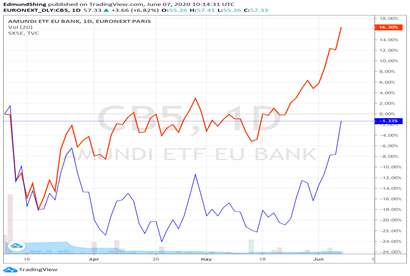
- Banks finally wake up, belatedly and helped by the ECB
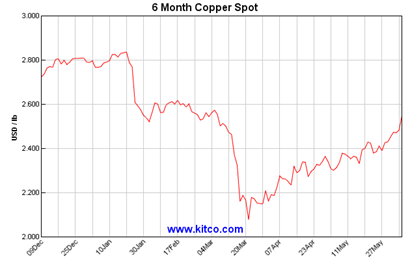
- Commodities: Copper is making a move higher
- Government bonds enter downtrend
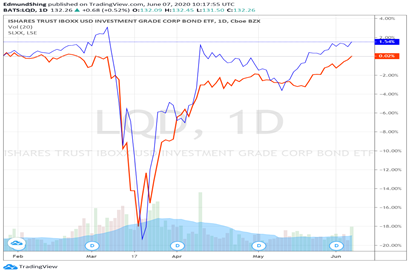
- US, UK investment-grade corporate bonds strong so far in June
- Leading themes: Value marks a long-overdue resurgence – but can it continue?
- Risks: Continuing US protests, but the markets don’t seem to care.
Could we really see a V-shaped economic rebound?
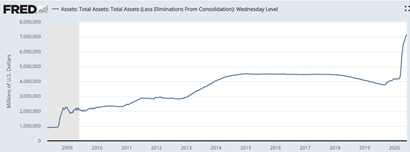
The impressive stock market rally that has seen the US Nasdaq 100 index surge to a new All-Time High has clearly been fuelled to now by the huge surge in central bank liquidity, with the US Federal Reserve injecting unparalleled amounts of money into the financial system, not to mention the supporting acts of the ECB and Bank of England.
Chart 1: Federal Reserve balance sheet has surged > 50% this year
But with lockdown fatigue pervasive throughout the developed world, and economies recovering as lockdown strategies are gradually abandoned, there seems now to be the belief of a sharp V-shaped economic recovery also being priced into stock markets.
If we look at official UK government statistics on the daily number of lab-confirmed cases in England, we can see that the number of new confirmed cases has indeed collapsed despite the surge in testing (Chart 2). This seems to back up the Government’s stance of opening up the economy – even if the R0 rate of transmission is not much below 1.
Chart 2: Daily lab-confirmed COVID cases in England by specimen date
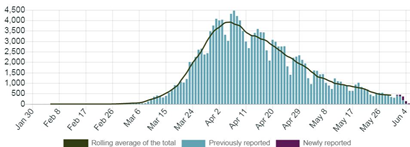
This comforts me that the risk of a huge 2nd wave of infection in the UK is low, and thus that the risk of renewed lockdowns in the short-term are correspondingly low.
This is crucial for anyone to believe in any sort of V-shaped rebound in economic activity. Let it be said that most professional investors do not believe in this: the recent Bank of America fund manager survey found that 25% of investors view this rally as a new bull market, while 68% see this as simply a bear market rally, with the stock markets due to fall anew.
But Friday’s US unemployment data boosted the case for this V-shaped recovery hypothesis, with the US economy adding 2.5 million jobs in May (versus an expectation of a loss of 8 million jobs!) according to monthly nonfarm payrolls data.
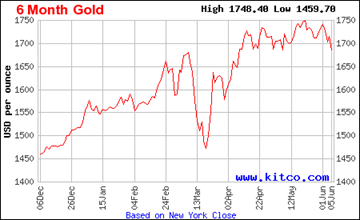
This sounds like great news, but actually wasn’t so great for me and my heavy weighting in precious metals – as gold and silver fell on the back of these hopes for a faster global economic rebound. A case for me of, what you gain on the one hand, you lose in the other…
But I am not losing faith in precious metals – rather, I see this as a correction post a strong run post COVID-crash. I still believe that gold remains a good hedge to the potential of an over-exuberant stock market.
Chart 3: Strong economic numbers deal setback to Gold
Stock Markets run even higher
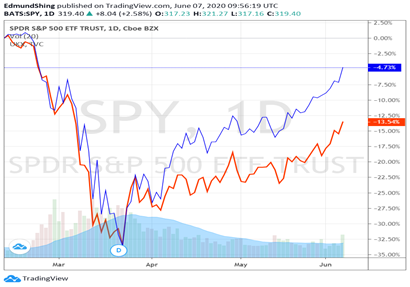
This last week has continued the uptrend in stock markets, with sharp ongoing rallied in the US S&P 500, Euro STOXX 50 and UK FTSE 100 indices (Chart 4).
So despite my scepticism over the strength of this stock market rebound (in common with the majority of investors, it would seem), we can but trade the market trend in front of us, which remains solidly positive.
Chart 4: S&P 500 (blue) and FTSE 100 (red) surge higher
Is there even hope for the lagging Banks sector? It would seem so, judging by the moves over the last week, as the ECB announced a better-than-expected support package for the Eurozone economy. In Chart 5 below, the European bank ETF (CB5, blue line) had a very strong week, starting to catch up finally to the overall Euro STOXX 50 benchmark index (SX5E, red).
Chart 5: Banks finally join the stock market party?
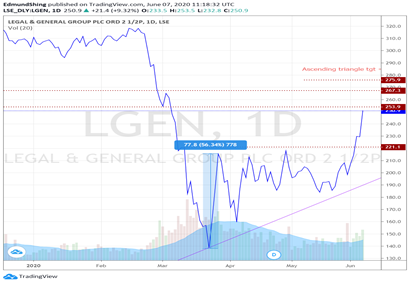
In other financial sectors, insurance companies also saw some belated love from investors, with companies such as Legal & General also rallying hard.
Chart 6: Legal & General enjoying a sharp bounce
Commodities: Dr Copper confirms the economic rebound
Economically-sensitive copper is following the general optimism in a sharp economic rebound, almost now back to pre-crash levels (Chart 7).
Chart 7: Copper price (in $) close to pre-crash levels
There are plenty of UK-listed companies exposed to copper production that could thus benefit from any – sustained – recovery in copper prices, including ANTO Antofagasta, CAML Central Asian Metals and diversified global miners such as AAL Anglo American.
Corporate bonds clearly preferred to Govvies
The rally in investment-grade corporate bonds continues as the Federal Reserve, ECB and Bank of England continue to buy corporate bonds as part of their quantitative easing programmes: hence the ongoing uptrends in LQD US investment-grade corporate bonds (in blue) and SLXX UK corporate bonds (in red).
This reflects investors’ desire to buy into the risk-on market rally, putting money to work over the last few weeks in higher-yielding corporate bond funds rather than sovereign bonds like gilts.
Chart 8: LQD and SLXX corporate bond ETFs power higher
Value finally rallies: but a flash in the pan?
Up to now the stock market rally has been led by growth- and momentum-oriented sectors such as Technology and Health care. But this last week marked a partial catch-up in more beaten-down cheap value stocks for the first time since the late last year.
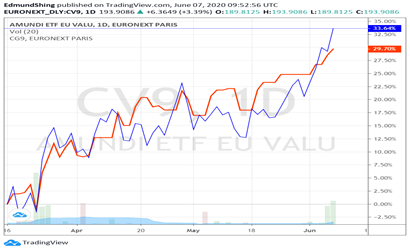
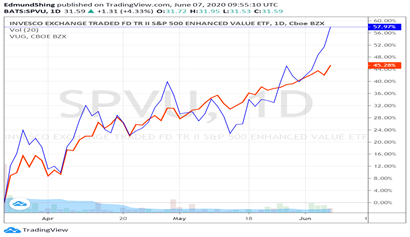
The two charts below illustrate the progression of Value factor ETFs in Europe and the US, with a representative Value factor ETF in blue and Growth ETF in red.
Chart 9: Value starting to catch up to Growth at last
As we have seen a number of false dawns for the Value factor since 2009, with small periods of outperformance by Value (VTV, in blue) then followed by long periods of growth (VUG, in red) outperformance…
Chart 10: In the US, Value has lagged Growth heavily since 2009
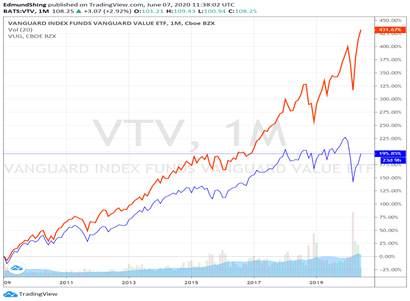
Looking to the long-term history of the US stock market, there have been periods before when value stocks have not kept up with growth stocks. The time to buy value has historically been when the economy exits recession and enters a period of sharp recovery, just as we - may – be starting to see now…
Put simply, a long-term bet on value factor outperformance here relies on a V-shaped economic recovery really taking place!
This is important for the UK stock market, as it tends to be a more value-oriented stock market when compared to the more growth-oriented US stock market.
In terms of sectors, then, one should be focused on the Banks and Oil & Gas sector, as these are the most depressed stock market sectors right now and are thus fairly representative of long-term traditional value.
Have a good week,
Edmund
Disclaimer
This is not financial advice. Our content is intended to be used and must be used for information and education purposes only. Please read our disclaimer and terms and conditions to understand our obligations.
5 comments
The economist Roger Martin-Fagg predicted a V shaped recovery many weeks ago. His theory, based on his experience as a "behavioural" economist more than mathematical, was that the lockdown had made it impossible for us to spend and that all evidence from the early openings of shops was that, given the slightest opportunity and any sort of imbalance in their finances, people trend towards restoring the original status quo. On that basis, those that sold up and are sitting on a war chest will seek to buy as soon as they see an upward trend that they believe in. And so on upwards irrespective of any reality in terms of goods made and profits declared.
Thanks for all your hard work and insights Edmund. I am sort of prepared for a 10-20% market correction some time in the next six months. Share prices need to take a breather after the surge over the last 11 weeks. And it may well prove to be another decent buying opportunity. The recovery of oil and copper prices suggests that another market crash in the near future is unlikely, as you imply despite the pessimism of some professional investors. (I find professional pessimism far more encouraging than irrational exuberance.)
Excellent stuff Edmund do you think its worth having exposure to long term corperate bonds in one's portfolio for a defensive element say mainly triple BBB rating and above given likely to be no increase in interest rates for 2-3 years ?
Thanks Andy
Hi Andy
Yes i do, given that decent yields are so hard to find these days. I particularly like the fact that this asset class is directly supported by central banks, which should give it more resilience versus stocks.
US corporate bond yields are higher than in the UK or Europe, but beware, the US dollar exposure must also be taken into consideration...
Edmund
Excellent insights into the future. Thank you