My StockRanks Farming Approach - a 20k Real Money Test Portfolio

In 6 months the portfolio has gained 20%
Background
As a Naked Trader type investor in the UK markets for the past 10 years I have found myself with some reasonable success doubling my total portfolio within that time. I have also found Naked Trader type investing to be easy to understand and simple to adopt while adding into Robbie Burns criteria my own important filters like the free cash flow.
But as an offshore worker, I have found it difficult to effectively manage several portfolios impossible due to slow (or overlay used) internet connections (via Satellite) while onboard vessels I really wanted to find another angle of investing that would be less intense.
During my first year using Stockopedia, I spend much of the time reading through all the material in the Stock Ranks, the hunter and farming approaches to stock selection and also portfolio management.
The farming approach appeared to me to be a more suitable system of investing that would fit my lifestyle. The farming approach would allow me to check my portfolio even just once a month, and I would still be able to sleep at nights.
If only I had trust in the StockRanks and the only way for me to gain trust in the system is to actually use the system, using real money. So last October I decided to take £19K from my main portfolio and create the farming test approach. I actually thought I put in £20k but it seems I mislead! My ISA portfolio fund contains quite a large amount which I prefer not to disclose. But within this fund is my farmed portfolio, started on the 16th October with a cash amount of £18, 992.
My Farming Rules
- The Stockopedia QVM Recipe (Quality > 66, Value > 66, Momentum > 66)
- Dividend Yield 12 month rolling > 0
- Market Cap > £20m
- Spread (bps) < 500
- Sector includes - One screener for each sector (10 sectors in total)
I also subscribe to the US & UK Edition. I only have one US stock (Tesoro) and I seem to have difficulty with adding other US stocks into my ISA via my broker. So my decision may be to revert back to just UK stocks for this portfolio.
Exit Plan
A stock will leave the portfolio when it goes below StockRank 90 and a more suitable qualifying stock can take its place.
I will report updates on this portfolio every quarter. I mentioned on twitter to say that I will convert 100% of my long term portfolio to this farming approach. This would take some time and for now I am happy to slowly add to this farmed account and keep it as a test for the next few years.
Portfolio as of 20 April 2015
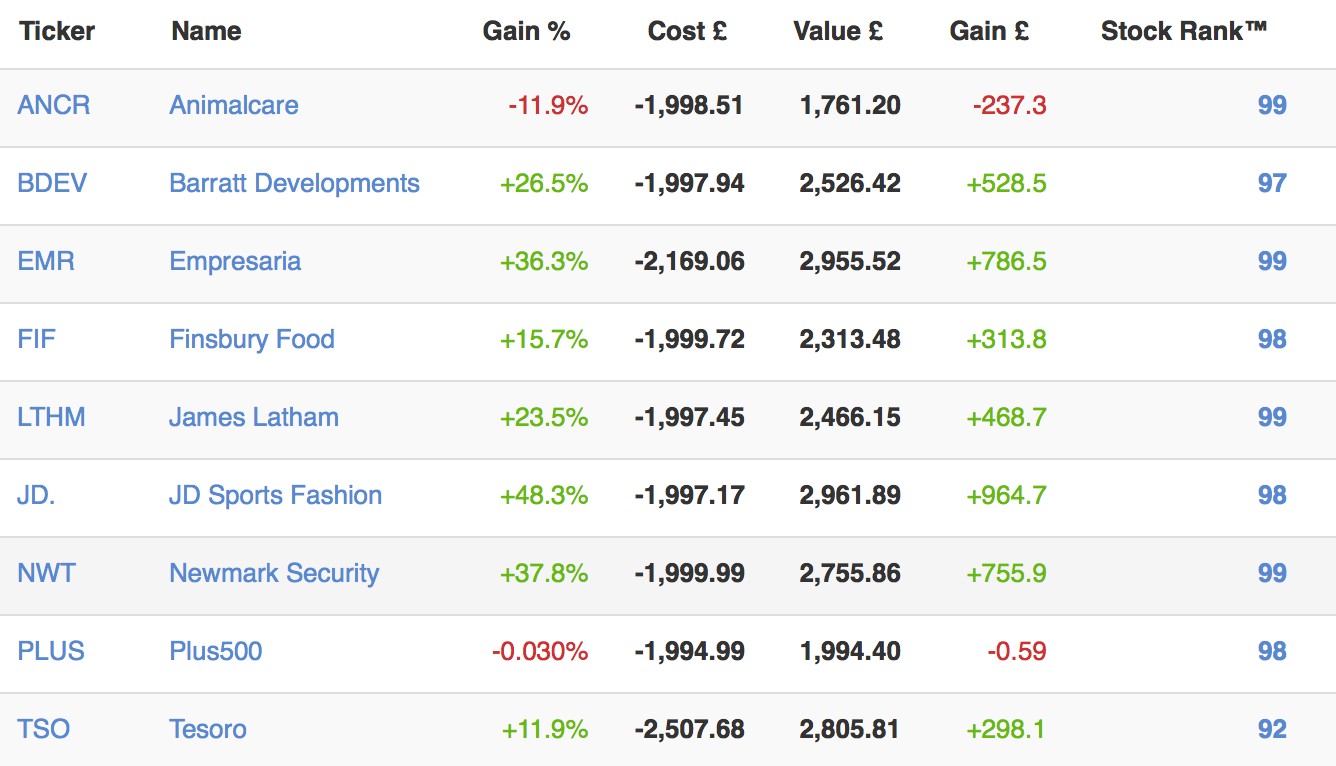
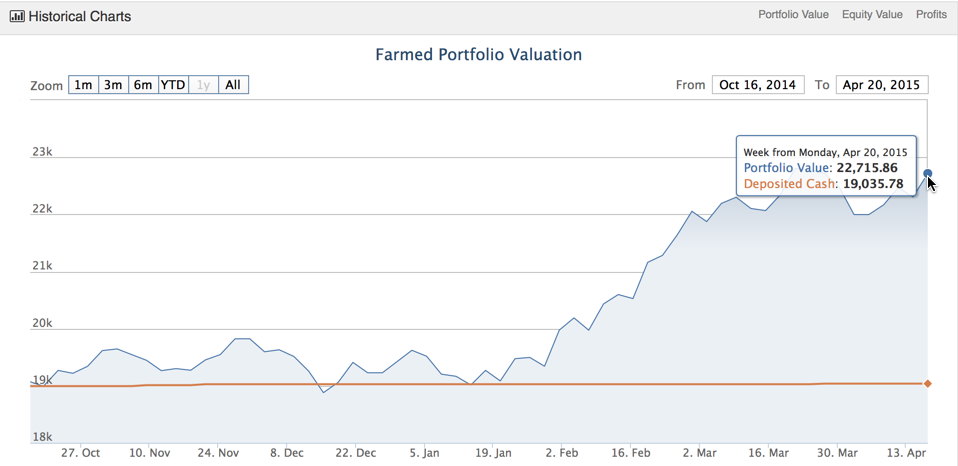
Since inception the value of the portfolio has increased by 20% I do understand that 6 months is simply too short a time frame to make any solid conclusion especially as the general market seems confident. However the tests so far has been encouraging and has outperformed my main portfolio by around 10%
NWT Has a market cap of around 13m. I just recently added in the Market Cap > £20m to promote liquidity
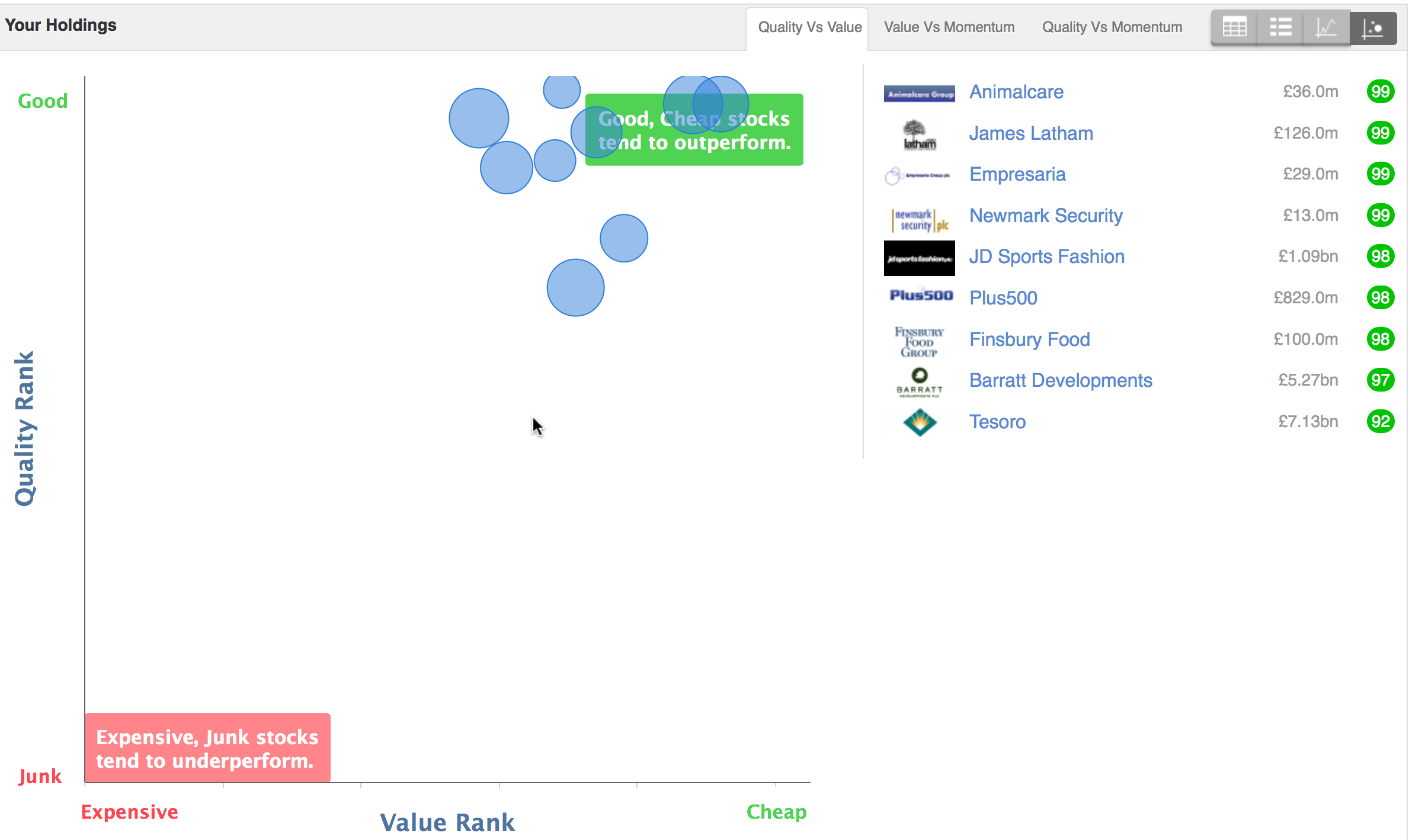
My favourite bubble chart!
Portfolio Value
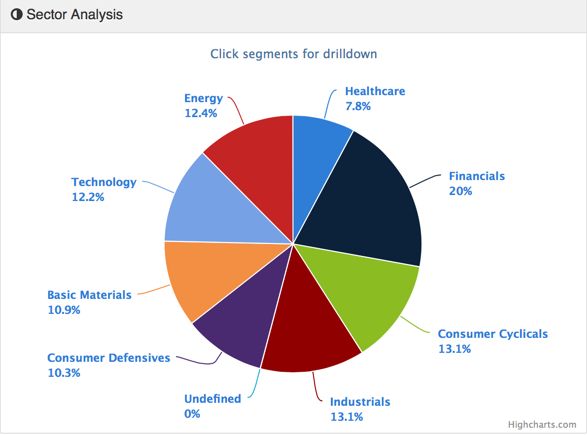
Sector Analysis
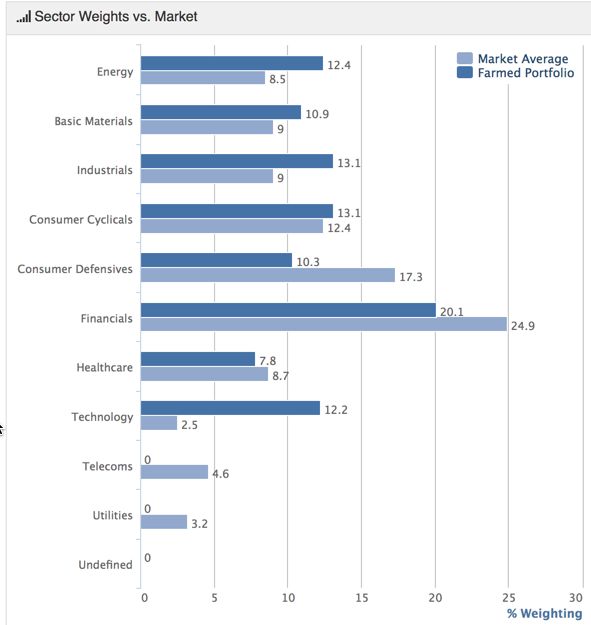
Sector Weights V Market
There is no Telecoms or Utilities in my portfolio. Buying in around £2000 worth of stock in each of these sectors would over weight each one. At this time my plan is to wait until my portfolio has doubled in the number of stocks to around 18 and with a portfolio value of around 40k
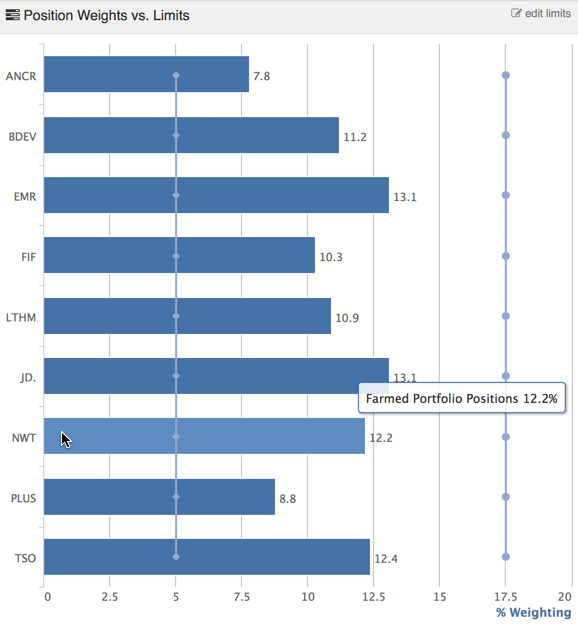
Position Weights vs Limits
I was previously overweight in EMR at 19% and sold around half the stocks and bought in PLUS. However there is much negativity reported about PLUS in the Financial Times about user numbers and churn rate. Thus I may throw this stock out at some point and replace with another
Disclaimer
This is not financial advice. Our content is intended to be used and must be used for information and education purposes only. Please read our disclaimer and terms and conditions to understand our obligations.
58 comments
herbie, that's great, thanks for the informative reply to my post. Certainly there were a lot of opportunities to buy the dip on the shares that you highlighted. Good point regarding stop losses and the spread that I haven't really paid enough attention to previously. I will watch Grindertrader's video. Cheers again.
Sorry to not be more helpful, but am on my phone. Paul recently wrote about not using stop for non leveraged long accounts. Essentially what I remember was that the stops dropped him at the wrong time, selling low and he was having to buy in on a higher price after a bounce. Also for a stockrank approach you would base your buying and selling upon the fundamentals of the company not random price action. I personally don't use stops as I am not levered, and I am diversified enough that 1 company blowing up is not going to hurt me, whereas a day like Monday would have blown my whole portfolio and missed me the bounce...
Many Thanks for replying, the situation Paul describes there is pretty much exactly what happened to me.. Although I lost money it's proved to be beneficial as 'success is a lousy teacher' as they say.. Thanks it's very informative to have an insight into a different approach with regard to stops especially if I'm buying on fundamentals as per the stockranks.
Sure, no problem. I too have made plenty of mistakes based around emotion and overriding which has really hurt my returns this year. Have good rational plan and stick to it. Checking price action everyday does not help either. Also bear in mind that stockranks are only up to date with the data received so can lag company announcements for a few days or even weeks for the tiddlers.
One quote that has helped me today is that you never want to take long term risk for short term benefit, but if you can find long term benefit for short term risk, keep hitting that button. I believe I am taking short term risk for long term benefit. Time will tell :)
Monday didn't blow my normal accounts. As you say I am diversified in all my portfolios. I use stop losses when i first buy into a stock, but much of my stocks in my portfolios were in high profits +50% upwards some over 100% that stops do not come into the equation
The key points for me for anyone who cannot decide to use stop losses are...
1. Are you totally satisfied with your research and direction of the stock and your knowledge of the stock is such that your totally confident with buying in and no matter the price action you...
2. are totally disciplined and control emotions to stay in the investment even if the price falls below a comfort zone... and finally
3. You have at a good number of stocks, (plus 10..20...30) diversed over a number of industries/sectors so any single stock goes wrong doesn't hurt the portfolio too much, thus taken away the emotion of falling in love with a stock
If so then stop losses may not be required in your investment plan
Hi underscored, that's what Im seeking opinion on.. I've been using stop losses of 10% from my interpretation (and I stress only my interpretation!) of Robbie Burns' advice in his Naked Trader book. The shares that I ended up coming out of pretty much all bounced back significantly. I know there's a lot of debate about stop losses - what I'm wondering is whether Grindertrader (or indeed anyone else who is using the stock ranks as the base for their stock selection) has been using them and if so if there was any impact with the last week. The reason I ask is that having made the beginner's mistake of trading too much I'm favouring the farming approach, but would stop losses protect or hinder this approach? Can I ask do you use them and if so did this have an impact on your portfolio from the last week? I've ended up selling due to them and missing the corresponding bounce so I'm keen to see what others think? Hope this all makes sense!
Grindertrader does use stop losses in fact he posted a youtube video about them only 2 days ago, if you have a look on the discussions board you should find it, however for this portfolio I believe he does not use stop losses and only Plus was sold because of a share price fall, he is talking about rebalancing in October.
I agree 10% stop loss on many shares will stop you out, I have seen Robbie Burns blog but not his book, believe he uses about 12%-15% stop losses on most of his buys. It depends on the spread as well, some shares have a wide spread of over 5%. You can also get taken out on a sudden blip down. I don't tend to use them anymore, I may consider on some high risk shares or if I'm going away and can't trade for a while. I often have found a share price fall a buying opportunity rather than selling. Look at some charts for shares like Solid State (LON:SOLI), Renishaw (LON:RSW), Ashtead (LON:AHT), Clarkson (LON:CKN) and Staffline (LON:STAF)
Hi Grindertrader,
Thanks for posting this - it's always really interesting to see how everyone goes about selecting stocks.
Can I ask - do you use stop losses? If so what level are you setting them at?
The reason I ask I started using Stockopedia last October and had excellent results as I learned how to trade. My profits were dented by impatience and stock swapping - leading to high transaction costs. I has decided ona 10% stop loss - Alliance Pharma was one of my big winners although at one point it was down about 8%. This was my interpretation of followed Robbie Burns' advice of quickly getting out of losing stocks and it has worked well although it was really tested in the last week! A lot of my stocks (all top ranking Stockopedia stocks) were suddenly down well over 10%. Part of this was due to bad timing on my part in when I had bought them - especially Empresaria. Anyway I ended up selling pretty much my entire portfolio as the losses mounted - working on the principle I could alway buy back in later. Of course this meant missing the bounce..Can I ask how did your stocks fare and did you get out of any or were you tempted? Are you still checking them only every so often or do you still find yourself checking them daily? Cheers!
Your time horizon seems pretty short. Also is a drift in the SP of an illiquid small cap of 10-15% on no news anything to talk about?
HI Bigclaw some good points already raised.
The stock ranks portfolio does not use stop losses at all. In this portfolio the focus os on the whole portfolio performance..rather than individual stocks within the portfolio. The stock ranks approach here is based on picking high stock ranks and then as a basket of stocks should in theory outperform the market with as little human interaction as possible. Easy to explain harder to not do anything. PLUS I intervened because I decided that was an 'extra ordinary' negative situation.
I believe it is better to NOT use stop losses when using a Stock Ranks basket approach, as stop losses defeat the purpose of making decisions based on Stock Ranks. Stop Losses are based on share price movement.
I use Stop Losses on my 'stock picking' picking portfolios and leverage accounts and if you click on my profile you can see my previous discussions on them and a link to the you tube video.
Hope this helps and good luck to you.
Ian
Hi Ian,
It does indeed help! It's really only now, and from what you and underscored have written that I've grasped the difference in managing a portfolio based on stock ranks compared with one based on a Naked Trader style of stock picking (although undoubtedly there will be stocks that fall into both). Is really interesting to get an insight into how you go about things. I watched your video on stop losses- it was really informative. I'm going to continue with stop losses as a means of safety for any stocks I pick myself. You should definitely do some more videos. Good look to you as well.
Your very welcome Bigclaw. Do what ever makes you comfortable until your confident to find other ways to de-risk.
It is difficult to put an argument for stop losses. We are a minority and plenty of people across discussions boards will tell you they do not use them with a risk the positive use of stop losses can be drowned out within the debate.
Most private investors underperform the markets yet most private investors argue against stop losses, have no investment plan at all and many chase high risk stocks. So to make your portfolio consitently gain over many years, you have to be better than average.
So I am happy to be a minority and while I do not think my knowledge of research is better than average, my discipline and controlling losses within both my investment and trade plans ensure I stay ahead of the average.
All the best.
Animalcare was bought on 23 March 15 when it replaced Alliance Pharma. Appliance Pharma had at the time (I think) dropped below 90. I am sorry I can't remember exactly why I dropped it from the portfolio.
That portfolio was the status as of reporting day. The portfolio value screen still shows the increase since I first started the portfolio. At the time I also said I would report every quarter and I was still determining fully when to balance .
Since then I have sold PLUS but made no other transactions. This will be reported in Octobet and I am considering to rebalance then and just rebalance once a year.
I see. Yes I will be looking forward to your update in October.
Dear all.
Since the article mentioned above that I was going to publish an update to this portfolio every quarter I wanted to comment on why I have not written a further article
I decided that doing less is more and looking at the current portfolio performance I think on a 20K account then 1 year rebalancing is enough. There is also a risk of writing about and acting on market noise should I rebalance quarterly or even six monthly. The portfolio has performed extremely well considering the Greece crisis and the problems with PLUS and is around 23% still in profit.
Despite my intervention of selling PLUS holding last May. my entry and exit rules will not change.
I also changed my mind about trying to double the portfolio size. While it is recommended to have more than 20 stocks; I want to see how I get on with around 10 stocks and only increasing number of stocks if future gains allow this. Finally I have also decided not to add more cash into this portfolio so over the coming years I can see how the portfolio performs with the 20K starting amount.
I have growing confidence in using StockRanks in a diversified portfolio and although I will only report on this portfolio's performance once a year; I have already implemented much of the StockRanks rules in my other portfolios both underlying stock market buying and leveraged accounts.
It's an exciting time to be part of the Stockopedia community and thank everyone for their patience. I wish you all good fortune in sensible investing.
regards Ian
Twitter - GrindertraderUK
Just came across this article again as looking at Animalcare, I can't understand how you are making a 11.9% loss as looking at the charts Oct to April sp has gone up from 140p to over 170p?
Ed, are these graphs available to users?
On PLUS impact on my portfolio I have an updated thread here
http://www.stockopedia.com/content/my-stockopedia-20k-farmed-portfolio-the-plus500-effect-and-why-i-am-happy-98928/
Whatever happens I shall probably impose a blanket ban on all AIM foreign stocks in future. No stop losses are used in this account as the StockRanks determine the exit point, although PLUS is challenging my mechanical rules at the moment.
I have not been here long so its too early to say about Stockopedia performance. What I can say though is my best performing shares are not ranked very highly by Stockopedia, best ones are Ashtead, Inland Homes, Trifast, BG, Friends Life, these are all over 40% gains, Barratt also but that is one that is highly rated. Others that have done well are Vislink, Solid State and Iomart. Worst shares are Plus500 and Xaar.
Herbie - we'd never claim the StockRanks can pick every stock market winner. That's not the point of the system which I've much elaborated on over time. It's about discipline and adhering to a process.
Your comment "What I can say though is my best performing shares are not ranked very highly by Stockopedia"is misleading. Actually - all the stocks you mention aside from Inland were ranked v highly ... before the moves. The point is that they aren't any longer as they've had big moves and the valuation is no longer compelling.
The key question to ask is what is one's sell discipline for winners if they become fairly valued?
Ashtead
Trifast
BG
Vislink
Friends Life
Great response Ed - how I love these graphs. I know that the ranks apply to a portfolio of stocks, rather than individuals, but the rise and fall of these examples is compelling.
What I'd love to do now is build a screen which filters on "3m StockRank Upgrades" in the same way as I can presently do this for EPS upgrades. Now that could produce a shortlist worth investing in!
Absolutely - me too. Working on it ! In the meantime there's the movers page - not as flexible but some find it useful.
Edward, Many thanks for explaining that, how do I look back at stock rankings?
Yes selling is a good question, some I have sold, like Barratts and Ashtead, Friends got taken over.
Very interesting, looking at AHT, the best time to buy was at 820p which was in June 2014, this was when AHT was ranked under 75? I see AHT now is only ranked 60 yet the shares have continued to rise and are at an all time high. What caused the big spike down? Think that is when I bought.
I'm not having a go, just trying to understand the rankings.
I think you are making the twin mistakes of
For me, the best time to buy AHT would have been August when the stock broke out of the top of its channel. At that point one could have clearly seen that the stock was back in demand - momentum was picking up. It would have been a much lower risk entry point than trying to catch the low price in the stock. As you can see from the StockRank chart, the interplay of value and momentum at that point rose to near its highest. The total returns may have been lower, but the risk-adjusted returns were higher.
A lot of value investors try to buy in at 'cheap' prices and end up catching falling knives & value traps instead. If the stock rises back you look like a brave genius, but if it keeps falling you fall victim to all kinds of mental curses like loss aversion, "get-even-itis" and the desire to average down. The statistics show that people tend to hang on to loser stocks far longer than they hang onto winner stocks. It's best not to play that game imo.
For me - the best time to buy a stock is when the risk is lowest rather than when the price is lowest. It's a subtle thing. I'm a student of what 'works' in markets. Simple trend following / momentum signals like buying new highs are highly profitable strategies - with many arguing that they are far more profitable than value strategies. But buy new highs in value stocks and you get the double whammy of getting paid off by both value and momentum.
Regarding the spike down. I'm not sure what that was - could have been a number of things - possibly even a system glitch or data error.
Edward, thank you. I was watching AHT for some time but always considered it too expensive, when it fell to 840p for no apparent reason I bought some, when it fell to 820p I bought some more, when it went up to 830 I bought some more, yes maybe brave, but its a FT100 company, not some some Aim stock, it is probably most successful FT100 co in last 5 years in terms of sp, going up nearly 10x. Anyway thats the situation. As for buying in August the sp did then fall back from 1060 to 900. So if I had bought at around 1000-1060 I would be worse off than at 830? Yes at 900 i should have bought more but I already had quite a few. You are probably right with some companies but I felt comfortable with AHT. When would you sell AHT?
Yes a good start but plus500 not looking good, did you sell as you use stop losses?
Hi
Very good work.
What will be the future of FTSE 100?
Just a hypothetical scenario. But if the FTSE All Share Index fell through a period of time by around 20%, but my portfolio fell 15%, then I would still have beaten the 'market' by 5%
"since the Stockranks started there has been a period where SR>90 have gone down by approx. 30% top to bottom."
I can't see any decline greater than 10%.
With regard to some of the Russian companies appearing very cheap I have discovered that some of the DR's that trade on the LSE represent 0.1 of a ordinary share, which is why they look crazy cheap.
Hi,
The other thing I would say is that you began your portfolio at a particularly fortuitous time. If one looks at the Ranks page associated graphs one can see this. I think it is wise to point out that since the Stockranks started there has been a period where SR>90 have gone down by approx. 30% top to bottom. This is clearly a risk to anybody seeking to replicate your experiment and does underpin the need to consider this is a long term strategy. We also have not been through a major stock crash with it either where even the best stategies get hit by 60% or so. I like the stockranks, but it would be good to have the data from the last 100 years!
Regards
Regards
Hi rick,
Thanks for the response. I will not be using stop losses at all in this strategy. It is the stock ranks that willl ultimately decide whether to sell.
I have mentioned previously my strong commitement to stop losses (and still do) for my usual way of investing.
Funnymoney,
I would not buy any Russian stocks but that is for some personal reasons that go beyond the scope of this forum. I apologise for not being able to expand on these reasons
Grinder - great idea, and very interesting article. You are off to a good start.
Do you place any actual price stop loss on your holdings? (I think I am correct in that you wrote about this topic in a previous post)
Is there any upper limit you intend to place on Market Cap or selection from a particular FTSE index?
Thanks Imranawan. Level 2 and even level 1 price data is unimportant to me in this portfolio and not used. It is a long term view so it doesn't matter if i buy in and next day and the price goes down. I do not use technical analysis on the charts at all really. I prefer to use the Relative Strength information provided in the Stock Reports. I would chose a stock that has positive 1 year and 3 month RS over anything less. But again I am not strict at all in any of this. It is the StockRank that is important and timing less important.
Hi Grindertrader,
Excellent post, and a really useful overview of your approach and results. When you constructed your portfolio and selected the stocks you'd like to invest in, did you try and time your entry based on technical analysis (charting), or level 2? Or did you simply invest in the stock.
Best wishes,
Imran.
Evening Andrew. Your might be right. Maybe exiting when it goes below 90 may prove to be too stringent. It is something that I can review in the passage of time. Certainly I will keep an eye on share price performance of any stock that I exit and also consider if transaction costs are too high. Looking at the Stockopedia tests on the 80 - 90 range the stocks as a basket have still outperformed so setting the limit to 80 is still a very viable consideration.
Thanks for that.
Hi dosh.
To be honest I will probably not immediately sell the stock if it goes below 90. I intend to review the portfolio at the end of every month, but as I plan to double the size of the portfolio in the next 12 months, then I will have built up some amount of transaction costs. But I will run the screener and see if the stock still qualifies the QVM recipe and also check to see if there is a higher ranked stock available to me. Most stocks in the 80s range are still excellent stocks to buy into so there is a small chance that stock would stay in the portfolio for a 'wee' while longer.
As I build up the portfolio to around 18 stocks my exit plans are still 'work in progress'. Once I get to 18 stocks then I will probably consider what exactly my exit plan will be. Below 90 is my simple rule of thumb at the moment.
I hope in the process of time that my transactions on the portfolio will be minimal. Certainly looking to turnover no more than 20 - 25% of stock in the portfolio per year. But this is all controlled by the StockRank performance of my portfolio so it is far to early to say how I will manage this.
Good evening
I have been moving towards what you are doing, and had some of the same concerns.
You can get shelves full of books explaining what/when to buy, but there is not the same emphasis on what/when to sell.
Selling on a SR fall below 90 (I use 80) seemed a little blunt to me,
but the point of the SR system is to remove the emotional issues - there is not point in buying according to mechanical criteria (that we pay for) if you don't do something similar on selling.
However I do not want to over-trade.
I measure the share performance against the FTAS performance from the point of a fall below 80 and sell if it underperforms by more than 5%.
Just my approach and have no stats to back it up. dyor etc.
Hi Grindertrader, all a good read and fairly close to some real money purchases that I am running myself using stock ranking within Stockopedia.
I see you set an exits plans “A stock will leave the portfolio when it goes below StockRank 90 and a more suitable qualifying stock can take its place”. One think I have found with using the stock ranks is that a rank can fall for various reasons and particularly after an RNS/results etc. Do you then immediately sell the stock as if falls below a stock rank of 90? Leading on from this, do you experience much trading within your portfolio particularly in terms of sale of stocks.
Will look forward to your updates.
Oh ok, I didn't realise. I can check the subscription information out again. Thanks for letting me know
Hi Phil,
Yep I certainly still need to find a way to filter a bit more of the US crop. Although for now I see the US stocks are highly priced in at the moment that maybe it is a good idea that I am under weight in them. According to the US only addition of Stockopedia the median value of all listed US stocks is a whopping PE 18 x.
I hope at some point we can subscribe to USA, UK and EU editions in one go. I see no option for it. But then again since Stockopedia will be used mainly for this portfolio I would have to consider the total subscription costs as part of the expenses.
To be honest I naturally calculate the Naked Trader criteria as I have been using it for so long it seems the habit of a lifetime!
Paul recommended the current ratio > 1.2 at a Sharesoc Masterclass event that I attended. I am seriously considering using this as a balance sheet check
It depends on how much stocks are listed I guess. The lines are blurring already for me between the Farmer and Hunter investor in this lol
Hi again,
You can subscribe to Euro (incl UK) & US as I I have that package.
To be honest I agree that it is hard to find cheap US stocks that match my criteria.
It's even harder to find UK stocks, but there are plenty of European ones.
I have investments in Germany, France, Portugal, Norway, Sweden, Denmark & Spain.
Yeah I'd suggest I'm a hybrid ... I farm according to my criteria. :-)
But just like you I'm not able to dissect a balance sheet so this strategy works really well for me and I too was inspired by the naked Trader strategy after seeing the returns of that guru screen 2 years ago.
Best of luck
Phil
Hi Grindertrader,
You might also consider some other ways to thin the European/US crop ...
Balance Sheet checks:
net debt < 3 * operating profit (from Naked Trader)
current ratio > 1.2 (from Paul Scott)
P/TB > 0 (from Paul Scott)
Additional quality checks ...
Benieish M Score < -1.8
Altman Z Score (2) > 1.8
The diversification of a portfolio is interesting for me too. Clearly diversification reduces risk but it can also reduce exposure to opportunity. So in my portfolio I currently hold a UK housebuilder, a Norwegian construction firm and Danish construction firm and that sector is steaming along. In the past I've held multiple salmon farmers when the salmon price was climbing and I've also held multiple recruitment firms (that never quite caught fire).
For me the stock ranks are highlighting these undervalued or cheap growth sectors.
I'm also quite comfortable holding no stocks in a particular sector too, e.g. telecoms or energy as they don't satisfy my criteria (so why would I buy them)
Keep up the good work and good luck with your selections
Warm regards
Phil
Some very interesting discussions going on. I will try my best to answer them but I am probably not as technically minded as many here.
pks.
The actual Stock Rank is a combination of the three Quality, Value and Momentum Ranks. It is explained here.
http://help.stockopedia.com/knowledgebase/articles/184381-how-do-you-calculate-the-compositerank-
There are a number of blended approaches like the QV, VM, or QM. I understand from reading the blog posts from Stockopedia Staff that currently it the is Value & Momentum blend that appears to be the best strategy but I wanted to chose a more balanced longer term blended approach so that I could benefit from any changes from which ever crossover blend is flavour of the moment.
The QVM recipe (Quality > 66, Value > 66, Momentum > 66) ensures that any stock that is in my portfolio has (at least originally) have all three Quality, Value and Momentum ranks in the top third of the market. My decision then to chose the highest Stock Rank above 90 within that criteria, so within the highest 10% of the market.
My decision then is to wait until the Stock Rank falls below 90. I find then that two of the three Q V or M rankings have also gone below 66, so it is chucked out.
Having subscribed to both USA and US packages then there can be far too many in the screener to harvest up, so I have to do some stock picking. I generally look at outlook statement and price volatility. I look at weighting of USA v UK stocks (I am well over weight in the UK) . If I have too many small caps I may in future look at spreading through the different indices.
My reason for the Dividend Yield 12 month rolling > 0. Is simply to chose one that is paying dividend, and like to continue paying a dividend. I guess I could use any dividend rolling screening choice. I noticed some high stock ranks didn't pay a dividend and although my portfolio is about growth over income i still like the divi.
Rambler/mpat89
It is my understanding the market weighting in the portfolio tools include every single stock for the UK from the Thomason Reuters directory that Stockopedia lists. Maybe the Stockopedia Team can clarify this?
When I am screening the market weights and as I understand it is for every single stock in the US and UK, split into the ten sectors. I am sorry I am really not so technical in how the weighting is constructed.
My reason for keeping with the weighting is to reduce risk and volatility. I know some people are happy to heavily weight on one sector, but for now my approach is about balance. I am really not fighting the telecoms and utilities sector. I am simply looking at it from a portfolio view rather than a individual stock picking view. I am sure there are some excellent utilities or telecoms companies out there that are due to give outstanding returns. But for now I am trying to stick with the market weightings and that my fund is not large enough yet when comparing transaction costs to buy into telecoms or utilities.
With regards to buying into an index I wouldn't want to do that. Again the portfolio is constructed over a number of indices & sectors, although still biased towards AIM there is FTSE100, FTSE AIM, S&P 500
I think with only 9 stocks I am reasonable happy with sector diversification and market weightings, to reduce risk and volatility without going too far.
In conclusion I am trying to construct a balanced portfolio using StockRanks and Folio tools without getting ground down in technical details and what-ifs. Partly because I am not that clever in understanding how markets work. I am not that clever in reading financial statements. My human emotions and attention to detail can work against me. Stockopedia computerised algorithms that result in the StockRanks is far more intelligent and clever than I am.
Computers make mistakes too, so I am sure some high StockRanks do not make any sense. But I am learning from the Stockopedia Educational tools to look at this from a portfolio view point. By using the system that I have adopted then 'on average' most stocks within my portfolio 'should' outperform thus my total portfolio 'should' also then outperform.
Hope this makes sense. I hope over the years my understanding will also improve. At the moment I feel my ignorance as an advantage in keeping it all simple.
Hi Grindertrader, Thanks for your useful replies to my questions.
Grinder, you are very disciplined and I truly admire you. I struggle to use a formal consistent investment process as I find the world is too interesting a place with ideas coming from lots of directions!
FTSE all share is very light to technology
Following on from the post above, I previously tried to mirror the weight of the market but the following points have since entered my mind:
- if I want to have the same sector risk as the index, why not buy the index?
- should I force myself to hold cash where there are no good opportunities in a sector, i.e. energy or telecoms
- what am I trying to achieve by mirroring the sector risk of the index? reduce risk of underperforming the index?
- which index is the 'market' sector based on? how does this vary in indices around the world? My guess is... quite a bit.. personally I'm not bothered about any one index, I suppose I'd be more interested in beating BOTH FTSE 100 (easy if you're buying smaller companies) and MSCI World. Even more importantly the FTSE 250 as this is a high performance index which tends to beat average indices with little effort
I decided that to me, sectors are equal to risk. What I want to do is diversify to reduce sector risk. This doesn't have to mirror the market. Instead, for now I set an arbitrary limit that each sector cannot be more than 15% of the portfolio. When I want to buy a stock, if my portfolio already has 15% in that sector I will just look at the next stock instead.
Great idea Grindertrader - there's nothing like real money to focus the attention!
One thing that I find odd though is the decision to weight the portfolio holdings to mirror the market (FTSE100?). I guess that this is to reduce risk but I'm not sure how this would work given that the market is biased towards popular stocks more than anything?
Also I would have thought that the StockRanks provide their own sector weighting by picking out companies that are relatively under-valued and so perhaps less popular? So my approach would be to equal-weight each sector thrown up by the screening process rather than to fight against the inclinations of the ranking system.
Otherwise I think that the yield and market cap limits make sense in leading away from micro-caps and towards companies that are generating enough cash to actually pay some back to the owners!
Cheers,
Damian
Grindertrader, thanks for your very interesting post.
Please would you explain your reasons for including the rule that:
Quality > 66, Value > 66, Momentum > 66
as you are also selecting the stock that has the highest StockRank in each sector whilst satisfying all your rules, and the StockRank is a combined Quality, Value and Momentum Rank.
Also, please would you explain your reason for including the rule that:
Dividend Yield 12 month rolling > 0.
I'm not suggesting that there is anything wrong with those rules, I would just like to understand your reasons for including them.
Hi purpleski. When I started on the 16th October I tried to equally weight all the stocks. However I learned from the Stockopedia tools that the general market doesn't weight each individual sector equally as can be seen in the Sector Weights v Market.
If I remember correctly no stocks qualified in the telecoms or utilities sector under my screener, except from some Russian or Eastern European which are within the Russian sphere of influence, so i knocked them out.
However I just run the telecoms screener (UK only) and BT is the only one to qualify with a StockRank of 97. So that would be a perfect buy for this sector, but in order to not overweight against the market in this sector I would only be able to put in around £500 worth of stock, which is not worth it due to transaction costs. I plan to double the portfolio with 18 stocks and £40K when cash becomes available from my other portfolios and then I should be able to buy telecoms or utilities sector stocks
My overweight technology stock is NWT. I bought this stock before I learned to consider and appreciate market weighting. It is only £13m market cap & illiquid, so would no longer qualify for my new market cap > £20m rule. While up 37.8% any major sell off could knock this price down 10% or even more. This is a situation i wish to avoid in future.
I am still in a learning process so I will make occasional 'mistakes' like NWT and its weighting in the technology sector.
But it is the Stockopedia folio tools that are helping to identify these sort of risks so that in future I can make sensible decisions in diversification and balancing of the portfolio
Hope this helps and looking forward to other investors using this approach so we can compare and discuss more.
thank you so much for the comprehensive reply. I will see if I can find the time to think this through and decide what criteria to apply. There seems to be a growing list of companies Pace (LON:PIC) Dart (LON:DTG) Finsbury Food (LON:FIF) that give strength to the Stockranks argument. And of course your returns!
Hi,
I too had avoided AGRO (Russ Agro/ Ross Agro, it really isn't clear) with a Stockrank of 98 because of its Russian link. However, I read this today by Jim Rogers (George Soros's old partner)
"China, Japan and Russia. If I sold India this week, I would probably put that money in Russia. But I am not selling India this week. Russia has been one of the strongest and most attractive stock markets in the world this year. Russia has vast natural resources, it is not a debtor nation and, unlike India, it doesn’t have exchange controls. If anybody should have changed that, it should have been Modi; but he is not doing anything about exchange controls. There are many things going right with Russia. The price of oil has collapsed, which is hurting Russia badly, but that has already happened—it is old news and it will not have much of an impact in the future. Russia is perhaps the most hated stock market in the world even though it is among the best performing. That is because most people’s reaction is, why would you invest in Russia? There are good things happening in Russia that are attracting me as an investor"
http://www.livemint.com/Politics/fgtow0fZMi9y61UDwSyfpI/So-far-the-Modi-government-has-done-nothing-but-talk-Jim-R.html
I would buy now but both IGIndex and Barclays do not list it.
Regards
Just got this from Ed:
"
Regarding Ros Agro, we are reviewing the data. We have been working on the Russian GDRs that are listed in London over the last couple of weeks. Most of their data looks sound but I do have to admit Ros Agro's valuation ratios look crazy low. We're reviewing it now - will let you know.
Best Regards,
Ed Croft
CEO, Stockopedia.com"
Thanks for a very interesting post. I am hoping to pursue a similar strategy over the summer if time allows. Ideally I would like to remove the need to make any qualitative checks once I had decided on the screen rules. I just hope I can find the time.
Why do some stocks have a larger weight than others? Is this based on StockRank?
Thanks Glaws. Once I ran my screener for the selected sector I would look into the stocks that had a total StockRank above 90. Starting with the highest StockRank I would do some qualitative checks that is not part of the StockRanks system. I would check the last trading statement or RNS to ensure the Outlook remains positive. I would also compare charts. If one stock is gaining new highs, is less volatile.. a sort of boring steady climb then I would prefer that over others. I guess I would also exclude high discussed stocks if any appeared in my screener. I would like to stick too boring stocks, that people do not speak about.
PLUS however is one stock being debated about which is causing me a little concern considering i just added this to the portfolio. But for now I'll do nothing with it and see how it pans out.
GL
Grinder - great post. Can I ask how you selected the single stock from each sector - did you use further 'screening rules' or something more intuitive ?