Patisserie Holdings: who dropped the cake?

It was a winding up order that started it, presented to The Gazette on a quiet September’s day, where it sat for a month like a ticking time bomb. Not even the board of the company in question knew a countdown had started.
This was not Act One of the Patisserie Holdings (LON:CAKE) fraud saga. Nobody knows how deep the rot goes, apart from the perpetrators. The fictitious accounts that propped this fraud up like a house of cards could even pre-date the May 2014 initial public offering. No-one has yet indicated otherwise.
The gig’s up. A few bad actors have dented a lot of people’s wallets. When good investors fail, they learn and move on - after all, experience is what you get when you don’t get what you want. Patisserie Holdings has been dishing out quite a lot of experience, recently.
It’s a curious feeling, revisiting the group’s half-year update from 2018, less than five months before that announcement in October. Can any of the figures be trusted or was it all a desperate work of fiction? I’m squinting at the screen, looking for hints of what was to come.
Surely, the diligent investor can’t be so easily duped? And yet nothing jumps out. The numbers are great but not stratospheric. They have been well-judged by a competent liar. Perhaps, in retrospect, they are too neat, too tidy. Easy to say, with hindsight.
Like the rest of the market, I didn’t have a clue about Patisserie Holdings. People want to trust other people. An unfortunate corollary of this is that smart, committed fraudsters can create a surprisingly large mess.
It’s a sad state of affairs. As Paul Scott notes, other frauds “such as Quindell, Globo, and Carillion, were easy to spot a mile off - indeed we warned investors of all 3 here, long before they blew up. Patisserie Valerie however, appeared to be a wonderful, cash generative business…”
Investment post-mortem: such a grim phrase to apply to a purveyor of cakes...
Following the crumbs - a brief timeline of events
Before the storm
- 14 May 2014: CAKE raised £32.8m (before expenses) through the Placing, the net proceeds of which were used “to repay the Group's existing outstanding senior debt and shareholder loans.”
Selling shareholders also received gross proceeds of £46.5m pursuant to the Placing
27 June 2014: Options over 2,024,666 ordinary shares exercisable at 170p and 199p awarded to certain directors and employees, including Paul May (LTIP award over 1,000,000 shares) and Chris Marsh (LTIP award over 666,666 shares)
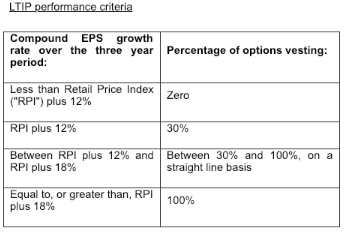
The LTIPs have aggressive growth targets, including 100% vestment of options should compound EPS growth over three years equal or exceed RPI + 18%
They are exercisable between 27 June 2017 and 27 June 2019
17 June 2015: Four directors sell 4,750,823 shares at a price of 312p
Luke Johnson sells 9.5% of his stake (4,046,823 shares) for c£12.6m. Post-sale, he owns 38.6% of the company (38,621,181 shares)
Paul May sells 10% of his stake (506,000 shares) for c£1.6m. Post-sale, he owns 4.6% of the company (4,554,000 shares)
Chris Marsh sells 10% of his stake (51,000 shares) for c£159,000. Post-sale, he owns 0.5% of the company (465,052 shares)
James Horler sells 50% of his stake (147,000 shares) for c£459,000. Post-sale, he owns 0.1% of the company (147,116 shares)
02 February 2018: Chris Marsh is given the 666,666 shares at an exercise price of 170p as part of his LTIP and sells them at 360p per share, netting £1.27m
At no point since the IPO has Chris Marsh been tempted to buy shares in CAKE
02 February 2018: James Horler, NED, sells 47,116 shares at 367.575p for £173,187. Horler now has 100,000 shares. At no point in nearly four years has he bought more
07 February 2018: Paul May receives the 1,000,000 shares at 170p as part of his LTIP and sells them at 330p for a profit of £1.6m
At no point since the IPO has Paul May decided to buy shares in CAKE
15 May 2018: Half-year update. Everything fine
29 June 2018: NED and deputy chairman Lee Ginsberg sells 40,000 shares at 469p. £187,600
20 July 2018: The company issues 666,666 shares at 316p as part of its LTIP to Chris Marsh, who sells them all at 418p for a profit of c£680,000
Still no need to buy any
20 July 2018: Paul May gets 1,000,000 shares at 316p as part of the LTIP, all of which are sold at 418p for a total of £1.02m
05 October 2018: Petition to wind up Stonebeach (Patisserie Holdings’ principal trading subsidiary) posted on The Gazette
10 October 2018: Suspension of shares “pending clarification of the Company's financial position”
The gateau hits the fan
- 10 October 2018: Trading update. The board has been made aware of “significant, and potentially fraudulent, accounting irregularities and therefore a potential material mis-statement of the Company's accounts.”
Chris Marsh, the Chief Financial Officer, has been suspended from his role
10 October 2018: It comes out that a winding up petition in respect of Stonebeach Limited (the "Petition"), the Company's principal trading subsidiary has been filed
The Petition relates to £1.14m owed to HMRC
11 October 2018: Further TU. “there is a material shortfall between the reported financial status and the current financial status of the business. Without an immediate injection of capital, the Directors are of the view that that is no scope for the business to continue trading in its current form.”
12 October 2018: Chris Marsh is arrested and released on bail
12 October 2018: Proposed placing. The board believes CAKE needs an immediate cash injection of no less than £20m. The group now believes it has net debt of £9.8m where once it was reported as having nearly £30m in cash
Placing of 30m shares to raise £15m
£10m loan agreement with Luke Johnson on an interest-free basis
Further £10m bridging loan from Johnson, to be repaid with proceeds from the placing
24 October 2018: LTIP clarification: “The Company¸ as part of the ongoing investigation, is seeking to understand why the grant of options relating to 2015 and 2016 have not been appropriately disclosed and accounted for in its financial statements.”
26 October 2018: Chris Marsh resigns
11 November 2018: Winding up petition is dismissed
15 November 2018: Paul May resigns and is replaced as CEO by Stephen Francis
19 November 2018: Banking update. Extended banking facilities until 18 January 2019
05 December 2018: Nick Perrin appointed CFO
20 December 2018: Grant Thornton resigns as auditor, to be replaced by RSM UK Audit
21 December 2018: New NED Jeremy Jensen appointed chair of the audit committee, replacing CAKE chairman Lee Ginsberg
25 December 2018: Merry Christmas!
01 January 2019: Happy New Year!
14 January 2019: NED James Horler resigns
16 January 2019: forensic accountants since then have revealed that the misstatement of its accounts was extensive, involving very significant manipulation of the balance sheet and profit and loss accounts. Among other manipulations, this involved thousands of false entries into the Company's ledgers.
Cash flow and profitability of the business is now materially below the materially lower level indicated in October 2018
CAKE describes the effects of the fraud as “devastating”
It is in talks to extend facilities beyond 18 January
17 January 2019: NED and chairman Lee Ginsberg resigns
21 January 2019: CAKE still in discussions with bankers
Even Professor Altman couldn’t spot it…
There are certain trends, ratios, and scores investors can check to quickly assess a company’s health at a glance. More often than not, these can help us avoid the biggest losing investments. Not always, though - this is why diversification can be so important.
We can back Paul’s point up with some data and give an example of why the CAKE fraud was harder to spot than others. Let’s take Altman’s Z-Score.
The Z-Score was developed in 1968 by Edward Altman, an Assistant Professor of Finance at New York University. It is a combination of five weighted ratios that, when added together, should give us an indication of a company’s financial health. The lower the score, the greater the risk of distress.
The Z-score results can be divided into three zones:
Z Score above 2.99 - Safe Zones
1.8 < Z < 2.99 -“Grey” Zones - good chance of the company going bankrupt within the next 2 years
Z below 1.80 -“Distress” Zones - high probability of distress within this time period
For public companies, the Z-Score is calculated as: 1.2T1 + 1.4T2 + 3.3T3 + 0.6T4 + 1.0*T5.
T1 = Working Capital / Total Assets. This measures liquid assets. Distressed firms usually experience shrinking liquidity
T2 = Retained Earnings / Total Assets. Shrinking cumulative profitability is a warning sign
T3 = Earnings Before Interest and Taxes / Total Assets. This ratio shows how productive a company in generating earnings, relative to its size
T4 = Market Value of Equity / Book Value of Total Liabilities. A test of how far the company's assets can decline before the firm becomes technically insolvent
T5 = Sales/ Total Assets. Asset turnover is a measure of how effectively the firm uses its assets to generate sales
The Score functions as a checklist and does a good job of highlighting areas of concern in a potential investment. Before Carillion’s July 2017 profit warning, which saw its shares fall from nearly 200p to 50p, the group’s Z-Score was 0.96.
This was Debenhams share price chart in May 2015 - it looks innocent enough. Bullish, even:
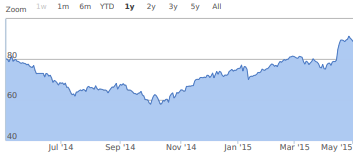
The Z-Score for Patisserie Holdings just before its shares were suspended? 74.7.
Good process, bad outcome
Although it is not a silver bullet, there are numerous examples of how a low, declining Z-Score often precedes the kind of drastic fall in share price that can put a serious dent in returns. Paul DeDodesta, the Harvard stats whizz featured in Moneyball, came up with the following matrix:
Good Outcome | Bad Outcome | |
Good Process | Deserved Success | Bad Break |
Bad Process | Dumb Luck | Poetic Justice |
DeDodesta writes: “We all want to be in the upper left box – deserved success resulting from a good process. … The box in the upper right, however, is the tough reality we all face in industries that are dominated by uncertainty. A good process can lead to a bad outcome in the real world. In fact, it happens all the time.
“… As tough as a good process/bad outcome combination is, nothing compares to the bottom left: bad process/good outcome. This is the wolf in sheep’s clothing that allows for one-time success but almost always cripples any chance of sustained success.”
What can we take from this?
Commiserations to those suffering a cake-related Bad Break. These things happen. The shareholder-corporation relationship requires a certain degree of trust to function. Sometimes this trust is violated. Perhaps the reason why this Patisserie saga is so shocking is that investors didn’t do anything wrong. It could’ve happened to any of us.
The only way we can guard ourselves against future events like this is to stick to good investing processes and to continue to take advantage of measures like the Z-Score to de-risk the universe of potential investments.
You can look to see what companies qualify for the Z-Score guru screen here and can find the Z-Score of any listed company on the right-hand side of its stock page.
Disclaimer
This is not financial advice. Our content is intended to be used and must be used for information and education purposes only. Please read our disclaimer and terms and conditions to understand our obligations.
79 comments
Five arrests:
https://www.bbc.co.uk/news/business-48736447
Hi all,
Shurely shome mishtake that the £ 13 m paid will neatly match Mr Johnson's £ 10m loan and £ 3 m advance re staff dues...?
ATB
"Scandal-hit British cafe chain owner Patisserie Holdings has been bought out of administration by its management with help from Los Angeles-based investment management firm Causeway Capital, the Financial Times reported."
Given the job that "management" did leading up to the company's demise - is it too much to ask "how is this possible"?
It's Mr Johnson and co looking after their interests having presided over the collapse of the company.
Thankfully I never went near after his treatment of shareholders at Interquest made any company connected with him a bargepole job for me. Sadly many weren't so fortunate.
Note that Grant Thornton is paying the money to AssetCo and NOT directly to shareholders. The concern with a so called "shareholder action" is that this would normally be a "derivative action" and the proceeds would go to the company first, in which case they then potentially go to creditors rather than shareholders.
Perhaps it is no accident that Messrs May, Marsh and J/son chose Grant Thornton ….. reassuringly cheap and ineffective?
This audit firm is a disgrace. Punishment must be meted out to all those responsible and not missing out those who have since left because many of the issues relate to decisions made by previous senior people. Were they motivated by profit to undercut rivals but do shoddy audit work.? Let's hope answers will be forthcoming.
"Grant Thornton has been ordered to pay an audit firm record of £21m in damages to former client AssetCo after a High Court judge branded its auditing of the company, which nearly collapsed as a result of an accounting scandal, to be a ‘flagrant breach of professional standards’, exhibiting failures ‘of the utmost gravity’"
Https://www.accountancydaily.co/ps21m-damages-bill-grant-thorntons-flagrant-audit-failures
The Judgement: Https://www.bailii.org/ew/cases/EWHC/Comm/2019/150.html
Little point in having an audit then, isn't there?
Or a body like the FCA which prosecutes neither the auditor, nor the fraudulent board/directors involved
Like being back in the wild west
Smell gets worse
https://www.investorschampion.com/channel/blog/patisserie-valerie-johnson-and-mays-big-secret
Sorry - I should have included the link:-
https://uk.finance.yahoo.com/news/patisserie-valerie-accountant-admits-audits-120033640.html
David Dunckley, chief executive of Grant Thornton, told MPs that ordinary audits look solely to the past and are not set up to detect fraud.
and he added: “We’re not looking for fraud or the future or giving a statement that the accounts are correct.
So there you have it.
Well that's an over-simplification:
1. "An auditor conducting an audit in accordance with ISAs is responsible for obtaining reasonable assurance that the financial statements taken as a whole are free from material misstatement, whether caused by fraud or error". ISA 240
2. An auditor needs to determine whether the company is a going concern - ie. will not go bust in the foreseeable future.
3. They are stating that the accounts are "true and fair" rather than "correct". I've always taken that to mean that any mis-statement is not sufficiently material to give a reader a different view of the company's financial state.
4. Auditors have to review post balance sheet events - i.e. events occurring between the balance sheet date and the date the accounts are signed. It has been reported that multi-million pound cheques bounced during this period - something that should have also been picked up when performing cut-off tests (testing transactions affecting year end balances).
What's the context behind his comment?
On your first point, that's a selective quoting of ISA240. The next sentence is also relevant:
No doubt a lot more information will come out in due course, but based on what has come out thus far, I don't think I have yet seen any evidence, let alone persuasive proof, that Grant Thornton have fallen short in their professional responsibilities.
That's depressing and is rather damning of the audit industry as a whole, but investors (and MPs) really should have a better idea of what an audit actually involves. That "expectation gap" Mr Dunckley referred to is a long standing thing and it's unlikely to disappear as a result of frauds like this one.
Bestace - I don't think it's selective at all. It clearly highlights that an audit is to ensure that financial statements are free from material misstatement and takes the legs out of anyone arguing - "except when it arises from fraud".
Non fraud mis-statements may be easier to spot because management, finance team and auditors want to find what are essentially mistakes. Whereas with frauds one party at least wants to hide the facts.
We don't know what happened behind the scenes at PV but if some of the reported rumours are true (multi million cheques bouncing across the year end) then it is truly gobsmacking that this got through (and for how long had it been going on)?
The sad truth is that audit quality has declined significantly over the last 20 to 30 years.
I have no problem with the point you originally highlighted from ISA240, that an audit aims to obtain assurance that the accounts are free from misstatements caused by fraud and error, but Mr Dunckley would probably make the point that he is trying to "take the legs out of" anyone arguing that it is the auditors' responsibility to identify fraud, or that the auditors must be at fault because a fraud occurred on their watch.
There are several posts on this very thread which appear to be arguing exactly that, as do some of the comments by MPs at the select committee hearing, hence why that second sentence I quoted is just as relevant.
I would also quibble with your paraphrasing of ISA240 in your last post. An audit does not "ensure that financial statements are free from material misstatement". The word "ensure" does not appear in ISA240 and auditors are not in a position to "ensure" anything when it comes to fraud, which is the very point that second sentence tries to make.
Teacher Stern are looking at a group action on behalf of shareholders. I've no idea what they might achieve but they have a web page to register interest:
http://www.teacherstern.com/practice-areas/dispute-resolution/banking-financial/patisserie-valerie-group-action-register-your-interest/
I received an email from them today saying: "We are considering the position and we will be in contact with you further."
I have low expectations but am curious to see what they might come up with.
What they have come up with , is they have just emailed me and asked me for £600 , they are going to send me their bank details (that's nice of them !!!)
Likewise. I shall decline their kind offer.
Quite although it seems to be phrased as a request rather than a requirement. So I don't think that you have to contribute in order to be part of the class action. However IANAL.
Yes agree. This was in retrospect a big warning sign. The way to max out your take from the company. It might infer a more widespread fraud than hitherto suspected. It's like Agatha Christie...it was the LTIP that done it.
Good commentary from David Mitchel in the Observer today. Not so much about the fraud but about the premise of the business (and similar businesses).
https://www.theguardian.com/commentisfree/2019/jan/27/more-means-less-when-it-comes-to-a-great-cafe-patisserie-valerie
Interestingly anyone who knew anything about the Enron scandal will have seen echoes of this in Patisserie! The warning sign was the high LTIP for vesting options. With a target of RPI + 18% for a new company in just 2 years and then seeing the company not only achieve this but the officers exercising their options without buying; that was your warning sign. You can't do much better for your investing education than to read up on previous scandals/frauds and I would highly recommend 'The Signs Were There' by Tim Steer, as well as 'Smartest Guys in the Room', (if you want to do a deep dive into the Enron fiasco).
Before going further, I should point out that Patisserie Holdings was not a company that I followed and neither do I have any knowledge of the sector. However, an earlier poster referenced a link that queried why the level of interest received was so low in comparison to the amount of cash held. Out of curiosity, I thought that it might be interesting to look back at the company's cash position and the interest relating to that cash.
This is simply a very broad overview of the company's year-end cash position and the associated interest received or paid. The most glaring point is the paucity of interest. For a simple core business model: Business to consumer and cash only transactions, treasury management would have been central to the business. Of course, it also had a wholesale arm and this is more opaque but that only made up some 3% of total revenue for the year ended 2017.
Over the six-months period to 31st March 2018, the company appears to have received just £1,000 interest on over £28 million in cash at the period end.
Year Cash (£m) Interest Paid/Received (£000)
(Six months to 31st March 2018) 28.8 1
2017 21.5 8
2016 13.3 <6>
2015 6 <29>
2014 0.484 <858>
2013 0.130 <907>
In the annual reports of 2017 and 2016, the same statement is used: “The Group had no external borrowings and therefore had no material finance costs in either the current or prior year”
For the earlier years, I can see the logic as it paid off its borrowings. But the real point I am making is what explanation could it have given to investors? There does not seem to be any offset. Does anyone have a technical explanation for the discrepancy? Sure, it has been expanding but the above figures do not seem to tally with reality. It seems to be a non-seasonal, cash based business. According to its 2017 accounts, “All new stores profitable from the first day of trading”. And so where is the interest on the cash?
Moreover, what possible explanation could the Finance Director present to the rest of the Board?
There has not yet been much coverage of the institutions that put up nearly £16 million of their clients money last October in the emergency placing. Focus in the press remains on the actual unravelling of the massive fraud.
However, questions should be asked of those institutions in putting up that capital (after all it is other people's money). One thing was clear at that point - nothing was a given and the hastily pulled together indicative financials were nothing more than a guess. As it is turns out a very bad guess. Not sure I would want to be giving capital to a fund manager that puts money at risk on that basis.
"FT reports Patisserie Holdings is pushing for the repayment of VAT on overstated sales"
Ha - we made fraudulent returns but, now that we've been caught out, can we have our money back please?
You couldn't make it up - Oh well, maybe you could.
"HM Revenue & Customs raised concerns with Patisserie Valerie’s parent company that some of its invoices and cheques had been forged more than two years before the café chain revealed an alleged fraud that led to its collapse, The Times has learnt. The tax authority sent letters to Patisserie Holdings in 2016 questioning the authenticity of documents submitted as part of its tax return. - The Times"
From ADVFN Morning Bulletin.
If true, then surely the BOD as a group and the auditors have serious questions to answer - in court?
(Never a holder)
This is remarkable. It now seems there is a new story every day about this massive fraud that no-one apparently was able to spot. I presume that the HMRC letters were sent to the individual at the company that was behind this fraud (hence nothing seems to have happened at the time). Why did HMRC not send to the Board of Directors / auditors etc given how serious the accusations were? I still find it hard to believe this is all the work of one individual - appears to be so extensive and over so many years.
Great report, thank you. I didn't hold. Just couldn't figure the retailing of cake through a chain as being potentially profitable. Not bragging; I did get hit by Globo. Interestingly some of the shorters' reports on Globo revealed, in a way similar to CAKE, that the physically visible business simply was not what the numbers suggested it was.
The one figure that should be almost impossible to mis-state, and survive the audit process, is the cash / overdraft position. On the other hand, if it can be mis-stated, one can construct almost any story in the accounts one wants.
It is shocking that Grant Thornton audited both companies and missed major mis-statements of cash in both cases. Wrongly valued inventory is one thing, but cash? No excuse I can see. Grant Thornton must be held accountable for their abject failure.
The failures in CAKE and Globo were so fundamental they materially debases the confidence on can have in audited accounts. I hope we learn the tortuous detail of what happened, by whom, and why. Based on that we might expect some improvement to the audit process that would go some way to restoring trust in the essential audited accounts.
Before anyone sheds too may tears about how much of his wealth was tied up in the one company:-
According to the FT ‘Luke Johnson has made at least £20m during the past 12 years from Patisserie Valerie'
and
‘based on publicly available information, LJ has put roughly £26m into the company and taken about £46m out, before taxes and professional fees. There is no suggestion of wrongdoing in either the loans or the share sales, but one investor said the numbers were nevertheless “pretty galling” given what has happened to the company.’
For what it's worth, I had 5% of my ISA portfolio in this stock. Like most people, well everyone, I didn't see this coming at all. Everything looked great. With hindsight (i'm hearing this word a lot) everything looked a bit too perfect, revenues and profits going up in a straight line, as mentioned, constant revenue per store. I didn't know about the Groupon scheme, but as a Barclays customer, I was entitled to a free coffee everyday! This did strike me as rather odd and so I'll be wary of freebies in the future...I will take a look at the links below for red flags and see if there is anything I can learn from them to avoid this happening again. Diversification is truly our greatest friend!!
Just send an email to Luke Johnson don't think I will get a reply but feel better for it !!!
luke@riskcapitalpartners.co.uk
He may not reply but what did you ask him? His thoughts on Premiership football or Brexit negotiations perhaps. Or his tips on spotting fraud?
None of the above
There were a couple of red flags
https://www.paddington-research.com/researchs
Interesting website, thanks.
Looking at the accounts and admission docs - EBITDA has been a key metric in their reports and has been amazingly consistent at c20% from 2011 through 2017.
Given scale economies should have fed through in later years, it's hard to believe that the fraud does not go back to well before the IPO.
Good article and sound comments.
I printed the Stocko page from Nov 2015 and still have it. Stock rank was 39 (only momentum was good) Greggs on the same day was 82.
Op cashflow was less than EPS in 2014 and in TTM - this is usually a warning for me, compounding this was Capex which wiped out the cash leaving the Price to FCF at an eye-watering 182.3 (so what? they were growing - and how? Revenue CAGR 23.7% Net profit CAGR 37.2% but Book value a staggering 363.5% CAGR how did they do that?)
The Piotroski F-Score was a worryingly low 4 and it passed the Beneish M-Score short-selling screen. Earnings manipulation risk was HIGH!
Probably enough to scare me at the time. I made a clincher note on the page however; it simply said - Luke Johnson :-(
To explain. I was then, and ever have been, seething with anger from the time Luke Johnson sold Pizza Express at a price below its perceived value. That was in 1999. Investors have long memories.
Patisserie Valerie was an interesting concept to brighten a high street but as a connoisseur of quality Kaffee and kuchen I would not even touch the cakes.
this link from aimprospector twitter suggests interest received on cash was a possible red flag
https://t.co/gVn5suAIuS
We didn't see the failure of Patisserie Holdings (LON:CAKE) coming but a quick look at another part of the listed Luke Johnson empire, Brighton Pier: (LON:PIER) is enough to make me question why anybody would choose to invest.
A balance sheet propped up by the illusion of "Goodwill", growing net debt, consistent equity raises, poor profitability and cash flow profiles.
I think the next debt or equity raise might prove difficult.
Bonitabeach
Oh, and the cherry on this particular cake: accounts audited by Grant Thornton!
From a consumer perspective I never really understood CAKE. Our outlet rarely seemed busy, certainly not in the way Greggs is, and being situated in a major shopping centre faced high rent/rates.
Not sure whether it has already been discussed but a red flag for me was its high dependency on the Groupon voucher system. Groupon is not necessarily a bad way of 'buying' sales, but the lower sales value cuts into the gross margin, and I understand that Groupon also take a significant cut which adds to marketing costs. Without knowing marginal costs, and the extent of transfer from full price to voucher price it is difficult to know how important this factor is.
BUT - and my reason for posting this, is that it would be quite possible to record these sales as full price at the retail level, and then account for the vouchers back at head office. There are a number of ways the marketing cost of the vouchers could be hidden/deferred, but ultimately the sales not translating into cash should show up. Unless the cash did appear but from the hidden overdraft accounts. This means though that overdraft cash has not gone missing per se, but is being used to mask the difference between to full price sales and the voucher value. Why would they do this? The logical answer would be to support the profits and the share price, successfully triggering bonuses, share options and share sales for the Directors.
I have no idea whether any of this is true, but I am always a little suspicious of voucher discounting. It can be used successfully in a number of ways, but can also be used to prop up a failing business................
Agree with your first observation that outlets appeared thin on customers and while the high street struggled how come CAKE grew when it was largely reliant on shopper footfall? At least with CAKE you could do some actual recies to assess customer uptake, unlike at lot of other companies where you have no way to assess sales. Selling expensive cake into a struggling highstreet did not marry. Agree the fundamentals showed nothing of concern.
The article is great - but why, oh why, is it necessary for you to remove any way of looking at patiserie's data on your website, including many historical months, so soon?
Indeed, I would submit, it should never be removed!
Interesting analysis on possible red flags with Patisserie Holdings (LON:CAKE). Sadly no smoking gun but then nobody has managed to find one of those just yet: https://behindthebalancesheet.com/blog_entry/patisserie_valerie
Sadly I got stung with Cake I guess I have to put this down to experience and try to learn from this .
However looking back at the annual reports and accounts I noticed that on average they were just under 50 pages which looking back seems rather short (most are between 80-120 pages ) the last annual report and accounts for 2017 were only 26 pages !! what happened to the missing 20 pages ?
2014 -50 pages
2015- 44pages
2016 -48 pages
2017 -26 pages
Not sure if there is anything in this .
Sorry to hear that, Tony.
This struck me while writing as well (again, with the benefit of hindsight), particularly when trying to track the LTIPs. Financial reporting quality, accounting complexity, transparency, and the degree of detail and disclosure in the footnotes are all very real aspects to consider.
When I had previously looked at the accounts I just put their brevity down to a straightforward business model. Now, of course, it feels a bit different. The near halving in length between 2016 and 2017 to just 26 pages is, as you say, a bit suspect - particularly considering CAKE had a c£400m market cap at the time... No other examples of companies of that size with such brief reports come to mind
Not sure his so called peer group comparisons are particularly relevant. Also if it was all so obvious why did all those highly paid analysts in the City fail to spot the problems - not to mention many savvy private investors.
I bought Patisserie over a few months in 2016. There was a significant drop in the first quarter of 2017 for no apparent reason, so I sold all my holding. Not because of a stop loss policy or press comment but I've learnt, especially with small companies, that I cannot know everything that is going on and if there is a sharp drop against the market, then probably someone knows more than me and I don't need to gamble.
I did the same with Globo in 2015. I sold Carillion in 2014, not because of a drop but extreme volatility. This again seemed to make it a gamble.
Clever? No, just sceptical and lucky. Sometimes you can over analyse.
It would seem that there was plenty of reward here linked to the LTIPs hence a need to have a high share price when exiting. How do you achieve a high sp-consistent northward progession in the numbers. What a hoot.
It's not really good enough to say "these things happen". They would happen less if sufficient deterrents were in place. In somewhere like China the guilty men would face double digit sentences and people have, quite rightly been executed there for large scale fraud. Not a lot will happen in the UK, a couple of years in an open prison maybe, while thousands suffer. The stock markets are full of fraudulent companies, especially on AIM and it's getting worse. This will make even more people reluctant to invest in equities which itself will have a knock on effect.
Hi Tradertimes82,
It will take a while for the full story to come out, but I agree that white collar crime isn't punished adequately and you're absolutely right to point out the reputational damage it causes to the stock market and equities as an asset class.
I still think it bears repeating that these things happen though, because they do happen and it is a risk to be considered when investing in equities as opposed to lower-returning, safer instruments. This kind of unsystematic risk is why diversification is so important, IMO.
Only on rare occasions have I read the pontifications of Luke Johnson. So I was wondering if someone with far greater knowledge could enlighten me? In September 2018, he wrote an article in the Sunday Times outlining how to spot corporate frauds. Does he regularly cover this topic? If he does then the timing would not be an issue. By the way, I would be intrigued to know whose idea it was to cover the subject. Presumably, the Sunday Times will plan well in advance the topics covered by all its contributors.
the facts with hind sight speak for them selves and the bottom line in my view is that what it boils down to is human integrity and professionalism . I think the biggest weakness was the fact that LJ was involved with two many coys and in my opinion was not a very good judge of character. Having spent my formative working years in the worlds second oldest profession I got out(after qualifying) when I felt standards were starting to deteriorate and they have done over the last 30 odd years. Unfortunately, in the case of CAKE Stockopedia can not point these weaknesses.
However, if one is not greedy and reads the charts with an open mind one could have made a nice little pile on CAKE using the simple basic rule of sell high. I was out within 5% of the top thank you very much.
I don't know whether it is because people planning a robbery or fraud have a warped sense of humour, but the idea of awarding 666,666 shares to Chris Marsh at the outset is an unusual number. Something to do with the mark of the devil and they knew what they were doing from the very outset of the IPO?
Yes 666 is the number of the beast in the final book of the New Testament and the Bible - see my earlier comment (no. 3 I think). You may well be right - this number might have been the only early warning of impending disaster for shareholders!
Re Patisserie Holdings (LON:CAKE): It will be interesting to find out whether the fraud was one individual at the top perhaps in cahoots with other more junior types in his department. Or was there collusion amongst several people at a more senior level. Have never held the shares but fascinated by this saga.
Absolutely disgraceful, they should be prosecuted particularly the finance director.
if you look at the stock reports for 2016 and 2017 - the Beneish M score was very high and indicated a high risk of earnings manipulation. interestingly this was not the case in 2018.
Thank you; useful article and posts.
Lessons; when it looks too good to be true????;when an entrepreneur takes his/her eyes to self promotion through books/press/etc....do they really have sufficient time and motivation to be close to the business?; Diversify, diversify, diversify; LTIPS that are aggressive and much shorter term than the cycle are a high risk indicator.
As always; keep em coming
Trouble with comparing Cake to others is as ever are we comparing apples with apples. For example, they had some sales of cakes through Sainsbury. Were Sainsbury slow to pay? If so, could that have muddied the waters regarding changes in working capital.
If I remember correctly they didn’t publish like for like analysis of the performance of their outlets. Was that a warning sign?
I’ve lost only a small amount here fortunately. So although I’m feeling I’ve got egg (or custard pie) on my face, (why didn’t I realise it was too good to be true), I’m not going to whip or beat myself up too much about it. (Might turn into a meringue!!).
Sorry, it's by Maynard Peyton!
Hate to post an advert for a competitor but there is a really good article here from Richard Beddard that does get close to identifying warning signs - consistent negative working capital movements that should have been positive
https://knowledge.sharescope.co.uk/2018/12/11/a-special-sharepad-investigation-patisserie-valerie/
No one expects to get caught, but even when they do the sanctions regime for white collar crime in the U.K. seem relatively light and the drawn out due process of the law makes the imposition of such sanctions a relatively remote proposition. Worst case for the directors if convicted (and the SFO record on this is not great) - maybe seven years in a low security open prison with a 50% reduction in time served for good behaviour. Unlikely assets will be sequestered (if the fraudsters are on the ball the money will be lost in the BVI or somewhere exotic) so the risk/reward (absent any sense of shame) is skewed in favour of the perpetrators and they probably make a second windfall selling the newspaper/book/film rights. Contrast the situation in the US (30+ years, detention without bail through the due process and they throw alway the keys) and one can understand why for those for those with that kind of mind set it’s a better game than mugging old ladies.
Gus.
If fraud was committed - and it seems certain it was - the question is to what purpose?
No scheme like this can remain undetected forever - although how long it was going on ought to be a major focus of the inquiry - so the perpetrators either have an exit plan, are unable to extricate themselves from a problem of their own making or are deluded as to their own ability to evade capture. The first and the latter don't appear to be the case here, as the game was up as soon as the Revenue got involved, so we're left to suppose it's the middling option. Humans are constantly puzzling, but this does seem odd.
One thing about frauds is that they do tend to leave detectable traces, because humans cannot generate genuinely random numbers. We impose order on chaos even if we don't mean to. The red flag for Patisserie Holdings (LON:CAKE) looks like the revenue per store, which stayed static at £600K per year even as the number of stores more than doubled even as costs increased.
There's probably a business for an auto-auditor in here somewhere ...
timarr
A classic scenario is to start with the intention of covering the fraud later with real performance (to be understated by the amount booked forward). Then the path of least resistance when the initial fraud isn’t detected and the expected reality doesn’t come true is to keep digging.
A fuzzing tool can surely be repurposed to defeat your auto-auditor.
It would appear that the LTIP might just have Incentivised the wrong kind of behaviour.
Achieve targets via allegedly fraudulent means, collect the free shares, sell them.
No alignment of incentives with shareholders interests there.
It would be much better practice if directors were required to keep any shares awarded for at least 10 years. Amending tax legislation to achieve this should not be difficult.
There was nothing suspicious about the various officers' failure to buy shares,given the fact that they were generally expensive.The only cause for suspicion without hindsight is how well the company appeared to be doing,given that other high street retailers were struggling.
From reading though that time line of events, it really has presented an unbelievable disaster at the end. I have owned this share in the past, and the only reason I sold is that I felt their cafe's were very basic and didn't really offer anything special (although they were busy). So because the numbers stacked up as well, it remained firmly on my watch list. I feel I have dodged a bullet here.
I keep reading comments about 'unlucky to shareholders' whilst this is true it doesn't quite sit right with me, its almost like the accepting that there will be no repercussions for those responsible, and these things can happen from time to time.
I wouldn't be surprised to see a documentary created out of this in the future, maybe someone like Piers Morgan could ruffle up a few feathers?
Hi smatthews 1,
I'm not sure that Morgan would be the most appropriate ruffler/presenter !
Per his Wikipedia entry :
…"Morgan was the subject of an investigation in 2000 after Suzy Jagger wrote an article for The Daily Telegraph revealing that he had bought £20,000 worth of shares in the computer company Viglen soon before the Mirror 's "City Slickers" column tipped Viglen as a good buy.[30] Morgan was found by the Press Complaints Commission to have breached the Code of Conduct on financial journalism, but kept his job. The "City Slickers" columnists, Anil Bhoyrul and James Hipwell, were both found to have committed further breaches of the Code and were sacked before the inquiry concluded.[31] Further enquiry by the Department of Trade and Industry in 2004 cleared Morgan of any charges.[32] On 7 December 2005, Bhoyrul and Hipwell were convicted of conspiracy to breach the Financial Services Act. During the trial it emerged that Morgan had bought £67,000 worth of Viglen shares, emptying his bank account and investing under his (first) wife's name, too.[33] .."
ATB
well I didn't know that, maybe not him then. He was the first person who came to mind who is more provoking than most. I still think a documentary should be made just to raise overall vigilance.
The statement noted by Jack from January 16 I find most telling in this sorry affair:
Forensic accountants since then have revealed that the misstatement of its accounts was extensive, involving very significant manipulation of the balance sheet and profit and loss accounts. Among other manipulations, this involved thousands of false entries into the Company's ledgers.
I am unable to comment on how much time and effort it took the forensic accountants to reveal the significant manipulation of the accounts, but given the relatively short time scale since news of the alleged fraud broke on October 11, it would seem reasonable to assume that the task of uncovering the deceits proved none too onerous for those charged with the task.
How then was it possible for such significant manipulation of the accounts to have gone unnoticed by the company's auditors, presumably over multiple years (audits)?
I agree with the poster who suggested that diversification of a portfolio is the best pragmatic solution to the problem of the occasional investment 'bad egg' caused by (alleged) fraudlent behaviour on the part of certain directors. Lending weight to public calls for an independent investigation and possible overhaul of the industry that oversees plc company audits is perhaps another measure private investors might want to consider by way of trying to protect their investment interests.
A low-tech business, UK-based, easy to monitor, established, profitable, no debt, pays a dividend. And it's backed by one of Britain's most respected businessmen/commentators. It ticked all the right boxes and yet it collapsed. The only possible solution I have come across is to accept events like this as inevitable and to spread the risk. Simplistic but does anyone have any other solutions? Today it was Patisserie Holdings (LON:CAKE) but I dare say that it will happen again in a slightly different format.
For those who look to Warren Buffett and his focus on a small portfolio of stocks, it might be worth remembering that the latter was the son of a stockbroker and member of the US House of Representatives. Basically, forget all the folksy stuff. He is very much a member of America Inc and he's an establishment player. He will have far greater access to information than almost any private investor. Maybe the rest of us need to accept our fallibility.
For those interested, I wrote something broadly covering why I think diversification makes sense:
https://www.stockopedia.com/content/diversification-ndash-useful-if-you-dont-have-a-crystal-ball-255928/
Hi Longvalue,
A really sad case and a real shame for the unsuspecting investors (not a holder, by luck only). You hit the nail on the head, adequate diversification is really the only way to mitigate the risk of this happening (when there are no warning signs).
(EVEN) Warren Buffet had his fingers burned on Tesco for similar reasons. Misrepresentation.
However, despite what he says, Warren is actually very diversified with Berkshire Hathaway. There are a large number of wholly owned companies within the group, in addition to the major holding in others companies. It is diversified across sectors too (I hold in my pension). Not sure he has access to better info. outside of his group companies. He is probably much better than most at reading between the lines and puts a lot of faith in having a trusting relationship with his CEOs (but can still get it wrong and I honestly believe anyone can from time to time). Hence diversification.
Genuinely very surprised it has come to this. Had expected a really bombed out share price, but that if the business got the cash to keep it going it would be fine.
Maybe Mike Ashley to the rescue? He seems to be in for every other failure.
Hi ACounsell, thanks for the post.
The LTIPs left me scratching me head. The company itself is still trying to figure out what's happened... You're right in assuming the data I got is from updates and company accounts.
1. Not sure! Commentary on the LTIP scheme was frustratingly sparse. This is from note 6 to the 2017 accounts:
The number of options held according to these notes is the same for every year: 1m for P May and (as you note) the number of the beast for Mr. Marsh. It appears that both the directors had at least twice this amount of options in the LTIP. Perhaps May and Marsh got 1m and 666,666 options every year - if this is the case that would mean they had built up LTIP options of 4m and 2.666m respectively between 2014 and 2018.
If anybody has a different take, I'm all ears.
2. The options were exercisable between 27 June 2017 and 27 June 2019. Assuming no retention period, then they should be able to exercise and sell quickly.
3. I assume so, although I haven't cross-checked with any news articles. All I have looked at are Director Shareholding RNS' and Full Year Accounts. This would go some way to backing up point 1 and how the directors were able to sell twice the reported amount of options...
4. Yes - LTIPs exercise at 170p, ESOS (minion) options exercise at 199p
Hi Jack,
A fascinating and staggering analysis of the debacle that is Patisserie Holdings (LON:CAKE) and an interesting link to the Z-score which as you say showed no indication of any problems at the company. Your analysis combined with the IPO prospectus and statutory reports up to and including the 15 May 2018 interims would make an excellent case study for an MBA finance course - even more so if and when the details of exactly how the alleged fraud was perpetrated are in the public domain. Clearly whoever perpetuated this alleged fraud (and I am sure there are more than one culprit/criminal) was very clever in their manipulation of statutory accounts and financial reporting. I assume all your information is from the annual and interim reports and assuming it is correct (perhaps a rash assumption with £CAKE!) then I have a some questions for clarification:
1. Is it a coincidence that the number of shares issued under a second LTIP on 20th July 2018 were exactly the same as those issued under the original LTIP on 27 June 2014?
2. Related to 1. - if these were part of an LTIP how were Paul May & Chris Marsh able to sell in the market immediately?
3. Also related to 1. Was this the same LTIP award that was not shown in the notes to the accounts as has been reported in the media?
4. Your analysis suggests that all the options under the original LTIP vested at £1.70. I assume the £1.99 options went to lesser minions within Patisserie Holdings (LON:CAKE).
If your analysis is correct what is truly staggering if you add up all the share sales is that the key directors and shareholders (and pre IPO debt providers) have pocketed cash just shy of £100m including c. £20m to named directors !!! This from a potential fraud which could have existed from the time of the IPO. I hope that the SFO, FCA, PwC and whoever else is investigating this are aware of these share awards and transactions and will be seeking financial redress from the directors along with jail terms if the alleged fraud is proven in a court of law.
As you say Jack private investors had very little chance of spotting this fraud despite many people claiming with hindsight they saw evidence of it in the day-to-day personal experience of Patisserie Holdings (LON:CAKE) and comparisons with other chains which didn't seem to stack up. Perhaps the only sign of anything being amiss was the number of LTIP shares/options issued to Chris Marsh on both occasions, 666,666 - the number of the beast twice! Not a religious person but this term in the Book of Revelation, of the New Testament (last book in the Bible) that is associated with the Beast of Revelation would seem appropriate in the circumstances! Perhaps they should throw the good book at the directors of £CAKE!
Its all over
https://www.londonstockexchange.com/exchange/news/market-news/market-news-detail/CAKE/13943149.html
Sad... It's good to see Luke Johnson extending the loan for staff payments. I don't think he had anything to do with it but it happened on his watch
Well I guess that was inevitable though to be honest I am not sure I share Jack's confidence with regard to Luke Johnson's involvement (see comment 2). Arguably he is going to be significantly out of pocket even allowing for his share sales at the time of the flotation and subsequently given his remaining shareholding and the cash injection he has made. Nevertheless he should have had oversight and his reputation as a brilliant entrepreneur and businessman must now be in tatters. Perhaps he would like to extend a loan to all those private investors who have lost money in this appalling fraud! Alternatively his fellow directors should return all their ill gotten gains and this should be used to recompense small shareholders. Well pigs might fly but it will be intersting to see what else comes out of the woodwork.