Portfolio Review: How I beat the market by 33% in my first year of investing

Introduction
I thought it would be worthwhile to share the results of my first investment portfolio on Stockopedia. By way of introduction I’m a private investor in my late-twenties with no previous experience in investing in the stock market prior to this year. In fact I’m pretty certain I couldn’t have told you the difference between a PE Ratio and a Dividend Yield last December!
My strategy for learning to invest was to read as much as possible from the best investors before making the dangerous decision to commit any money to the stock market. For anyone here that’s new to investing, the books I would highly recommend are the Intelligent Investor (i.e. the Bible) by Benjamin Graham, Five Rules for Successful Stock Investing by Pat Dorsey, You Can Be A Stock Market Genius by Joel Greenblatt and for those starting early Millennial Money by Patrick O’Shaughnessy.
My Strategy
After reading a number of books, I created a £42,000 portfolio in January 2015 with the aim of investing in UK small-cap companies.
My strategy was to identify good quality, reasonable-priced, growth companies with positive market sentiment. Investing in small-caps is inherently risky so I wanted to ensure that the companies I was investing in were financially sound, which to me meant having a reasonable debt position and the capability of paying out dividends to shareholders.
I set about finding these companies using a rule-based investment strategy in an attempt to minimise the cognitive biases of stock selection that we’re all plagued by.
Clearly the Stockopedia Stockrank metrics for ‘Value, Quality and Momentum’ can provide a good starting point, but I wanted to delve deeper than this and identify the most important individual metrics in each of these categories, amalgamated from the advice from a number of successful investors.
The Rules
The screening criteria I decided upon were as follows:
Value:
Enterprise Value /Free-Cash-Flow < 20
PE Rolling 1yr <20
Momentum:
Relative Strength 6m> 0
Growth:
Earning-Per-Share 3yr CAGR > 0
Quality:
Return on Capital Employed > 12%
Financial Health:
Long Term Debt < 5x Net Profit
Dividend Yield > 0%
Sizing:
Market Cp > £20M
Market Cp < £1000M
Sector Exclude:Financials
These screening criteria identified 21 stocks on 2nd January 2015. The vast majority of the stocks were in the top-quartile of StockRanks which provided me with some validation that the metrics I had selected were indeed useful.
I invested £2000 in each stock. My intention was to buy and hold for at least one year and set a trailing 20% stop-loss to minimise downside risk and cut out the emotion in selling. As it turned out the stop-loss wasn’t hit on any stock so all 21 stocks remained in the portfolio by the end of the year.
The Results
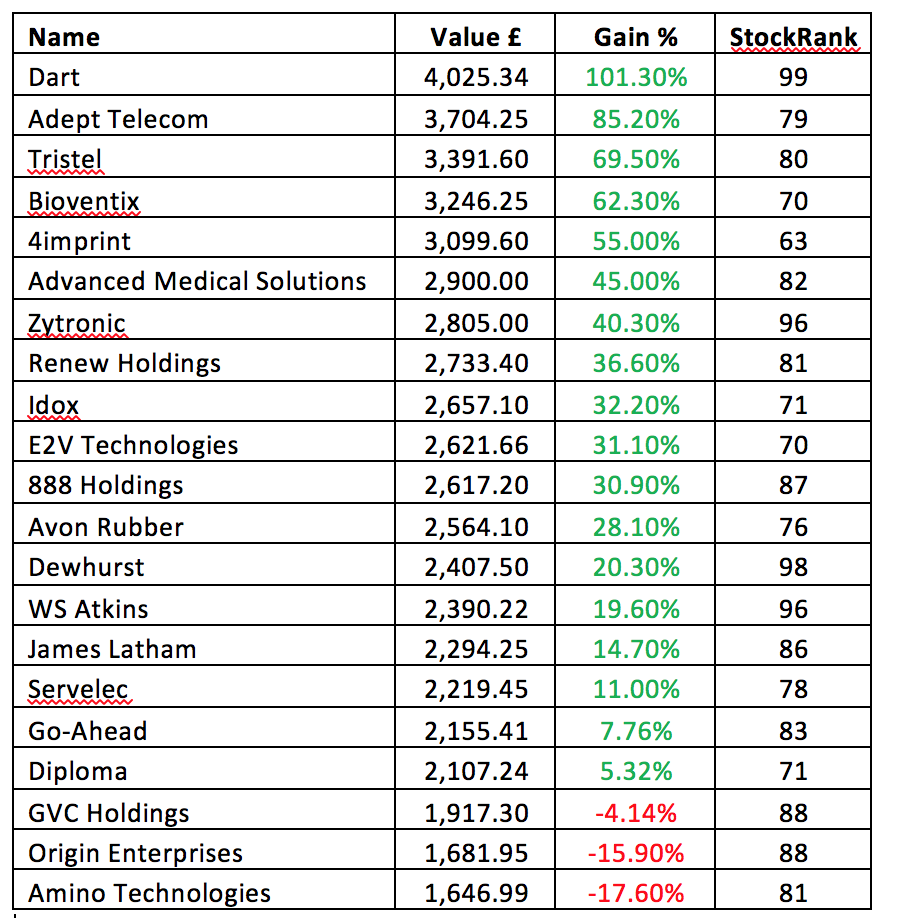
Having invested £42,000 in total, the value of the portfolio on 1st January 2016 was £55,185, giving an annual return of 31.4%. Over the same period the FTSE All-Share has given a return of -2.0%.
Out of the 21 stocks,there were 18 winners and only 3 losers. The biggest winners were Dart (LON:DTG) (+101.3%), Adept Telecom (LON:ADT) (+85.2%), Tristel (LON:TSTL) (+69.5%). The three losers were GVC Holdings (LON:GVC) (-4.14%), Amino Technologies (LON:AMO) (-17.6%) and Origin Enterprises (LON:OGN) (-15.9%).
A full breakdown of the results:
Lessons I’ve learnt
I’ve been really overwhelmed by the success of the portfolio in my first year of investing and have learnt some really valuable lessons:
Factor-based investing works
Sticking to the rules you’ve set does indeed pay dividends! Coming from a medical background, we have the concept of signal:noise ratio in making a diagnosis - certain symptoms and signs are associated with a condition, but the challenge in making the diagnosis is identifying these factors amongst a raft of noise. So to be successful in making the diagnosis you need to know what you’re looking for!
I think the analogy holds true for investing. What I’ve really noticed is that the signal:noise ratio surrounding the stock market is incredibly low. My view is what really matters are the statistically and academically-proven signs that are associated with success, and without having a pre-defined strategy to identify these it’s very easy to get lost in the noise and follow the crowd. Adopting this strategy means I haven't had to spend lots of time checking my stocks or waiting for news because I’ve become increasingly confident that I’ve selected good stocks and made the correct diagnosis!
Cognitive biases can hamper returns
To illustrate this perfectly I simultaneously ran a Fantasy Fund over the year, loosely based around high StockRank companies but allowing myself a degree of freedom in selecting stocks I felt would do well. As you can see here, the portfolio is still up around 10% over the year, but I’ve incurred heavy losses in story-stocks like Tungsten (LON:TUNG), financially-distressed Globo (LON:GBO), and falling-knife Northbridge Industrial Services (LON:NBI), all of which I would have avoided by sticking to a rule-based strategy.
Similarly, the temptation to sell stocks early can be overpowering, especially when you’ve multi-bagged. Running the winners and being prepared to sell the losers is a strategy that has worked well for me over the year.
Good companies tend to keep doing well
I was initially skeptical about investing in companies with good relative strength, but what I’ve learnt is that good companies keep doing well.That may sound like an obvious thing to say but there are so many occasions where I’ve been tempted to buy stocks after they’ve fallen in price, only to see them fall further. Clearly if you time it right there can be some healthy returns to be had, but it takes a lot of skill and you only need to get it wrong once or twice to hamper your portfolio returns. As a new investor I’ve been much more successful in buying reasonably-priced companies that have already surged 10-15% off the back of a good trading update, and have then continued to do well over the course of the year. The caveat is that this may not be such a successful strategy in a bear market!
It is possible to beat institutional investors
Warren Buffet famously said 'It's a huge structural advantage not to have a lot of money. I think I could make you 50% a year on $1 million. No, I know I could. I guarantee that’
Whilst most of us would still consider $1M to to be a lot of money, I think this still holds true! I’ve been apprehensive about my chances of success in the stock market - if fund managers are doing this full-time and can’t beat the market, what chance do I stand!? What has become clear to me is that small-cap private investors are at a huge advantage compared to institutional investors, given our ability to invest more significant amounts of our portfolio in small fast-growing companies and make decisions to enter/exit companies much more quickly.
Personally I’ve found that having easy access to financial data and reports online has made it possible for newbie investors to be much more successful in the stock market than we ever could have been in the past. Hats off to Stockopedia for this!
Looking forward to 2016
My strategy will be to continue to hold the stocks in this portfolio with the strategy of running the winners with a trailing stop-loss.
In addition I’ve created a new portfolio based on the same screening criteria for 2016. I will again be investing £2000 in twenty-five stocks and will provide an update at the end of the year. I will be really interested to see if the screen can maintain similar returns over the year or whether it’s all just been beginners luck!
Happy investing for 2016!
Disclaimer
This is not financial advice. Our content is intended to be used and must be used for information and education purposes only. Please read our disclaimer and terms and conditions to understand our obligations.
33 comments
Hi weycome.
Are you sure you're looking at Dart (LON:DTG) ? Stocko page shows substantial operating and free cash flow for past few years and the Q rank of 95 suggests the algos are pretty happy with the overall quality. I agree the share price had a bit of a wobble last summer (being in the travel sector it took a hit with the Brexit vote and then some of the continental terror incidents) but this seems to have been more down to sentiment than underlying problems and the shares have been on a roll for the past 6 months.
Gus.
impressive BUT I've checked on DART...a random pickon one of your stocks and according to STOCKO there is no FCF PER SHARE for last few years so why has it rocketed ?
GVC Holdings (LON:GVC) now has a lowly stockrank of 27 and whilst I continue to like the story I am wondering if I should be selling some as this is probably the lowest ranked stock I hold.
Looking at their charts, surely at least a couple of those losing shares should have been curtailed by the 20% trailing stop-loss?
Gundroo-have you updated the performance of your 2016 stock picks? Be interested in how they are doing?
Grindertraders's blog post was:
Grinder trader 'My StockRanks Farming Approach - a 20k Real Money Test Portfolio'
You run a 20% trailing stop, which seems pretty sensible in money management terms.
Two questions:
1. Was the stop automatic, or would it require you physical intervention to make the sale.
2. What would you have done with the money if any of the stops had been hit?
Rgds
David
This thread reminds me of some of the discussions on The Motley Fool in 1999. This from November of that year.
"The [momentum] strategy appears a great idea, but why accept 35% over 6 months,(albeit impressive) when 100% is possible after 6 weeks?"
"http://boards.fool.co.uk/mechanical-strategies-577...
The Footsie peak was 6930 at the end of December that year, a level it took 15 years to reach again.
I really loved this article Gundroo and it has made me a great deal more thoughtful about momentum and less obsessed about dividend yield. I have attempted several times to create a decent screen but always set my limits far too high to raise as many as 20 stocks on the list and rarely like them when I look closer. Once I applied your rules to the present day, I found much to admire in the portfolio it threw up. My problem now is how to incorporate some of these principles into my own portfolio management without throwing my own, apparently successful but rather unsophisticated system overboard completely.
I worry a bit about balancing, partly because I probably don't do it that logically or ruthlessly. Maybe I trade too infrequently for that reason. Having said that, my own shambolic method has also raised a return of 30% in the calendar year but while the dividend return has been 5.6%, because I have yet to decide on a stop loss policy as such, i now hold a really weird looking collection with some stocks up 55% balanced by others down 55%.
Gundroo, much appreciation for sharing your investment experiences over this past year. Well done on starting investing early, and for sticking to a strategy - probably the hardest thing is to follow your convictions, through both the good times and bad.
Look forward to your upcoming posts.
Regards,
Cisk
Well done Gundroo. I too am a one year newbie investor. I read James O 'Shaughnessy "What Works on Wall Street"; " How to Make Money in Stocks" by William O'Neill"; "The Little Book that Beats the Market" by Joel Greenblatt; "The Little Book that Builds Wealth" by Pat Dorsey; and "Beyond the Zulu Principle" by Jim Slater. All have been invaluable.
I too started a Fantasy Portfolio, DB9, which, after a wild start with some strange selections until I put in a more rules based selection process, is doing reasonably well at 18.7%. Thanks to Grindertrader, I have started to use his criteria and then pick the highest relative strength in each sector. There are still some that don't meet these criteria, particularly when I get carried away by some of Paul Scott's audiocasts, which is probably why a stricter rules based strategy will work better.
I also look at timing my entries and stop losses by looking at Ichimoku charts (thanks PhilH) and chart signals ( You Tube: StockGoodies Chart School). I read all the wonderful comments from the Stockopedia community and learn a huge amount from you all, especially Paul Scott, so many thanks. Now I have a clearer idea of stock picking and feel a bit more confident, my real portfolio is starting. It is such a different sensation pressing the button with real money !!
Happy New Year to you all
Hi Amanda
Do you have a link to Grindertrader's specific blog post? I've come across a few, but wondered whether you had a link.
Best wishes,
Imran.
Hi Gunderoo,
Thanks for sharing.
A couple of comments on your screen:
1. As your title suggests you've built a Quality & Momentum portfolio. The average stock rank is Q=87 & M=88. However you don't have much value exposure with an avergae rank of V=60. The past couple of years have seen good returns to Momentum and not so much to Value. A lot of high profile Value Investors struggled in 2015. This may reverse at some point - in fact one of the reasons that strategies work is that they face long periods of underperformance. There will be a time when momentum does the same. e.g.
http://www.stockopedia.com/content/what-is-a-momentum-crash-and-why-does-it-happen-69010/
If you find that a QM strategy works best with your temperament then you will need the courage to see out these periods of underperformance and stick with the strategy.
If you consider yourself a quant investor not wedded to QM you may want to consider increasing your value exposure through tightening your value criteria or a seperate value portfolio. It may even have harmed your return in 2015 in a period of value underperformance but it should give you more consistent returns over the long term.
2. When deploying your money you may want to consider some earnings quality measures either quantitively or qualitively. This would avoid the likes of Globo (LON:GBO). Also on your 2016 list some well regarded investors have questioned £MTO's earnings quality:
http://lordshipstrading.blogspot.com/search/label/Mitie
You may also want to check for large or increasing short positions that can be a sign that things are not as rosie as they seem. e.g.
http://www.shorttracker.co.uk/company/GB0004657408/all
Here's my thoughts on how to use this info:
http://www.dangercapital.co.uk/2015/11/using-short-interest-data-to-make.html
3. Dewhurst has 2 classes of share - Voting & Non-Voting - you would only want to buy the non-voting A shares Dewhurst (LON:DWHA) since the voting shares are family held so that your vote won't have any influence and the non-voting generally trade at a discount.
4. Some shares can be quite illiquid despite being MCap >20m. A big spread on a quant strategy that buys and sells yearly can be a big drag on performance. You may want to add a screening criteria on the spread to avoid the shares that have large spreads.
Good luck for 2016.
Hi Dangersimpson.
Thanks for the link to the shorting analysis on Mitie (LON:MTO). Very thorough and well argued, and I note there is still an open shorted interest of at least 5.5% on this stock making it about the 20th most shorted on the list from a group of about five traders.
Not sure if Lordshiptrading is still open on his reported short at £2.70, (dated Jan 2015) but if he is the shares are now at about £3.08 with a running yield of 4.2%. Do you have any sense as to how long traders typically look to keep this kind of position open for? My sense in this case is that the analysis is that the shares are overvalued (rather than that they're about to fall off a cliff as a result of discovery of fraud a la Globo) and that accordingly it could be a long and expensive wait for this particular trade to pay off.
Gus.
Hi Gus,
I don't personally know the author of the Lordship Trading blog so don't know his personal timeframe for investments. If I short anything I try to treat it like any other investment so don't have a shorter investment timeframe than a long position. Where I do modify strategy is to have a much smaller maximum position size to be able to ride out spikes or not suffer serious losses if someone makes an offer for the company. Many small shorts are much better than a few conviction shorts in this regard.
If I understand it correctly the concern with Mitie (LON:MTO) is the increase in long term recievables. That the company keeps booking revenues and profits today for cash that will be recieved more than 1 year in the future and therefore the earnings quality is deterioating. I don't think anyone thinks that what the company is doing is improper just that it adds to the risk. I'm not sufficiently convinced that the risks are serious enough to take a short position myself but tbh I haven't gone into great detail in my personal analysis. However the combination of concerns over earnings quality combined with the level of short interest makes me very wary about a long investment in the company.
This is really my point to the OP. When we make investments based purely on screening results these results are wholly dependent on the figures that are in the database. Therefore we should check these figures before investing. When we make decisions based on reported earnings then earnings quality really matters and we should check this.
In fact the more I think about this the more I think a simple checklist would add significant value to those running mechanical screening/quant portfolios:
- Do the published accounts match the numbers in the database?
- Is the database up to date?
- Is earnings quality good? e.g. does OCF roughly match PTP over the long term?
- Is there a low or no short position declared on the FCA declarations? (see: www.shorttracker.co.uk)
- Are any well known bears with concerns over the company?
- Is the company subject to a takeover offer? (Often missed by momentum quant investors.)
One should be able to answer yes to the first four questions and no to the last two for inclusion in the portfolio.
You may get some false positives where the shorts are wrong but the beauty of a quant portfolio is that you have plenty of other options that have (by definition in your opinion) the same expected return so can easily exclude the few that have concerns raised about them - you really don't need to swing at every pitch.
Mark
Hi Mark.
Many thanks for your detailed reply. I share your view that we should temper our enthusiasm for mechanical stock picking with a rigorous sanity checking of the underlying data - "trust but verify" and all that. I'm quite a simple (minded?) investor in that I prefer to avoid shorting and either go long or stay in cash. Given the start to 2016 I should perhaps broaden my horizons and at least investigate some kind of short hedge based on the market index as a whole.
With regards to Mitie (LON:MTO) (appreciate it's not a stock you are specifically focused on) I've revisited the half year results and management presentation from November 2015. I am not too concerned about the increase in the receivables duration. I note Mitie (LON:MTO) have been increasing the proportion of sales and revenues to the public vs private sector (44% to 56%, 36 to 38% respectively). I used to do a lot of asset based lending and found that although public sector accounts are strong credits they often exact longer payment terms and/or tend to be less punctual making payments when due. I believe this could well be the primary driver of this increase. Needs to be kept under review, but commentary suggests the company is aware of this and working to manage it.
As a general comment, I wonder if there is an element of "me-too-ism" among the shorting community, as I note that Carillion (17.2%) and Serco (4.1%), both facilities management companies are also significantly shorted. Post problems at the likes of G4S, it may be that FM is seen as fertile ground for this particular trade.
Anyway, thanks again for your response.
Best,
Gus.
Hi Gus,
We are probably wandering dangerously OT from the original post but couple of quick comments:
- Maybe you are right regarding payment terms Mitie (LON:MTO) but I'm surprised that a company would accept 1 year+ terms even to a government contract. Did you accept 1 year+ terms in your business? It seems more likely to me that they have booked revenue on contracts that they intend to deliver in the future rather than accepting late payment terms on contracts they have alredy delivered. But again I think the default option for a quant investor should just be to avoid companies that have question marks over their earnings quality even if they are ultimately misplaced.
- Re: Carillion (LON:CLLN) at least some of the short will be due to convertible bond arbitrage so it's quite hard to work out how much is delta hedging and how much is directional positioning.
- I am actually short a small amount of Serco (LON:SRP). They recently announced that they would only generate £50m PTP in 2016 with cash outflow giving £200-250m debt at YE. So their EV = £1.3b = 26 x PTP. Anyone long here is betting on a big turnaround in business in 2017 and the market is not usually that patient with underperforming businesses!
Anyway good luck for 2016.
Mark
Gundroo,
Can I ask why you excluded financials?
Gundroo, Well done for devising an excellent set of rules that gave you great results last year.
If there is a general re-rating of the market, you might have a problem in the future that your rules would produce fewer candidate stocks for your portfolio, for example because there might be fewer stocks in the market that have a PE Rolling 1yr value less than 20. A way to avoid that is to use some screening rules based on average market values, rather than on absolute values. That would produce roughly the same number of candidate stocks for your portfolio each time you used the rules.
For example, instead of using a rule that PE Rolling 1yr < 20, you could use a rule that PE Rolling 1yr < 1.2 x Market Median. (The 1.2 value is arbitrary - you could use whatever value you think is appropriate.)
Thank you all for your kind words! I'll try and keep you posted on the progress throughout the year as promised.
For anyone that’s interested I’ve created my screener here so you can see what stocks are flagging up for 2016.
Paul - interesting what you're saying about the growth re-rating. I did consider using PEG Rolling as a screener for the growth component this year. Looking back the average PEG rolling for the 21 stocks was 1.68 at beginning of 2015 and is now 2.05, which fits with a significant re-rating. Similarly the stocks flagging up for 2016 have an average PEG of 2.12, so not necessarily the cheap growth. I think 33% will be hard to beat!
Gundroo.
Thanks for posting your list. A reassuringly large number of these correspond with my own QVM Naps picks that I derived from a different set of selection criteria.
On the understanding that you have a broad enough group to be able select a subset to invest in, what further criteria do you apply? You might want to consider applying a slightly subjective test and look through some of the recent discussion threads as one or two of these stocks (e.g GVC Holdings (LON:GVC), Renew Holdings (LON:RNWH), Connect (LON:CNCT) ) may have a bit of hair on them such as excessive Executive LTIPs or comparatively weak balance sheets that aren't necessarily picked up in the raw Stockopedia stats. Also, as you allude to above, you might want to look at the specific Value Rankings as one or two of your screened stocks look quite expensive.
Good luck,
Gus.
Thanks for posting only just seen it. I agree value does not look so good, in fact I was considering selling some of those on valuation grounds. Yes I prefer PEG to PE, you can use the Slater PEG on these screens I see. I would not buy 2 companies in the same sub-sector, ie Vertu and Cambriam Autos.
Excellent post Gundroo, thanks for such a clear and comprehensive write up. I think watching the performance of your 2015 portfolio into 2016, then comparing that to your new 2016 portfolio will make excellent reading if, as we hope (see requests above), you post updates in the future.
Regards
Howard
Impressive post, thank you for sharing. Well done on how much you've learnt in such a short period of time.
Well done Gundroo, not beginners luck, you put in the work and stuck with the plan. Clarity of thought unhindered by history and opinion has rewarded you well. There are three phases of entrepreneurial life the first is starry eyed enthusiasm developing into mature simplicity followed by complicated sophistication. The last is the road down, you read with enthusiasm, acted with maturity avoid the mistake of complicated sophistication. Stick with the rolling stop loss and protect what you have.
Wonderful, l thoroughly enjoyed reading this and hope you continue updating us on your investment journey!
Who knows you may be giving our resident small cap man a run for his money...
Yes, splendid results! Keep the updates coming :)
Well done mister medical man fascinated by your noise signal ratio you deserve to do well in the future after all the hard work
A lot of knowledge plus success in one year for someone who had never studied the stock market before..well done! Impressive! Very Impressive.
A terrific article, a model of clarity, both in thought processes & explanation. Very impressive results too, well done!
It's been a very good year for growth companies, with many having perhaps one-off re-ratings, moving to much higher PERs. The danger now is that they might be fully, or over-priced, and maybe mean reversion might kick in at some point? So it will be interesting to see if the same approach keeps out-performing in future years. It does look a sensible set of filters though, I must say, so excellent work.
I'm looking forward to future articles from you.
Regards, Paul.
Great post thanks for sharing, i will look forward to your updates, well done.
Well done in your first year thats an excellent return. Some interesting rules, it will be good to compare yours with NAPS which was done about the same time and see which rules are working.
PS I think you meant 2 Jan 2015 not 2014?
Congratulations on a successful 2015 Gundroo, and thanks for sharing this excellent piece !