RM plc: faltering QM stock or undervalued buying opportunity?

Rm (LON:RM.) is a leading supplier of technology and resources to the education sector - and a small cap that has been earmarked by Stockopedia’s rankings as a promising Quality Momentum (99) and Value Momentum (88) candidate.
With a market cap of just £231m, annualised revenue of £224m and a strategy that involves moving into higher margin global markets, you would think then that there is plenty of opportunity for earnings growth and share price reratings here.

Founded in 1973 as Research Machines in Oxford, RM initially traded as a mail-order supplier of electronic components and then moved on to creating and supplying computers to UK schools. The RM of today has long since moved on from the low margin supply of hardware. Instead, it focuses on providing software solutions and automated exam processes to educational establishments around the world.
RM’s old core business of providing computers to schools was low margin and capital intensive. Education cuts in 2011 hurt the group badly, prompting a review of its businesses. Hundreds of jobs were cut and non-core divisions were jettisoned.
You can clearly see this story playing out below, with a spike down in 2011 followed by declining revenues but increasing margins as the company set about becoming more profitable and expanding into higher margin software services.
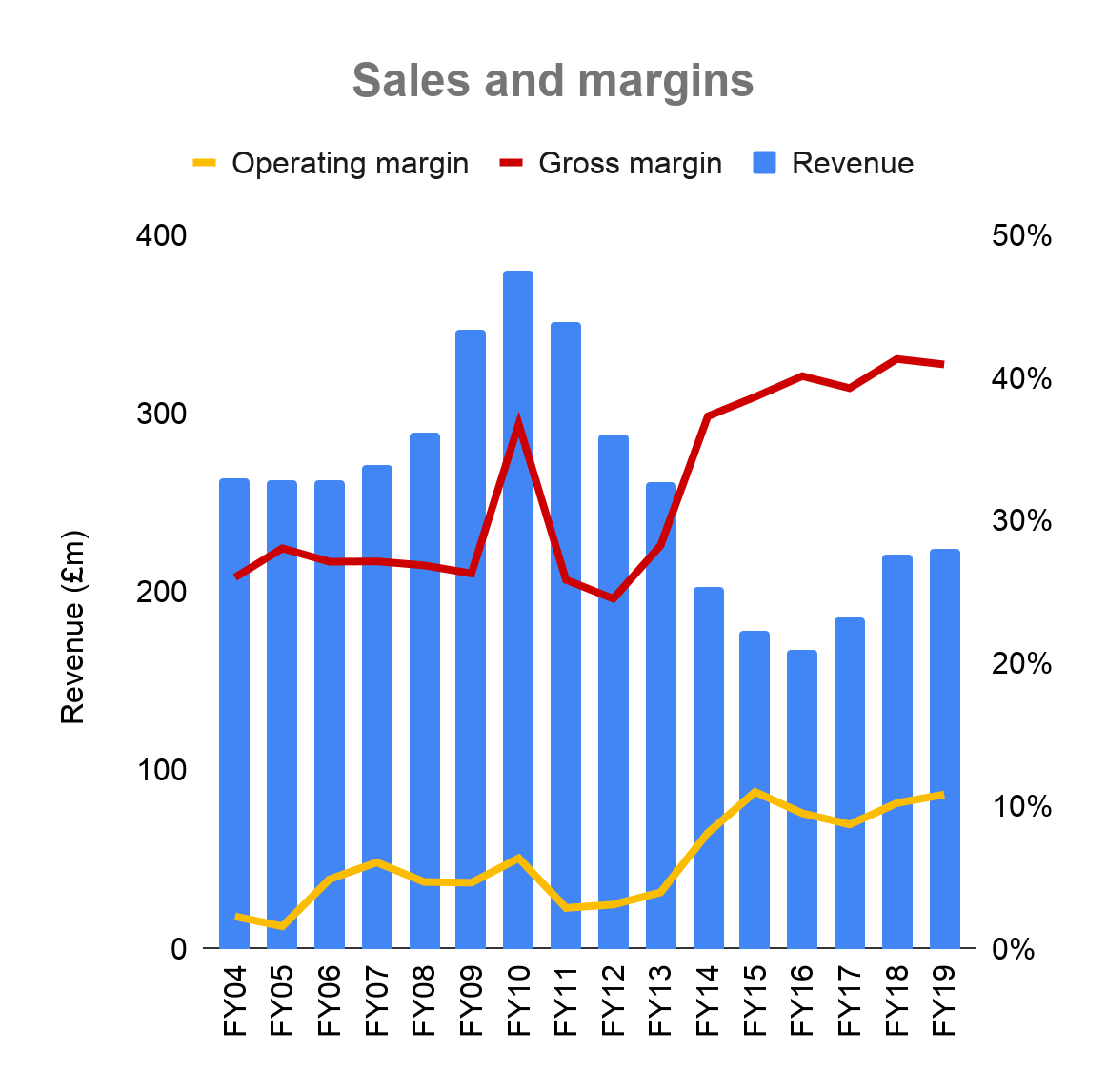
So it looks as though RM is evolving into a more profitable, higher margin company. It certainly talks a good game of higher margin integrated products, growing intellectual property and international expansion.
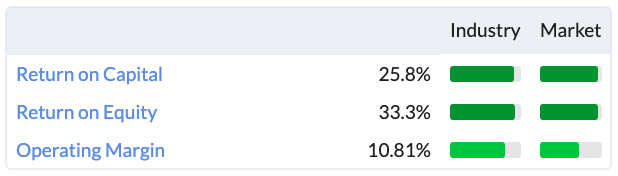
This, you’d think, would allow for a much larger and more profitable company. The company’s return on capital figures suggest it is finding smart ways of investing its capital
Upon closer look though, I do have some concerns which I go into below.
Is RM at an inflection point or does it flatter to deceive?
With the exception of 2011 the group has a solid history of making dividend payments to shareholders.
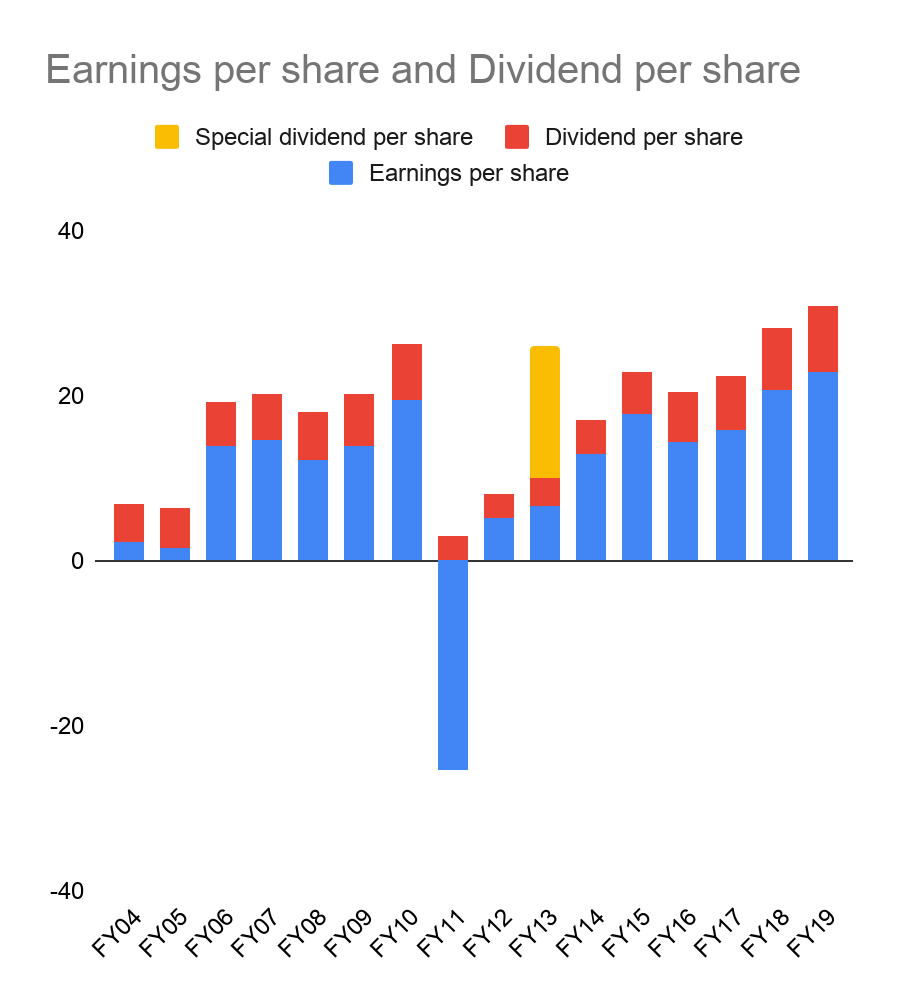
RM’s FY19 results show 23p of earnings and an 8p dividend - not bad when shares are trading at c280p. However, the update is a mixed bag with lots of moving parts.
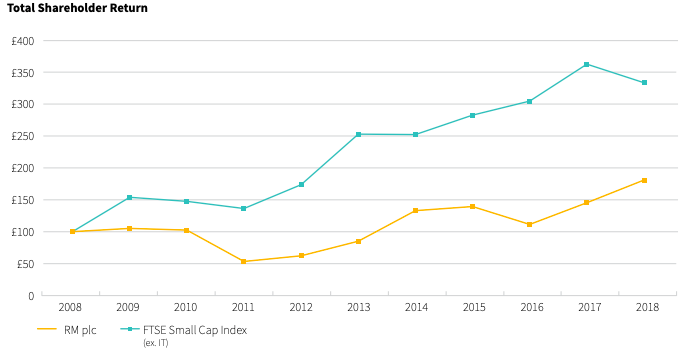
The company’s own performance graph in its 2018 accounts shows that being an RM shareholder has been underwhelming in the past. Is this a company at an inflection point that is about to embark on a period of significant growth, or have shareholders heard it all before?
FY19 in review: “steady” progress but where is the growth?
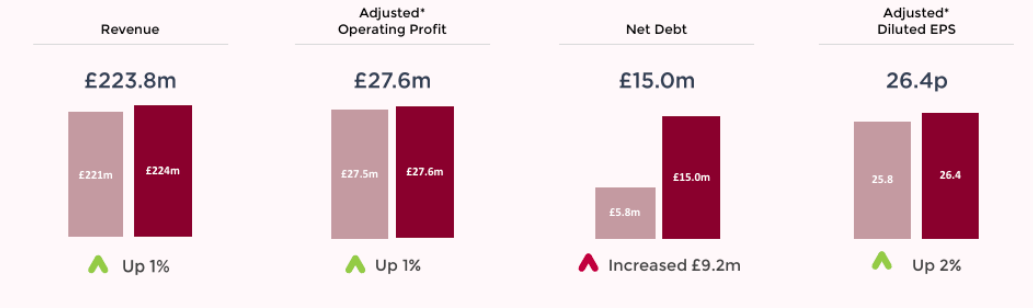
In its recent preliminary results announcement, RM says 2019 has been a year of “steady” progress, with revenue and operating profit up slightly thanks to good performances in its Technology divisions, which more offset a challenging year of trading in RM Resources.
International revenue grew +18% thanks to strong RM Results due to new contract wins & growth with existing customers - but the group’s overall results are hardly those of a high growth company:
Source: FY19 Analyst Presentation
The group is split into three segments:
- RM Results: a world-leading provider of e-assessment services, enabling e-marking, e-testing and the management and analysis of educational data.
- RM Resources: a provider of education resources for early learning centres, primary schools and secondary schools across the UK and internationally.
- RM Education: a market-leading supplier of ICT software and technology services in the UK.
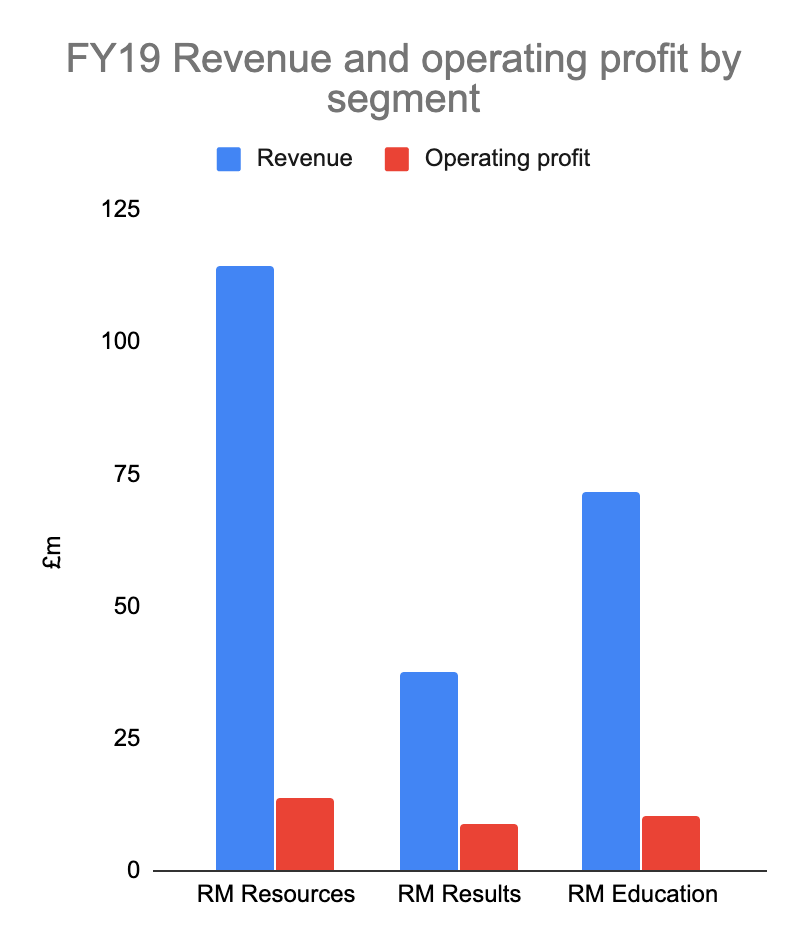
Below are the FY19 revenue and adjusted operating profit figures for each of the segments.
RM Results
This is the one shareholders are hoping will drive growth in future. It automates exam marking and provides the technology to allow approximately 15 million exams to be taken each year, working with prominent exam providers, professional bodies, universities and governments.
You can see its profit margin is nearly double that of the other two divisions, so continued growth here would be great for company margins. Here is how the division has grown over time:
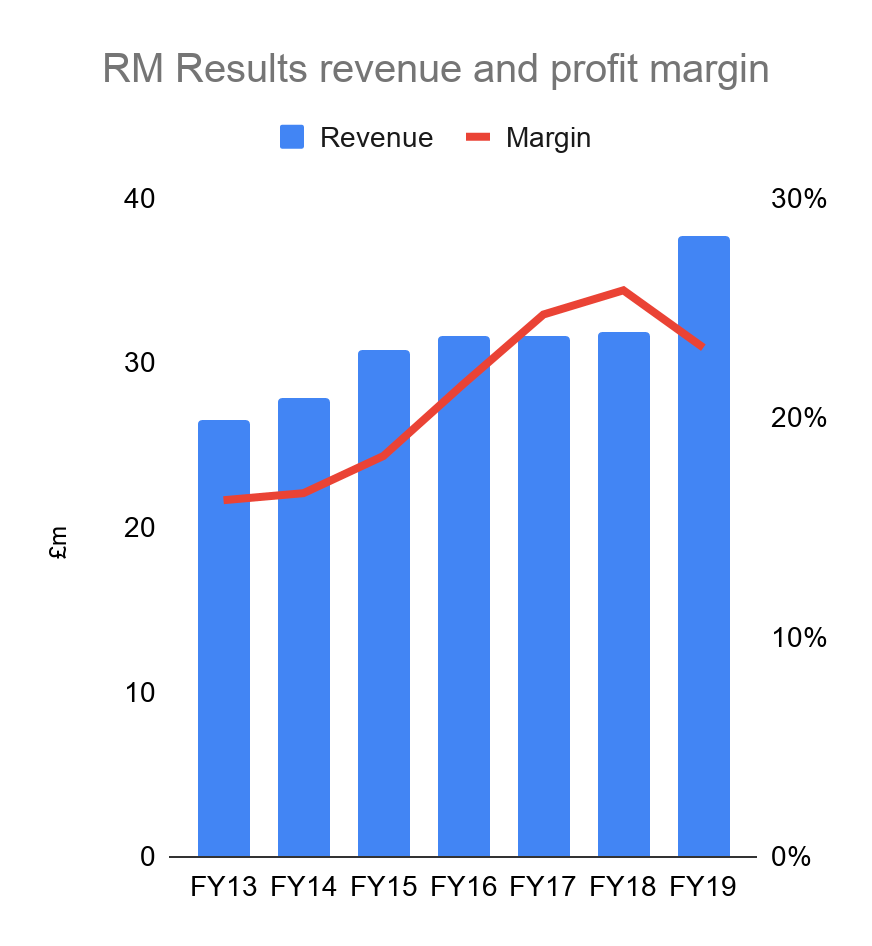
Revenue here has only grown at an annualised rate of around 6% a year since 2013, although annualised operating profit growth has been a more encouraging 12.5%.
That said, FY19 does show a nearly 20% jump in revenue thanks to new client wins and enhanced business from existing customers. Promisingly, RM says “the pipeline of opportunities for RM Results continues to be strong going into 2020.”
This division should also benefit from an acquisition made during the year...
SoNET acquisition
SoNET is a strategic acquisition that brings new technology to RM Results, allowing it to offer a “full end-to-end digital assessment service” to customers. Headquartered in Melbourne, Australia, SoNET provides Software as a Service platforms principally to the education and government sectors.
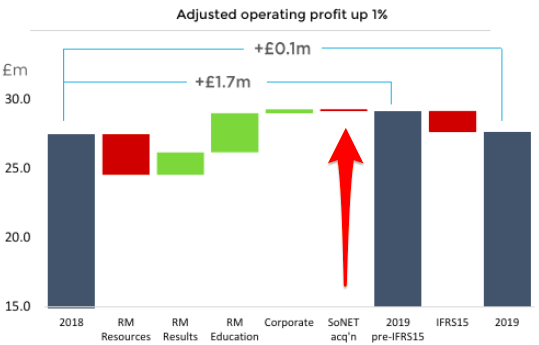
RM purchased SoNET in June 2019 for £7.3m, valuing the business at 2.43 times sales. The purchase has driven net debt up by £9m to £15m. This does not look to be immediately earnings enhancing deal. In fact, RM’s own adjusted operating profit slide shows that SoNET contributed a small loss to group results in the period.
Source: FY19 Analyst Presentation
RM sees SoNET as a mid term growth opportunity that strengthens RM Results and opens up additional international markets. The group does say that “The addition of this technology is starting to open new market opportunities and accelerate the growth of the RM Results division” though so perhaps this will drive RM Results performance sooner than expected.
We shall see.
RM Resources
RM Resources’ brands, TTS and Consortium, develop and supply resources to help bring the curriculum to life for teachers and students. This division hopes to meaningfully reduce its cost base by consolidating five distribution centres into a single automated facility (expected to be completed by the end of 2021).
Performance has been poor in 2019, however.
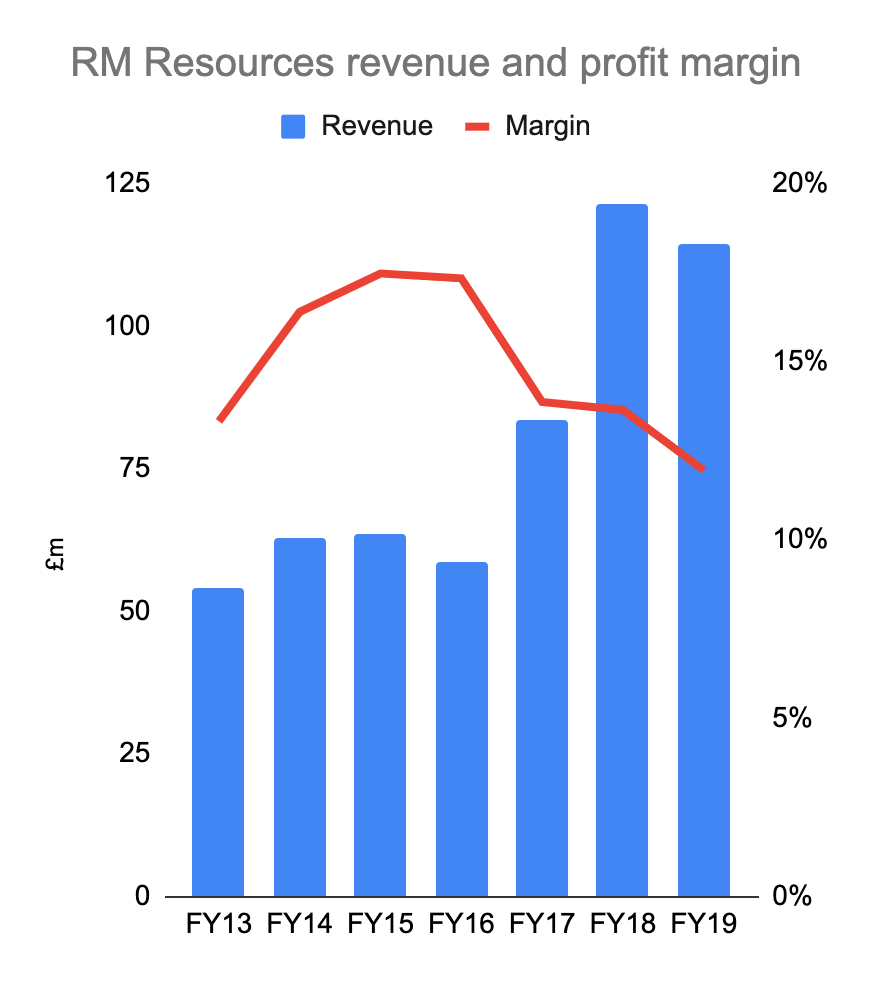
Resources’ notable revenue growth from FY16 through to FY18 was primarily driven by the £56m acquisition of Consortium. However this growth also coincided with a decline in margins and in the FY19 results, RM attributes a weak Resources performance to this recent large acquisition.
Consortium had a tough time in 2019, down 9% and underperforming the wider market (which was down 4%). Some of this underperformance was driven by “service blips” that have since been fixed but have impacted order intake, making for a possible headwind in upcoming periods.
To my mind, this raises questions concerning RM’s acquisition track record.
RM Education
RM Education is a market-leading supplier of ICT software and technology services in the UK. It enables schools to save time and money, create a secure environment and enhance teaching and learning.
RM Education is by far the most changed division in the company. Looking purely at the numbers, its transformation is very encouraging. While revenue has dropped at an annualised rate of 12% since FY13, profit has actually grown at about 1.5% per year over that period.
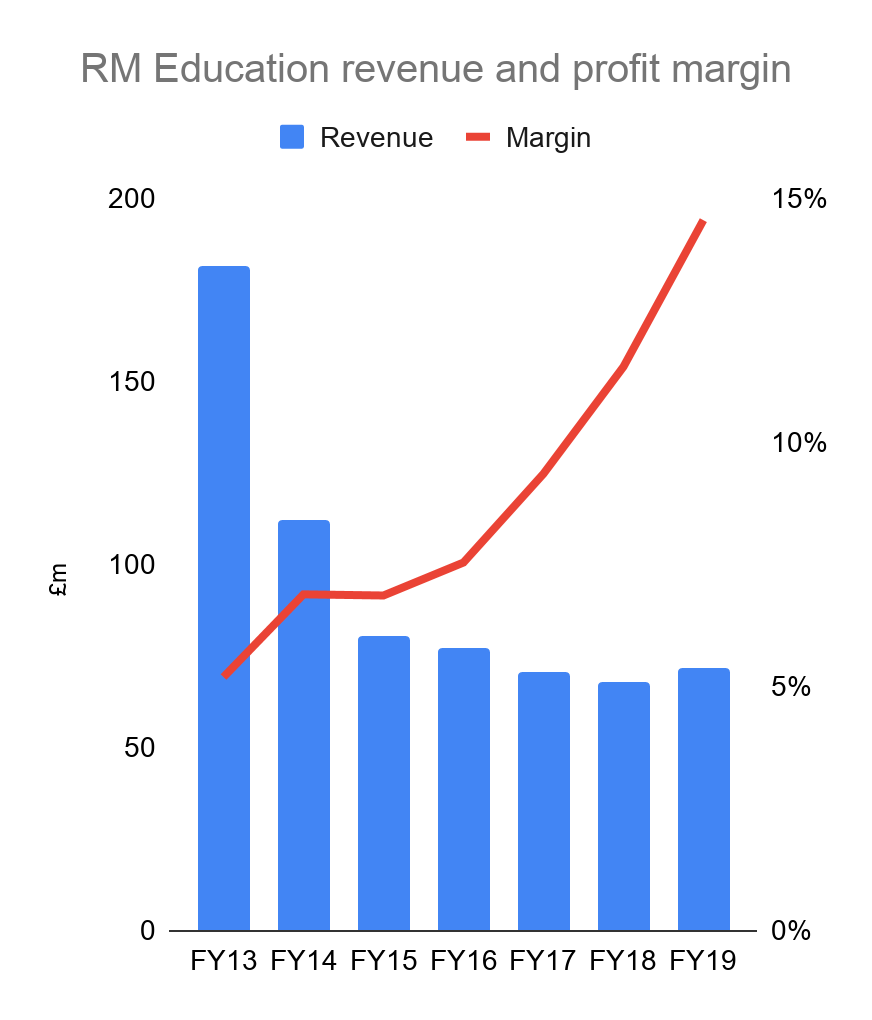
This was actually the first year of revenue growth in this division since 2010, and adjusted operating growth has grown strongly. With 70% of revenue recurring in this division, perhaps there is more to like about this division than has historically been the case?
Pension fund risk
Shareholders are rightly wary of defined benefit pension funds. These funds are under no obligation to provide shareholders with detail concerning assets and liabilities but are not afraid to drain company cash flow in the form of annual contributions. It’s a bit of a one-way street.
The IAS19 net deficit (pre-tax) across the Group increased by £3.7m to £6.0m (2018: £2.3m). This increase was caused by an increase in the liabilities of the Schemes driven by lower discount rates.
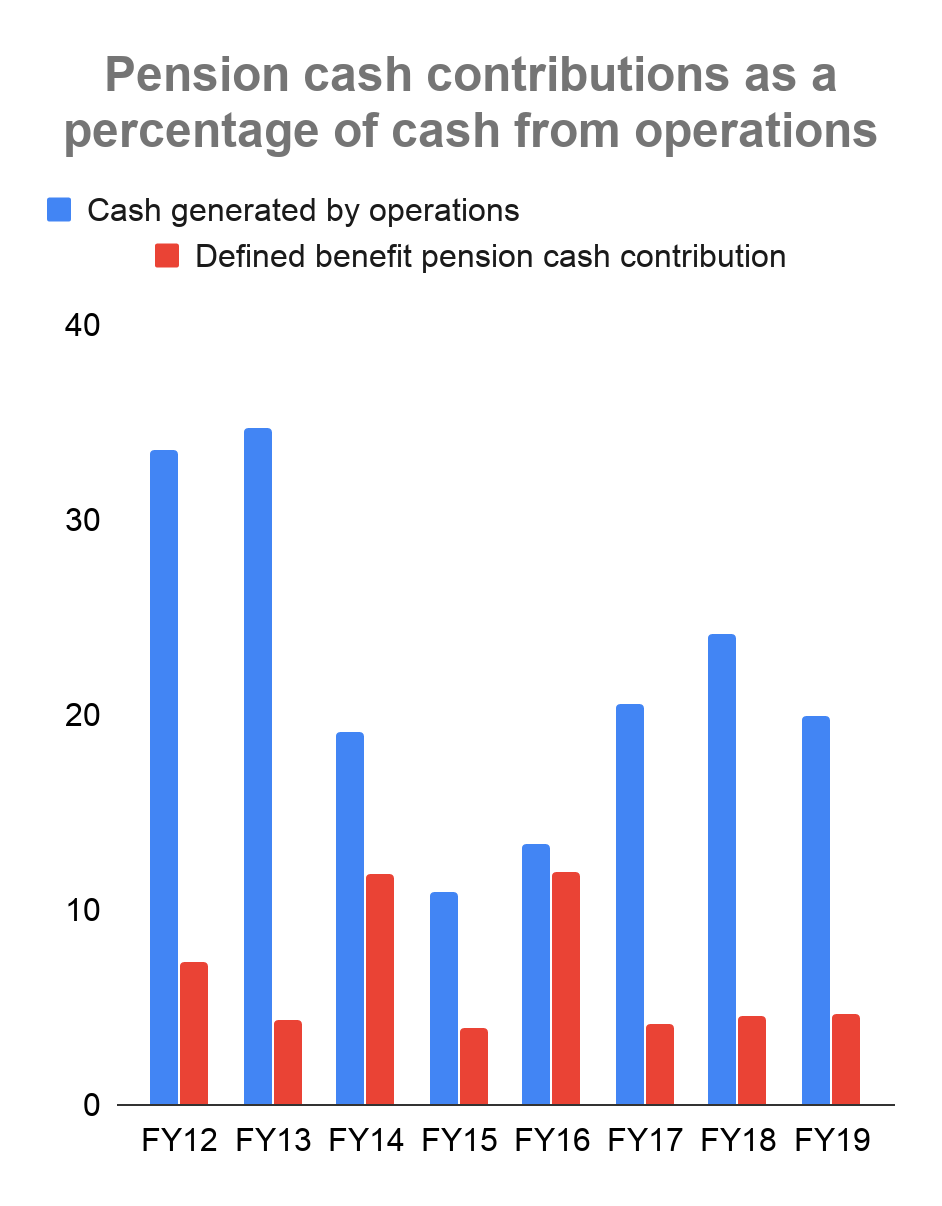
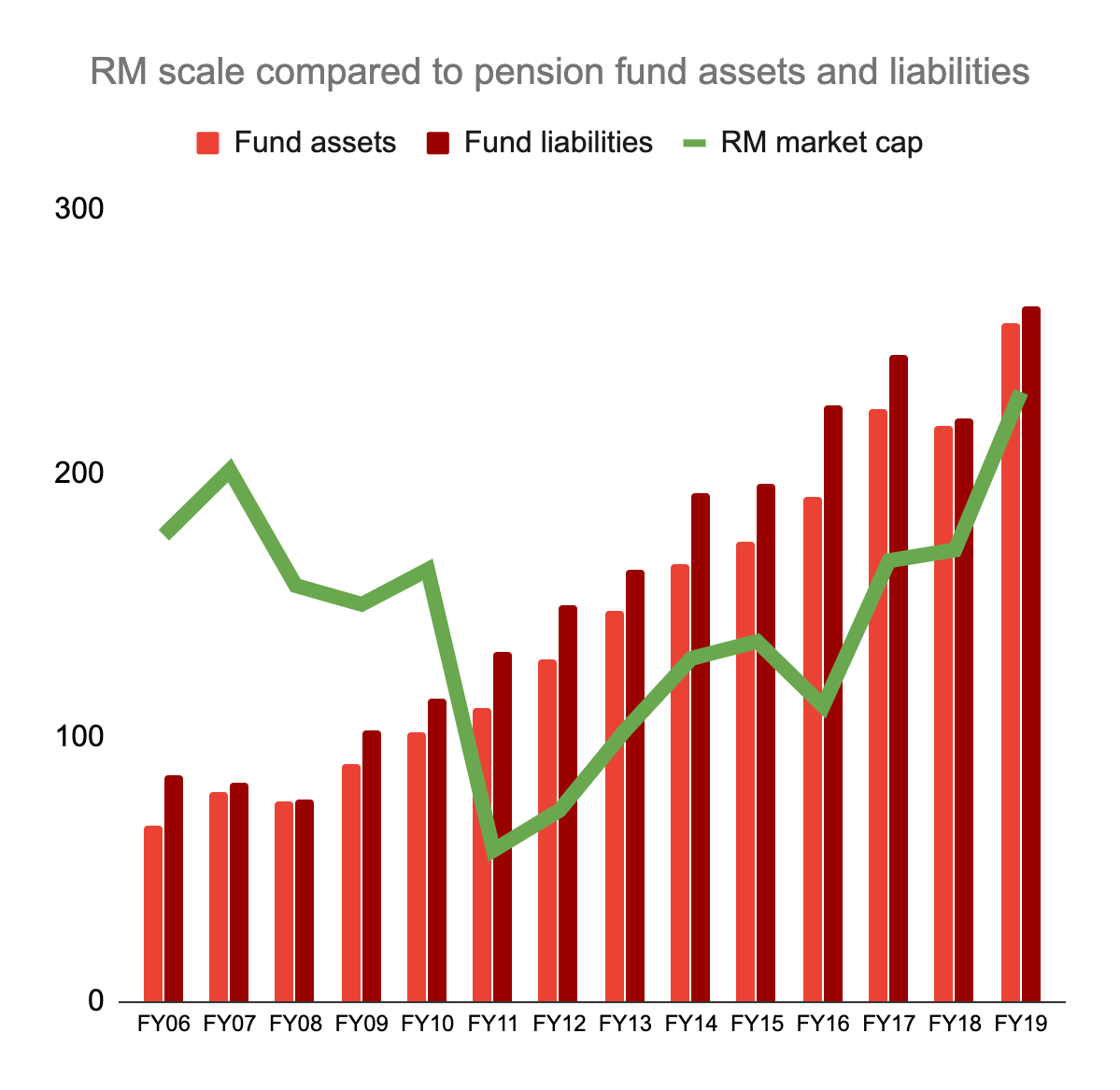
RM has a small pension deficit by accounting standards, but the triennial actuarial valuations are what decide the cold hard cash contributions a company has to make. As you can see in the chart below, RM has to hand over a meaningful amount of cash flow to its pension funds.
The group’s IAS funded status figures historically understates the triennial actuarial valuations, which are more important as they then dictate the real cash contributions a company has to make. Perhaps the recent IAS calculations are a leading indicator and signify an upcoming reduction in the actuarial deficit?
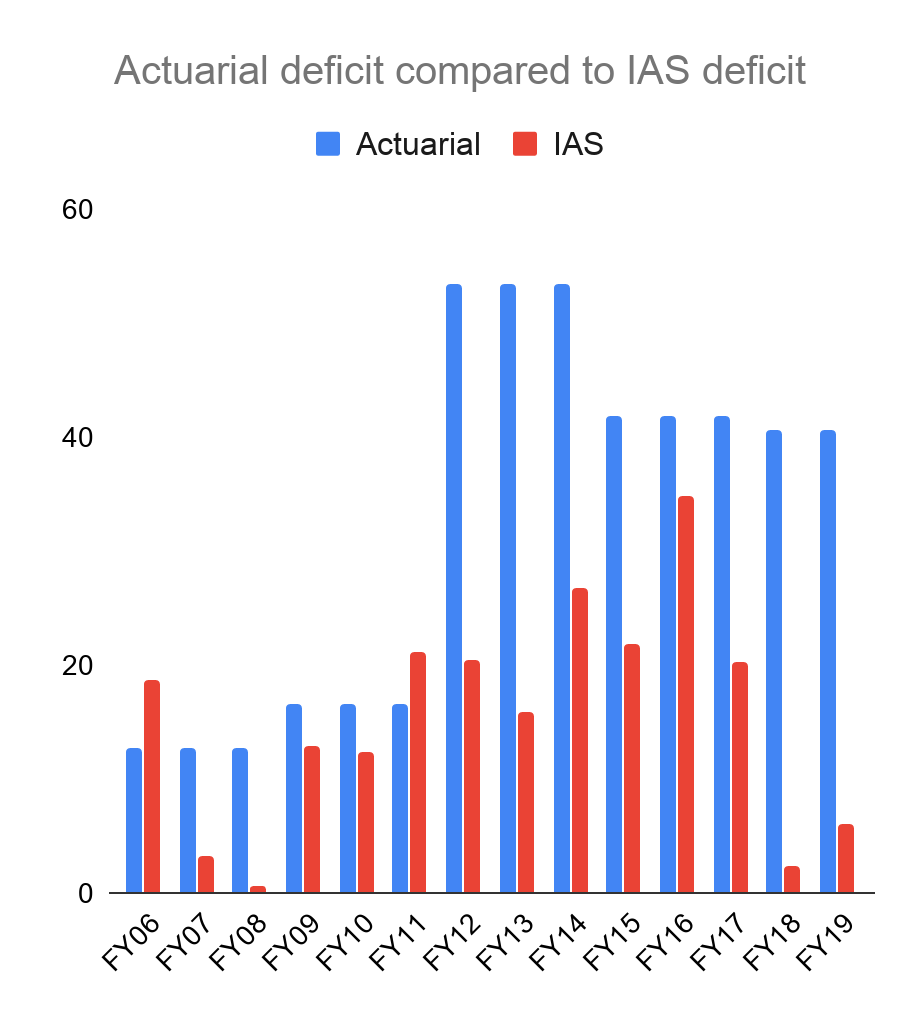
Pension funds are tricky beasts to analyse given that company shareholders are typically on the outside trying to look in. That said, given the size of the annual cash contributions RM has to make and the size of the absolute size of the funds themselves, I do think these funds are an important financial risk for prospective shareholders to consider.
I am concerned that the size of RM’s pension funds have roughly trebled since 2008, although this might have happened to most companies with pension funds as a result of low interest rates.
Cash generation and uses of cash
One further slide that caught my eye in the group’s FY19 analyst presentation:
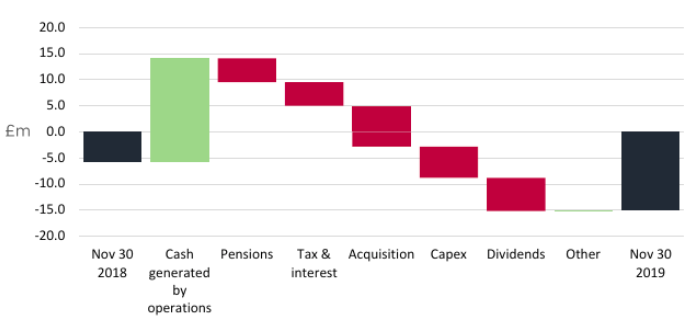
This shows that even without the SoNET acquisition, RM did not generate enough cash from operations to completely cover pension payments, tax and interest, capex, and dividend payments in the year.
- RM generated £19.9m in cash from operations in FY19
- It bought SoNET for £7.8m
- The group funded £6m of capex
- It gave up £4.6m in defined benefit pension contributions
- It paid £3.6m in tax, and
- Paid out £6.3m in dividends
Net debt at year end was £15m after funding the SoNET acquisition (helpfully, RM explains that the average net debt position during the year was higher, at £24.1m, with the highest borrowing point being £38.7m). Capital expenditure is set to increase to around £10m per year for the next two years and RM is also forecast to pay out an increased dividend in FY20.
In my view, the net debt position could increase as RM builds its new warehouse, pays out dividends, continues to make pension contributions, and searches for additional acquisitions.
Conclusion
I’ve spent longer on this than I intended… For a £240m small cap, I find RM a surprisingly complex proposition. There are a few moving parts and it feels as though when one bit starts to grow, something falls over somewhere else.
Perhaps the most efficient way to summarise my thoughts is to bullet point pros and cons.
Pros:
- Modest valuation: RM trades on a forecast PE of just 10.5 times, nearly one times sales and it pays out a useful 3% forecast yield.
- The group is investing for international growth.
- RM Results looks like a genuinely exciting, high margin proposition.
- Moving from five warehouses to a single site with greater automation should drive profitability once it is live in 2021.
- The group has an attractive factor profile (high QM, high VM, StockRank of 91).
- The group has a solid c10% operating margin and good return on capital (25.8%) and equity (33.3%) figures.
Cons:
- I am unconvinced by RM’s track record of acquisitions. Consortium was acquired for £56m in 2018 but is currently causing headaches at RM Resources. SoNET has been acquired for 2.4 times sales but has so far only contributed a small loss.
- Pension cash contributions are a consideration, at c£4.6m per year.
- Net debt has increased and could increase further given the outlook of higher capital expenditure and dividend payments.
- FY19 results are mixed and growth is limited.
- RM’s balance sheet shows negative net tangible assets of -£12.5m after accounting for £49.1m of goodwill and £23.3m of intangible assets.
Given the group’s cash generation and the fact that a reasonable portion of its revenues are recurring, perhaps this last point is fine. But add to that lacklustre growth in FY19, the potential for increasing net debt, and question marks over existing acquisitions and there is enough keep me on the sidelines. There is a good growth story here, buried under the results, but I am yet to be convinced. If future updates show concrete evidence of more meaningful, sustainable growth - or if anybody wants to present a more bullish argument for RM in the comments - then I will happily consider it.
Disclaimer
This is not financial advice. Our content is intended to be used and must be used for information and education purposes only. Please read our disclaimer and terms and conditions to understand our obligations.

16 comments
I've owned Rm (LON:RM.) for several years (2015 or 16) from +/-150p level. Even at 300p it was a bit of disappointment in terms of performance and obvs the trough of covid even pulled me underwater. I bought more of many shares I own during that period but not RM as its been going through a little bit of a muddled execution period (normally superb) with the acquisition of Consortium into the RM Resources biz not going smoothly. Plus I found it near impossible to imagine how they would handle the pandemic and its aftermath whereas with others I could get more handle on it. There was a chance of an emergency raise required...
...to date they have managed it really well. Once again showing just how well run the business is and showing a bit more robustness in end markets than feared. I regret not buying more but I don't beat myself up as I spent my £££ where I could see more.
It's a fairly complex small business with majority of sales linked to UK state schools (so not a client base to love for last decade). Current CEO took over c.2012 and was an internal promote (I believe at business since graduating). He has overseen a massive reorganisation and turnaround of its operating businesses that has seen sales half peak to trough but margins and quality of earning continually improve such that they earned as much on half the revenue. This is roughly where I got in as it felt to me that market was blinded by the revenue side and missing the beauty underneath
c.2018/19 I believe RM felt ready to sing their song to the market and court more attention. This introvert group (and CEO) became more extrovert...they felt that strong margins would now be backlit by compound headline revenue growth (adjusted for Consortium acquisition...ie that revenue jump in 2018 is acquisition)...
But the acquisition stumbled, therefore revenue and profits stayed static (as growth in RM Education and RM Results held back by RM Resources). Then covid came along too. Boom!
Anyway, CEO David Brooks notified the board of his desire to resign in Sept 2020 and will leave by March 2021. I'm sad to see him go...and if he lands at one of your companies you are lucky...particularly if it needs a little sorting out. The task he undertook at RM was massive and complex and for a bit of bad luck at the end would be shining. I suspect he's put so much in that he needs a break from it. The trashing of his 'graduation party' by events probably made it time for him to personally move on
What happens from here? At £160m market cap and assuming that a degree of normality returns to end markets then RM is likely significantly undervalued:
Current share price undervalues RM Education + RM Results given margins and growth -> approx £100m revenue pre covid and should be able to normalise, approx 20% blended margin with RM Education margin improving drastically (turnaround work) and forward growth likely in top line revenue for combo (again RM Education turnaround mainly in the bag), lets call top line growth high single digits (hopefully more)
RM Resources is not a failed business and in fact the plan to consolidate old RM Resources biz with Consortium into one major warehouse and distribution business is quite simple value creation (although requires upfront capital clearly...approx £25 from memory). How to value is trickier but with c.£110m pre covid sales (probably a little temporarily depressed) and margin of 12% (again a bit depressed) its at least worth a significant chunk of the £160m market cap....and this is the business segment undergoing the heaviest surgery at present by surgeons that have good track record. In addition they are in a position of dominating the school supplies market in UK...not a sexy position but one that nevertheless has value and durability...the sort of thing private equity houses see...(I'm not a fan of the idea of selling it off just making the point).
Pension issue is well flagged by Jack. Its been a pain but it has been actively dealt with over the years and a lot of the remedial work has been done and its far from an albatross. Perhaps deflation is a head of us and liabilities will overcome assets (and remember this is why defined benefit pensions have been ploughing money in for 20+ yrs now as secular disinflation inflates liabilities) but a slight secular shift in inflation or discount rates has powerful impacts on liabilities.
Overall, RM is hard to love....but is probably quite to very undervalued and probably has good non cyclical growth ahead of it.
Good insights Mojo. Will buy back on a dip. Current holding of RM at 70p so its been kind to me over the years and hopefully will continue to do so.
Careful now Berksbee ....I have not done a good job on RM so far ;)
Hi Jack, Hope you get to see this as its been a long time since you wrote the article.
I sold some LON:RM @258 back in Feb as indicated, bought back in in March @ 158, sold in April @ 204 and am now looking at buying back @170. I was wondering if you had a view on RM post Covid - in theory it should be a massive boost for an online education provider.
Very thorough analysis and summary. I have this on my watch list and will keep on watching based on this.
Really useful analysis. I will sit this one out but, keep em coming
Great article and impressive analysis.
Great analysis thanks.
I have been a long term holder though have top sliced last year. My couple of points...
Re: RM Resources - they are investing c.20m into a new distribution centre but have said it will lead to material cost savings. if we think that might be 3% margin enhancement on 120m of turnover that it material to future profit growth in 2 or 3 years times. Also they have said they will sell the old warehouses and cover the majority of the investment. So it is an attractive investment proposition for them to embark upon.
Confirmed Gvt spending will also benefit this area of their business when it has certainly been held back in 2019 as schools needed to fund increased contributions to teachers pensions.
I felt the tone and body language of the results presentation was quite confident.
Secondly I think they are a very likely take over target. They are a chunky size for an overseas player and i'm sure there must be international economies of scale for the technology divisions as well as the general central costs to be eliminated. US businesses are rated much higher so RM would be a nice earnings enhancement for them.
For me this is backed up by observing daily trading patterns for the past 6 months and reported share volumes. The chart break above 200p last year was a very positive move after 10 years of trying to break that level - I find when such long term breaks happen the upside can be substantial and prolonged , so although it is up a good 35% since that break out, I am prepared to hold in size until there is definite evidence of no share price support especially when I feel a bid is an above average possibility.
Defined-benefit pension plans have proved to be a huge source of risk and uncertainty in the past. I'm surprised there are still companies left that have them.
They haven't always been good for employees/retirees in the past, either. A promise to pay a defined pension isn't worth much if the company making the promise goes bankrupt.
Really useful - long term holder with a sub £1.00 in price but still tempted to shave my stake and cash-in a bit more profit. Its the pension over hang that concerns me - but super low interest rates have pros and cons - cheap debt and high pension liabilities or visa versa
Interesting analysis, thank you. I sold my holding yesterday, having done quite nicely, because of uncertainty over future growth. I shall continue to sit this one out.
Other matters needing further investigation: FCF is weak; ‘Other operating expenses’ (what?) are 70% of Gross Profit; Working Capital is falling (which could be good, but will it reverse in future years?) despite Accounts Receivable rising proportionately faster than Revenue; high and rising Goodwill & Intangibles.
One thing that alarmed me on this week's results was that inventories had risen from £17.7m to £22.2m on flat sales in the Resources division. By my reckoning, this is the only division that would need to hold significant inventory. There's no explanation given for that in the announcement as far as I can see, so I sold this morning having done very well with this share, but sharing the concerns others have expressed.
Thanks for bringing these up... I ran out of time here but there's definitely enough to explore for a follow up at some point. I'm sure I'll revisit. It sounds as though a few people on here have done very well on Rm (LON:RM.) so congrats to holders.
I wish the company well but I've seen enough to keep me on the sidelines for now. If the company can establish more of a trend of broad-based revenue and profit growth across its divisions over a string of quarters I will be interested and would happily forgo some share price gains in exchange for stronger trading momentum. When I do return to it I'll make a note to check up on the points you raise.
Hi Jack
Interesting analysis - thanks - just wondering if you had an updated opinion now that RM sp has dropped to 218p? Looks interesting to me but not sure how the current situation will impact, although thinking the Results division of the business might do well out of this as e-learning is adopted more broadly.
Thanks
Martin