Rockrose Energy: is this share price just too cheap?

Investors have high hopes for Rockrose Energy (LON:RRE) - it was the single most popular pick in our Stock Picking Challenge 2020. Why are so many savvy retail investors predicting big things in 2020 from this North Sea oil producer and explorer?
The bull case is that Rockrose shares are cheap given recent acquisitions. A rapid roll-up of assets is not without execution risk, but so far Rockrose has proven to be an extremely lucrative investment for long-term shareholders.
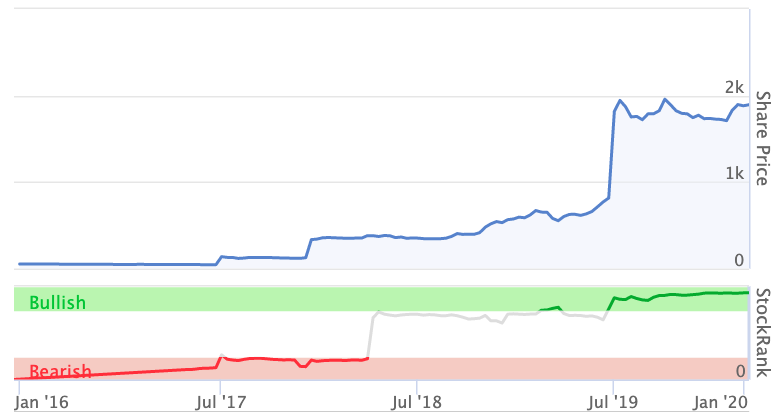
It has been a pretty stratospheric ride so far: the share price has shot up from 51.5p to 2,107p in just four years. Meanwhile, the share count has risen from six million to 15 million shares in issue in order to fund acquisitions.
In 2014 a sudden crash in the oil price caused many overseas operators to evaluate their North Sea oil and gas portfolios. For some (particularly US and Japanese operators), it kickstarted a period of retrenchment. They left behind mature, profitable operating assets that were deemed to be non-core.
Andrew Austin, the executive chairman and founder and 27% owner of Rockrose Energy, saw an opportunity. A new vehicle could step into this void and roll up orphaned sites. In this manner, you might rapidly assemble a substantial portfolio of North Sea oil and gas assets.
Four years later, and that appears to be what is happening. The group has gone from a standing start with a market cap of £5m to more than half a billion dollars in assets and a market cap in excess of £260m. Here’s a quick recap on how the group did it.
How to build a North Sea oil and gas producer
2015: incorporation
RockRose Energy is established as an acquisition vehicle to identify onshore and offshore production opportunities and infrastructure projects.
2016: listing
On 13 January 2016 Rockrose began trading on the London Stock Exchange, raising £4.4m before expenses at 50p per share. The team looked at more than 35 opportunities with a focus on “mature cash producing assets in politically stable geographies, particularly in the UK.”
2017: Egerton, Sojitz and Idemitsu
The group agreed to acquire Egerton Energy Ventures for £1m in March, before raising £8m at 150p in July. A month later, Rockrose acquired Sojitz Energy for £2.5m. Later in the year, the group made its biggest acquisition so far: Idemitsu UK for £29.7m.
Following these acquisitions, RockRose had a projected 5,250 barrels of oil equivalent per day (boepd) of production in 2018.The production and cash flow provided by these deals created a solid platform for further expansion.
2018: Dyas and Arran
2018 was a big year for the company, with two substantial acquisitions.
First, a deal to acquire a package of non-operated producing assets from the Dyas group of companies for €107m. This transaction added 6,000 boepd to group output, taking the total to over 10,000 boepd. Some 13 million barrels of oil equivalent (mmboe) of 1P reserves (proven reserves with at least a 90% chance of being profitably recoverable) were also added.
On 8 August 2018, RockRose acquired a 20.43% interest in the Arran field development for a nominal amount. This development brought another 8.6 mmboe of 2P reserves (proven and probable reserves). It is operated by Shell and due onstream in the first half of 2021, at which point it should produce 5,200 boepd of initial net production.
2019: Marathon
This M&A momentum continued into 2019 with the transformational purchase of Marathon Oil UK.
Rockrose paid $95m but Marathon had some $250m in the bank. The reverse takeover doubled Rockrose’s production (again) to over 20,000 boepd and brought net 2P reserves up to 63 MMboe.
A promising value-momentum candidate?
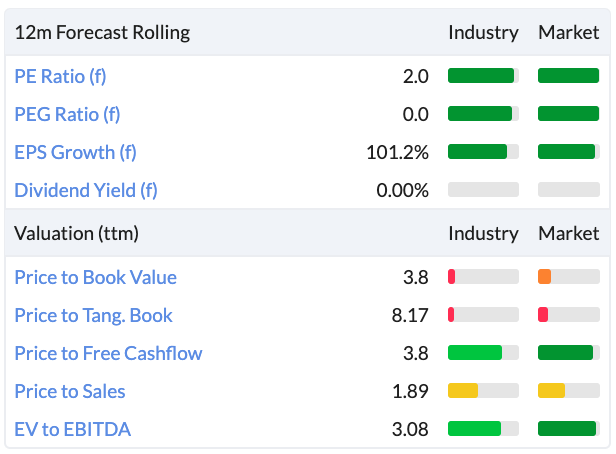
The argument for buying Rockrose shares is pretty straightforward: the shares look very cheap. They trade on a forecast PE ratio of 2 and at just 3.8 times free cash flow. The company has also committed to paying out 85p per share in dividends, making for a c4.3% forecast yield.
The group’s cash (post-Marathon) is pretty much equal to its market cap - unrestricted cash (cash that does not have to be put aside for future decommissioning costs) for the enlarged group is now estimated at around 1,950p a share.
Furthermore, Rockrose’s share price has been suppressed by non-economic sellers being made to trim their holdings due to the rapid share price appreciation. There are signs that this is reducing. Share price momentum is definitely on the up.
Combine the group’s positive relative strength with its cheap valuation metrics and you have an intriguing value-momentum candidate.
An experienced board aligned with shareholders
The board certainly seems to think Rockrose shares are good value. They bought nearly £140k worth of stock in 2019 at between 1,868p and 1,984p.

Running through the board briefly, we have:
Andrew Austin, founder and executive chairman, 27.2% shareholder. Founder of RockRose Energy and one of the founders and the former chief executive officer of IGas Energy. Prior to IGas, he raised funds from private and public equity and spent 17 years in investment banking, working for Merrill Lynch, Nomura, Citibank and Barclays Capital.
Richard Benmore, non-executive director, 2.5% shareholder. 35 years of experience in the Oil and Gas industry with Conoco, Oryx Energy, Nimir Petroleum, EnCana, Nexen Petroleum and Igas Energy.
John Morrow, non-executive director, 1.7% shareholder. Chartered Engineer and has over 30 years of experience in the oil and gas industry. Previously chief operating officer and on the board of directors of Bowleven, before moving on to work as head of exploration and production at Glencore from 2011 to 2019.
Peter Mann, managing director, 2.1% shareholder. Joined IGas in 2013 and moved to Rockrose in 2017. Prior to his oil and gas career, Mann attended Sandhurst and spent six years in the army before joining Cazenove Capital’s asset management team and in 2011 left to implement and run a private office in London
Richard Slape, chief financial officer. Joined Rockrose in 2019 and has over three decades’ experience working with independent oil and gas exploration and production companies.
Together, the board owns a material interest in the company:
More growth and acquisitions to come?
There are studies out there that suggest, on the whole, mergers and acquisitions are at best neutral to the buyer and at worst a value-destructive distraction. That said, given the background and expertise of the board, and the specific North Sea opportunity it has identified, perhaps Rockrose can buck this trend.
Existing assets are generating cash flow. The team wants to deploy that cash flow into development projects that could push out the decommissioning point and make money for shareholders.
Rockrose has so far focused on sites run by experienced operators with strong track records that have the potential to extend field life, and that are viewed as mid-life to late-life and as non-core by existing owners. This last point might be a way of enabling both buyer and seller to realise value in these exchanges. A core part of Rockrose’s strategy is to minimise overheads and to function as a low-cost operator. This low cost base permits it to identify value where more traditional operators cannot.
It is likely that more deals will be announced in 2020 and management is looking at multiple potential transactions right now. Rockrose has been linked to a bid to acquire private equity-backed Siccar Point Energy and withdrew an offer to acquire Independent Oil and Gas last year.
Risks
There are several risks to bear in mind with a company like Rockrose. Perhaps the most fundamental is the execution risk involved in such an acquisition-heavy strategy. There is no way to really forecast the materiality, timing, or riskiness of future deals. The group is building a track record of successful acquisitions though and investors are clearly willing to assume that this can continue.
As part of this strategy, Rockrose has rapidly built up its decommissioning liabilities. Tests show a decommissioning date more than six years in the future for most of Rockrose’s fields but the group is searching for acquisitions that will extend the life of its overall portfolio.
As of 31 March 2019, total decommissioning obligations were estimated at £456.9m for UK assets and €115.8m in respect of Dutch assets (on a post-tax basis). Of that amount, £37.0m plus €0.6m is expected to be spent between 1 April 2019 and 31 December 2020. For a company with a market cap of less than £300m, these are sizable obligations to be aware of.
Competition could also increase. Oil prices have recovered and stabilised from the 2014 crash. In that time, other companies with similar strategies have been established, such as Delek Group and Chrysaor. Increased competition for assets could make favourable deals harder to come by.
There are also the standard risks that apply to all oil and gas explorers and producers - namely declining commodity prices and overstated reserves.
Conclusion
Given its popularity in the 2020 stock picking competition, Rockrose seems to be an open secret in the retail investing community. The group’s shares are up by more than 10% in the year to date. In such cases, it is worth revisiting some behavioural biases and emotional traps.
One behavioural bias is the fear of regret - a hindsight bias that can lead us to buy investments we wish they had purchased, which in turn fuels a trend-chasing effect. Just because Rockrose is a popular pick in a competition and its share price is going up, it does not mean it is an objectively good investment.
That said, another bias is anchoring, where an initial value - in this case the share price of c2,100p - is used as an “anchor” that people then adjust up or down to reflect new information. People tend to adjust their anchors insufficiently, however, meaning share prices can take a while to fully reflect a change in prospects.
On the face of it, it looks as though Rockrose’s shares are cheap even given recent reratings. The ranks show an attractive blend of value and momentum:

As such, it’s no surprise that the stock figures highly on the VM Rank screen and has a VM score of 97. With management signalling its appetite for further M&A, is the Rockrose share price just too cheap to ignore?
Disclaimer
This is not financial advice. Our content is intended to be used and must be used for information and education purposes only. Please read our disclaimer and terms and conditions to understand our obligations.

23 comments
Brilliant article , especially for idiots like me who only heard of the company via the Share tipping completion .
Well done Jack
EnQuest (ENQ) seems a better bet than RockRose I bought about 2 week ago up 27% they are also accumulating N sea assets
No need to shout.
It has a lot of debt, not one for me.
A lot of debt? Net debt is -82.7m dollars (negative net debt means no debt i.e. positive cash).
I was replying about EnQuest (LON:ENQ).
Apologies I thought you were talking about Rockrose.
Dear Ed
My comment this morning was " I bought some in December, but I am now going to buy some more" but it did not appear for some reason. Anyway, I did buy some more and was grateful for your opinion. Regards
Kit
One factor that is holding the SP back is the involvement of Cavendish Asset Management.
They have an outsize position compared to the size of their funds and are forced sellers when the price rises - see the TR-1 today.
The argument is .... when they are finally done ................
I am persuaded and have bought Rockrose today.
Hi Jack, great report. From my technical Wyckoff perspective it looks very bullish.
Is decommissioning actually likely to present an opportunity? I think I read in the "Economist" some time ago, that old oil wells could be used for carbon capture.
In my view, Carbon Capture is an expensive process due to the challenges of transporting carbon dioxide in old steel pipes. However, It may generate revenue in enhanced oil recovery (by increasing well pressure from injecting CO2 releasing more hydrocarbons), any may generate some revenue for transporting the waste produce, like a landfill site. Until producers are taxed heavily however, I don't see much revenue opportunity here.
The investment case here is that the company has 5-6 years to create and implement a very big cash pile before it needs to concentrate on decoms.
The company estimates decoms to be covered by 20/25% of cashflow.
Tons of cash to go hunting, vulnerable to collapse in oil price.
With these established fields I believe a lot comes down to operational efficiencies when run by a smaller company. For instance; production is halted, widget #4983 is needed to get production moving again - 'big company' has lots of bureaucracy in ordering the part and getting it fitted, 'small company' just gets on with it with little loss of production.
Serica Energy (LON:SQZ) in another in the North Sea space. Will certainly be interesting to see who takes-over/merges with who over the next year or so..
Not to diss any person or any company, but I had been thinking about the whole decommissioning thing the other day. I wouldn't call it a scam, but perhaps I could call it a jolly wheeze to circumvent enormous decommissioning expenses. Think about it. Big Oil offloads their declining assets to a small outfit, thereby removing a huge potential liability for them. The name of the game for the smaller outfits would then be to syphon off as much cash as absolutely possible. Come the day of reckoning, the small operator declares bankruptcy, exactly according to plan, and shrugs its shoulders when it is expected to decommission. Big Oil also shrugs its shoulders, because hey, those assets have nothing to do with us.
It's all quite clever, really.
From a National Audit Office report on offshore decommissioning (https://www.nao.org.uk/wp-content/uploads/2019/01/Oil-and-gas-in-the-UK-offshore-decommissioning.pdf p27), my bolding:
2.19
Taxpayers will be liable for the full costs of decommissioning assets if operators are unable to pay in certain circumstances. If an operator is unable to meet its decommissioning liabilities, under the Petroleum Act 1998, the liability transfers to any existing partners or any other operator that was previously liable for decommissioning the asset. If there are no previous operators able to fund the decommissioning, the liability ultimately falls to the government. This would mean taxpayers could be liable for the entire cost of decommissioning an asset, rather than the current situation where it only covers a portion through tax reliefs.
So either the likes of BP, Shell, Chevron, etc. have to go bust too or the liability falls back on them before HMG has to pick up the tab.
perhaps I could call it a jolly wheeze to circumvent enormous decommissioning expenses
Decommisioning costs are so huge (and not known accurately in advance) that they are accrued during an oil/gas field's life and they are a major consideration when equity in a field changes hands. An oil company cannot avoid responsibility for decom expenses by just selling it's share in a venture. Licensees in North Sea fields enter "Decommissioning Security Agreements" to provide for decoms, and the government now has "Decommissioning Relief Deeds" to guide operators to quantify future decom costs. However, if the decom costs are more than provided for following the guide, then the UK taxpayer would indeed on the hook for part of the difference. And decom costs are tax deductible so operators and their partners effectively get back some prior tax paid to help pay for decom.
There is no jolly wheeze to circumvent enormous decommissioning expenses by selling out of an oil or gas field before it is decommissioned.
I NEVER buy energy companies or highly speculative companies. But I just bought some of this because it is obviously very cheap and generating lots of cash.
Great article, thanks. In terms of the valuation of RockRose Energy (LON:RRE), it is also interesting to compare its value to that of the acquisition just made by Premier Oil (LON:PMO) of certain BP North Sea assets. Not a perfect comparison but the annual kboepd are broadly similar between the acquired assets by PMO and those of RRE, with similar reserves and decommission liabilities expected to kick-in around the same time (although both companies will likely try their very best to extend and push those liabilities out). As I say, there are differences between the two assets but certainly not enough to justify the difference between the circa US$625m that PMO are paying for those assets and RRE's current mcap of around US$300m. It's a crowded trade but I expect it to be fairly lucrative, unless oil prices decide to dive.
Superb article. Thanks.
Couldn’t believe when first checking out and then buying Rockrose a couple of months ago that even after the share price had more than tripled the share price was covered by cash.Those who got in earlier found an incredible bargain share to invest in.
Guess that despite the still very low PE ratio the easy finds for the Company and easy gains for investors have been had. Surely competition for assets will increase making bargains harder for RRE to find. otoh.....the fact that they are looking at MULTIPLE potential transactions suggests maybe not? And share looks so cheap, again even AFTER the share price has quadrupled, suggests that the many who went for Rockrose in the tipping competition could be proved right, and not that it’s all too good to be true. Hope the oil price holds up.
If the Sunday Mail Midas team are tipping it then i'd be wary ;-}
jack i have looked at this before and felt it was to much of a pig in a poke to get involved
That's fair mortimer - one thing I did notice when looking into Rockrose Energy (LON:RRE) was that there is not as much financial data to hang onto as I would usually like. Three annual reports, none of which are that comparable due to acquisitions.
That said, if you are more of a diversified, quantitative, screen-based investor there are clear attractions both technically and fundamentally. Not without risk... If anybody out there has any expertise in this space or is invested in Rockrose, it would be great to hear additional views.