Scoping out cybersecurity: BAE Systems, Avast, and Intercede

Risk in the market seems high at the moment - this rally is good for morale but it smacks of euphoria and relief. I’m not about to make short term forecasts, though.
Perhaps the positive momentum keeps going, economies recover quickly, and we all sail on to new all time highs - but I’m prepared for further volatility should that not come to pass.
In the short term who knows, but in the longer term you can be a little more clear-sighted. Investors that place themselves in markets with favourable long term growth trends allow structural growth characteristics to do more of the heavy lifting for them.
Following on from this look at IT value-added reseller Softcat, I’ve done some work on cybersecurity stocks. It’s one area that the world will need more of in the future - so finding well-run companies with good prospects in this sector makes sense.
Listed cybersecurity plays
I’ve constructed a 60-strong sample of listed cybersecurity firms. It includes FANGMAN giants Microsoft and Amazon but even when not weighting the set by market cap, the results show a clear US bias.
This is probably not a surprise to many, but the scale is sobering. In looking at UK opportunities, we narrow our options dramatically.
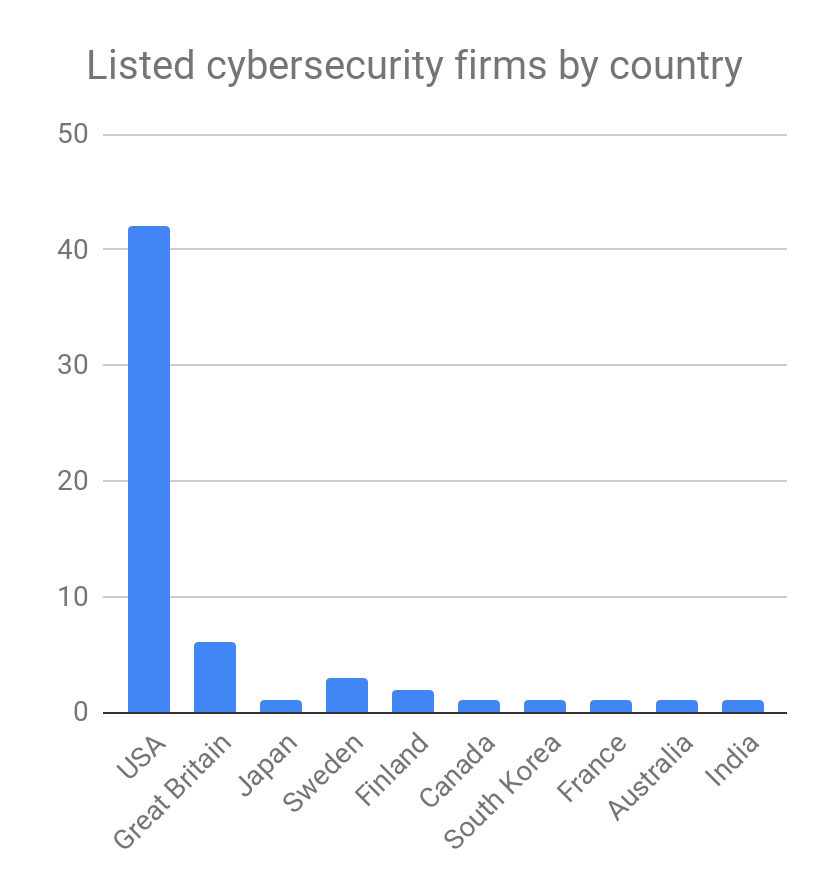
If people want to see the names of the companies in the sample let me know. It’s a question of where to put them (perhaps in a comment?). For the sake of brevity, I haven’t included the list in this article. Some of the bigger names include, in order of market cap: Microsoft, Amazon, Cisco, and IBM, and in the UK: BAE and Avast.
The sample set has an aggregate market cap of a cool £2.8 trillion. Bear in mind though that Microsoft and Amazon alone account for more than three quarters of that market cap, with vast swathes of their business being unrelated to cybersecurity. It’s a tremendous range of market caps, from Microsoft’s titanic $1tn+ valuation right down to sub-$10m micro caps.
Putting those considerations to one side for now, the clear QM bias of the sample is striking.
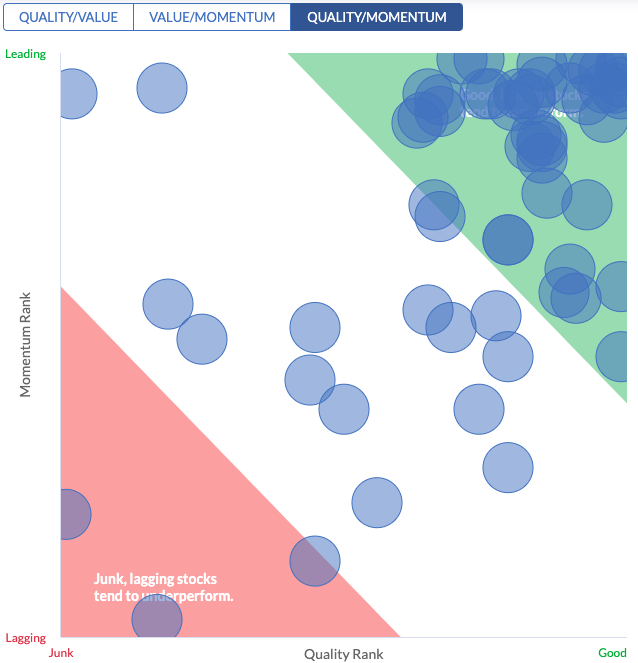
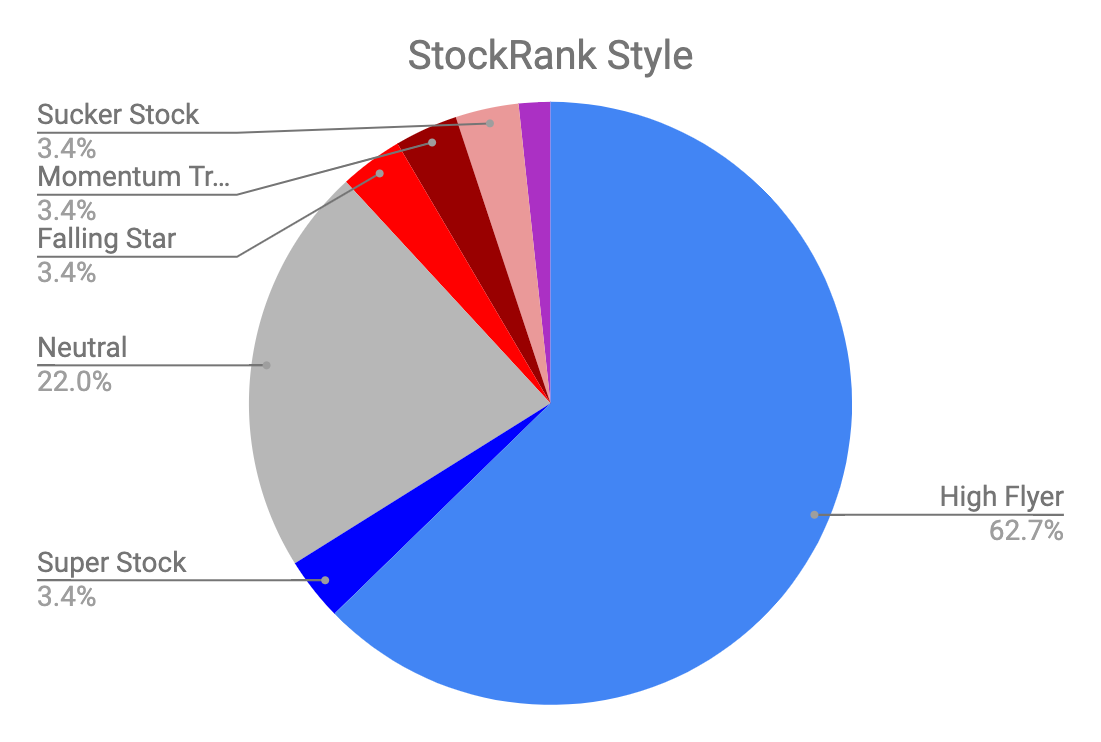
Aggregating the data, the high QM factor profile becomes even clearer - nearly two-thirds of the sample are High Flyers, with not a single Contrarian or Turnaround stock in the set:
Stockopedia unsurprisingly identifies this sector as a vibrant, high growth part of the market. Here are the market cap-weighted Ranks of this 60-strong cybersecurity sample - a clear high QM profile:
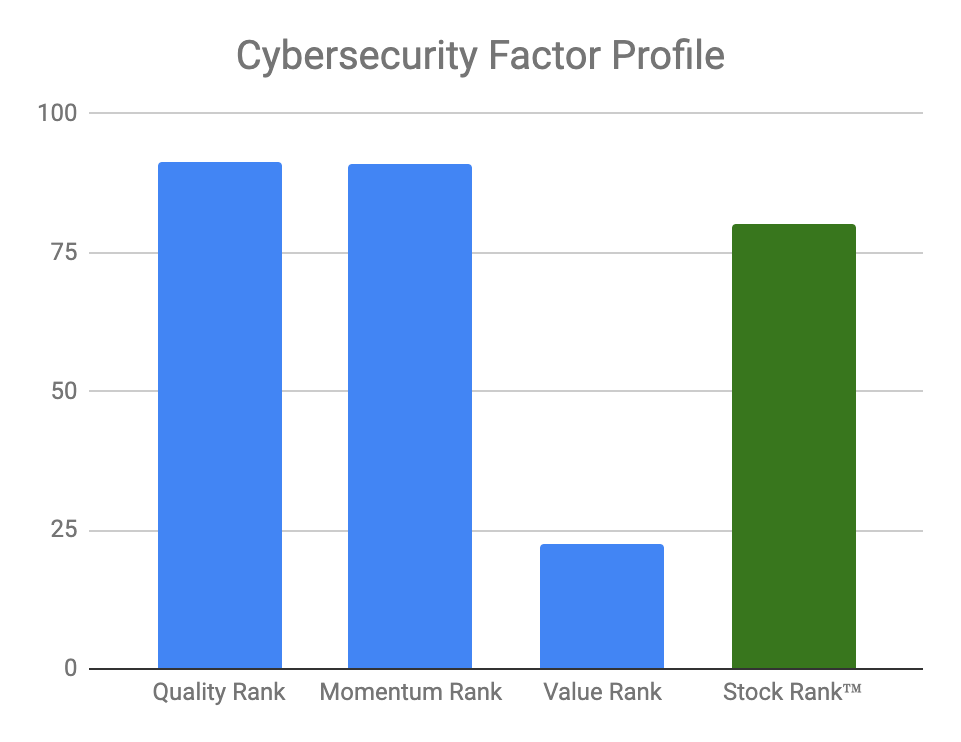
This is probably to be expected given how software-focused these companies are. Such companies often score poorly on traditional value metrics.
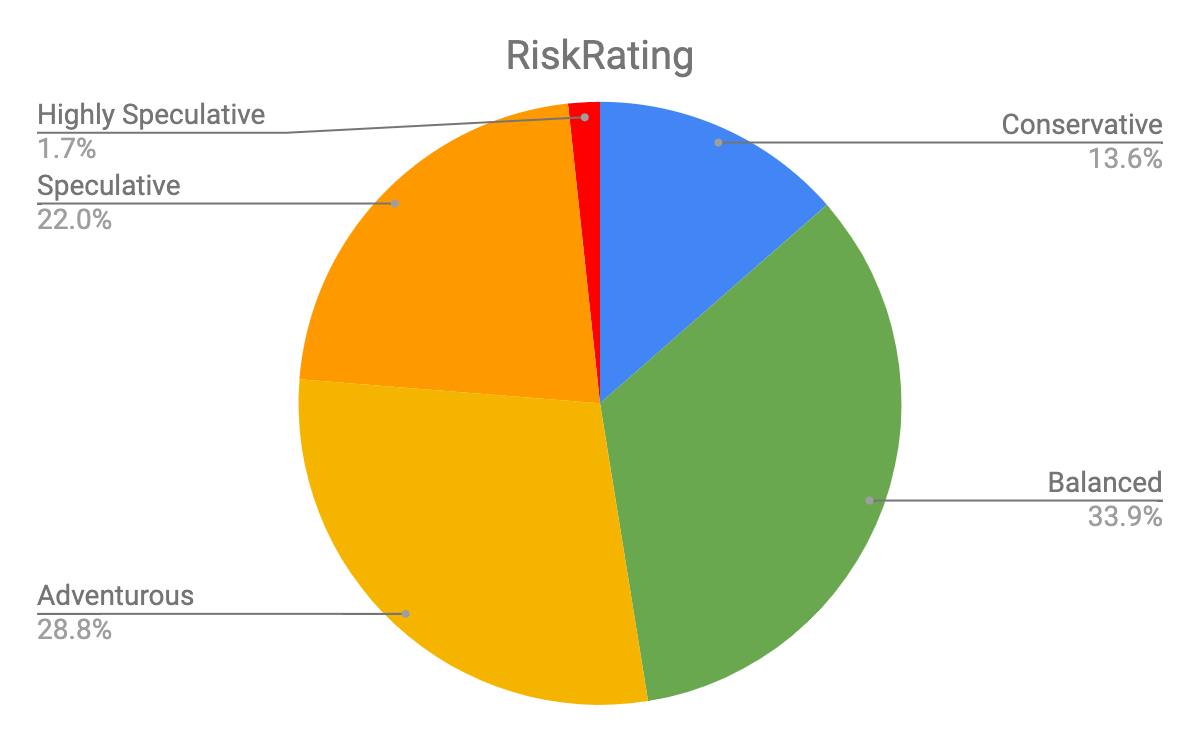
Even the RiskRating data paints an interesting picture, split quite nicely between Conservative and Balanced giants and swashbuckling Adventurous and Speculative growth stocks. There are very few troublesome, Highly Speculative shares - perhaps a nod to the above average quality of the set.
UK stocks
US-listings dominate this part of the market but there are five or so viable UK-listed plays. If I’ve missed any likely candidates, let me know.
In terms of market cap, we have:
Name | Ticker | Market cap (£m) | RiskRating | F-Score | 1y Relative Strength | StockRank |
BA. | 15,980.26 | Balanced | 6 | -8.0% | 90 | |
AVST | 5,299.68 | Adventurous | 7 | +6.8% | 80 | |
NCC | 428.40 | Adventurous | 6 | -11.2% | 62 | |
KAPE | 304.77 | Speculative | 4 | +9.9% | 33 | |
IGP | 37.86 | Highly Speculative | 8 | +16.4% | 64 | |
CNS | 23.26 | Adventurous | 5 | +4.2% | 16 |
These metrics capture quite a lot of information - market cap gives size; RiskRating shows volatility; the F-Score is a nine-strong financial health and profitability checklist; relative strength captures market sentiment, and the StockRank gives an idea of the QVM profile.
For now, I’ll look at the three highest ranking UK stocks in this set (by StockRank):
- BAE Systems: large cap (safer), Balanced RiskRating, solid F-Score
- Avast: strong share price momentum and strong F-Score
- Intercede: small cap (growth potential), strong relative strength and F-Score
BAE Systems (LON:BA.)
- Stock price: 513.4p
- Market cap: £15.98bn
- Revenue: £18.3bn
- Net income: £1.476bn
- StockRank: 90
What it does
BAE’s cyber division supplies cyber, intelligence, and security capabilities to government agencies, and is a growing supplier of cyber and network security capabilities to commercial customers.
This large cap boasts strong relationships with governments and large commercial customers. It has built up a reputation as a trusted supplier of global defence solutions with leading positions in the US, UK, the Kingdom of Saudi Arabia and Australia.
These trusted and important positions allow it to generate consistently high margins and cash flows for its shareholders.
It’s a huge company, though, and cybersecurity is not a big part of the mix clocking in at just 9% of FY19 revenue.
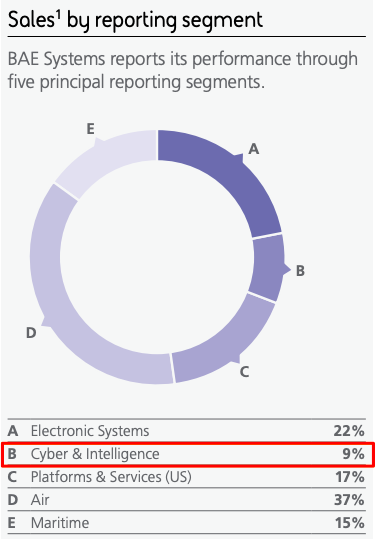
Still, that’s a £915m a year cybersecurity business providing large contracts to a high quality customer base. Given its scale and complexity, I’ve used a checklist approach in order to quickly identify important trends.
Profitability
Is it cash generative?
Yes - BAE Systems has a TTM price to free cash flow of 14.2x, or a free cash flow yield of c7%. It has generated millions of pounds of free cash flow every year for the past five years.
Are margins stable or increasing?
Yes - the group’s TTM operating margin is an encouraging 10.37%, which is a shade above its five-year average of 9.38%.
Does it have double digit ROCE?
Yes - TTM return on capital employed is 11.5%, which is just above its five-year average of 10.75%.
How efficient is BAE at generating cash for shareholders?
BAE’s free cash flow divided by revenue is 6.16% - not high but acceptable, especially given that it generates close to £20bn of sales per year. This is quite a lot lower than Avast’s figure (below) and presumably shows the costs of running a far more diversified operation.
Does it generate more than its earnings in cash flow?
43p of earnings per share is covered by 50p of operating cash flow flow, with investors getting 35p in free cash flow per share.
Financial health checks
An F-Score of 6 and a Z-Score of 1.6 are just about acceptable. The F-Score flags up increasing levels of net debt over the past three years, a slight drop in the group’s current ratio and a small decline in gross margins.
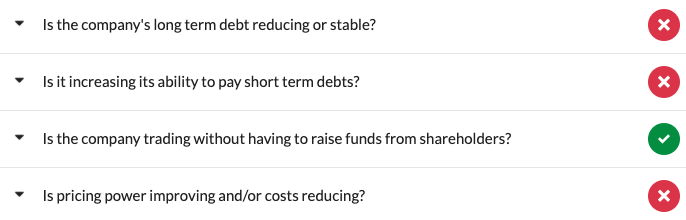
These F and Z-Scores are really useful for flagging areas to look at. Sometimes I forget to take advantage of them. Of the three flags here, the increasing net debt position is the really serious one to watch out for.
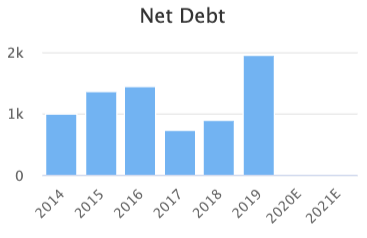
Over the next year or so, I remain wary when I see a jump up in net debt like this as companies adjust to IFRS 16. This is an accounting change that means capital leases are brought onto the balance sheet as a part of total debt. It makes a company’s long term obligations more transparent, but optically it looks like a sharp deterioration in financial health.
Heading over to the group’s balance sheet does show c£1bn of capital leases have been added to debt. BAE also has a pension deficit most recently measured at £1.9bn. Net gearing of 36.14% is manageable but when you include the pension deficit, this does increase.
BAE’s Z-Score is a little more problematic - at 1.6 it “indicates a risk of serious financial distress within the next two years”. This low score is in part due to a large amount of illiquid assets on the balance sheet - the group has some £10bn+ in Goodwill and Intangibles on its balance sheet, representing c40% of total assets.
The Z-Score also flags solvency (low equity to liabilities) and efficiency (low revenue generation from assets) as concerns.
Latest comment
3 April 2020 - Market Update
In the first quarter of 2020, the pandemic has had no material impact on the financial performance of the Group [but] as the second quarter commences, we are seeing more significant disruptions. A further update will be provided when appropriate.
Verdict
There are better ways of gaining exposure to cybersecurity.
That said, BAE Systems could play a valuable diversification role in a portfolio given its scale, low share price volatility, and relatively resilient operating margins. Business tends to be long term and diversified, coming from a high quality customer base.
There are some flags, though, namely concerning the group’s pension deficit, debt levels, and high levels of goodwill and intangibles.
BAE is a behemoth, and cyber security is just one of its businesses. In fact, this arm is responsible for just 9% of group revenue as of FY19. Ultimately its fortunes are more closely tied to unrelated areas like aircraft manufacturing and electronic systems so this rules it out for me.
Avast (LON:AVST)
- Stock price: 500.5p
- Market cap: £5.3bn
- Revenue: £871m
- Net income: £249m
- StockRank: 80
What it does
Avast bills itself as the “global leader” in consumer cybersecurity, with over 435 million users around the globe. In AVG and Avast it has two top-tier, global computer security brands.
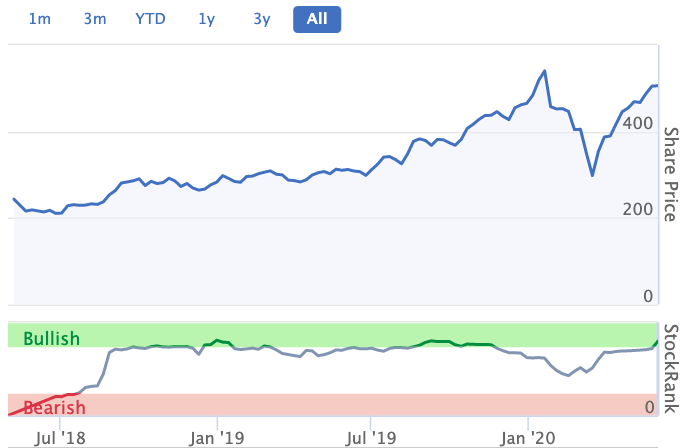
Even after rebounding strongly from the March crash and more than doubling since IPO a couple of years ago, its StockRank has never been better:
Avast is focused more on retail consumers:
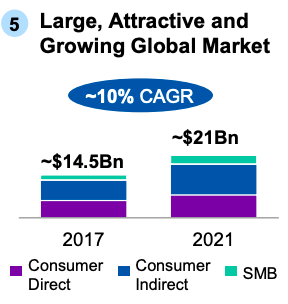
- 82% of revenue comes from Consumer Direct (securing consumer devices, data, and networks),
- 13% comes from Consumer Indirect (where third parties pay for advertising access),
- the remaining 5% comes from SMB (protection for small businesses).
Market growth in each of these segments looks robust, with a shift to smart homes and increasing interconnectivity likely to drive broad-based demand.
Profitability checks
Is it cash generative?
Yes - Avast has a TTM price to free cash flow of 18x, or a free cash flow yield of c5.6% and has generated strong levels of free cash flow for as far back as our data goes (2015 in this instance).
Are margins stable or increasing?
Yes - the group’s TTM operating margin is an impressive 41.57%, which is well above its five-year average of 28.07%.
Does it have double digit ROCE?
Yes - TTM return on capital employed is 15.7%, which is just above its five-year average of 9.28%.
How efficient is Avast at generating cash for shareholders?
Avast’s free cash flow divided by revenue is 42.38% - so it appears to be very efficient at turning revenue into cash flow for shareholders.
Does it generate more than its earnings in cash flow?
Avast generated 26 cents of earnings per share on a trailing twelve month basis compared to 39 cents of operating cash flow and 36 cents of free cash flow.
Financial health checks
Avast has an F-Score of 7, which is good. Its Z-Score of 5.19 is very comfortable.
Does the group have debt?
Yes - Avast has £874.7m of net debt. Interest cover is strong at 7.64x. It also has a small pension deficit of £56.3m compared to its market cap of £5.3bn.
Net gearing of 78.32% is high and this increases to 83.4% once you include the pension deficit.
Does the group have acceptable liquidity?
A current ratio of 0.63x is low and worth looking at more closely.
Latest comments
16 April First Quarter Update
Avast says lockdown impact has been mixed: more home working has increased Desktop conversion rates and billings, but there has been lower advertising spend by certain sectors. There were also weaker trends in SMB and the mobile carrier business.
The former is the majority of group revenue though, so the net effect has been positive and, encouragingly, Avast maintains previous guidance for FY2020 of mid-single digit organic revenue growth.
The board currently retains its recommendation for the payment of a final 2019 dividend of 10.3 cents per share. The only other company that comes to mind that has retained its dividend is Moneysupermarket.com, which has also rallied strongly. Sometimes the simplest signals can be the most powerful.
All in all, recent comments are very encouraging.
Verdict
It’s an impressively resilient update from Avast and the share price has been strong. Despite this, though, the group’s shares trade at just 19x forecast earnings and on a PEG of 1.0.
It is paying its dividend, business is stable (or apparently even improving) and Avast continues to make long term investments in capabilities and skills for the long-term. The group guides towards mid-single digit organic growth (excluding discontinued businesses) for FY20 and it has recently reaffirmed these targets.
Low liquidity and high gearing ratios are a potential concern. That said, Avast’s business model benefits from recurring subscription revenue and generates significant levels of cash. At quarter-end, the Group had $262.6m in cash on the balance sheet. Liquidity is further supported by the availability of an undrawn $40m Revolving Credit Facility, maturing in September 2022.
At c19x forecast PE it is not cheap there is plenty of opportunity for Avast to broaden and deepen its offering in the years ahead. Congratulations to those that got in earlier, but even at c500p, I think it warrants a closer look.
Intercede (LON:IGP)
- Stock price: 76.8p
- Market cap: £38.37m
- Revenue: £10.3m
- Net income: £0.544m
- StockRank: 64
What it does
Intercede integrates secure digital identities into governments and large organisations around the world. It has been providing cyber security solutions for governments, police, military and multi-national companies for more than twenty years now - a great niche for such a small company to occupy.
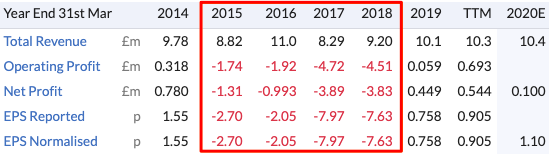
IGP has strong technical capabilities backed up by partnerships with leading technology partners and a global network of integration and reseller partners. The elephant in the room is the group’s patchy operating track record - clearly this is a turnaround stock:
Paul has covered this company in great detail as a holder, so do check out his SCVRs on the company. I am approaching this stock for the first time, but it looks potentially promising.
Running through the same checklist as above:
Profitability checks
Is it cash generative?
Yes - Intercede has a TTM price to free cash flow of 30.5x, or a free cash flow yield of c3.3%. This is “expensive” but what matters more is IGP’s potential to grow free cash flow.
Are margins stable or increasing?
Yes - Intercede’s TTM operating margin is notably lower than its two larger listed peers, at 6.73%, although this is an encouraging improvement on its five-year track record of -28.5%.
Does it have double digit ROCE?
Yes - TTM return on capital employed is 17.0%, although its five-year ROCE is negative as a result of years of losses.
How efficient is IGP at generating cash for shareholders?
IGP’s free cash flow divided by revenue is 12.14% - this is pretty good given the group’s mixed track record as there is a potentially high quality business here for shareholders.
Does it generate more than its earnings in cash flow?
IGP has 1p of trailing twelve month earnings covered by 2p of operating and free cash flow.
Financial health checks
The group has an F-Score of 8, which is strong. Its Z-Score of 4.65 is also a comfortable pass.
Catalyst
What matters most here is turnaround execution and growth prospects. Intercede released its Final Results just a couple of days ago, which showed:
- A continuing trend of improved operational and financial performance,
- Revenues of £10.4m (2019: £10.1m) and profit up from £0.4m to £1.0m,
- £1.4m of cash from operations and an increase in cash balances to £4.8m,
- The group’s sales pipeline is over 40% higher than this time last year.
Chuck Pol, Chairman, said:
Just over two years ago a major Board reconstruction was undertaken with the clear recognition that the Group had to get back to sustainable revenue growth and profitability. All members of the team have remained focused throughout the last two years and it is to their great credit that the most difficult part of the operational turnaround has been delivered despite the worsening backdrop posed by the Covid-19 pandemic at the end of the period.
Verdict
All in all this strikes me as a good turnaround prospect: niche, technological expertise and a position of trust with a high quality client base built up over decades. If a lot of the hard work has been done around rebasing costs and repositioning the business for profitable growth then the next question to address is how big Intercede’s market opportunity is.
I’ve just noticed as well that Intercede’s gross margin is extremely high - almost 100% of revenue - so the group’s assertion that its sales pipeline is up 40% year-on-year is extremely promising as it could drop almost straight through to gross profit. “Turnarounds seldom turn” but there are always exceptions, and it sounds like there could be a high quality, high margin business about to emerge at Intercede.
I prefer to back strong and steady operating momentum rather than this type of situation, as the latter requires more faith. I can always make exceptions though and will look at this company more closely.
I’ll have to park this for now but these are three interesting companies. Avast and Intercede in particular appear to have promising prospects, even given recent share price strength.
BAE Systems’ fortunes depend more on other parts of its business and for that reason I will focus on Avast and Intercede. Their short term prospects appear better and their longer term prospects are more directly tied to the rapidly growing global cybersecurity market.
And then, of course, there is the home bias issue: UK companies are a fraction of the whole. Who knows what opportunities lay overseas?
Disclaimer
This is not financial advice. Our content is intended to be used and must be used for information and education purposes only. Please read our disclaimer and terms and conditions to understand our obligations.

36 comments
Avast (LON:AVST) : You state net income at £249m but don't Avast report in US$? Isn't net income $249 million? If so, your calculations are off - overvaluing the company by c.25%?
a fair review of the relevant companies and I will further research Avast with a view to purchase
Hi Jack,
I really appreciate the article. The depth of the insight into this market space is excellent. I've also enjoyed your other articles. Please keep them coming.
BSV
I suspect that as Stockopedia subscribers our collective preference is usually to pick our own stocks! However when it comes to something like cyber security, where there are many unknowns about the future, I wonder whether it’s not better opting for a thematic etf or similar? What do folks think? I’ve only room for a couple of plays in a niche area such as this, and so wonder about the wisdom of trying to pick a winner....
However when it comes to something like cyber security, where there are many unknowns about the future, I wonder whether it’s not better opting for a thematic etf or similar?
Yes, that's the simplest approach. I hold £ISPY which has a decent selection of stocks in the sector.
Overall "cybersecurity" is a catch-all for some very different companies as even the small selection discussed by Jack shows. You have to look at each stock separately rather than just lumping them all together - I hold Ncc (LON:NCC) and Avast (LON:AVST) but you couldn't have two more different companies really. Same is true of Intercede (LON:IGP) - only it's even more esoteric and difficult to understand from the outside.
Overall the main drivers for growth in the sector are data protection regulation and an increase in remote working. Anything that doesn't address one of those two areas needs a lot of thought and analysis to figure out where growth is going to come from.
In terms of data protection consider the recent Easyjet data breach - apparently a "sophisticated attack", although as they're using email adddresses and passwords it certainly isn't a sophisticated defence - could attract an ICO fine of over £100 million. We're still waiting to see if the £160 million fine dished out to BA sticks - but frankly it's hard to see why it shouldn't.
That's the kind of financial pain that will make directors think very hard about their cybersecurity investments. Most companies should outsource because they really don't have the knowledge or skill to manage this stuff properly.
timarr
Timarr, thanks for flagging up ISPY, I have had a look at their holdings just now. I will be buying. I think it answers the question of how best to get exposure to the sector. Cheers!
thanks for your reply: very helpful
Gb (LON:GBG) looks interesting. Results due w/c 29 June.
Hi Jack, very useful thanks - any chance you can add your view on Ncc (LON:NCC)? They've under-performed of late but they are much more of a pure play than BAe and look a safer investment than IGP.
A good, detailed read, Jack. I've been put off Avast (LON:AVST) by director share sales. Someone mentioned Kape Technologies (LON:KAPE) which seem to be doing very well, though I'm put off by the huge majority holding in this company. Intercede (LON:IGP) look interesting... if the recovery story continues
ComputaCenter worth a look. They don't just focus on CyberSecurity (neither do BaE), but that's likely a huge part of their workload.
Jack, interesting article.
I would echo Chris's comments. Whilst on the face of it, cyber security would look to be a great sector to get involved in - the large increase in home working etc - I am not sure that there's a company that really fit for investing in that is high quality with that crucial 'moat'.
Some brief thoughts:
Built in and open source applications are so much better at reducing threats now that even a few years ago. Windows Defender for example. Browsers have much increased protection as well. Imho a lot of the commercial anti-virus software does no more than the free stuff, other than introducing a lot of bloatware onto a system. I am perhaps being cynical but it seems many of the AV companies rely for a lot of their business on older/ novice computer buyers being sold unnecessary expensive packages in places like PC World.
The most important thing for companies to do is to ensure that their software is up to date and patched, that firewall policies are strict, the password policy is strong and that user access is correctly configured. This comes down to the network systems manager of that business, or a consultancy, rather than a software solution.
The weakest link in the security chain is always the staff. Client side attacks - particularly phishing emails etc are the fraudsters weapons of choice. I may be wrong but I believe mandate fraud (persuading a business to make a payment to a different bank account having purported to be a supplier etc) is the biggest issue there. This is something that can be solved by strict internal systems and staff training rather than any software.
Much mobile security is also built in, for example remote-wiping of devices.
Given this, I think the best opportunities would lie with investing in a business that provides network security reviews, penetration testing and staff training, with ongoing contracts. There are quite a lot of these firms but the ones I am aware of are all private companies. I would be very interested to know of any that we could invest in.
Bigclaw, your point is a reasonable one. What you also need to consider though is the complexity of the solutions that corporations are using to drive business efficiency and the complete dearth of people that know how to configure and manage those solutions as BAU.
In the interest of transparency I work for and hold stock in NCC Group...
Yes, that’s certainly true, a good point. I will be having a closer look at NCC as well.
Overall "cybersecurity" is a catch-all for some very different companies as even the small selection discussed by Jack shows. You have to look at each stock separately rather than just lumping them all together - I hold Ncc (LON:NCC) and Avast (LON:AVST) but you couldn't have two more different companies really. Same is true of Intercede (LON:IGP) - only it's even more esoteric and difficult to understand from the outside.
timarr,
Surprised to hear you hold Ncc (LON:NCC) - but perhaps that's more for the solid escrow business rather than any of the low quality cyber security bolt-ons made by the previously disgraced management team. I held this for a while many years ago for the escrow business and it was a nice investment, solid but boring, until completely ruined by management who had no idea how to do acquisitions. I don't like what I see from today's business with lots of lumpy revenue, low margin contract work. I studiously avoid such companies these days.
As someone that's worked in data security for the last 20 years, I couldn't agree more and make the point any better than chrisgb when he wrote:
1. Good security depends on good education. Users have to be discipline, e.g. checking out who actually sent a mail and not believing the From: name.
2. Over spec-ed Security often gets in the way of functionality, e.g. it won't let you see the data you need to see to do your job. You can't just slap on security.
The consequence of 1 and 2 is that there is no IT product that can magically solve your security problems. There is a great deal of thinking and analysis to do.
3. If you have an IT security product there is a good chance the operating system vendor and/or cloud vendors will implement a competitive product - and probably better, e.g. Microsoft Defender vs other virus checkers.
There's nothing you can do about the weakest link in any security system - human stupidity. I think there's an obvious attraction to private investors to try and find ways of playing themes like cyber security but IMHO there is no credible way to do so on the London markets. Even BAe only bought in that capability by acquiring Detica. And it's only competition authorities that stop Microsoft from wiping out the third party anti-virus industry overnight.
All the best, Si
Hi Si
I bought Ncc (LON:NCC) at the recent trough, which I thought offered a reasonable entry point for a business that, to my eye, is underperforming. A number of my clients use the escrow service and everyone's pretty happy, but I don't know anyone who uses any of the other services. There ought to be a decent business in here but if the management doesn't sort it out then I'd expect that someone else will.
I can trump your 20 years with 30, but you're absolutely right that human stupidity is an unstoppable force. Although it's not helped by the mass production of internet enabled domestic appliances that have no useful security at all. My favourite demonstration of recent years was someone using an iKettle to hack a home network and then to contiuously boil until it caught fire and burnt the house down. And then there were the internet enabled sex toys ... but perhaps the less said about those the better :-/
timarr
I bought Ncc (LON:NCC) at the recent trough, which I thought offered a reasonable entry point for a business that, to my eye, is underperforming. A number of my clients use the escrow service and everyone's pretty happy, but I don't know anyone who uses any of the other services.
We had to use the escrow service when working with Cisco 10 years ago at their behest. I was impressed how much it cost! Talk about money for old rope... No wonder we got so many follow up calls from their sales team in Manchester :-)
Although it's not helped by the mass production of internet enabled domestic appliances that have no useful security at all. My favourite demonstration of recent years was someone using an iKettle to hack a home network and then to contiuously boil until it caught fire and burnt the house down. And then there were the internet enabled sex toys ... but perhaps the less said about those the better :-/
Yes, I studiously avoid any appliances that connect to the internet for this reason, especially cars! You'll not be surprised to hear I don't own an Amazon Echo or similar too :) Owning these items falls into my "human stupidity" category.
All the best, Si
Excellent article Jack,
Kape Technologies (LON:KAPE) is worth a look, Israeli /teddy sagri company but last year it bought one of the leading us VPN providers & the two us owners took all shares & have stayed on. Kape use their own online marketing platform for their product and importantly the Us company mostly sold through recommendations. The US VPN is now on Kape’s platform so growth could be very high. Worth some research.
Hi Jack
Another great article. I have exposure to sector via investments in Qualys and Fortinet, both Nasdaq companies. Very good quality and momentum but not on a cheap multiple. Both long term buy And hold for me. Worth having a look if you like good QM stocks.
Greyster
website: http://www.intercede.com/
What they do: Interecede's MyID software enables any organisation to manage the lifecycle of devices and identity credentials (smart cards, tokens, mobile phones etc.)
Market position: Top 2 globally for high end smart card systems
Major Partners: Gemalto, Thales, Verisign, Oracle, RSA Security, Safenet
Major Contracts: NHS, US Transport Workers Identity Credential (TWIC), The White House
Opportunities: National ID cards, Transport workers, health cards, corporate physical/logical access, online banking
Bull Points: 99% margins, relatively fixed cost base, management experience
Bear Points: Prolonged (and often delayed) contract implementation timing
"Intercede calculates that the combined value of the projects outlined above and other existing projects is several times its current annual revenue run rate."
I think this suggests that cyber security firms are not all necessarily in direct completion with each other as inferred by some comments . Good consolidation today on IGP sp
Bear points:
Market moving away from smartcards to virtual smart cards.
All the major identity providers have secure multi factor authentication built into their products that work across most services using industry standards like SAML and FIDO.
Company is providing a tech that is niche
Great article Jack, as always. Thank you!
Avast (LON:AVST) has always looked pretty tempting to me, but I remember some really bad publicity about a year ago or so in regards to how they charge their customers. Can't remember the full story, but maybe someone else does? In any case it put me off from investing in them, which judging by the current share price I highly regret!
Jack I would love to see your full list of companies if possible? Being from Sweden I'm especially keen on knowing more about the Swedish companies. Being nr 3 in the world is not bad for such a small country!
AVST bought a company called Jumpshot in 2016 which collected browser traffic and sold the info on to various companies. They were part way through offloading it to ASCL when a magazine article called into question a conflict of interest and possible breach of private information. They responded by buying back the 30 million Ascl had paid and closing the whole operation down. So next years figures should have an impairment of 30 million plus costs, or whatever they originally purchased for. Ascl was reputedly going to pay upto £300 million for the whole of Jumpshot , thereby reducing AVST's debt considerably. Pretty surprised to see it bounce back this well with everything else going on. I believe they also have an office next to Microsoft in Silicon Valley . I did get a bit spooked by possible litigation. It was pretty dumb to be honest but I think they acted decisively and pretty smartly in the end.
Yes, I did see this actually while I was looking through Avast's FY19 accounts:
Jumpshot
In January 2020, we decided to terminate the provision of data
to Avast’s data analytics business, Jumpshot. We reached this
difficult decision because we no longer believed that the data
collection business was consistent long term with our privacy
priorities as a global cybersecurity company.
We take seriously the responsibility to balance user privacy
with the necessary use of data for our core security products.
Protecting people is our top priority and we are working to
ensure going forward it is embedded in everything we do in
our business and in our products.
Anybody that can read between the lines can infer that this is hardly Avast's finest hour... I take the company's comments at face value for now and assume that lessons have been learned. Still a mark against though.
Pretty funny mix really. The new CO refused to take a salary.I think it was the old one donated a load of shares to a charity, One of the original investors pulled out in the autumn with a staged sell and a hell of a lot on director sells. Then the Jumpshot fiasco. I've used Avst for years and now Kape and invested in both. Am out now partly because they both exceeded 5 year targets rather early. I guess that is the nature of these stocks and a rapidly changing environment. So I started switching to IGP when one of you guys first brought it to my attention back in March. I think 3 of you have covered them now. Certainly looks promising if a little more niche. I quite like the small number of shares in issue even if it does make them illiquid as somebody mentioned. Depends how much you want them! Thanks for article, I'm no tech or accountant but it made me think about the differences of the various companies in this field.
An office next to Microsoft in Silicon Valley? So what? Microsoft's main HQ is Redmond in Washington, not California. It's a bit like saying a suspension manufacturer has a plus point because they have an office next to a Tesla dealership.
It wasn't particularly a plus point just that some body asked why would you want Avst when Microsoft provide the same thing. I'm not sure that is actually the case. I use avst for some things, I use Kape for privacy security. I dont use IGP yet. I can't think of a situation I would need to, but they all have a place .
One problem with Intercede (LON:IGP) is that it can be difficult to deal - see my post 22 and Paul's reply 36 at https://www.stockopedia.com/content/small-cap-value-report-tue-2-june-2020-igp-ted-dlar-qtx-vnet-card-xar-ztf-gmr-615203/
Excellent article Jack. Be interesting to see your list but the Hot 100 Cybersecuirty List is here:
https://cybersecurityventures....
Avast (LON:AVST) is a consumer proposition - very scalable, lots of recurring revenue and surfing a rising tide (I hold).
Intercede (LON:IGP) is more difficult to assess. Historically its problem has been scaling - it's a complex proposition involving lots of integration which is done by its integration partners who are also the sales channels. Given the scale of the end customers they won't trust their business to a small UK company so they look to the partners - e.g. Lockheed - for that guarantee.
I don't know, but I'd imagine every project comes with the partner having the right to copies and use of the software if there's an issue - or probably if there's M&A by some party they don't like. Imagine how the US TSA would react if Intercede was taken over by a Chinese company ...
So their integration partners are far bigger and will take a lot of the project profit. The upside is that once installed their stuff is impossible to remove. To invest here I'd want to understand how they remove the barriers to entry and how they drive more income from existing customers. The trouble is that for smaller solutions there are other more scaleable offers - HID, for instance, provide extensive access control solutions that meet most corporate needs.
Nothing wrong with the company or the products, it's just that sometimes you're investing with the tide and sometimes against. Easier to go with the flow ...
timarr
high state of jitters and nerves climbing a wall of worry at the moment
Any views on the L&G Cyber Security ETF? I came across this the other day (think it was mentioned in Sunday Times) so put some in SIPP.
It feels like cybersecurity is going to be an increasing need for all businesses ramped up even more by the current covid shifts to online. It's probably hard to pick all the winners unless an expert in field so this ETF should help do that. Need to research more but thoughts appreciated and could be useful for others to take a look at
I used to be a professional in this area, and I see IT security as a difficult business area. The problems are:
1. Good security depends on good education. Users have to be discipline, e.g. checking out who actually sent a mail and not believing the From: name.
2. Over spec-ed Security often gets in the way of functionality, e.g. it won't let you see the data you need to see to do your job. You can't just slap on security.
The consequence of 1 and 2 is that there is no IT product that can magically solve your security problems. There is a great deal of thinking and analysis to do.
3. If you have an IT security product there is a good chance the operating system vendor and/or cloud vendors will implement a competitive product - and probably better, e.g. Microsoft Defender vs other virus checkers.
Just my two pennies' worth.
Thanks Chris, always good to hear the counter arguments.
I wonder if you could almost flip 1 so it is a "switching cost" of the product (unless I'm misunderstanding your point on education)
2- facility creep, bloatware, etc. are valid concerns. Many of these products I haven't used personally but am assuming that rising revenue and profits are reflective of good products that satisfy demand. Googling reviews will hopefully prove or disprove that assumption...
3 is a serious competitive threat, but in a growing market, perhaps there will always be space for "neutral" 3rd party providers. Would the market accept security products only from operating system and/or cloud vendors, or will there always be demand for additional specialists? I'm not sure of the answers, but your points are worth considering.
To answer your points.
1. I didn't make myself clear - I was talking about end users not about IT administrators and developers. Education is more than product education. It is essentially awareness - knowing to avoid the actions that let in the bad guys (e.g. clicking on links in emails) and following procedures like regular SW updates. The point is that without user discipline achieving good security is a real struggle. (Unfortunately often the least disciplined are senior managers.)
2. IT security is like security anywhere - you can make it more secure by putting in more barriers. Take data security. The more people who can see some information the more likely it is to be leaked. So for every piece of information you need to decide who can see it and who can't. This requires business analysis. Thus security is not something that can take place in a silo - it permeates everything. The reason for raising this point is that implementing security products is only one aspect of a much larger process, and frankly it is the business/security interface that usually goes wrong.
3. There is a market for niche security products. The problem as I see it is (a) because of reasons 1 and 2, its not easy sell and (b) if it is too successful the big boys will muscle in and take over your market.
From an investment angle, I can see there should be a number of successful but slowly growing companies. The problem I have is that I'm not sure which ones they are (I would guess Intercede (LON:IGP) has a chance). What I don't see is spectacular growth.
Thanks Jack, found your summary interesting.
I like this sector and have a large holding in #IGP.
I also own #SWG which you do not mention. It is also an interesting company which has potential in the Cyber-security sector.
Loving the depth and quality of these articles Jack. I particularly like that the industries and sectors you are focusing on are not covered by other contributors to Stockopedia so they feel like a fresh set of material. No criticism of the other contributors, just that a range of views on a range of sectors will appeal to a wider range of people.