SIF August review: Can H&T and Vitec stay in the folio?

I’d like to start thanking the many readers who completed my International SIF survey last week, or left comments sharing their views. I really appreciate your feedback.
Happily, 75% of you were keen for me to continue experimenting with rules-based investing in foreign stocks. However, only 51% thought I should include stocks from all of the markets available on Stockopedia.
About one quarter of you said you’d prefer me to focus only on European and/or US stocks.
The final 25% said they were only interested in UK stocks.
Many of you also took the time to make thoughtful suggestions about how I could make the International SIF folio more relevant. There were several recurring themes, especially around changing the mix of geographic coverage.
I’m now planning some changes as a result of your feedback, and will reveal these with my next portfolio update in September.
Shares Awards: Before I get back to my main UK SIF fund, I’d just like to remind you that there are only a few days left to vote for Stockopedia in this year’s Shares Awards. We’re in categories 15 and 17 -- you can vote here.
Two stocks up for eviction
It’s the end of another month. That means it’s time to review any stocks that have spent nine months or more in the SIF folio, to see if they still qualify for my screen.
There are two stocks up for review this month:
Vitec Group - this photography and videography equipment firm has had a good run but has slipped back recently. Does this High Flyer still pass all of my tests?
H&T Group - pawnbroker and personal loan group H&T is expanding steadily and delivering a solid 10% return on equity. But the market is out of love with the group, perhaps because of regulatory risks. Should I hold on for a turnaround, or sell at a loss?
Here’s how the two companies have fared during their time in the SIF fantasy fund:

Not exactly record breaking. But not disastrous either. Let’s find out more.
Vitec Group
Original coverage - 01/11/2017
Vitec Group joined the SIF folio in November 2017. This firm makes products such as autocues, tripods, portable power packs and baggage for carrying camera gear. Vitec’s brands include Gitzo, JOBY, Manfrotto, Anton/Bauer, Teradek and LowePro.
In my limited experience, these are popular brands with good quality products.
However, what’s most interesting about this stock is that I purchased it from the relaxed version of my SIF screen. I use this modified screen when I’ve had a run of four weeks without any new stocks qualifying for my regular screen. To expand the field of potential purchases, two of my main valuation criteria are relaxed:
Minimum earnings yield is reduced from 8pc to 6pc
Maximum rolling PEG ratio is increased from 1.2 to 1.3
These changes mean that more expensive stocks, such as Vitec, are allowed into the portfolio. All things being equal, I’d expect these shares to deliver lower returns and perhaps carry greater downside risk. But this is a compromise I’m prepared to accept to prevent me being stuck in cash during strong bull markets, when almost everything looks expensive.
How has Vitec performed? By consolidating many smaller companies into one larger group, Vitec has been able to build a business with quite attractive levels of profitability:
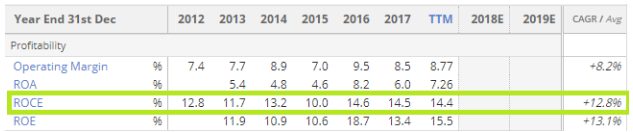
This process of consolidation and cost-cutting has delivered attractive profit growth. But it has to be said that sales growth has been less impressive:

The company’s recent half-year results suggested that sales should improve this year. Revenue rose by 11.2% to £183.3m during the first half, while operating profit rose by 13.1% to £20.7m. These figures seem to support broker forecasts for full-year sales of £400m.
Screening fail: The problem for me is that the group’s shares have become more expensive over the last nine months. Vitec scraped into my relaxed screen with an earnings yield (EBIT/EV) of 6.4% back in November. But that figure has now fallen to just 5.2%, putting the stock firmly out of contention.
Vitec Group will be sold from the SIF fund this week as it no longer passes all of my screening rules.
Since November, I’ve received two dividends from Vitec, adding 2.8% to my return on this stock.The resulting total return figure of 16% seems reasonable to me, and strengthens my confidence in the relaxed version of the SIF screen.
Total return: 16pc
Verdict: Sell
Joel Greenblatt interview: I often discuss the importance of earnings yield to my strategy, but I can’t claim any credit for discovering how useful this valuation ratio can be. I first started to use it seriously after I read The Little Book That Beats The Market, by US investing legend Joel Greenblatt.
Greenblatt’s Magic Formula approach to investing has helped to inspire a generation of investors, including me. Stockpedia’s Ben Hobson was recently lucky enough to interview Joel in New York. I’d strongly recommend taking a look, if you haven’t already.
H&T Group
Original coverage - 15/11/2017
Unlike Vitec, pawnbroking and financial group H&T was selected from the regular version of my screen. So its valuation in November last year suggested an attractive level of affordability and potential earnings growth.
Unfortunately the market doesn’t seem to share this view. The shares have fallen during their time in the portfolio, and the position is currently running a small loss.
So what’s gone wrong?
Nothing, so far. H&T seems to be performing well at the moment, as Graham Neary explained in his recent review of the firm’s half-year results.
However, this sector faces significant regulatory risk. The FCA is currently consulting with the industry on various matters relating to how consumer lenders assess creditworthiness. Investors appear to be selling the stock to avoid this uncertainty.
H&T claims to have “a robust assessment of affordability and creditworthiness”. But profit growth is partly being driven by the rapid expansion of personal loan business. So a harsh new set of FCA guidelines could affect the firm’s progress.
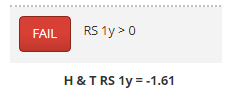
Screening fail: In the meantime, my screening rules say I should sell this stock. This year’s weak share price performance means that H&T is now lagging the index, with a negative 1-year relative strength.
In a discretionary portfolio I’d be inclined to hold the stock at current levels. The shares look cheap to me on a forecast P/E of 9.4 and the group’s management appear to be executing well.
However, my rules-based strategy means I don’t get this choice. The shares will have to go. This will crystallise a loss for SIF, but it will also limit the risk of any further downside from this regulated business.
My total return has been boosted by a received dividend yield of 3.1%. So the overall loss on this position isn’t too painful.
Total return: -4.4pc
Verdict: Sell
I will sell H&T and Vitec from the SIF fund and from my own holdings this week, after this article has been published.
Disclosure: At the time of writing, Roland owned shares of Vitec Group and H&T Group.
Disclaimer
This is not financial advice. Our content is intended to be used and must be used for information and education purposes only. Please read our disclaimer and terms and conditions to understand our obligations.

5 comments
Hi Roland
As always great article and a timely reminder to me weed out the less well performing stocks particularly where some of the metrics have changed. It is tempting to leave things unchanged where the overall value of my portfolio is increasing.
Hi Roland
A good article as ever.
I note that, I think for the first time since you began the SIF, that the portfolio has under-performed your tracking index for 6mth, 3mth, 1mth and 1 wk.
I also note that five of the SIF holdings are negative by greater than 10%, indeed BNC by 20.4%.
I wonder, as you relaxed your buy rules slightly in the bull market period as you explain above, might you consider adjusting your sell rules in a similar manner as the market down turns?
For example augment the nine month reassessment rule with an extra rule which triggers a reassessment, against your screening rules, at say negative 15% (or some other percentage). Then exit if the rules fail even it it is earlier than nine months.
I pose this question because the SIF has operated during quite a nice market upturn but has not yet been tested in a down turning market. It seems that staying rigid to the nine month assessment period could be an over excessive exposure to overall portfolio performance in a sustained down turning market.
Regards
Howard
Hi Howard,
It's certainly true that SIF (like many portfolios) has only operated in strong market conditions. So we don't really know how it will perform in a downturn.
My hope is that my rules will prevent me buying outright dogs and limit the potential portfolio damage to a de-rating, rather than a structural collapse. I also hope that my momentum criteria (e.g. relative strength) will keep me from buying too much when everything is falling.
I'm not overly concerned about a short period of underperformance -- the numbers involved are pretty small so far and I expect this (and worse) from time to time.
I have considered the idea of additional sell rules, perhaps in the form of a stop loss at a certain percentage. One reservation I have is that a number of the smaller stocks in the folio are capable of quite sharp price movements. So I could be stopped out prematurely.
Personally I've never had any success with stop-loss rules and do not use them at all. Your mileage may vary - I know they work for some people, but I prefer to focus on stock selection and take my chances on being on the receiving end of Mr Market's bad moods...!
Regards,
Roland
For those seeking income, HAT is still a good play.
Holding on to my HATs..Think the company might benefit a bit as WONGA runs out of wonga,and other payday lenders suffer from restrictions and bad publicity.