SIF Folio: Finsbury Foods results - a contrarian play?

As I write this on Monday, the market is falling as investors price in another lockdown. But who knows. Perhaps we’ll have a circuit breaker instead. And maybe Chancellor ‘Dishi’ Rishi Sunak will decide to extend the furlough scheme.
The pandemic has brought these words into everyday use in contexts that none of us have ever known before.
It’s been a similar story for the hospitality industry, and for those companies which service it. Who could have imagined that almost every pub and restaurant in the UK would close for three months? I don’t think any of us would, before February.
These closures have shone a harsh light on the defensive qualities of many firms in the food and drink sector. Previously, we could gloss over the exact mix of sales channels which generated a company’s revenue. Supermarkets or restaurants - it didn’t always matter too much. Now, this mix has become much more important.
My rules-based SIF folio currently has two companies which sell food and drink:
Stock Spirits: Eastern Europe-focused drinks producer (see my review last week)
Finsbury Food - Bread and cake producer
Both firms generate the majority of their revenue (85% and 80% respectively) from retail channels. The remainder comes from foodservice - bars, cafes and restaurants.
This revenue mix was one of the reasons why I decided to add Stock Spirits to the portfolio last week.
But with Finsbury Food, it was more a question of dumb luck. When I added Finsbury to SIF in January, I didn’t have any idea what would happen next.
I still don’t. But we do have some new information - Finsbury Food has published its preliminary results for the year to 27 June. This week, I’m going to take a closer look at these numbers and consider how they might affect this highly-ranked firm’s QVM metrics.
Finsbury Food (LON: FIF) - “resilient”
Buying shares in January was generally a poor trade. Finsbury is no exception and SIF’s holding is down by 43% at the time of writing:

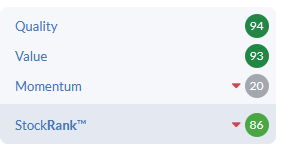
However, my feeling since March has been that this firm’s dismal valuation is a little harsh. Stockopedia’s algorithms seem to share this view. Ahead of Monday’s results they awarded Finsbury a StockRank of 86 and Contrarian status -- a winning style, statistically.
However, one problem with contrarian plays is that they can take a long time to come good. I’ve only got one month left to be proved correct, but despite this I’m broadly encouraged by today’s results from Finsbury Food. In my view they show a fairly resilient performance, albeit with a few caveats.
Results summary: Finsbury’s business suffered “an immediate and adverse impact” from lockdown, which covered the final quarter of the group’s financial year. Its foodservice business was hit hard and while retail sales had “winners and losers”. Broadly speaking, staple items like bread and snacking products (e.g. cake slices) sold well. As you’d expect, sales of more expensive celebration cakes suffered, as large gatherings were off limits.
In terms of financials, I think the picture is fairly resilient:
Revenue -2.8% to £306.3m
Adjusted pre-tax profit -12.9% to £13.9m
Statutory pre-tax profit -79% to £2.9m
Adjusted eps -15.1% to 7.9p
Capital expenditure cut by 57% to £4.7m
Dividend suspended
Net debt bank debt cut by 25.6% to £26.5m (1.1x annualised EBITDA)
The obvious outlier here is the slump in statutory profit, which fell by nearly 80%. This was caused by £8.7m of non-recurring items.
The most significant of these was a £7.5m impairment in the value of the firm’s Ultrapharm business, which makes gluten-free products. This was acquired for £25m in 2018. Finsbury now says that “the business has proven more immature than expected” and has faced some commercial issues. Finsbury has invested additional resources in Ultrapharm and cut earnings forecasts to reflect this setback. To me, this sounds like the firm was desperate to jump into a hyped-up sector and overpaid. I hope there’s not worse to come.
Looking ahead, Finsbury has opted not to provide any guidance for the current year, due to ongoing uncertainty. So in the absence of informed forecasts, let’s take a look at how today’s results might affect Finsbury's factor scores.
Value: it’s cheap!
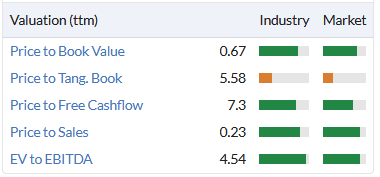
Ahead of this week’s results, Finsbury had a ValueRank of 93. The shares definitely looked cheap on most common measures, with a trailing P/E ratio of 7.3 and a trailing earnings yield of about 14%.
Most of the stock’s other valuation measures also looked attractive from a value perspective (this graphic shows H2/2019+H1/2020):
I’m not able to calculate a new ValueRank based on this week’s results, but I have re-calculated some of the metrics used to calculate this factor score. These are historic numbers, based on Finsbury’s FY20 results:
P/E (adjusted): 7.1
P/FCF: 5.6
P/S: 0.2
Dividend yield: 0%
Earnings yield: 4.7% (statutory) or c.15% (adjusted)
This year’s impairment charges have knocked the group’s operating profit down to under £5m. But given last year’s strong free cash generation I’d be willing at this stage to use the adjusted operating profit figure of £14.8m for financial modelling.
Based on the facts today, I believe Finsbury Food continues to look attractively cheap. What we need to know now is whether it deserves to be cheap...
Quality: not too bad
Much of Finsbury’s product is produced for supermarket’s own brands. It does have a few brands, but it’s not clear to me how much these contribute in terms of profit or margin.
You wouldn’t expect this to be a high-margin business and it’s not. But recent years have showed fairly stable margins and returns on capital:
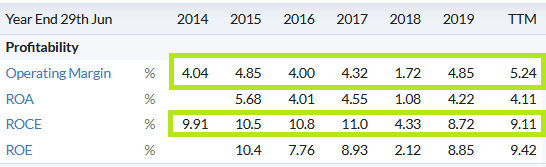
Together with a healthy Piotroski F-Score of 7/9, Finsbury’s solid profitability contributed to an impressive QualityRank of 94 ahead of this week’s results.
I suspect this rank will fall when the FY20 data is added into Stockopedia’s database. The profitability metrics use statutory operating profit, which has been hit by large impairment charges this year.
I’ve crunched the numbers to provide adjusted and statutory profitability metrics from Monday’s results:
Adjusted operating margin: 4.8%
Statutory operating margin: 1.6%
Adjusted ROCE: 9.0%
Statutory ROCE: 2.9%
The adjusted figures look okay and show consistency with recent years. But perhaps I’m being too charitable in relying on these measures. Finsbury also reported significant one-off charges in 2018, relating to a site closure. So that’s twice in seven years that profits (and margins) have been crushed by one-off charges.
I think the board should be very skeptical about any future acquisitions. Apart from this, I think Finsbury is a reasonably good quality business for this sector. Cash generation is strong and net debt looks comfortable to me. But I don’t think the shares deserve a premium valuation.
Momentum: Not good
The classic footprint of a contrarian stock is a high QV score, paired with weak momentum. Finsbury Food certainly fits this description. Ahead of Monday’s results its MomentumRank was just 20.
I’m afraid I can’t see things improving very soon, either.
As usual, let’s split momentum into its technical and fundamental elements.
Price Momentum: Finsbury Food hit a 52-week low of 50p in March. The shares are at 56p as I type. There’s no technical momentum here, something which is painfully obvious from the momentum chart on the StockReport:
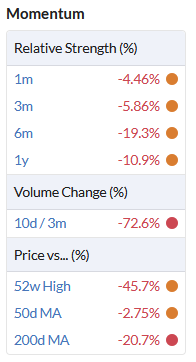
The only point I’d make here is that Finsbury is a small cap with fairly poor liquidity. Much of the stock is held by large institutional holders who couldn’t sell in any size without crashing the shares.
These momentum measures are probably more meaningful for larger, more liquid stocks. But they do appear to tell us that there’s very little buying interest at the moment - hence the stock’s continuing underperformance.
Earnings estimates: Unfortunately there is no salvation here. Finsbury’s management has opted not to provide guidance for the current year at this time. The firm’s house broker hasn’t included any forecasts in its latest note, either.
Given this, I think we’re unlikely to see any meaningful updates to the consensus forecasts shown on the firm’s StockReport. In this context, I’m not sure how credible the FY21 forecast currently shown is.
My verdict
We can’t predict what will happen next, but we can see what has happened so far.
Based on Finsbury Food’s 2020 results, I feel fairly comfortable continuing to hold this stock in SIF and my personal portfolio.
Despite my concerns about past acquisitions, I can’t see any obvious reasons why the firm’s results for the current year shouldn’t be similar to or better than those for the year just ended. Management says that sales have “continued to improve month-on-month” since July, despite the uncertainty in its foodservice division.
At the current valuation, I think there could be an opportunity for patient buyers. I’m not sure if my SIF rules will allow me to hold the stock long enough to find out, but we will see.
As always, let me know what you think about Finsbury and the wider outlook for defensive stocks. I always read every comment and really appreciate all of your feedback.
Disclosure: Roland owns shares of Finsbury Food.
Disclaimer
This is not financial advice. Our content is intended to be used and must be used for information and education purposes only. Please read our disclaimer and terms and conditions to understand our obligations.

4 comments
Thanks. As a new investor I need the understanding what underlies the StockReport especially when need a quick check over its quality before clicking the button. It can make you too cautious and cut out many good plays but thats what Paul's for.
Excellent stuff Roland. All that I can add is that I understand an institutional investor has been selling off which had deadened the share price. I continue to hold and think it will come good. One thing seems pretty sure its not going bust and, in time, we will see a return to a dividend.
there were big director purchases yesterday. CEO through his wife now owns 2%.
Thanks for flagging this up eltorero. I saw the Finsbury Food (LON:FIF) RNS this morning and thought it was quite encouraging.
https://www.stockopedia.com/sh...
Roland