SIF Folio January review: Is it finally time to sell TAM and RWA?

It’s been an uncertain start to the year for the markets. My rules-based SIF portfolio has not escaped unscathed, but I’m comfortable with the businesses represented in the portfolio and am happy to wait for my screening system to seek out new opportunities when they arise.
As a reminder, I buy shares for the SIF virtual portfolio which pass my screening tests and satisfy my need for diversification. Broadly speaking, my screen is designed to highlight affordable growth stocks with positive momentum.
I sell stocks if they no longer pass my screening rules after nine months – or sooner if they issue a profit warning or trigger my 25% stop-loss rule.
It’s a system that’s worked well for me since 2016 and one I’m happy to continue with – including investing a portion of my own cash in the same stocks.
SIF share trades in January
January saw an upsurge in buying activity, with three new stocks joining the portfolio.
Morgan Advanced Materials (LON:MGAM) - I reviewed this industrial materials group in December and added it in January as prices started to fall.
Redde Northgate (LON:REDD) - I’ve always had mixed views on this business, which was formed when Redde and Northgate merged in 2020. But the stock ticked all my boxes, so it joined the portfolio.
Watkin Jones (LON:WJG) - this AIM-listed property developer specialises in student accommodation and build-to-rent apartment blocks. I reviewed the stock and decided to add it to SIF.
In addition to these purchases, I also reviewed commercial property stock Custodian REIT (LON:CREI) as a potential purchase.
Portfolio stocks under review
There are only two stocks in SIF that have been held for more than nine months. In fact, both have been held for well over a year now - they are the final two cheap shares I added in the wake of the 2020 market crash.
Financial services group Tatton Asset Management (LON:TAM)
Global recruiter Robert Walters (LON:RWA)
Both stocks have lagged the market in January after a long run of stellar gains. Is it time for SIF to take profits, or should I hold on?
I’ll review Tatton and Robert Walters in more detail shortly. First, here’s a snapshot of how the portfolio has performed over the last month.
SIF Folio: January performance update
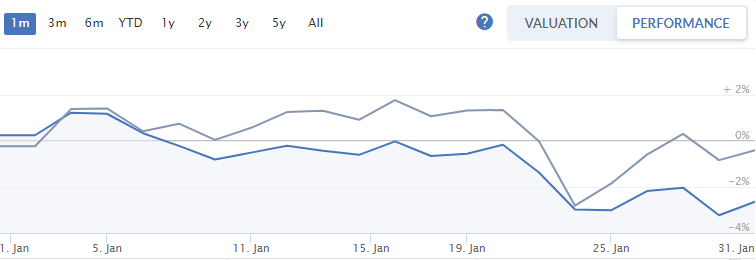
After a strong 2021, SIF has started 2020 by falling behind its benchmark, the FTSE All-Share index.
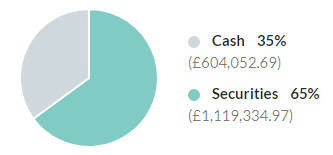
More positively (I think), January’s trio of new stocks have helped to bring down the portfolio’s cash weighting. This had reached 45% at the end of last year.
Finally, here’s how the portfolio looked on 31 January, before any changes that might result from this review. Almost half the portfolio’s current holdings are now showing a loss, compared with just 25% of holdings at the end of 2021.
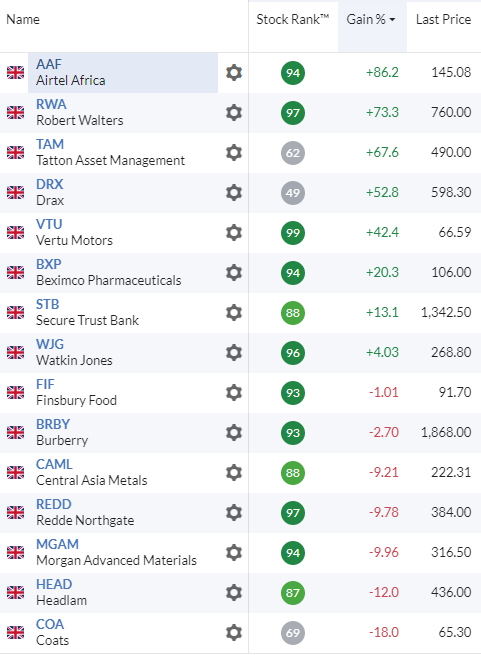
You can see what’s changed since last month by looking back at December's review.
Let’s move onto this month’s stocks.
Tatton Asset Management (LON:TAM)
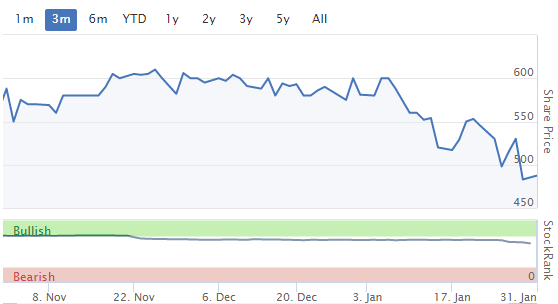
It’s not a profit until you sell. I really thought Tatton Asset Management would be a double bagger for SIF, but after falling by 17% in January, this financial services group is now some way short of this benchmark.
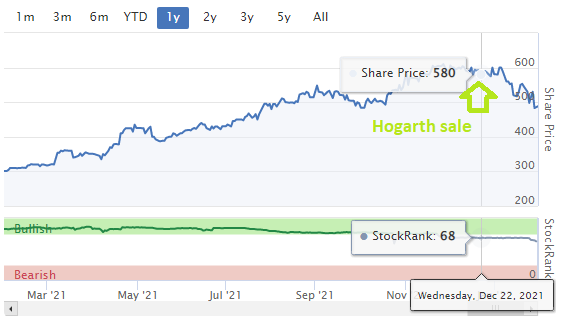
Note the predictive quality of the StockRank in the chart below. Selling when Tatton dropped out of the green would have delivered an optimum result in this case.
I’ve always been very aware of the cyclical risks for Tatton Asset Management. With the stock valued on a growth rating, I felt that any hint of a market downturn could see the shares slide as investors priced in a fall in assets under management, and thus fee income.
By December I felt pretty sure that the good news was in the price. I would have liked to sell, but my rules prevented it; Tatton still passed my screening tests.
However, CEO and founder Paul Hogarth was not constrained by my rules. Mr Hogarth dropped 1.2m shares into the market on 22 December, collecting a perfectly timed £7.0m payout just before Christmas.
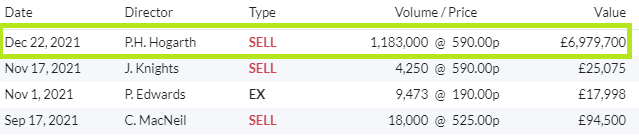
Mr Hogath still owns 16.4% of this business, so I’m certainly not doubting his ongoing commitment and alignment with shareholders. But the sale looks to me like a signal that he believed the top was in, at least for now.
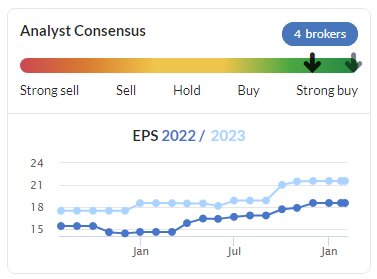
There’s been no update on trading since 17 November and analysts’ earnings forecasts have held steady through January. However, the consensus rating on the stock has slipped back slightly:
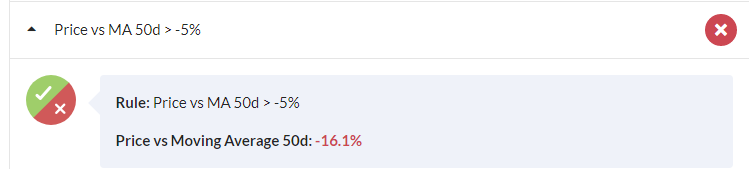
My decision: For me the decision is simple. Tatton’s slide means that the share price has fallen more than 5% below its 50-day moving average. As a result, the stock no longer passes one of my key screening tests for momentum:
I’ll sell Tatton Asset Management from SIF this week. Despite January’s slide, this holding has still delivered a satisfactory total return of 75% in 18 months, giving an annualised total return of c.47%.
Verdict: Sell
Total return: +75%
Robert Walters (LON:RWA)
Recruitment group Robert Walters has benefited from its international exposure to deliver a strong and rapid recovery from the events of 2020. The company issued nine trading updates or results statements in 2021. Every single one of these contained a statement to the effect that trading was ahead of expectations.
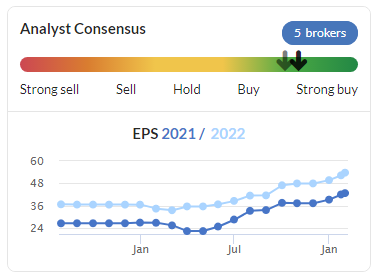
The impact on the outlook for earnings is clear enough – consensus estimates for 2021 earnings have risen by 60% over the last 12 months:
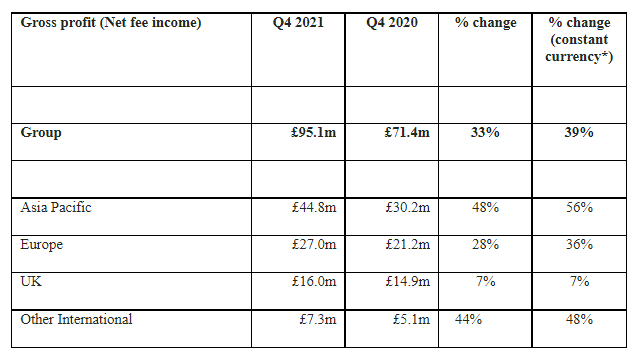
The company’s recent fourth quarter trading update provides some insight into the strength of the recovery seen since 2020, driven by Asia Pacific markets:
Broker forecasts for 2022 have been upgraded in parallel with earnings estimates for 2021. But as far as I can see, Robert Walters has not yet commented on the outlook for 2022. I’d guess that to some extent at least, these 2022 forecasts have just been extrapolated from 2021 guidance.
This may well turn out to be an accurate approach, if recruitment demand stays strong. But this is a highly cyclical sector, so it might not take much to alter sentiment.
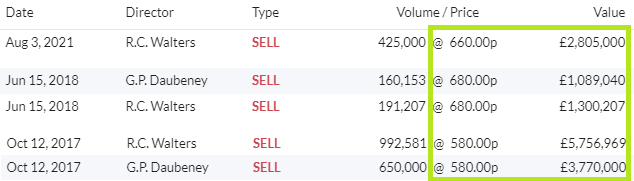
When profits have reached similar levels previously, founder/CEO Robert Walters and former deputy CEO Giles Daubeney have both made seven-figure share sales. All of these took place at share price levels considerably below the current price of 740p:
Of course, Robert Walters is continuing to expand and may be able to justify a higher market cap than in the past. But I think the cyclical risks are worth considering.
In my view, the shares look significantly more expensive than they did when I added them in October 2020:
October 2020 | January 2022 | |
Price/tang. book ratio | 1.9 | 3.8 |
Price/sales ratio | 0.3 | 0.6 |
Dividend yield | 3.2% | 2.2% |
N.B. I’ve not used the P/E ratio because this can make stocks look cheaper than they really are when profits are at cyclical highs.
My decision: I don’t have a macro view on the outlook for the global economy, but my feeling is that Robert Walters is one of the more attractive stocks in this sector.
As always, my trading decision will be dictated by my screening results. In this case Robert Walters’ stock narrowly fails to qualify for an extended stay in SIF. This is because the RWA share price has fallen more than 5% below its 50-day moving average, based on the closing share price on 31 January.
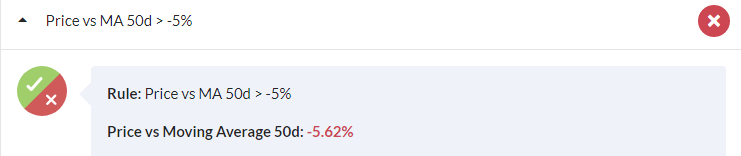
It’s a narrow margin in this case, but with a rules-based system I have to draw a line somewhere.
Verdict: Sell
Total return: +78%
What next?
I’ll sell Tatton and Robert Walters from SIF and my personal holdings this week, after this article has been published.
Next week I’ll return to my screening results in search of more affordable growth stocks to add to the portfolio.
Disclosure: At the time of publication, Roland owned all the shares listed in the SIF portfolio.
Disclaimer
This is not financial advice. Our content is intended to be used and must be used for information and education purposes only. Please read our disclaimer and terms and conditions to understand our obligations.

13 comments
Morgan Advanced Materials - Net tangible equity growth over the past 4 years have averaged c3.5% pa and that includes the numbers for the very difficult year of 2020 for MGAM. Intangibles from acquisitions appear to be written down fairly quickly as well, which is always good to see. If the divi returns to pre-covid levels quite quickly, that will be a divi of c3.3%. No share issuing diluton to sepak of. Putting it all toghether gives a tangible surplus of just under 7%. Better than a fair price, not really a compelling bargain at this price, more of a moderate bargain I would say.
Doug2b, Have you looked into Redde Northgate (LON:REDD), yet?
Not yet, but I was meaning to get round to it, I will have a look now:
Redde Northgate - 85% share issuing over the past 4 years. This does not rule a stock out for me, contrary to how many see my approach, one of my own holdings, CAML issued and lot of shares and took on a lot of debt in 2017 and 2018 for a major acquisition. But in the case of CAML, the tangible asset generation in the form of cash, or rather debt pay down to be precise, has been significant.
Redde having issued a lot of the shares makes the assessment of the impact of the aquisition difficult. The position will be a little clearer with next years results and the following H1 for FY 2023. The tangible equity build up for H1 for this year was decent, during which time no further shares were issued, in fact it does appear that some shares may have been bought back this year.
In the case of CAML I waited for a couple of years after the acquistion just to make sure that a) the tangible equity growth was coming through and b) that CAML stopped issuing more shares without a very clear reason - they did not issue any more shares and the tangible equity build up was very strong.
Sorry that this is long winded but there are a few moving parts and my view is evolving as I look closer. Looking at the half year 2022 results, the tangible equity growth, if extrapolated on an equivalent basis for the full year, was over 4% of MCap. A couple of % of share buy backs it seems, and a divi of around 4.5% - suggests a tangible surplus of over 10%. But that is assuming that the H1 results are half the tangible equity build up for the whole year, i.e. H2 is equally good. Then I normally assess over 4 years, obviously with the likes of CAML I have measured post 2018. With Redde I am interpreting just 6 month data. But, a business that is exagerrating its short term returns does not normally pay a decent divi and buy back shares at the same time. I need to look at forecasts for the rest of this year to get a clearer picture. But overall, yes this is interesting.
Thanks Doug2b, only just seen your post.
I do hold both Central Asia Metals (LON:CAML) and Redde Northgate (LON:REDD)
ref redde
Cheers for your thoughts on redde doug - the large increase in shares for redde was slightly different than normal run of the mill share issues as it was more a merger of two businesses into one on almost equal terms rather than one acquiring the other - the new shares simply being the vehicle to get the sum of the two previous separate parts.
One slight worry here is that redde have obviously benefited from materially higher used van prices recently - so probably some short term tailwinds. Saying that the accident side of things was held back by covid and all the business seems to be firing on all cylinders now so management seem confident ref the future. Management strike me as a safe paid of hands - they give out good data when releasing results.Apologies for hijacking this thread peeps.
It’s fascinating to see Roland’s reluctance to sell allied to his determination to follow the SIF rules.
I am unencumbered by the rules and what I see is that we are in an Employee’s market. Lots of people have left the workplace and those that remain are pickier. In this setting a head-hunter ought to do really well. I hold Robert Walters (LON:RWA) under the NAPS banner and recognise that my approach is the polar opposite of the disciplined SIF strategy.
Robert Walters is often mentioned here and elsewhere, thought that I would take a look.
Net tangible equity growth has been around 2.7% pa relative to the current MCap. Dividend about 2.4%. Small amount of share issuing over the past 4 years, about 0.6% pa. Put it all together and there is a net tangible surplus of aroun d 4.5%.
Seems like a well run business, can't have been easy in recruitment over the past 2 years. Yet the business has strong net cash and that is without any signifcant share issuing over the past 2 years.
Despite the business being strong, the tangible surplus of c4.5% indicates that this is not a good entry point. Yes trading and tangible wealth generation should recover strongly from here, but Robert Walters has that recovery already priced in, the net tangible surplus for Walters would need to grow by c50% from here for the current share price to represent bargain territory.
In my experience, one of the keys to averaging just over 25% annual compounding return on my investments over an almost 13 year period, is to value the stock based upon its fundamental strengths and not to be influenced by whether the stock has broken through a certain moving average. At the end of the day, if a stock is offering great value at say, £10 per share. If nothing in the fundamentals has changed for the worse, how can you then be a seller at £8 per share, it makes no sense. I am not saying that Robert Walters is a buy at this price. I am just surprised and concerned that your sell decision is infuenced by technical analysis.
Roland I think you're allowing yourself to be bounced out of a quality stock because your strict rules don't accommodate a macro-driven stock-agnostic correction. Would it be worth changing your rules to recognise externalities?
Hi BnB,
I agree with the first part of your comment - I think Tatton Asset Management (LON:TAM) and Robert Walters (LON:RWA) probably are good quality stocks in the sectors within which they operate. In a long-term portfolio, I'd be unlikely to sell either at this point.
However, SIF is more of a trading portfolio, so I do have to respond to shorter-term movements. My system is designed to respond to factors such as price action, valuation and momentum indicators. These factors (supposedly) reflect the collective wisdom of the market. They can be objectively measured, even if they may sometimes be misleading or incomplete.
Including externalities as you suggest is more difficult. You suggest that we're seeing a macro-driven stock-agnostic correction. But I think it could also be the start of a wider slowdown, as stimulus unwinds and inflation suppresses asset valuations.
I don't know which of us is right - the accuracy of each suggestion cannot be objectively measured until after the event. There are other plausible scenarios for the year ahead, too.
Making trading decisions based on conjecture defeats the purpose of having a rules-based system, in my view.
Yes - my rules will sometimes lead me to the wrong decisions, with the benefit of hindsight. But by applying the rules consistently, I hope that my batting average will still be acceptable.
Regards,
Roland
Hi Roland. Thanks for taking the trouble to reply. I completely agree that what is a currently a correction could escalate into a bear market in the event that the Fed tightens too far. I was watching a presentation by the CIO of my bank this afternoon where his fear of a policy mistake was palpable. Essentially, the CIO attaches a meaningful probability to the estimates of "team transitory" and strongly suspects the Fed has irrevocably swapped sides to "team permanent" under political pressure from a government facing mid-terms this year during a period when inflation is undermining its economic policies. If the Fed raises rates on autopilot without regard for the possibility of inflation to cool of itself then the world could be tipped into a minor recession. On the more positive side, he did point out that, in his opinion, a reasonable portion of the damage to portfolios has already been done.
And I do understand the rules-driven nature of the portfolio. It just seems illogical to single out a stock when the externality that has driven the re-rating is equally threatening to each and every holding in the portfolio.
I think you are probably right on both account.
How backward looking the Stockopedia rating is: For RWA it is 99,97,97. Nearly top for everything but for value 53.
I was confused because it had Jack's profile initially.
Not sure about Morgan Advanced Materials (LON:MGAM), that's about 10% below the 50MA. I think energy costs will be eating into their profit margins unless they can pass all the increases on.
Robert Walters (LON:RWA) is doing well judging by the recent update, as are most recruiters, I don't really understand why they have fallen back so much. It is also the top QM stock with a score of 100. Sthree (LON:STEM) also put out some excellent results yesterday, profits up around 100%. I have topped up my Robert Walters (LON:RWA) holding this morning, so shares will probably fall again.
Also added, as the conditions, despite the obvious cyclical nature look favourable for the foreseeable. I base that on the labour shortages and wage inflation as highlighted by the CEO, particularly at the higher end where RWA is focused.
I'd be interested in what EPS figure Investec has put in, got to be circa 45p one would have thought and despite Roland pointing out an argument against using this, its still relevant for me.
Bulging cash pile too, perhaps a significant dividend increase is on the cards, or a one off?