SIF folio review for October (TAM, RWA, UPGS, SQZ, FIF, HEAD)

It’s been another steady month for the rules-based SIF folio. I’ve added two new stocks and will shortly be selling two older holdings from this model portfolio.
In this month’s review I’m going to introduce a new section, based on reader feedback. In addition to looking at the stocks which I might sell, I’ll also list new shares added to the portfolio during the month.
In this way, these monthly articles should make it easier to track all activity in SIF and the progress of the portfolio.
SIF buys in October
After something of a dry spell, I added two new stocks to SIF during October.
Headlam (LON:HEAD): I’ve admired this floor covering distributor for a while. I was pleased to have the opportunity to add it to SIF. You can read my purchase review here.
Finsbury Food (LON:FIF): Cake and bread producer Finsbury Food was a slightly more contentious choice, judging from subscriber comments. You can see my purchase review and read the comments here.
Portfolio stocks under review
My policy is to hold shares for a minimum of nine months. I then review them to see if they still satisfy my screening criteria. There are four SIF holdings up for review this month:
Tatton Asset Management (LON:TAM) : A strong stock market has boosted assets under management at this financial services firm. Tatton is now SIF’s oldest holding. Can the good times keep rolling?
Robert Walters (LON:RWA) : It’s boom time for recruiters at the moment, thanks to strong demand from employers and rising wages.
Up Global Sourcing Holdings (LON:UPGS) : Shares in this consumer goods firm have retreated from the highs seen over the summer. Are shipping delays and rising costs likely to hit profits?
Serica Energy (LON:SQZ) : SIF’s move into the oil sector has proved to be perfectly timed. Is it time to take profits?
SIF Folio: October performance update
SIF has tracked the market over the last month and is up by just under 2% at the time of writing.
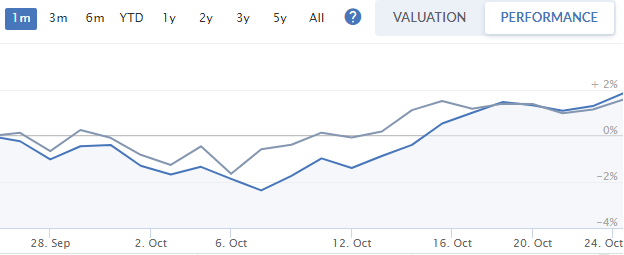
This steady performance has helped the portfolio maintain the lead it’s built up over the benchmark FTSE All-Share index so far this year:
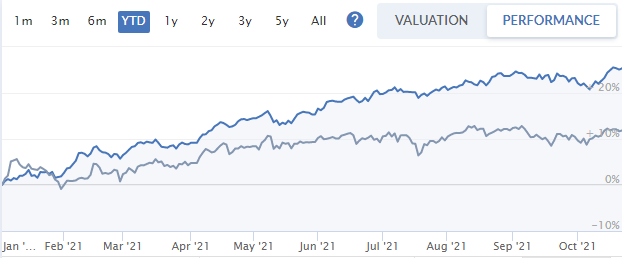
This performance has been achieved despite SIF running a significant cash position for most of the time. This gives me optionality but also dampens returns. If the portfolio had been fully invested, returns would probably have been greater.
The portfolio’s (virtual) cash weighting remains high, at 30%:
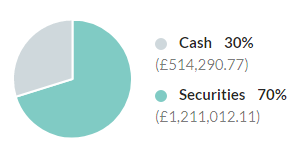
This heavy cash weighting isn’t a deliberate decision on my part. My screen just hasn’t provided a sufficient number of shares to expand the portfolio and reduce the cash balance.
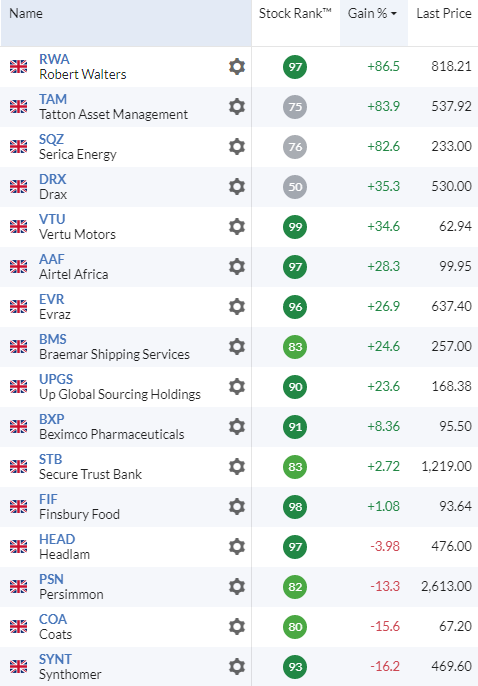
To wrap up this section, here’s a snapshot of all the portfolio’s current holdings. This was taken before any changes that might result from this review.
UP Global Sourcing Holdings (LON:UPGS)
I have mixed feelings about the outlook for this consumer goods firm, which manufactures many of its ranges in China.
So far, the company has not warned on profits despite the impact of shipping delays and rising costs. In a full-year update in August, UPGS said it was prioritising customer orders over stock purchases. The company didn’t state the expected impact of this policy, but unless the situation normalises quickly, I’d expect some kind of negative impact on costs or future product availability.
The easy thing to do would be to wait until next week, when the company is scheduled to report its full-year results. However, I’m not going to do that. The systematic approach I use to run SIF doesn’t really allow such ad hoc decisions.
It’s also possible to make a case that the bull case for this business is softening. Momentum is weakening and without strong buying I don’t see this reversing:
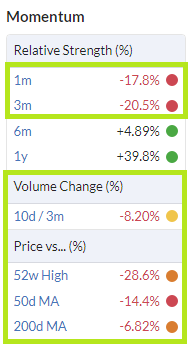
Does UPGS still pass my screening tests? This stock’s weakening price momentum means that UPGS no longer passes all of my screening tests:

For this reason, I’m going to sell UPGS from SIF this month, even though I recognise that this situation might reverse following next week’s results.
UPGS shares peaked at well over 238p over the summer. The stock is trading at 172p as I write, so this position is already much less successful than it was.
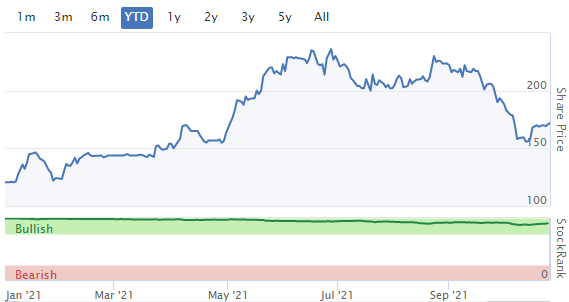
I’m still not too disappointed with the overall result from this holding, which has produced a total return of 25%. I believe the outlook is now more speculative than it was nine months ago, so I’m happy to lock in a gain.
Total return: +25%
Verdict: Sell
Serica Energy (LON:SQZ)
The oil and gas market is something of a guilty investing pleasure for me, so I’m quite pleased at the way SIF’s investment in Serica Energy has turned out.
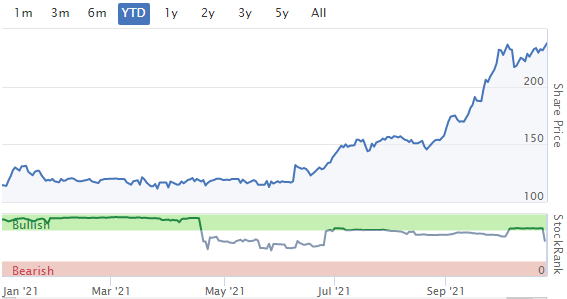
The price of a barrel of Brent crude has risen by 55% to $86 since Serica joined SIF. The wholesale price of gas - which accounts for 80% of the company’s production - has risen by more than 50% since the start of February, based on Ofgem-supplied week ahead gas prices.
Based on forecast P/E ratios, Serica continues to look very cheap.
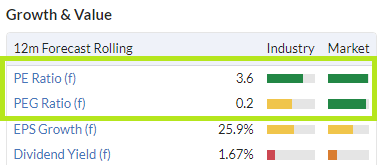
However, as I explained in my original buy report on Serica, I don’t share the view that this business is very cheap just because it has a low P/E. In this case, I think we can get a more meaningful view on valuation by focusing on two other metrics:
Dividend yield: 1.7%
Price/book value: 3.2
Neither of these metrics suggest obvious value to me. It’s also interesting to note that the company’s price/book ratio has doubled since I added the stock to SIF in January. Has the outlook really changed that much? On a medium-term view, I’m not sure it has.
I see this business as a special situation, operating assets that are in extended run-off. Serica’s oil and gas fields are producing reliably at relatively low costs today. But the remaining lifespan of many of these assets can be measured in years, rather than decades. The group will face significant decommissioning costs over time, potentially without the offsetting benefit of new long-term production.
I think Serica’s balance sheet situation and dividend policy support this view. Serica had a cash balance of £92m at the end of June and double-digit operating margins during the first half of the year.
But despite forecasting earnings per share of around 65p in 2021 and 2022, brokers only expect the company to pay a dividend of 3.4p for 2021 and 4p in 2022. That’s equivalent to a payout ratio of around 5% - extremely low for such a cash-generative business.
The logical conclusion I draw from this is that Serica’s management expects to need cash for other, more binding commitments. One possibility is M&A, which could benefit shareholders. But my feeling is that Serica is also holding plenty of cash to ensure it can satisfy future decommissioning liabilities. For example, the group will be liable for 30% of decommissioning costs on the BKR fields, with staged prepayments starting from 2022.
Is this the top for oil and gas prices? In the short term, perhaps not. But I suspect that a lot of good news is already in the price at Serica.
Does Serica still pass my screening tests? Serica only passes 12 of the 14 tests in my SIF Sell Screen. The two rules the stock fails are:
TTM Earnings yield > 2%
Forecast dividend per share growth >%
This situation means I have little choice but to sell the shares from SIF. Although there is clearly some further upside potential here, I can also see downside risks. Given these, I’m not too unhappy at locking in an 85% total return in nine months.
Total return: +85%
Verdict: Sell
Tatton Asset Management (LON:TAM)
The latest update from financial services firm Tatton Asset Management covered the six months period to 30 September and confirmed that trading is in line with expectations.
Tatton reported growth across revenue, profit and assets under management. The latter rose by 20% to £10.8bn during the period, thanks to net inflows of £0.7bn, market gains of 5.5% and the recent acquisition of Verbatim. I commented on this briefly in September.
SIF’s longest-serving holding continues to pass all of my screening tests, so will stay in the portfolio for at least one more month.
Total return to date: +90%
Verdict: Hold
Robert Walters (LON:RWA)
Market conditions are strong for most recruitment firms currently. Robert Walters is no exception.
This founder-led business recently reported a 32% rise in fee income during the third quarter and upgraded its full-year guidance (again).
Robert Walters also continues to pass all of my screening tests, so will remain in SIF for another month.
Total return to date: +91%
Verdict: Hold
I’ll make the trades listed above after this article has been published this week.
As always, I’d be interested to hear your views and insight on the outlook for the sectors highlighted by this report. My comments reflect my opinion only and may well be wrong, so please DYOR before making any decisions yourself.
Disclosure: At the time of publication, Roland owned all of the shares listed in the SIF portfolio
Disclaimer
This is not financial advice. Our content is intended to be used and must be used for information and education purposes only. Please read our disclaimer and terms and conditions to understand our obligations.

23 comments
Thank you Roland. Newbie question. Why do you select stocks P/E >=7 but not lower ratio? Thanks.
Hi GenX, clicking on your name I see you only joined Stocko about 8 weeks ago and hence why you are asking Roland the question. I'm sure he will reply to you in due course but in the meantime I will give you some reasons why I don't like investing in such low P/E companies. When a company has a low P/E it sometimes means there is some bad news going on behind the scenes, such as:
1. The company is drowning in debt and it might be on the verge of going bust so the smart money will sell their shares in the company, which in turn lowers the share price, which in turn lowers the P/E.
2. The company is being sued and the legal claim made against a company is huge. So much so that the outcome is not clear cut. Hence, there is a possibility the company might go bust or it may have to pay out huge sums of money as compensation if it loses the court case, so investors sell which in turn lowers the share price and lowers the P/E.
3. The company has an enormous pension deficit which is resulting in the company drowning in debt. Or at best, a large chunk of its profits are being used to fund the company's pension scheme which doesn't leave much profit left to invest and grow the company or even pay a dividend.
There are many more reasons why a company can have a low P/E but I find once a P/E drops to 4 or below, it is generally not a good time to be invested in that company and it is time to sell and move on. Incidentally, mining companies seem to have a low P/E because some people don't like to invest in that sector because the output of mining companies (and thus profit) can sometimes be an unknown quantity due to such things like earthquakes, mineral price movement, etc.
David.
Hi David, thanks very much for this useful insight. Yes, well spotted, I'm new to the "hobby". In March last year, I got some trackers on "sale". That was easy. Recently I started looking into individual stocks. This is trickier but more exciting, and potentially more rewarding. Stocko is a great resource.
Thanks for explaining how debt, deficit and litigation may affect P/E. I didn't think of that. I'm currently using the Stock In Focus (SIF) BUY screener and added some debt ratios: Debt / Assets Latest < 40%, Gross Gearing Latest < 50%, Gross Gearing including Pension Latest < 50%.
I recently acquired some Sylvania Platinum (LON:SLP) stock. Good to know about the miners.
Hi David.
I wouldn’t disagree with any of what you say but suggest that perhaps the main reason many miners trade on low P/Es is that they operate in very cyclical markets where the price of the underlying commodities tends to fluctuate widely over time. As a result even when output is relatively predictable the difference between the AISC and market price ( i.e. there operating profit) can go from a lot to nothing (or even minus) in a matter of a few months. Similar reasoning applies to the O&G sector. Some of the bigger companies look to hedge this risk using forward sales or derivatives but rarely cover the full level of output for an extended period.
Gus.
Thanks Gus, for a great comment re P/E ratios.
Hi GenX,
I missed your comment earlier, but hopefully you'll see this.
In my experience, there's often a reason why a company has a very low P/E. This might be sinister or it might just be that the company is ex-growth and unloved. Tobacco is a good example of this latter group.
The reason why I avoid these stocks in SIF is because I want to avoid outliers of all kinds.
My rules-based selection approach is deliberately designed to focus on middle-of-the-road businesses. I particularly want to avoid companies where the market is flagging up some kind of unusual situation.
Sometimes, this might mean I miss an interesting opportunity. But other times it means I avoid a disappointing result.
I hope this makes sense! You can find a more detailed explanation of the system I use to run the SIF portfolio here, in my June review:
https://www.stockopedia.com/co...
Regards,
Roland
Thanks Roland, much appreciate your response
Thanks for the snapshot of current holdings - very helpful.
You can sell gas into the U.K. market to the end of January at between 220-230p a therm so up six fold over the year might have been better to wait until the results next March to see that in the numbers particularly as by then they will have had the first quarter of a 100% of revenues from The BP fields. Field life has stretched out to 2030 who is to say at current prices they may continue beyond that
Roland
Thank you for your pieces, which I read with interest.
Please would you clarify what "performance" you are showing? Your commentary would seem to indicate you are assuming total return.
Stocko have confirmed to me that if you use the Allshare in their Folios (which is where your chart appears to come from?) you get the index with dividends excluded - they are not willing to make the total return index available for "business reasons".
Are you adding in the dividends for the SIF portfolio or are you showing price performance only?
Total return is essential for any longer period to assess performance properly. Just knocking out some of the special divis has a material impact on the stats. Just look at the special divis that have been paid recently e.g. £RIO.
I would be grateful for your clarification here.
Monty Carlo,
The performance charts I use in these articles exclude dividends, so they are comparable with the FTSE All-Share index.
However, where I refer to total return I am including dividend payments.
I'm a big fan of dividends and fully share your view on their importance in total return. To capture this information I run a second version of the SIF folio to which I add all dividend payments.
Here's how they've both performed since inception in April 2016:
SIF Folio ex-dividends: +74% since inception
SIF Folio with dividends: +96% since inception
Dividends have added almost 22% to the portfolio's total return since April 2016, even though they aren't reinvested. Nor do I target high yield.
I hope this answers your questions.
Regards,
Roland
Thanks Roland
I've held Serica Energy (LON:SQZ) for quite a while now. I have topped sliced some recently, as it is now an absolutely huge part of my portfolio. I'd just point out that the forecast dividends, certainly for next year, are clearly wrong. They paid 3.5p this year and their latest interims said the following: "2020 dividend of 3.5 pence per share (2019: 3 pence per share) paid in July. The level of dividend for 2021 will be reviewed in light of the strong gas price trends currently unfolding in the second half of this year."
https://www.investegate.co.uk/...
I'm expecting a lot more than 3.4p next year that's for sure.
Hi BlueFrew,
You could be right about the Serica Energy (LON:SQZ) dividend, forecasts for such small companies are not always entirely reliable. But I suspect that management won't want to have to cut the 2022 payout if gas prices return to more normal levels. So I expect this year's payout ratio to remain relatively low.
Obviously I could be completely wrong. But Serica has had net cash for a few years now, and has shown no inclination to return much of it to shareholders.
Regards,
Roland
I have to agree with your decision to sell Up Global Sourcing Holdings (LON:UPGS) because I fully expect a downgrade in expectations for next FY when the final results are released. i've just checked again and they're still not shipping to EU customers directly from their own sites - instead they this time directed me to purchase the same item via Amazon. This is a new change and I wonder how using Amazons distrubtion network is impacting their margins?
international sales are typically over 30% of total sales so iw as expecting a lofty decrease in revenue, perhaps using amazon has managed to mitigate this somewhat? I will be watching this one with great interest.
I think there may be a scaling issue here. Direct to EU individual customers is very small part of business. The main EU business is supplies to big retailers (increasingly in Germany). Am I missing your point though?
I've been an investor in Up Global Sourcing Holdings (LON:UPGS) since its post IPO lows few years back. I did sell a bit above 220p feeling sp a bit over-exuberant plus simply decent point to take a bit of profit but I've mainly held on...
I think this is a multi-year growth company with its underlying growth trajectory under appreciated due to the underlying transformation business has experienced. This is little out of date but sketched out here:
https://www.stockopedia.com/co...
I admit to some trepidation around forthcoming results. All managements can sugarcoat and/or put off bad news hoping for miraculous change. I think that the post IPO bust has taught UPGS to be pretty straightforward and mgt seem keen to temper expectations prudently not hype talk but that said the coming year end results may be when they view it as appropriate to warn...so there's definitely a risk of a sting in the tail. And they did tap the market for cash and acquisition...which is always a potential driver of prior overhyping.
I have some optimism that they will show they have been able to trade better than others through supply chain and China power issues. It may still hurt a little but that's definitely priced to a moderate degree now in sp.
Its conceivable that direct to consumer has been backburnered a bit recently so as they can maximise their relationship and delivery to retailers. This could mess up numbers a little...but if they strengthen their relationship with retailers as they have been able to source when others couldn't then that is super valuable (a fall on that type of news would likely be a great buying opp). They are unusual in their on the ground China team, sourcing and quality control and have very broad factory relationships. People with relationships have been best placed to keep things moving.
China focus is a risk...but if its taking UPGS down then there's a much bigger market and geopolitical story that is not priced in markets yet and the sp of UPGS is a rather trivial matter for most portfolios.
On balance, my guess (and it is very much that!) is that UPGS will please markets next week.
My thinking is that if they completely cant ship direct to individual customers outside of the UK at all they are very likely to have been impacted in shipping to the retailers.
I think we can agree its the shipping costs that have made it significantly less profitable to sell direct to customers. Who knows how high these additional costs have run RE shipping to international retailers?
I actually wanted to pick up a small position on the company when I initially looked in to it, they really do have an outstanding set of businesses. they could be poised for a great couple of years once shipping normalises. However, I've been hit very hard by these supply chain worries and so i'm going with my gut instinct which is telling me to wait and see how they have mitigated it.
I hope you are right though and that the SP bounces up nicely!
I just did a bit of checking on their brand websites for UK direct to consumer sales and there was pretty good availability of product for Beldray and Salter (key brands)...eyeballing and non systematic I'd say its >75-80%. Progress is a smaller brand that they are pushing hard. Availability there patchier...but its the brand they are pushing in Germany rather than UK. Intempo was a bigger brand but faded a little but its small electronic stuff seems well stocked onsite. I haven't made this sort of check previously so I don't have a benchmark
With European retailers they ship direct to them rather than via UK. I'd be curious whether they use overground rail for some of these deliveries.
Just a quick follow up on Up Global Sourcing Holdings (LON:UPGS) - I watched some of the results presentation on Equity Development this week. The company explained that they've prioritised supplying retailers ahead of stocking their own direct online sales.
Retail is seen as a priority for the business, as it's the biggest earner.
However, what struck me as interesting is that management say that stock is now coming through strongly and online availability is improving.
I'm not sure what this tells us about the broader supply chain situation -- unfortunately I wasn't able to watch the whole presentation. But I wonder if the worst is already nearly over for supply chain issues.
In fairness, UPGS seems to have handled supply chain issues quite well -- extra costs of c.£2.5m have been offset by around 50% (£1.3m from memory) of pricing increases/cost savings. According to management, they've won plaudits from big retailers such as Tesco for their ability to keep supplies coming.
The European (i.e. Brexit) issue is likely to be solved as they'll soon have warehouse and fulfilment capacity in the EU. This is seen as an exciting opportunity.
Roland
As with all these things...time will tell!
My surprise was no talk of production problem due to energy supply in China and reduced working. That said this was highly variable regionally in severity and UPGS have quite disperse manufacturing relationships in China and a long established team on the ground (got to be quite advantageous in the environment since covid re control and access when some will struggle to have presence). I'll probably follow up on this.
Supply delays mean that, with delay, you can still fill up your stock....so maybe we are seeing this. But then that means you've got to keep rolling this forward too. And that can get complex and has risks...
In effect the supply delays and goods stuck in transit (ships off LA etc) is a massive inventory overhang for everyone. So in reality the world is massively oversupplied with goods but doesn't know it! This 'inventory' will not be fully recorded or aggregated well across everyone (clearly individual businesses have been over ordering to get as much stock as they can now). This means that retailers in general have a risk at some point of the channel being over stuffed with product... -> big sales for consumers coming.
The above is not specific UPGS risk and I'm sure they are aware and managing (as they always do)
I will be honest and say that I do not use rules-based investing to any great extent and to largely ignore price multiple measurements which are generally (not always) of great use, especially with smaller or newer companies that are growing. However, the only stock that I have which is in your group, UPGS, has just been granted leave of absence prompted by your comments. This is, I think, a rather good conpany though I was always unconfortable with an operation that bought and shipped most of its product from China. We know that container costs are having a race with natural gas for price spike of the year. Against that surely temporary factor, the trading update was pretty good, on the whole, the purchase of Salter seems a good addition, and the quite remarkable returns (RoCE etc)) have been nothing short of sensational. Also clear that some stuttering in the progress may already be in the share price but one cannot own every good company and I am prepared to be quite wrong. Let's see.
I like the new section Roland :-)
Thanks Jeff!