SIF Folio: TRIG + Pershing Square offers me top US stocks at a discount

Well this is a bit awkward. You give a stock the elbow one month and a few weeks later it’s back, with a shiny new set of profit figures.
Sometimes the timing of my mechanical sales and purchases isn’t perfect. My sale of The Renewables Infrastructure Group (LON:TRIG) at the end of July is a case in point. Just seven days later, this investment trust issued half-year results that showed half-year profits up by a staggering 174% to £128m.
I’ll review TRIG’s results in brief in a moment. But in short, I’m going to welcome this stock back to the SIF portfolio. However, having written about it so recently, my comments will only be brief. So I think there’s room to consider a second new stock this week.
Two companies are vying for my attention in my screening results that could fit the bill:
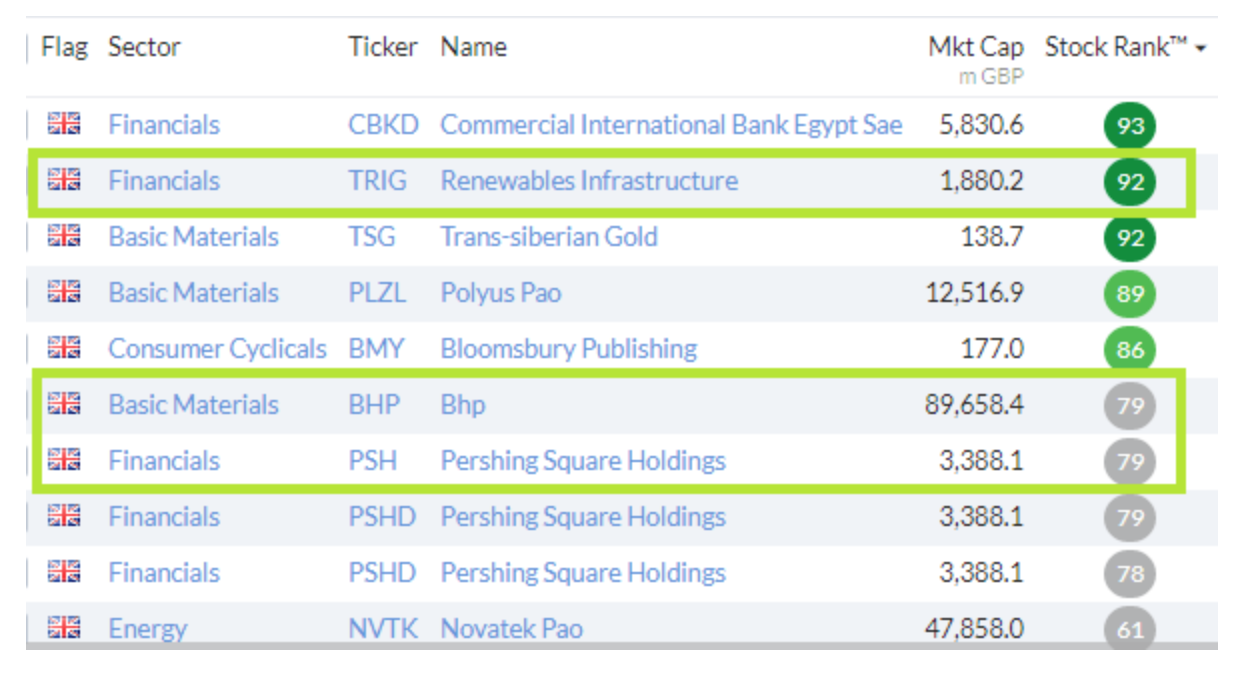
The one I’m going to consider this week is something completely new and rather different. It’s the FTSE 250-listed arm of US hedge fund manager Bill Ackman’s investment vehicle, Pershing Square Holdings.
I’m not really sure if this is a suitable investment for my trading strategy, but it’s interesting for a number of reasons. I’ll explain more below. Let’s deal with TRIG first.
TRIG shows renewable growth
The Renewable Energy Group’s profit growth looks pretty spectacular. You might wonder how an investment trust that owns stakes in wind and solar farms could increase its half-year pre-tax profit from £47m in 2018 to £122m in 2019.
The short answer is that much of this growth came from unrealised valuation gains on the firm’s assets. These resulted from changes to asset life assumptions made earlier this year. Essentially, a technical review led management to increase the expected operating life of its wind farms from 26 years to 29 years.
Make of this what you will. But I was reassured to see that the group’s continued expansion was backed by a 29% increase in cash distributions received from its portfolio. These rose to £63m, from £49m in H1 2018. The dividend was covered by cash 1.4 times, which seems comfortable to me for a business of this type.
Management say they are still finding attractive subsidised renewable energy opportunities in European markets. Increasingly, these are said to include unsubsidised projects as well as those benefiting from government subsidies. This suggests to me that renewable energy is really coming of age and becoming truly commercially viable. Perhaps this is a good example of how state support for new technology can be used effectively?
My decision: In my sell report on TRIG at the end of July, I commented unfavourably on the stock’s 14% premium to its net asset value and falling dividend yield. Although I would rather buy a stock of this kind at a discount to NAV, I’ve been thinking about this valuation some more.
We’re currently living in a world of unprecedented negative interest rates. In this context, paying a modest premium to NAV to secure a 5%+ dividend yield from long-lived tangible assets doesn’t seem too crazy to me.
The main risks I can see to TRIG’s dividends are an increase in financing costs and a shortfall in power production. I’m starting to think that finance costs will stay low for a while yet. And the increasing diversity of TRIG’s portfolio suggests to me that power disruptions should be manageable.
I’m going to add TRIG back into the SIF fund this month. I regret the wasted trading costs, but I feel that this could be useful ‘ballast’ for the portfolio over the coming months.
A US fund in the FTSE 250?
One of the most commonly-heard themes in stock market commentary at the moment is that the US market is expensive. The implication is that there’s a correction in the making, perhaps linked to a wider economic downturn.
I’d share the general view that many big US stocks look pricey. But that doesn’t necessarily mean that there isn’t room for an active manager to make money from the market.
Managers don’t get much more active than Pershing Square hedge fund boss Bill Ackman, a noted activist investor with an impressive track record.
Since its launch in 2004, the main Pershing Square fund has delivered a gain of about 700%, after a 20% performance fee. The fund’s compound annual return since 2004 is 14.2%, which is pretty respectable.
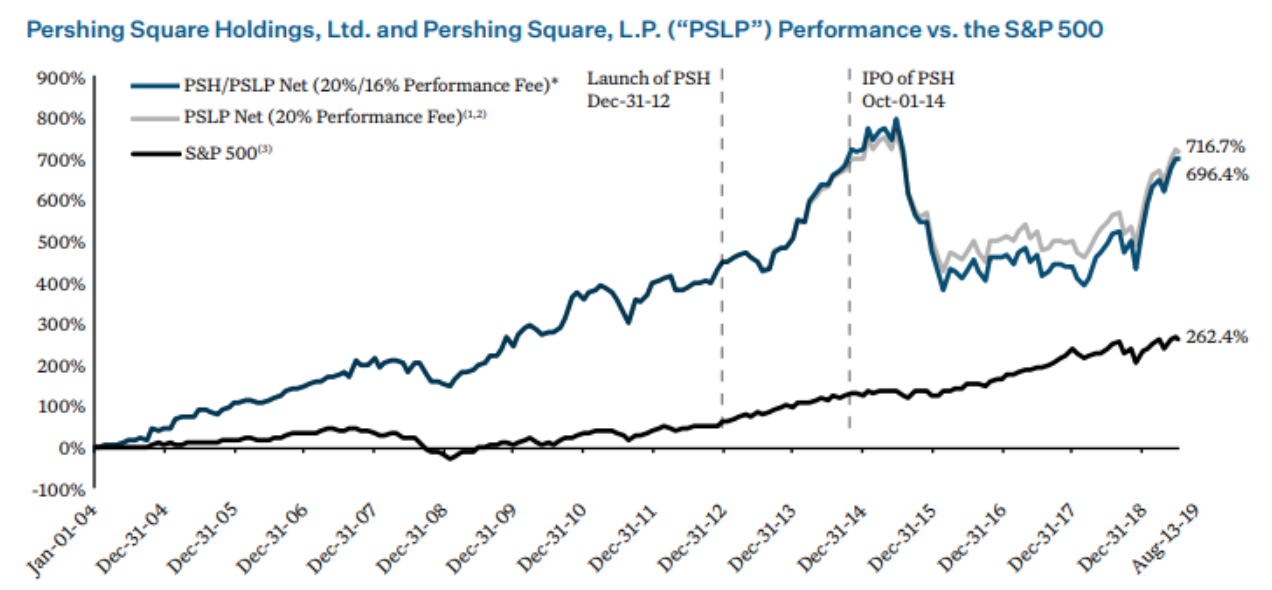
Source: Pershing Square 2019 interim report.
In recent years, Mr Ackman has had a poor run. His fund reported losses each year from 2015 to 2018. But to date, 2019 has seen a return to form. Pershing reported 48.9% year-to-date return as of 13 August.
I don’t have the sort of cash needed to invest in hedge funds. But I can afford to buy FTSE 250 stocks. This means I can invest in Pershing through its UK-listed vehicle, Pershing Square Holdings Limited (LON:PSH).
This feeder fund was listed on the UK market in 2017. It provides the same exposure as the main hedge fund. PSH stock currently trades at a discount of nearly 18% to its last-reported net asset value of $26.03. Although I’d expect some level of discount for a share of this type, this seems quite a large. Regular buybacks are helping to shrink this discount. I think it’s fair to say that if performance remains strong, there’s a good chance the stock might trade closer to its NAV.
Mr Ackman runs an extremely concentrated fund, with a focus on large, liquid US stocks. Here’s how the portfolio looks at the time of writing, as far as I can tell from the firm’s disclosures:
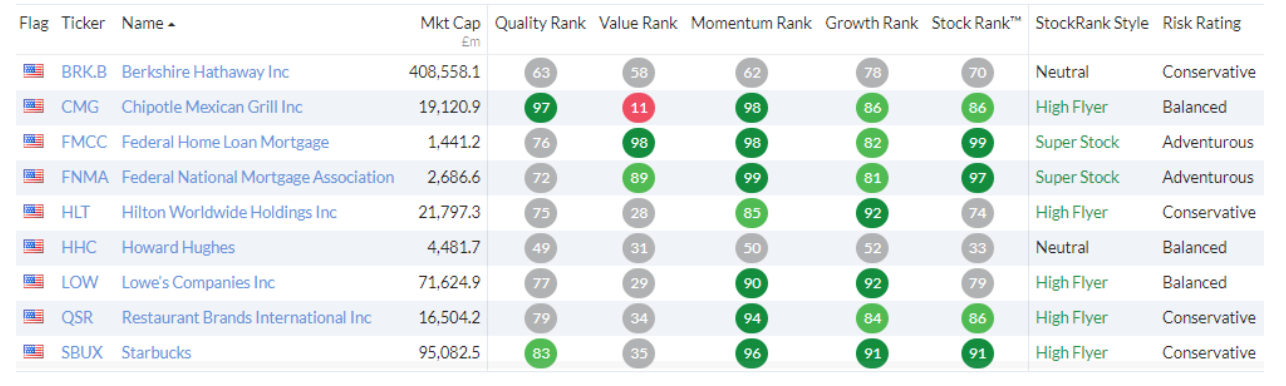
The majority of these stocks score well with Stockopedia’s algorithms, but there are some low ValueRanks. These represent some demanding valuations. If you’d like to know more about Mr Ackman’s views on these holdings, Pershing Square’s half-year report provides a detailed commentary on each one.
My decision: Many of these businesses look expensive to me. But broadly speaking, I’d say they are strong, durable brands with good market share and attractive outlooks.
Would I like to own a slice of this? Probably, at the right price. I wouldn’t buy all of these stocks directly today. But by investing in Pershing Square at a discount, I get exposure to these stocks at a lower price and I get to benefit from Mr Ackman’s management skills. There’s also a useful 3% dividend yield.
Although PSH stock isn’t without risk, I am comfortable investing a small slice of my own cash in this way.
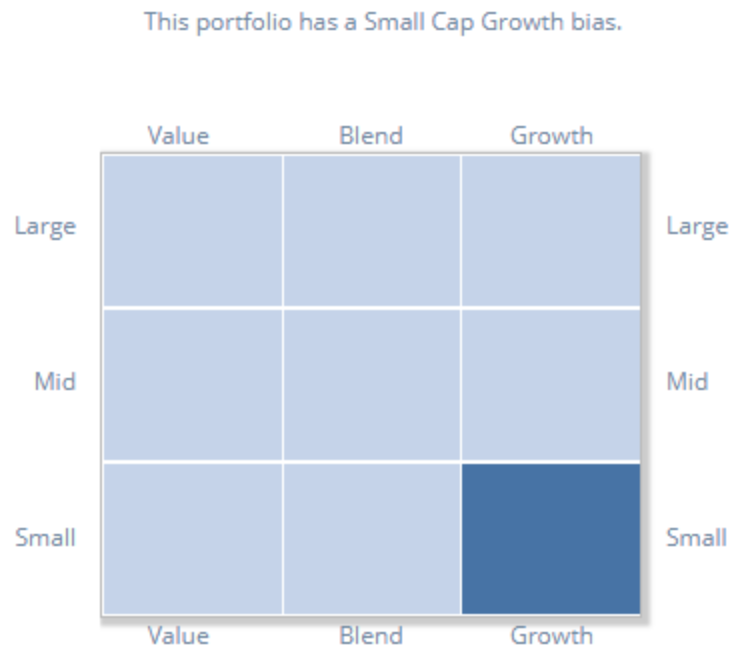
I also believe that Pershing Square’s portfolio should add meaningful diversity to my SIF fund, which has inadvertently gained a heavy weighting to UK-focused small caps:
My decision is to add Pershing Square Holdings to the SIF this week, along with standard-sized holding of TRIG stock.
I’d love to hear what you think about this decision, which I admit is something of an experiment. As usual, I will also be purchasing both stocks for my own real-money portfolio after this article has been published.
Disclaimer
This is not financial advice. Our content is intended to be used and must be used for information and education purposes only. Please read our disclaimer and terms and conditions to understand our obligations.

6 comments
Also a TRIG holder. They appear to raise cash via new share issues rather than borrowing - there has been a steady increase in number in circulation in the last 7 years. Interestingly, the book value per share has scarcely moved in the same period.
Have owned PSH for a couple of years& decided to sell a couple of weeks ago on the grounds US looks extended & more importantly to me was the corporate governance saga,where they decided to raise more equity at a big discount.( diluting existing shareholders),it all came across of enhancing their remuneration without consulting shareholders.
Re Pershing Square Holdings (LON:PSH) I am rather put off morally by the manager being paid a 20% performance fee for delivering a compound return of 14.2%, as well as his performance being very inconsistent.
The reason why PSH is at such a discount is 1 the portfolio is concentrated 2 Bill A has been quite accident prone and it is unclear his current leaning to long positions will persist 3 it will take a good period of non controversial investing for Uk investors to forgive the Valeant and Herbal Life exploits
Hi Martin,
Thanks for your comment. I agree that Mr Ackman's recent record isn't outstanding. But over the longer term he's proved very able. And the current Pershing Square Holdings (LON:PSH) portfolio looks less controversial than Herbal Life or Valeant, in my opinion. I'm happy to take a (small) chance on it.
Regards,
Roland
I see the appeal of buying major US companies at 18% discount, since UK turmoil should push the pound lower against the dollar and in a US election year one might expect that Trump will find a way to increase US share prices.
But all this information and more is in the market, so why the discount to NAV? There's a feeling of "too good to be true" about PSH.